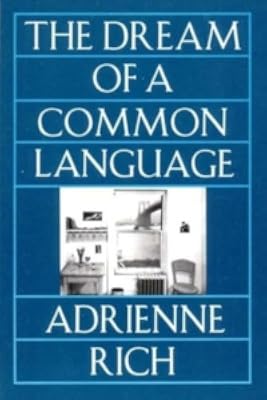
The Dream of a Common Language: Poems 1974-1977
by Adrienne Rich
On This Page
Description
"The Dream of a Common Language explores the contours of a woman's heart and mind in language for everybody--language whose plainness, laughter, questions and nobility everyone can respond to. . . . No one is writing better or more needed verse than this."--Boston Evening GlobeTags
Recommendations







Member Reviews
Rich is one of my favorite poets, and there are few words to describe how beautiful and thoughtful these poems are. This slim volume is divided into three sections, "Power," "Twenty-One Love Poems," and "Not Somewhere Else, But Here." This is one of her later collections, written after receiving the National Book Award, and is remarkable for it's openness in writing about sexuality, power and violence against women.
"Twenty-One Love Poems" is perfection, a distilled experience of a relationship arc, and XVII is permanently etched on my consciousness. It begins:
"No one's fated or doomed to love anyone.
The accidents happen, we're not heroines,
they happen in our lives like car crashes,
books that change us, neighborhoods
we move into and come show more to love."
I've read it almost as many times as "Origins and History of Consciousness," in the "Power" group, and find it is sheer excellence of how a writer strives to interpret self and other:
"No one lives in this room
without confronting the whiteness of the wall
behind the poems, planks of books,
photographs of dead heroines.
Without contemplating last and late
the true nature of poetry. The drive
to connect. The dream of a common language.
Thinking of lovers, their blind faith, their
experienced crucifixions,
my envy is not simple."
"Cartographies of Silence" also stands out. To me, Rich is at her best writing about language, identity and love, and virtually every line floors me.
"Silence can be a plan
rigorously executed"
The remainder of the poems are somewhat uneven for me, especially the "Not Somewhere Else" section, which seem to be primarily odes and center around specific people. They provide interesting insight into both Rich and the time period she writes in, particularly the poem for Audre Lorde. I could probably leave this in my GR "currently reading" shelves indefinitely, as I periodically revisit it, each time finding more to appreciate. If I'm headed for a writing sabbatical, this is one that always gets stuffed in the backpack.
Adrienne, you will be dearly missed. show less
"Twenty-One Love Poems" is perfection, a distilled experience of a relationship arc, and XVII is permanently etched on my consciousness. It begins:
"No one's fated or doomed to love anyone.
The accidents happen, we're not heroines,
they happen in our lives like car crashes,
books that change us, neighborhoods
we move into and come show more to love."
I've read it almost as many times as "Origins and History of Consciousness," in the "Power" group, and find it is sheer excellence of how a writer strives to interpret self and other:
"No one lives in this room
without confronting the whiteness of the wall
behind the poems, planks of books,
photographs of dead heroines.
Without contemplating last and late
the true nature of poetry. The drive
to connect. The dream of a common language.
Thinking of lovers, their blind faith, their
experienced crucifixions,
my envy is not simple."
"Cartographies of Silence" also stands out. To me, Rich is at her best writing about language, identity and love, and virtually every line floors me.
"Silence can be a plan
rigorously executed"
The remainder of the poems are somewhat uneven for me, especially the "Not Somewhere Else" section, which seem to be primarily odes and center around specific people. They provide interesting insight into both Rich and the time period she writes in, particularly the poem for Audre Lorde. I could probably leave this in my GR "currently reading" shelves indefinitely, as I periodically revisit it, each time finding more to appreciate. If I'm headed for a writing sabbatical, this is one that always gets stuffed in the backpack.
Adrienne, you will be dearly missed. show less
Hunger
-for Audre Lorde
1.
A fogged hill-scene on an enormous continent,
intimacy rigged with terrors,
a sequence of blurs the Chinese painter's ink-stick planned,
a scene of desolation comforted
by two human figures recklessly exposed,
leaning together in a sticklike boat
in the foreground. Maybe we look like this,
I don't know. I'm wondering
whether we even have what we think we have--
lighted windows signifying shelter,
a film of domesticity
over fragile roofs. I know I'm partly somewhere else--
huts strung across a drought-stretched land
not mine, dried breasts, mine and not mine, a mother
watching my children shrink with hunger.
I live in my Western skin,
my Western vision, torn
and flung to what I can't control or even fathom.
Quantify suffering, you show more could rule the world.
2.
They *can* rule the world while they can persuade us
our pain belongs in some order.
Is death by famine worse than death by suicide,
than a life of famine and suicide, if a black lesbian dies,
if a white prostitute dies, if a woman genius
starves herself to feed others,
self-hatred battening on her body?
Something that kills us or leaves us half-alive
is raging under the name of an "act of god"
in Chad, in Niger, in teh Upper Volta--
yes, that male god that acts on us and on our children,
that male State that acts on us and on our children
till our brains are blunted by malnutritiou,
yet sharpened by the passion for survival,
our powers expended daily on the struggle
to hand a kind of life on to our children,
to change reality for our lovers
even in a single trembling drop of water.
3.
We can look at each other through both our lifetimes
like those two figures in the sticklike boat
flung together in the Chinese ink-scene;
even our intimacies are rigged with terror.
Quantify suffering? My guilt at least is open,
I stand convicted by all my convictions--
you, too. We shrink from touching
our power, we shrink away, we starve ourselves
and each otehr, we're scared shitless
of what it could be to take and use our love,
hose it on a city, on a world,
to wield and guide its spray, destroying
poisons, parasites, rats, viruses--
like the terrible mothers we long and dread to be.
4.
The decision to feed the world
is the real decision. No revolution
has chosen it. For that choice requires
that women shall be free.
I choke on the taste of bread in North America
but the taste of hunger in North America
is poisoning me. Yes, I'm alive to write these words,
to leaf through Kollwitz's women
huddling the stricken children into their stricken arms
the "mothers" drained of milk, the "survivors" driven
to self-abortion, self-starvation, to a vision
bitter, concrete, and wordless.
I'm alive to want more than life,
want it for others starving and unborn,
to name the deprivations boring
into my will, my affections, into the brains
of daughters, sisters, lovers caught in the crossfire
of terrorists of the mind.
In the black mirror of the subway window
hangs my own face, hollow with anger and desire.
Swathed in exhaustion, on the trampled newsprint,
a woman shields a dead child from the camera.
The passion to be inscribes her body.
Until we find each other, we are alone. show less
-for Audre Lorde
1.
A fogged hill-scene on an enormous continent,
intimacy rigged with terrors,
a sequence of blurs the Chinese painter's ink-stick planned,
a scene of desolation comforted
by two human figures recklessly exposed,
leaning together in a sticklike boat
in the foreground. Maybe we look like this,
I don't know. I'm wondering
whether we even have what we think we have--
lighted windows signifying shelter,
a film of domesticity
over fragile roofs. I know I'm partly somewhere else--
huts strung across a drought-stretched land
not mine, dried breasts, mine and not mine, a mother
watching my children shrink with hunger.
I live in my Western skin,
my Western vision, torn
and flung to what I can't control or even fathom.
Quantify suffering, you show more could rule the world.
2.
They *can* rule the world while they can persuade us
our pain belongs in some order.
Is death by famine worse than death by suicide,
than a life of famine and suicide, if a black lesbian dies,
if a white prostitute dies, if a woman genius
starves herself to feed others,
self-hatred battening on her body?
Something that kills us or leaves us half-alive
is raging under the name of an "act of god"
in Chad, in Niger, in teh Upper Volta--
yes, that male god that acts on us and on our children,
that male State that acts on us and on our children
till our brains are blunted by malnutritiou,
yet sharpened by the passion for survival,
our powers expended daily on the struggle
to hand a kind of life on to our children,
to change reality for our lovers
even in a single trembling drop of water.
3.
We can look at each other through both our lifetimes
like those two figures in the sticklike boat
flung together in the Chinese ink-scene;
even our intimacies are rigged with terror.
Quantify suffering? My guilt at least is open,
I stand convicted by all my convictions--
you, too. We shrink from touching
our power, we shrink away, we starve ourselves
and each otehr, we're scared shitless
of what it could be to take and use our love,
hose it on a city, on a world,
to wield and guide its spray, destroying
poisons, parasites, rats, viruses--
like the terrible mothers we long and dread to be.
4.
The decision to feed the world
is the real decision. No revolution
has chosen it. For that choice requires
that women shall be free.
I choke on the taste of bread in North America
but the taste of hunger in North America
is poisoning me. Yes, I'm alive to write these words,
to leaf through Kollwitz's women
huddling the stricken children into their stricken arms
the "mothers" drained of milk, the "survivors" driven
to self-abortion, self-starvation, to a vision
bitter, concrete, and wordless.
I'm alive to want more than life,
want it for others starving and unborn,
to name the deprivations boring
into my will, my affections, into the brains
of daughters, sisters, lovers caught in the crossfire
of terrorists of the mind.
In the black mirror of the subway window
hangs my own face, hollow with anger and desire.
Swathed in exhaustion, on the trampled newsprint,
a woman shields a dead child from the camera.
The passion to be inscribes her body.
Until we find each other, we are alone. show less
I read this collection in two sittings, several months apart. The opening salvo was difficult, deftly constructed and potentially militant. The tome was placed aside and my interests went elsewhere.
This morning, with its megamoon and balmy 0F temperatures saw me grasp it again from my kit bag. I am glad I did. These are sinuous verses, targeted to a relationship where the flesh is often generous. I liked the caprice, the intellectual possibility which occurred periodically.
The collection features two poems deliberately attached to historical situations. That was an intriguing development. I can’t place it at the same level of the William Carlos Williams which I have grown to savor. There is little doubt, however, that this will not show more mark my last effort with Adrienne Rich. show less
This morning, with its megamoon and balmy 0F temperatures saw me grasp it again from my kit bag. I am glad I did. These are sinuous verses, targeted to a relationship where the flesh is often generous. I liked the caprice, the intellectual possibility which occurred periodically.
The collection features two poems deliberately attached to historical situations. That was an intriguing development. I can’t place it at the same level of the William Carlos Williams which I have grown to savor. There is little doubt, however, that this will not show more mark my last effort with Adrienne Rich. show less
I don't know what to say: this collection just didn't land for me. There were poems and sections of poems that moved me, but then it would slip out of my fingers again. The hype on the back cover is so fierce! It just felt too removed somehow. The second-wave feminism of it all? I am sure she broke ground for later poems who I read before this and then thought they did the things she was attempting better... I don't know. A miss for me, in this moment.
"Twenty One Love Poems" was a pivotal sequence for me, especially as I grew to understand why I tend to write in sequences. I spent the month of December that year transcribing one poem each day, rewriting and retyping each word to really inhabit what she had done on the page.
These poems read hot and cold for me, but the ones I liked had lines that gave me a supercharge.
Wow. This is Real Poetry. Raw and beautiful emotion and tragedy. I felt rather embarrassed to be reading some of these - just from the sense of intimacy that they portrayed, I felt as though I was an ugly intruder upon that.
Copied almost all of these down. Power, the 21 love poems. Now to decide which ones to commit to memory.
Copied almost all of these down. Power, the 21 love poems. Now to decide which ones to commit to memory.
Members
- Recently Added By
Lists

Jewish Books
367 works; 24 members

Nobel non-laureates, non-male
30 works; 10 members

The Mother of All Questions
10 works; 1 member

The Five Books That Represent Us
391 works; 150 members
Author Information

105+ Works 9,922 Members
Adrienne Cecile Rich was born in Baltimore, Maryland on May 16, 1929. In 1951 she graduated from Radcliffe College and was selected for the Yale Series of Younger Poets prize by W.H. Auden. She began teaching for City College of New York in 1968, and was also a lecturer and adjunct professor at Swarthmore College and Columbia University School of show more the Arts. She taught in CUNY's basic writing program during the early 1970s. In the 1970s, she started to be active in the women's liberation movement. Her work has been characterized as confrontational, treating women's role in society, racism, and the Vietnam War. In addition to many collections of poetry, she has also written several books of nonfiction prose, such as Arts of the Possible: Essays and Conversations, What is Found There: Notebooks on Poetry and Politics, and Of Woman Born: Motherhood as Experience and Institution. Her last poetry collection was entitled Tonight No Poetry Will Serve: Poems 2007-2010. She has won numerous literary awards, including the 1986 Ruth Lilly Poetry Prize, the 1992 Poets' Prize, the 1997 Wallace Stevens Award of the Academy of American Poets, the 2004 National Book Critics Circle Award in Poetry, and the 2006 National Book Foundation Medal of Distinguished Contribution to American Letters. She has also received the Bollingen Prize, the Lannan Lifetime Achievement Award, the Academy of American Poets Fellowship, the Lenore Marshall Poetry Prize, and a MacArthur Fellowship. In 1974, she refused to receive as an individual the National Book Award for Poetry, instead accepting it on behalf of all silenced women. She also refused the National Medal of Arts in 1997, stating that "I could not accept such an award from President Clinton or this White House because the very meaning of art, as I understand it, is incompatible with the cynical politics of this administration." In 2012, she won the Lifetime Recognition Award from the Griffin Poetry Prize. She died from long-term rheumatoid arthritis on March 27, 2012. (Bowker Author Biography) show less
Awards and Honors
Awards
Distinctions
Common Knowledge
- Original publication date
- 1978
- Blurbers
- Atwood, Margaret
Classifications
Statistics
- Members
- 1,156
- Popularity
- 21,840
- Reviews
- 14
- Rating
- (4.35)
- Languages
- English, Spanish
- Media
- Paper, Ebook
- ISBNs
- 7
- ASINs
- 6