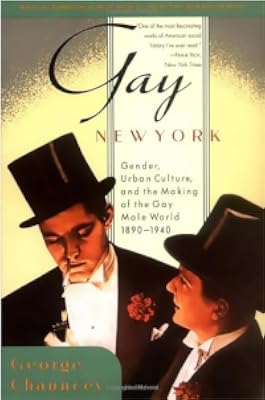
Gay New York: Gender, Urban Culture, and the Makings of the Gay Male World, 1890-1940
by George Chauncey
On This Page
Description
The award-winning, field-defining history of gay life in New York City in the early to mid-20th century "Gay New York" brilliantly shatters the myth that before the 1960s gay life existed only in the closet, where gay men were isolated, invisible, and self-hating. Drawing on a rich trove of diaries, legal records, and other unpublished documents, George Chauncey constructs a fascinating portrait of a vibrant, cohesive gay world that is not supposed to have existed. "Gay New York" forever show more changed how we think about the history of gay life in New York City, and beyond. show lessTags
Recommendations












Member Reviews
A life-changing book for gay people who think they have no history. Although it focuses almost exclusively on gay men (with good reason, and Chauncey acknowledges that reason,) and only looks at New York City, Chauncey masterfully strips apart dominant narratives about the history of sexuality and explores the nuances of masculinity at the turn of the century. My primary complaint is that communities of color are not as present as they could have been; although Chauncey devotes some space to Black men and women in the section about Harlem, that constitutes half a chapter, with no real acknowledgement as to the gap he's left behind.
Regardless, this book is life-changing and definitely necessary for those interested in the history of show more sexuality in general, and of gay male history in particular. The notes alone may also be worth a serious look for those less interested in gay men--the sources he draws from also cover urban history, some Black history, the history of sex work, women's history, and lesbian history. We can also argue here (happily!) over whether or not it's a work of transgender history--certainly it's a history of gender variance in this country, and for that I think it is worth for transgender people, especially transfeminine folk, to look at this too, despite the title. show less
Regardless, this book is life-changing and definitely necessary for those interested in the history of show more sexuality in general, and of gay male history in particular. The notes alone may also be worth a serious look for those less interested in gay men--the sources he draws from also cover urban history, some Black history, the history of sex work, women's history, and lesbian history. We can also argue here (happily!) over whether or not it's a work of transgender history--certainly it's a history of gender variance in this country, and for that I think it is worth for transgender people, especially transfeminine folk, to look at this too, despite the title. show less
A superbly-researched history of gay lives, where the author sought to dispel the myth that gay male culture itself only fermented in WWII and fully exploded into the cultural consciousness with the Stonewall riots in 1969 but that a very active and vibrant gay (sub)culture existed very publicly in New York from 1890 to 1930.
It was fascinating to learn about the way gay men created their own social world in both public and private spheres of their lives. How they constantly walked the line of being ostracised and acknowledged (or just tolerated) as long as they still conformed to social ideas of masculinity and femininity. How they manage to transform public areas into their own, recognising each other via subtle cues of conversation show more etc, undetected by the otherwise heteronormative, social-purity surroundings. How they persisted and created a culture of their own in the face of constant oppression, to thrive in their own private social lives, and fostered a supportive environment for the next generation of gay men.
Chauncey acknowledges the difficulty of doing research on such a suppressed culture, the source texts mainly involving court records and oral history from interviews he conducted. Despite this, he managed to recreate the vivid everyday lives that gay men achieved in spite of the constant opposition they faced. Black gay history of the Harlem area was also included in the book (but to a lesser extent than the white gay lives of the Village) which I think could be a really great book on its own. As would the lesser-discussed lesbian lives of the same era.
Truly an important and much-needed addition to gay history. I look forward to his next book on the postwar gay world.
Fascinating things I've learnt:
- the rise of the word gay (the semantics of labels defining particular sexual identities, which later became perjoratives, which in turn led to gay being adopted as an umbrella term whose dominant use and whose redefined parameters helped increase the visibility of gay culture),
- how working-class culture was the driving force in the establishment of gay culture in then New York (which made sense since the burgeoning middle class sought to distinguish themselves from the working class, one aspect of which meant they centred their lives more around their private homes whereas the tenement housing of the working class means they sought for public places such as saloons to congregate where like-minded people might meet and be able to mingle more freely),
- the difference between working class men and middle class men of era. The former can be with effeminate gay men while retaining their "masculine" identity (without having to label themselves as gay) within the working class community, provided they maintain the dominant male roles in the relations. Meanwhile middle class men are slowly enforcing the strict heterosexual/homosexual binary because they feel like their masculinity are being threatened (by working class men because they're viewed as more traditionally masculine than middle class men who work in an office and are in deference to bigger bosses, by women because they want to vote which undermines the man's position at home and also because they're taking over the work domains of middle class men [albeit in subservient roles but I suppose the presence of the women is enough to make the men feel threatened]). Which leads to the interesting pursuits that these middle class men thinks would restore their masculinity, such as, bodybuilding for the purposes of admiring each other naked... Men! show less
It was fascinating to learn about the way gay men created their own social world in both public and private spheres of their lives. How they constantly walked the line of being ostracised and acknowledged (or just tolerated) as long as they still conformed to social ideas of masculinity and femininity. How they manage to transform public areas into their own, recognising each other via subtle cues of conversation show more etc, undetected by the otherwise heteronormative, social-purity surroundings. How they persisted and created a culture of their own in the face of constant oppression, to thrive in their own private social lives, and fostered a supportive environment for the next generation of gay men.
Chauncey acknowledges the difficulty of doing research on such a suppressed culture, the source texts mainly involving court records and oral history from interviews he conducted. Despite this, he managed to recreate the vivid everyday lives that gay men achieved in spite of the constant opposition they faced. Black gay history of the Harlem area was also included in the book (but to a lesser extent than the white gay lives of the Village) which I think could be a really great book on its own. As would the lesser-discussed lesbian lives of the same era.
Truly an important and much-needed addition to gay history. I look forward to his next book on the postwar gay world.
Fascinating things I've learnt:
- the rise of the word gay (the semantics of labels defining particular sexual identities, which later became perjoratives, which in turn led to gay being adopted as an umbrella term whose dominant use and whose redefined parameters helped increase the visibility of gay culture),
- how working-class culture was the driving force in the establishment of gay culture in then New York (which made sense since the burgeoning middle class sought to distinguish themselves from the working class, one aspect of which meant they centred their lives more around their private homes whereas the tenement housing of the working class means they sought for public places such as saloons to congregate where like-minded people might meet and be able to mingle more freely),
- the difference between working class men and middle class men of era. The former can be with effeminate gay men while retaining their "masculine" identity (without having to label themselves as gay) within the working class community, provided they maintain the dominant male roles in the relations. Meanwhile middle class men are slowly enforcing the strict heterosexual/homosexual binary because they feel like their masculinity are being threatened (by working class men because they're viewed as more traditionally masculine than middle class men who work in an office and are in deference to bigger bosses, by women because they want to vote which undermines the man's position at home and also because they're taking over the work domains of middle class men [albeit in subservient roles but I suppose the presence of the women is enough to make the men feel threatened]). Which leads to the interesting pursuits that these middle class men thinks would restore their masculinity, such as, bodybuilding for the purposes of admiring each other naked... Men! show less
Really interesting preface to the reprint edition about how Chauncey would treat transgender issues differently if he were writing it 20 years later. Chauncey argues that in the 1890s and for several decades thereafter, the flourishing gay life in NYC was not defined by sexual object choice but by gender—“fairies” etc. were men who “took the woman’s part” and therefore “had a woman’s soul.” Among other things, this meant that many men who had or even preferred sex with women were willing to interact with and have sex with men we’d now call gay. Relatedly, working-class gay male life was heavily integrated with working-class heterosexual male life. Although many men saw themselves as living a double life or wearing a show more mask, they did not see themselves as “closeted” in the sense of isolated from other gay men. There were robust public forms of gay life, including balls, bathhouses, and bars, most of which were shut down by midcentury (the bathhouses lived until the AIDS crisis) but which before that were publicly acknowledged by newspapers, police, and others. It wasn’t that being gay was safe—arrests and attacks were real, albeit less common than they became—but that gay men nonetheless carved out lives that included public aspects. show less
I'm glad I read Gay New York just after reading Odd Girls and Twilight Lovers: the differences between the two queer social histories was edifying. Where Odd Girls attempts to create a narrative structure, in which queer culture progressed in a straight line, Gay New York looks at the first third of the 20th century thematically rather than chronologically. While this certainly makes it a much more difficult, dense read, it has the wonderful effect of showing the many simultaneous gay experiences of New Yorkers from different racial and economic backgrounds. In the end, Chauncey has described a vibrant polyphonic culture, and done it great justice.
It's probably been more than 15 years since I read this, so my recollection is hazy at best, but I remember that it made a huge impact on me for its vivid portrayal of a modern urban world structured by gender distinctions far more than distinctions of sexual practice--- where "normal" men could and did have sex with people who would at least partially be categorized as men today, but were distinguished by their feminine presentations. The shift to the gay/straight divide that we know today was a tectonic shift for these communities.
I read this for research for a queer historical fiction novel I'm writing, and it was interesting.
Chauncey gives a very detailed, thorough, well-researched account of queer meeting places, attitudes and urban culture in New York from the 1800's till 1940 and even slightly beyond that. It was a fascinating social history, although I found parts of it often dragged on or were repeated, I learned a lot and books like this will prove invaluable in my research.
I would also like to add that this focuses purely on queer men, not so much queer women. The writer acknowledges that a whole book ought to written about queer women and their respective collective identities in New York City.
While I was a little disappointed, I do agree. I also show more really appreciate Chauncey's concerted efforts to dismantle white privilege and how so many people thought they were being progressive in NYC, but were not necessarily, especially when it comes to black creators, performers and singers in the Harlem Renaissance.
I'd happily read his second book. show less
Chauncey gives a very detailed, thorough, well-researched account of queer meeting places, attitudes and urban culture in New York from the 1800's till 1940 and even slightly beyond that. It was a fascinating social history, although I found parts of it often dragged on or were repeated, I learned a lot and books like this will prove invaluable in my research.
I would also like to add that this focuses purely on queer men, not so much queer women. The writer acknowledges that a whole book ought to written about queer women and their respective collective identities in New York City.
While I was a little disappointed, I do agree. I also show more really appreciate Chauncey's concerted efforts to dismantle white privilege and how so many people thought they were being progressive in NYC, but were not necessarily, especially when it comes to black creators, performers and singers in the Harlem Renaissance.
I'd happily read his second book. show less
I was intrigued by this essay since recently some of my preconceptions are starting to fall down and I wanted a book that helped me to rebuild my basis. If I think to a hypothetic “modern” past (more or less pre II World War) I had the idea the gay culture was more or less “underground”, or better, completely hidden. My idea was that, if you were gay (and yes, I know at the time the word gay had a different meaning, but bear with me), you were also probably fated to be unhappily married, or completely alone; some exception were allowed to the very wealthy men that sheltered themselves in some isolated paradise, far from the society eyes and judgement. Then I started to read about John Gray (March 2, 1866 – June 14, 1934), the show more man who apparently inspired Oscar Wilde’s Dorian Gray, and who, more or less, lived happily together with his lover Marc-André Raffalovich (September 11, 1864 – February 14, 1934): when John Gray, a catholic priest, went to Edinburgh Marc-André Raffalovich settled nearby; he then helped finance St Peter's Church in Morningside where Gray would serve as priest for the rest of his life. And is it a coincidence that John died barely 4 months after Marc-André?
Or about Edward Carpenter (August 29, 1844 – June 28, 1929), the man who most used the term “intermediate sex”, referring to those men who were not exactly men, not exactly women, men who were attracted by other men, but usually stronger and masculine men. Edward Carpenter was a strong advocate of sexual freedom, living in a gay community near Sheffield, and had a profound influence on both D. H. Lawrence and E. M. Forster, so much that they said Forster took inspiration from Carpenter for Maurice and D.H. Lawrence for Lady Chatterley’s Lover: Edward Carpenter had a long-lasting relationship with George Merrill (1866–1928), a working class man also from Sheffield. Again, when Merrill suddenly died in January 1928, Carpenter was devastated and 13 months after, he himself died, on Friday 28 June 1929.
And what about F.O. Matthiessen (February 19, 1902 - April 1, 1950), the noted Harward literary historian and critic, who wrote to his lover, the painter Russell Cheney (1881–1945), “we are complex – both of us – in that we are neither wholly man, woman, or child”. In another letter he noted, “just as there are energetic active women and sensitive delicate men, so also there are… men, like us, who appear to be masculine but have a female sex element”. Both Yale graduate and members of the Skull & Bones, Matthiessen was 20 years younger than Cheney, but they died at only 5 years of distance.
And then there is the story of Glenway Wescott (April 11, 1901 - February 22, 1987) and his lover Monroe Wheeler (February 13, 1899 - August 14, 1988); despite apparently having an open relationship, and an on-off ménages a trois with fashion photographer and male nude artist George Platt Lynes (April 15, 1907 – December 6, 1955), they lived together until old age, hosting one of the most important intellectual saloon in their Greenwich Village apartment. Again, when Wescott dies in 1987, Monroe followed soon after 1 year and half later (on a sad note, it seems that to Monroe Wheeler was prohibited to live in the country house he had always shared with Glenway; truth be told, the house was not of Glenway, but of his brother who had married a wealthy heiress who apparently maintained for all her life both her husband than Glenway and Monroe).
But other than tidbits about these men, you will read also about the Harlem’s drag balls with the quintessentia of Harlem Renaissance poets like Langston Hughes and Richard Bruce Nugent, but also with, among the attendants, Broadway gay celebrities like Beatrice Lillie, Clifton Webb, Jay Brennan and Tallulah Bankhead (it’s a coincidence that most of these names are almost forgotten? I loved black and white movies by Clifton Webb, but those other names were completely new to me). It was the chance for me to google about Beatrice Lillie and Tallulah Bankhead, and rediscover these fascinating women.
On a closing note, even if today there seems to be more “freedom”, popular culture still likes to erase the memory, like in the case of Charles Henri Ford (February 10, 1913 - September 27, 2002) whose lover Indra Tamang is still today identified as “the butler”; upon her death, Charles Henri Ford’s sister, actress Ruth Ford (July 7, 1911 - August 12, 2009), according to the newspapers left 2 multimillionaire apartments in New York City plus an art collection (n.d.r. Charles Henri Ford was the partner of painter Pavel Tchelitchew, until his death in 1957) to her “butler”… who is no one else than Indra Tamang that already in the ’70 and ’80 was well known as to be Charles Henri Ford devoted partner. It’s so hard to imagine that she was not leaving an unthinkable generous legacy to a simple partner, but was probably honouring the memory of her late brother?
Gay New York is maybe a little more academic than my review is letting you believe, and that is a worth for the essay I suppose. But to me, romantic reader, it allowed to have a more solid basis to read about the above men and women, and their sometime hidden lives. It’s a pity they are hidden, since apparently, these men and women were not afraid, at their time, to openly live their love.
http://www.amazon.com/dp/0465026214/?tag=elimyrevandra-20 show less
Or about Edward Carpenter (August 29, 1844 – June 28, 1929), the man who most used the term “intermediate sex”, referring to those men who were not exactly men, not exactly women, men who were attracted by other men, but usually stronger and masculine men. Edward Carpenter was a strong advocate of sexual freedom, living in a gay community near Sheffield, and had a profound influence on both D. H. Lawrence and E. M. Forster, so much that they said Forster took inspiration from Carpenter for Maurice and D.H. Lawrence for Lady Chatterley’s Lover: Edward Carpenter had a long-lasting relationship with George Merrill (1866–1928), a working class man also from Sheffield. Again, when Merrill suddenly died in January 1928, Carpenter was devastated and 13 months after, he himself died, on Friday 28 June 1929.
And what about F.O. Matthiessen (February 19, 1902 - April 1, 1950), the noted Harward literary historian and critic, who wrote to his lover, the painter Russell Cheney (1881–1945), “we are complex – both of us – in that we are neither wholly man, woman, or child”. In another letter he noted, “just as there are energetic active women and sensitive delicate men, so also there are… men, like us, who appear to be masculine but have a female sex element”. Both Yale graduate and members of the Skull & Bones, Matthiessen was 20 years younger than Cheney, but they died at only 5 years of distance.
And then there is the story of Glenway Wescott (April 11, 1901 - February 22, 1987) and his lover Monroe Wheeler (February 13, 1899 - August 14, 1988); despite apparently having an open relationship, and an on-off ménages a trois with fashion photographer and male nude artist George Platt Lynes (April 15, 1907 – December 6, 1955), they lived together until old age, hosting one of the most important intellectual saloon in their Greenwich Village apartment. Again, when Wescott dies in 1987, Monroe followed soon after 1 year and half later (on a sad note, it seems that to Monroe Wheeler was prohibited to live in the country house he had always shared with Glenway; truth be told, the house was not of Glenway, but of his brother who had married a wealthy heiress who apparently maintained for all her life both her husband than Glenway and Monroe).
But other than tidbits about these men, you will read also about the Harlem’s drag balls with the quintessentia of Harlem Renaissance poets like Langston Hughes and Richard Bruce Nugent, but also with, among the attendants, Broadway gay celebrities like Beatrice Lillie, Clifton Webb, Jay Brennan and Tallulah Bankhead (it’s a coincidence that most of these names are almost forgotten? I loved black and white movies by Clifton Webb, but those other names were completely new to me). It was the chance for me to google about Beatrice Lillie and Tallulah Bankhead, and rediscover these fascinating women.
On a closing note, even if today there seems to be more “freedom”, popular culture still likes to erase the memory, like in the case of Charles Henri Ford (February 10, 1913 - September 27, 2002) whose lover Indra Tamang is still today identified as “the butler”; upon her death, Charles Henri Ford’s sister, actress Ruth Ford (July 7, 1911 - August 12, 2009), according to the newspapers left 2 multimillionaire apartments in New York City plus an art collection (n.d.r. Charles Henri Ford was the partner of painter Pavel Tchelitchew, until his death in 1957) to her “butler”… who is no one else than Indra Tamang that already in the ’70 and ’80 was well known as to be Charles Henri Ford devoted partner. It’s so hard to imagine that she was not leaving an unthinkable generous legacy to a simple partner, but was probably honouring the memory of her late brother?
Gay New York is maybe a little more academic than my review is letting you believe, and that is a worth for the essay I suppose. But to me, romantic reader, it allowed to have a more solid basis to read about the above men and women, and their sometime hidden lives. It’s a pity they are hidden, since apparently, these men and women were not afraid, at their time, to openly live their love.
http://www.amazon.com/dp/0465026214/?tag=elimyrevandra-20 show less
Members
- Recently Added By
Lists

Books Read in 2018
4,360 works; 110 members

r/AskHistorians' Recommended Books
1,068 works; 19 members

Queer History - Specialized
37 works; 1 member
Author Information

5+ Works 2,056 Members
Some Editions
Awards and Honors
Common Knowledge
- Canonical title
- Gay New York: Gender, Urban Culture, and the Makings of the Gay Male World, 1890-1940
- Original publication date
- 1994-05-01
- Important places
- New York, USA; New York, New York, USA
- Disambiguation notice
- Full title (1994): Gay New York : gender, urban culture, and the makings of the gay male world, 1890-1940.
Classifications
- Genres
- LGBTQ+, History, Nonfiction, Sexuality and Gender Studies, General Nonfiction, Sociology
- DDC/MDS
- 305 — Society, government, & culture Social sciences, sociology & anthropology Social group - Age, Gender, Ethnicity
- LCC
- HQ76.2 .U52 .N53 — Social sciences The family. Marriage, Women and Sexuality The Family. Marriage. Women Sexual life Homosexuality. Lesbianism
- BISAC
Statistics
- Members
- 1,149
- Popularity
- 21,981
- Reviews
- 11
- Rating
- (4.44)
- Languages
- English, French
- Media
- Paper, Audiobook, Ebook
- ISBNs
- 7
- ASINs
- 4