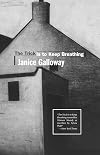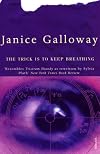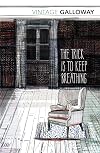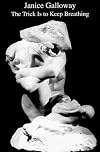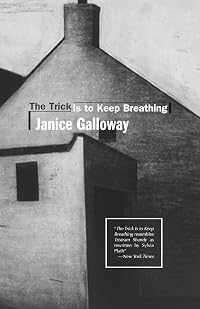
The Trick is to Keep Breathing
by Janice Galloway
On This Page
Description
From the corner of a darkened room Joy Stone watches herself. As memories of the deaths of her lover and mother surface unbidden, life for Joy narrows - to negotiating each day, each encounter, each second; to finding the trick to keep living. Told with shattering clarity and wry wit, this is a Scottish classic fit for our time.Tags
Recommendations




















Member Recommendations

Member Reviews
A seemingly unceasing descent to madness, The Trick is to Keep Breathing has interesting tricks up its prose. Words and phrases break down, split, and transform, sentences lose itself midway and regain their momentous back only to incoherently mesh with each other, as they steer the novel’s gnawing touch of realism. Depression enshrouds it all in its despair and darkness; the dullness and repetitive nature of work further puts weight against the novel’s already heavy narrative. In spite of its largely threatening gloom, it strips the layers of stigma against mental illness down to a degree without romanticising or highlighting it as a mere pity party; the accurate portrayal of the overwhelming lack of understanding perpetuates show more abuse, manipulation, at times sexual coercion, even the disgusting manner of how people treat it as a laughable matter. And the mental health care system here, as much as a reflection of reality, is thoroughly frustrating and ugly which deeply represent the problematic disregard and insensitivity not only from the government but also mental health professionals themselves. It is expectedly disappointing. Only the inclusion of family history of mental illness on the female side is a little uneven and is grazed upon in haste as it sits between unsuccessfully dying and unsuccessfully living. Nonetheless, The Trick is to Keep Breathing gasps for air in relief after nearly drowning near its end; a hold onto any fragile thread of survival just to keep going. show less
The narrator of this novel is Joy, a 27-year-old women who works as a drama teacher and is struggling with depression, anorexia, and alcoholism. The accidental death of the married man who was her lover prompts a breakdown which leads to her spending time in a mental institution (where she doesn't get much help). The fractured narrative uncovers both the events of her traumatic events and the societal expectations of women that have lead to her current state. This is a challenging book to read, both due to the raw emotions of an honest appraisal of depression, and the stream of conscious style of writing. One feature Galloway uses is adding snippets of text to the margins as if Joy is annotating the novel. It took me waaaaay too long to show more finish reading this book, but I'm glad I did because it is a powerful story of mental health issues that are too often hidden. show less
LESSON 1: Psychiatrists aren't as smart as you'd think.
I knew three things right away:
1. I hate facile questions (So-why-do-you-think-you're-here is so easy to subvert);
2. You have to try: it's the whole purpose of being here;
and
3. You have to be on your guard. There is no defence against the arbitrariness of things. You have to be suspicious of everything.
[...]
LESSON 2: Psychiatrists are not mind-readers. They just try to look as though they are.
[...]
LESSON 3: Psychiatrists give you a lot of rope knowingly.
[...]
LESSON 4: Psychiatrists are just like all the rest.
[...]
LESSON 5: Psychiatrists set things up the way they want them.
(p. 103-107)
_______________________
Other people. Other people interest me. How they manage. There are several show more possibilities.
1. They are just as confused as me but they aren't letting on.
2. They don't know they don't know what the point is.
3. They don't understand they don't know what the point is.
4. They don't mind they don't know what the point is.
5. They don't even know there are any questions.
(p. 198) show less
This book has been sitting on my shelves for a while now, and I think I chose exactly the right time to read it. Although my depression has thankfully not been triggered by anything as traumatic as Joy's experiences, I could relate to a character who is in freefall and trying to save herself. It's a powerful book, but not overpowering. There's not a lot of action but there is so much depth, and I loved the fact that there were no buzzwords or cliches to trip the flow of the story up. And the writing is flawless - I could actually feel the cold and smell the mould in the air of Joy's abandoned cottage, a cottage which is so symbolic of her mind and journey. This is one of those books where you're left wondering about the character at the show more end...I hope she made it out ok. I've spoilered this section, because honestly at one point I really thought she was preparing to commit suicide. I'm thankful that Galloway avoided that outcome. I hope things got better for Joy. show less
The Trick is to Keep Reading.
That is what I had to keep telling myself every 25 pages or so. I would have to break away and move to another book for a bit, before I could breathe in and come back, always willingly, to this Keep Breathing of a novel.
There is not too much of a plot in this book. It is the account of a young woman in shock after her lover drowned in a camping resort during holidays abroad. Instead of action what Janice Galloway offers us, brilliantly, is the inner pulsing of a depressed mind.
Galloway has Joy Stone, a woman aged 27, narrating the story in first person. In spite of her first name, Joy Stone has a soul that is weighing on her more than her second name. Trapped in her body she tries to undo her Self through show more anorexia that, amongst other things, will eat away her gums. She is also prone to sudden bursts of other disfiguring initiatives, such as cutting short her hair and dyeing it with strident colors. She is self–inflicting but her broken language, full of non sequitur thoughts and unfinished sentences, is never self-deprecating. Her conception of time is also broken. Galloway uses italics to help us identify flashbacks, but lets Joy narrate the present in disconnected blocks. Stone succeeds in disembodying herself through her account.
Galloway has also granted Stone with a very candid language. Many of Joy’s observations become as lucid as those of any acute social critic. As Joy is detaching herself from her surroundings, her comments can at times throw the reader off-balance and have an awakening affect. Her language can break a sunken mind out of its stupor.
Amidst the drama of witnessing the hopeless despair of this young woman in deep mourning for her lost happiness, I was struck by the humor in the book. The account is toned with a subtle irony becoming at times a blatant parody. Stone/Galloway puts mental medical assistance in utter ridicule.
Humor is brought not only by the joke that Joy herself repeats, repeats, repeats, and repeats (count of four times):
Q: How many Psychiatrists does it take to change a light bulb?
A: One. But the light bulb must really want to change.
But particularly, the scenes with her dialogues with a series of shrinks (appropriately named Doctor One, Doctor Two and Doctor Three), just made me burst out laughing.
But it is exhausting to live inside a depressed mind. All those irrelevant details upon irrelevant details of this painstakingly observant mind, take up so much of the reader’s energy because they are recorded without affection.
I will have to admit, though, that I am not too interested in this kind of barren self-absorption. I prefer tales of fighters, of adventurers, of discoverers and the personalities of creative people who are full of vitality. I look for expansive vistas, and not microscopic visions. I am not talking about triumphalism. Accounts of persons who summon up strength in the face of adversity awaken awe. I prefer to feel fascination.
This takes me to consider which can be the possible reactions to suffering or utter distress. In my recent reading of Magda Denes Castles Burning: A Child's Life in War, anger offered the saving path. Luise Rinser’s Prison Diary Gefangnistagebuch would be another. In The Trick, we see Joy on her way to recovery because she ends up picking one of the possible paths suggested by a Self-Help magazine, forgiveness.
But I ask myself, to what extent is one entitled to blame and exculpate anyone because that person’s death has sunk one in loneliness and misery. What about the sorrow for the other person’s loss of life?
P.S.: If I am allowed a pedantic comment, in the early scene in a Spanish camping resort a local boy comes to tell Joy the news of a drowned Michael, calling on her attention with a: “Signora, Signora!”… Well, that’s Italian, not Spanish. show less
That is what I had to keep telling myself every 25 pages or so. I would have to break away and move to another book for a bit, before I could breathe in and come back, always willingly, to this Keep Breathing of a novel.
There is not too much of a plot in this book. It is the account of a young woman in shock after her lover drowned in a camping resort during holidays abroad. Instead of action what Janice Galloway offers us, brilliantly, is the inner pulsing of a depressed mind.
Galloway has Joy Stone, a woman aged 27, narrating the story in first person. In spite of her first name, Joy Stone has a soul that is weighing on her more than her second name. Trapped in her body she tries to undo her Self through show more anorexia that, amongst other things, will eat away her gums. She is also prone to sudden bursts of other disfiguring initiatives, such as cutting short her hair and dyeing it with strident colors. She is self–inflicting but her broken language, full of non sequitur thoughts and unfinished sentences, is never self-deprecating. Her conception of time is also broken. Galloway uses italics to help us identify flashbacks, but lets Joy narrate the present in disconnected blocks. Stone succeeds in disembodying herself through her account.
Galloway has also granted Stone with a very candid language. Many of Joy’s observations become as lucid as those of any acute social critic. As Joy is detaching herself from her surroundings, her comments can at times throw the reader off-balance and have an awakening affect. Her language can break a sunken mind out of its stupor.
Amidst the drama of witnessing the hopeless despair of this young woman in deep mourning for her lost happiness, I was struck by the humor in the book. The account is toned with a subtle irony becoming at times a blatant parody. Stone/Galloway puts mental medical assistance in utter ridicule.
Humor is brought not only by the joke that Joy herself repeats, repeats, repeats, and repeats (count of four times):
Q: How many Psychiatrists does it take to change a light bulb?
A: One. But the light bulb must really want to change.
But particularly, the scenes with her dialogues with a series of shrinks (appropriately named Doctor One, Doctor Two and Doctor Three), just made me burst out laughing.
But it is exhausting to live inside a depressed mind. All those irrelevant details upon irrelevant details of this painstakingly observant mind, take up so much of the reader’s energy because they are recorded without affection.
I will have to admit, though, that I am not too interested in this kind of barren self-absorption. I prefer tales of fighters, of adventurers, of discoverers and the personalities of creative people who are full of vitality. I look for expansive vistas, and not microscopic visions. I am not talking about triumphalism. Accounts of persons who summon up strength in the face of adversity awaken awe. I prefer to feel fascination.
This takes me to consider which can be the possible reactions to suffering or utter distress. In my recent reading of Magda Denes Castles Burning: A Child's Life in War, anger offered the saving path. Luise Rinser’s Prison Diary Gefangnistagebuch would be another. In The Trick, we see Joy on her way to recovery because she ends up picking one of the possible paths suggested by a Self-Help magazine, forgiveness.
But I ask myself, to what extent is one entitled to blame and exculpate anyone because that person’s death has sunk one in loneliness and misery. What about the sorrow for the other person’s loss of life?
P.S.: If I am allowed a pedantic comment, in the early scene in a Spanish camping resort a local boy comes to tell Joy the news of a drowned Michael, calling on her attention with a: “Signora, Signora!”… Well, that’s Italian, not Spanish. show less
The main character in this novel, ironically named Joy, is as deeply depressed as any character I've encountered. Joy has lost her mother to suicide and has broken off her long-term relationship with a boyfriend. She started an affair with a married man who unexpectedly dies as well. Reviewers say the novel is full "of great warmth and energy", that "the wit and irony found in moments of despair prove to be Joy's salvation." It didn't feel that way to me. The novel closes with Joy drinking heavily (again) while bemoaning her life (again). I didn't see any salvation for Joy; Joy felt destined for suicide. We ought to check on Galloway, too, while we’re at it.
Janice Galloway's "The Trick is to Keep Breathing" is the story of Joy, a woman who is struggling with depression after the death of her lover Michael. The emotion is palpable and raw in the story, which at times made it a difficult read, as were Joy's efforts to find help only to be rebuffed and passed some pills instead.
This definitely isn't the book to read if you're going through a hard period in your own life.
This definitely isn't the book to read if you're going through a hard period in your own life.
Members
- Recently Added By
Lists

1,001 BYMRBYD Concensus
723 works; 27 members

Read These Too
458 works; 9 members

My TBR
371 works; 3 members

BBC World Book Club
267 works; 5 members

World Book Club (BBC World Service)
212 works; 1 member
Author Information

17+ Works 1,328 Members
Janice Galloway's first novel, The Trick Is to Keep Breathing, was published in 1990 and won the MIND/Allen Lane Book of the Year and was shortlisted for the Whitbread First Novel and Scottish First Book. A story from her second book, Blood, won the Cosmopolitan/Perrier Short Story Award. Her second novel, Foreign Parts, won the McVitie's Prize in show more 1994, the same year she won the American Academy of Arts and Letters' E. M. Forster Award. She lives in Glasgow show less
Awards and Honors
Awards
Common Knowledge
- Canonical title
- The Trick is to Keep Breathing
- Original title
- The Trick is to Keep Breathing
- Original publication date
- 1989
- People/Characters
- Joy Stone
- Dedication
- For Alison and Margaret and Drew
- First words
- I can't remember the last week with any clarity.
Classifications
Statistics
- Members
- 659
- Popularity
- 44,046
- Reviews
- 16
- Rating
- (3.75)
- Languages
- English, French, German, Italian
- Media
- Paper, Audiobook, Ebook
- ISBNs
- 10
- UPCs
- 1
- ASINs
- 4