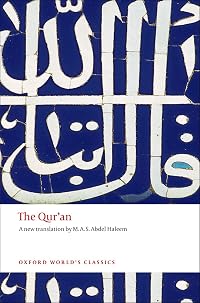
The Qur'an (Abdel Haleem)
by M. A. S. Abdel Haleem (Translator)
On This Page
Description
The Qur'an, believed by Muslims to be the word of God, was revealed to the Prophet Muhammad 1400 years ago. It is the supreme authority in Islam and the living source of all Islamic teaching; it is a sacred text and a book of guidance, that sets out the creed, rituals, ethics, and laws of the Islamic religion. It has been one of the most influential books in the history of literature. Recognized as the greatest literary masterpiece in Arabic, it has nevertheless remained difficult to show more understand. in its English translations. This new translation is written in a contemporary idiom that remains faithful to the original, making it easy to read while retaining its powers of eloquence. Archaisms and cryptic language are avoided, and the Arabic meaning preserved by respecting the context of the. discourse. The message of the Qur'an was directly addressed to all people regardless of class, gender, or age, and this translation is equally accessible to everyone.-- show lessTags
Recommendations










Member Reviews
If you're here because you want reasons to hate Muslims, or Islam, or to love Muslims, or Islam, the exit is to your right.
Also, I'm not rating the qur'an, which is idiotic, but the edition, which is wonderful. I'd never considered reading the thing until a friend of mine gave a little workshop on teaching bits of it. Then another friend said this was a really good edition. And behold, it is: Haleem gives you just enough historical and linguistic information to let you read and interpret more or less on your own. No doubt his interpretation/translation has a liberal bias, but let's be honest, why bother trying to read an edition by someone whose main interest in one of the world's greatest religious texts is how it can help them show more justify their atavistic tendency to beat women, behead people or murder journalists?
As for my experience reading the Qur'an: I started reading it at the same time I watched the first season of Homeland, which, despite some unreconstructed post-colonialist discussion to the contrary, is quite sympathetic to a) Islam and b) terrorists. Watching Brodie's conversion while reading the first few suras made me think, more or less, I can see the attraction here. And although all the ingrained theological, philosophical and historical barriers to taking the book quite *that* seriously returned pretty quickly to my mind, the feeling was memorable enough that I kept on reading.
Unlike the Jewish and Christian bibles, the Qur'an looks a bit like a modernist literary experimenter's idea of a sacred text. It's impossible to read either bible and think it's the word of God, for the very good reason that God is a character, and if there's a God, s/he is by definition not such a douchebag as to talk about him/herself in the third person. But the style of the Qur'an is unified, and you never lose sight of the fact that this is, structurally at least, God using Gabriel to talk to Mohammed about, by and and large, everyday matters of social and religious organization. The experimental feel comes from the text's willingness to switch without notice between first, second and third person perspectives, which Haleem handles very well. There's nothing like these jumps in all the world's literature, as far as I know.
The themes of the text are also clear, whereas the bibles really don't seem to have any unifying themes at all.
i) Muhammad is the latest and last in a line of prophets stretching back to Abraham. All of them were rejected by their people in some way.
ii) God took vengeance on those who rejected the prophet, and will take vengeance on the idolators who threaten the Muslim communities *of the time*.
iii) The rules for being saved are very simple, and God's pretty laid back about most things. You shouldn't eat meat sacrificed to idols, but on the other hand, you can eat such meat if you're really hungry.
iv) Compared to the idols living around the Muslims, God is a very mild ruler; compared to their social customs, Muslim social customs are equally mild. [This is not to say that those customs and rules are mild compared to ours].
v) At the end of time, God will separate out the believers/good people from the unbelievers/evil doers. Evil doing mostly consists in being cruel or vicious towards the poor and unfortunate. E.g., if you're mean to orphans, or use your wealth for yourself rather than others, you've going into the fire.
All that said, it can get dull for the unbeliever at times. These themes are unified but also stated over and over again; given that the original point of the suras was God's explaining, through the prophet, something important for the specific historical moment at which the revelation was made, that's hardly surprising. But provided you know biblical stories, which the Qur'an refunctions in all sorts of ways, you should be able to read this. And you should: it's a marvel.
********************************************
Passages I found particularly interesting or poetic. Please note I only started marking them with sura 8, about a quarter of the way through. Believe it or not, I've actually cut down on the apocalyptic things that I liked. If you only look at one or two, check out the last three, which are astonishingly beautiful.
8:24--"Know that God comes between a man and his heart..."
10:28--"On the Day We gather them all together, We shall say to those who associate partners with God, 'Stay in your place, you and your partner-gods.'... their partner-gods will say, 'It was not us you worshipped... we had not idea that you worshipped us.'"
17:13--"We have bound each human being's destiny to his neck. On the Day of Resurrection, We shall bring out a record for each of them, which they will find spread wide open, 'Read your record. Today your own soul is enough to calculate your account.'"
20:102--"When the trumpet is sounded and We gather the sinful, sightless, they will murmur to one another, 'You stayed only ten days.' We know best what they say, but the more perceptive of them will say, 'Your stay on earth was only a single day.'"
31:27--If all the trees on earth were pens and all the seas, with seven more seas besides [were ink], still God's words would not run out: God is almighty and all wise. Creating and resurrecting all of you is only like creating or resurrecting a single soul."
33:72--"We offered the Trust to the heavens, the earth, and the mountains, yet they refused to undertake it and were afraid of it; mankind undertook it--they have always been very inept and rash."
34:12--"And We subjected the wind for Solomon. Its outward journey took a month, and its return journey likewise... some of the jinn worked under his control with his Lord's permission... They made him whatever he wanted... then, when We decreed Solomon's death, nothing showed the jinn he was dead, but a creature of the earth eating at his stick: when he fell down they realized--if they had known what was hidden they would not have continued their demeaning labor." [WTF?]
41:19: "On the Day when God's enemies are gathered up for the Fire and driven onward, their ears, eyes and skins will, when they reach it, testify against them for their misdeeds. They will turn to their skins, 'Why did you testify against us?'"
All of sura 56
69:25--"But anyone who is given his Record in his left hand will say, 'If only I had never been given any Record and knew nothing of my Reckoning.... My wealth has been no use to me, and my power has vanished. 'Take him, put a collar on him, lead him to burn in the blazing Fire... he would not believe in Almighty God, he never encouraged feeding the destitute, so today he has no real friend here, and the only food he has is the filth that only sinners eat.'"
75:16--"Prophet, do not rush your tongue in an attempt to hasten your memorization of the Revelation: It is for Us to make sure of its safe collection and recitation." [Muhammad was worried he couldn't remember it all, God tells him it'll be okay. Cute!]
80:1--"He frowned and turned away when the blind man came to him..." [Muhammad turns away from a believer to try to convert others, and is chastised by God.]
89:15--"Man is [such] that, when his Lord tries him through honour and blessings, he says, 'My Lord has honoured me,' but when He tries him through the restriction of provision, he says 'My Lord has humiliated me.' No indeed! You people do not honour orphans, you don not urge one another to feed the poor... and you love wealth with a passion."
90:12--"What will explain to you what the steep path is? It is to free a slave, to feed at a time of hunger an orphaned relative or a poor person in distress, and to be one of those who believe and urge one another to steadfastness and compassion."
103: "By the fading day, man is deep in loss, except for those who believe, do good deeds, urge one another to truth, and urge one another to steadfastness."
113: "Say, 'I seek refuge with the Lord of daybreak against the harm of what He has created, the harm of the night when darkness gathers, the harm of witches when they blow on knots, the harm of the envier when he envies." show less
Also, I'm not rating the qur'an, which is idiotic, but the edition, which is wonderful. I'd never considered reading the thing until a friend of mine gave a little workshop on teaching bits of it. Then another friend said this was a really good edition. And behold, it is: Haleem gives you just enough historical and linguistic information to let you read and interpret more or less on your own. No doubt his interpretation/translation has a liberal bias, but let's be honest, why bother trying to read an edition by someone whose main interest in one of the world's greatest religious texts is how it can help them show more justify their atavistic tendency to beat women, behead people or murder journalists?
As for my experience reading the Qur'an: I started reading it at the same time I watched the first season of Homeland, which, despite some unreconstructed post-colonialist discussion to the contrary, is quite sympathetic to a) Islam and b) terrorists. Watching Brodie's conversion while reading the first few suras made me think, more or less, I can see the attraction here. And although all the ingrained theological, philosophical and historical barriers to taking the book quite *that* seriously returned pretty quickly to my mind, the feeling was memorable enough that I kept on reading.
Unlike the Jewish and Christian bibles, the Qur'an looks a bit like a modernist literary experimenter's idea of a sacred text. It's impossible to read either bible and think it's the word of God, for the very good reason that God is a character, and if there's a God, s/he is by definition not such a douchebag as to talk about him/herself in the third person. But the style of the Qur'an is unified, and you never lose sight of the fact that this is, structurally at least, God using Gabriel to talk to Mohammed about, by and and large, everyday matters of social and religious organization. The experimental feel comes from the text's willingness to switch without notice between first, second and third person perspectives, which Haleem handles very well. There's nothing like these jumps in all the world's literature, as far as I know.
The themes of the text are also clear, whereas the bibles really don't seem to have any unifying themes at all.
i) Muhammad is the latest and last in a line of prophets stretching back to Abraham. All of them were rejected by their people in some way.
ii) God took vengeance on those who rejected the prophet, and will take vengeance on the idolators who threaten the Muslim communities *of the time*.
iii) The rules for being saved are very simple, and God's pretty laid back about most things. You shouldn't eat meat sacrificed to idols, but on the other hand, you can eat such meat if you're really hungry.
iv) Compared to the idols living around the Muslims, God is a very mild ruler; compared to their social customs, Muslim social customs are equally mild. [This is not to say that those customs and rules are mild compared to ours].
v) At the end of time, God will separate out the believers/good people from the unbelievers/evil doers. Evil doing mostly consists in being cruel or vicious towards the poor and unfortunate. E.g., if you're mean to orphans, or use your wealth for yourself rather than others, you've going into the fire.
All that said, it can get dull for the unbeliever at times. These themes are unified but also stated over and over again; given that the original point of the suras was God's explaining, through the prophet, something important for the specific historical moment at which the revelation was made, that's hardly surprising. But provided you know biblical stories, which the Qur'an refunctions in all sorts of ways, you should be able to read this. And you should: it's a marvel.
********************************************
Passages I found particularly interesting or poetic. Please note I only started marking them with sura 8, about a quarter of the way through. Believe it or not, I've actually cut down on the apocalyptic things that I liked. If you only look at one or two, check out the last three, which are astonishingly beautiful.
8:24--"Know that God comes between a man and his heart..."
10:28--"On the Day We gather them all together, We shall say to those who associate partners with God, 'Stay in your place, you and your partner-gods.'... their partner-gods will say, 'It was not us you worshipped... we had not idea that you worshipped us.'"
17:13--"We have bound each human being's destiny to his neck. On the Day of Resurrection, We shall bring out a record for each of them, which they will find spread wide open, 'Read your record. Today your own soul is enough to calculate your account.'"
20:102--"When the trumpet is sounded and We gather the sinful, sightless, they will murmur to one another, 'You stayed only ten days.' We know best what they say, but the more perceptive of them will say, 'Your stay on earth was only a single day.'"
31:27--If all the trees on earth were pens and all the seas, with seven more seas besides [were ink], still God's words would not run out: God is almighty and all wise. Creating and resurrecting all of you is only like creating or resurrecting a single soul."
33:72--"We offered the Trust to the heavens, the earth, and the mountains, yet they refused to undertake it and were afraid of it; mankind undertook it--they have always been very inept and rash."
34:12--"And We subjected the wind for Solomon. Its outward journey took a month, and its return journey likewise... some of the jinn worked under his control with his Lord's permission... They made him whatever he wanted... then, when We decreed Solomon's death, nothing showed the jinn he was dead, but a creature of the earth eating at his stick: when he fell down they realized--if they had known what was hidden they would not have continued their demeaning labor." [WTF?]
41:19: "On the Day when God's enemies are gathered up for the Fire and driven onward, their ears, eyes and skins will, when they reach it, testify against them for their misdeeds. They will turn to their skins, 'Why did you testify against us?'"
All of sura 56
69:25--"But anyone who is given his Record in his left hand will say, 'If only I had never been given any Record and knew nothing of my Reckoning.... My wealth has been no use to me, and my power has vanished. 'Take him, put a collar on him, lead him to burn in the blazing Fire... he would not believe in Almighty God, he never encouraged feeding the destitute, so today he has no real friend here, and the only food he has is the filth that only sinners eat.'"
75:16--"Prophet, do not rush your tongue in an attempt to hasten your memorization of the Revelation: It is for Us to make sure of its safe collection and recitation." [Muhammad was worried he couldn't remember it all, God tells him it'll be okay. Cute!]
80:1--"He frowned and turned away when the blind man came to him..." [Muhammad turns away from a believer to try to convert others, and is chastised by God.]
89:15--"Man is [such] that, when his Lord tries him through honour and blessings, he says, 'My Lord has honoured me,' but when He tries him through the restriction of provision, he says 'My Lord has humiliated me.' No indeed! You people do not honour orphans, you don not urge one another to feed the poor... and you love wealth with a passion."
90:12--"What will explain to you what the steep path is? It is to free a slave, to feed at a time of hunger an orphaned relative or a poor person in distress, and to be one of those who believe and urge one another to steadfastness and compassion."
103: "By the fading day, man is deep in loss, except for those who believe, do good deeds, urge one another to truth, and urge one another to steadfastness."
113: "Say, 'I seek refuge with the Lord of daybreak against the harm of what He has created, the harm of the night when darkness gathers, the harm of witches when they blow on knots, the harm of the envier when he envies." show less
(Rating for translation/editing, not for content.)
I found this a very slow read. Haleem's translation is quite clear and accessible, but as the Qur'an is arranged in order of Suras of decreasing length, there's no internal progression of ideas or chronology. There's little variation in style—understandable, given that the text allegedly records a series of revelations given to one individual—and a lot of the content is quite repetitive. Again, understandable given that this is a transcription of a series of lectures designed to instruct in the basics of the faith, but there's a reason it took me several months to get through this. Unless you're truly interested in/open to the theological ideas expressed here (which this atheist is show more not), it can be a slog—I'm glad I read it, for the historical context, but I did find my eyes glazing over by about the twentieth iteration of evil-people-will-go-to-hell. show less
I found this a very slow read. Haleem's translation is quite clear and accessible, but as the Qur'an is arranged in order of Suras of decreasing length, there's no internal progression of ideas or chronology. There's little variation in style—understandable, given that the text allegedly records a series of revelations given to one individual—and a lot of the content is quite repetitive. Again, understandable given that this is a transcription of a series of lectures designed to instruct in the basics of the faith, but there's a reason it took me several months to get through this. Unless you're truly interested in/open to the theological ideas expressed here (which this atheist is show more not), it can be a slog—I'm glad I read it, for the historical context, but I did find my eyes glazing over by about the twentieth iteration of evil-people-will-go-to-hell. show less
I have several Oxford Classics (novels) but this was my first Oxford religious text. I am not an expert on Arabic or Muslim culture, but the other reviews for this product encouraged me to buy it, and I was not disappointed. Oxford has great footnotes, to help explain things such as cultural references or certain words, so for anyone wishing to learn/read the Quran but not knowing Arabic or Muslim culture, this is a great way to learn more about the Quran and Islam itself.
Christians will recognize some of the figures in this, since both religions (and Judaism) came from the same ancestor. There's also some parallels to the Bible, such as charity toward the poor or other acts of kindness.
Of course, to truly understand/feel the Quran, you show more would need to know the Quran's original language, but for those of us who do not speak that language (classical Arabic, Arabic) there's this. show less
Christians will recognize some of the figures in this, since both religions (and Judaism) came from the same ancestor. There's also some parallels to the Bible, such as charity toward the poor or other acts of kindness.
Of course, to truly understand/feel the Quran, you show more would need to know the Quran's original language, but for those of us who do not speak that language (classical Arabic, Arabic) there's this. show less
I give it five stars because it's an Oxford production, which to me means it's the most authoritative version printed in English. The front matter, by itself, counts 41 numbered pages (Roman numerals, of course).
I want to read it. I will read it and write down my thoughts upon what I read as I stroll through it. But not being a moral or religious scholar myself, I am in no way fit to pass judgement on the whole or any part of "The Qur'an". So just because I note that this or that piece of the text strikes me as being in some way 'odd' should mean nothing to anyone because I don't know enough to pass moral or spiritual judgement upon a single line in this book. I only took it up in the first place to learn for myself what the West is all show more upset about -- and whatever became of Cat Stevens, anyway? show less
I want to read it. I will read it and write down my thoughts upon what I read as I stroll through it. But not being a moral or religious scholar myself, I am in no way fit to pass judgement on the whole or any part of "The Qur'an". So just because I note that this or that piece of the text strikes me as being in some way 'odd' should mean nothing to anyone because I don't know enough to pass moral or spiritual judgement upon a single line in this book. I only took it up in the first place to learn for myself what the West is all show more upset about -- and whatever became of Cat Stevens, anyway? show less
Al-Qur’ān is a holy book of guidance revealed by Allah to prophet Muhammad (peace be upon him) that teaches the believers of Islam (the Muslim) on the right course of life.
The Qur’an (Oxford World’s Classics) translated into English is a good read for the believers of Islam to understand the words of God (Allah the Almighty) as a primary source of guidance for human life.
As Muslims, we must reflect upon our actions based on our Islamic belief (īmān). In order to strengthen our faith to Allah, we need to have a strong understanding of Islam. Ergo, learning the Qur’an in its context is important to achieve a knowledge base of what the Qur’an teaches us. As a result, it will be easier for us Muslims to perceive the show more guidance of Allah in the Qur’an wholeheartedly and to practice the teachings of the prophet Muhammad in our whole life. show less
The Qur’an (Oxford World’s Classics) translated into English is a good read for the believers of Islam to understand the words of God (Allah the Almighty) as a primary source of guidance for human life.
As Muslims, we must reflect upon our actions based on our Islamic belief (īmān). In order to strengthen our faith to Allah, we need to have a strong understanding of Islam. Ergo, learning the Qur’an in its context is important to achieve a knowledge base of what the Qur’an teaches us. As a result, it will be easier for us Muslims to perceive the show more guidance of Allah in the Qur’an wholeheartedly and to practice the teachings of the prophet Muhammad in our whole life. show less
Halfway through. Now I need a reasonably unbiased, or Islam biased commentary.
after reading this i have decided that i am going to travel back in time and repeatedly rape mohammed.
Members
- Recently Added By
Lists

Books Referenced by Izetbegovic's Islam Between East and West
233 works; 2 members

Books Referenced by Tarsin's Being Muslim
29 works; 1 member
Recommended Reading List of Professor Timothy J. Winter
60 works; 1 member
Author Information

Some Editions
Series
Belongs to Publisher Series
Common Knowledge
- Canonical title
- The Qur'an (Abdel Haleem) (Abdel Haleem)
- Original publication date
- 2004 (this translation) (this translation)
- Disambiguation notice
- M. A. S. Abdel Haleem's translation of the Qur'ān. Do not combine with other interpretations/translations by other people.
Classifications
- Genres
- Religion & Spirituality, Nonfiction
- DDC/MDS
- 297.122521 — Religion Other religions Islam Textual Sources Sacred Books and Scriptures Koran Translations Anglo-Saxon English
- LCC
- BP109 — Philosophy, Psychology and Religion Islam. Bahaism. Theosophy, etc. Islam. Bahai Faith. Theosophy, etc. Sacred books Koran
- BISAC
Statistics
- Members
- 1,851
- Popularity
- 11,702
- Reviews
- 9
- Rating
- (3.99)
- Languages
- Arabic, English
- Media
- Paper, Ebook
- ISBNs
- 13
- UPCs
- 1
- ASINs
- 8