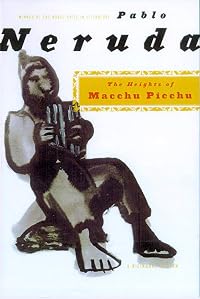
The Heights of Macchu Picchu
by Pablo Neruda
On This Page
Description
""The most important poet of the twentieth century-in any language."-Gabriel Garcia Marquez. 'The Heights of Macchu Picchu' is a poem of ascension. In its final passages, Neruda's poetry jumps from a personal hope to a global one; from a poetry dealing with the poet's heart to a poetry centered on humanity's struggles."-BBC "The Heights of Machu Picchu" has been called Pablo Neruda's greatest contribution to poetry-a search for the "indestructible, imperishable life" in all things. Inspired show more by his journey to the ancient ruins, Neruda calls the lost Incan civilization to "rise up and be born," and also empowers the people of his time. This new translation by poet Tomás Q. Morín includes an introduction by Morín and Neruda's Spanish original.I stare at the clothes and hands, the carvings of water in a sonorous hollow, the wall rubbed smooth by the touch of a face that with my eyes gazed at the earthly lights, that with my hands oiled the vanished planks: because everything, clothes, skin, dishes, words, wine, breads, went away, fell to the earth. Pablo Neruda (1904-73), one of the world's most beloved poets, was also a diplomat and member of the Chilean Senate. In 1970 he was appointed as Chile's ambassador to France; in 1971 he was awarded the Nobel Prize in Literature. Tomás Q. Morín is a poet and translator and teaches at Texas State University."-- show lessTags
Recommendations












Member Reviews
Inspired by Pablo Neruda’s journey to Machu Picchu, the Peruvian Inca city in the Andes, The Heights of Macchu Picchu is Neruda’s most famous longer poems.
The version of this poem has Spanish on one side and English on the other - mostly so you can compare the two if you’re able to read both languages. I only speak English and only know a few words in Spanish, so this wasn’t something I was able to take advantage of. But, I’m not doubting Nathaniel Tarn’s translation and believe he did the translation as true as he could.
This long poem, broken up into 11 sections, is all about life, death, and the history of Machu Picchu through the thoughts and questions of Neruda as he visits. You read about the emotions he goes through - show more from Sections II - V it’s a lot about his thoughts of death and how tired he is of the human world. Then, in Section VI, we get to Machu Picchu and he marvels at how amazing it is and how spectacular it could have been at its prime. But, we go back to sadder sections as Neruda discusses how there’s no living memory of the lives of the Ancient Incans at Machu Picchu, especially since the Incan’s had more oral history than written. He asks the river for its history in Section VIII, and then in Section X askes Machu Picchu itself its history, especially those of the slaves and poor who most likely built and made the location what it was. He calls out to the dead to allow him to be their voice so their stories are never forgotten in the last few sections.
This poem took me a bit to get through - I read it once all the way through in the evening, and then again the next afternoon after doing a bit of research. The second time around, I wrote my thoughts and connections down. That definitely helped me better understand what Neruda was talking about in certain sections, especially when calling out to the slaves and the poor of Macchu Picchu.
After reading this, I can see how this poem is marked as being one of Neruda’s most famous poems. It dives deep into the experience he had while visiting such a historical site of his heritage. show less
The version of this poem has Spanish on one side and English on the other - mostly so you can compare the two if you’re able to read both languages. I only speak English and only know a few words in Spanish, so this wasn’t something I was able to take advantage of. But, I’m not doubting Nathaniel Tarn’s translation and believe he did the translation as true as he could.
This long poem, broken up into 11 sections, is all about life, death, and the history of Machu Picchu through the thoughts and questions of Neruda as he visits. You read about the emotions he goes through - show more from Sections II - V it’s a lot about his thoughts of death and how tired he is of the human world. Then, in Section VI, we get to Machu Picchu and he marvels at how amazing it is and how spectacular it could have been at its prime. But, we go back to sadder sections as Neruda discusses how there’s no living memory of the lives of the Ancient Incans at Machu Picchu, especially since the Incan’s had more oral history than written. He asks the river for its history in Section VIII, and then in Section X askes Machu Picchu itself its history, especially those of the slaves and poor who most likely built and made the location what it was. He calls out to the dead to allow him to be their voice so their stories are never forgotten in the last few sections.
This poem took me a bit to get through - I read it once all the way through in the evening, and then again the next afternoon after doing a bit of research. The second time around, I wrote my thoughts and connections down. That definitely helped me better understand what Neruda was talking about in certain sections, especially when calling out to the slaves and the poor of Macchu Picchu.
After reading this, I can see how this poem is marked as being one of Neruda’s most famous poems. It dives deep into the experience he had while visiting such a historical site of his heritage. show less
A mythopoetic and somewhat surrealistic set of 12 cantos by Pablo Neruda, "The Heights" by one of the finest poets of the 20th Century transcends the personal/lyrical in an eloquence of vision. Neruda uses Macchu Picchu (Intentionally writing two Cs in the first word) to place himself in a larger world of history and time.
I love nearly everything I read by Neruda, but I wish that I could read Spanish better than I do so I could give a more informed review as to the quality of this translation. Nonetheless, Tomas Morin gives a workmanlike English version that is worth reading.
I love nearly everything I read by Neruda, but I wish that I could read Spanish better than I do so I could give a more informed review as to the quality of this translation. Nonetheless, Tomas Morin gives a workmanlike English version that is worth reading.
I found myself confused by many of the stanzas to this poem. I am sure that the problem is with me not the poem but I much prefer Neruda's odes.
Ratings
Members
- Recently Added By
Author Information

651+ Works 25,947 Members
Pablo Neruda was born Ricardo Eliecer Neftalí Reyes Basoalto in Ferral, Chile on July 12, 1904. In 1923 he sold all of his possessions to finance the publication of his first book, Crepusculario (Twilight), which he published under the pseudonym Pablo Neruda. Veinte Poemas de Amor y una Cancion Desesperada (Twenty Love Poems and a Song of show more Despair), which was published the following year, made him a celebrity and allowed him to stop his studies to devote himself to poetry. His other works include España en el Corazón, Canto General, Las Uvas y el Viento, and Para Nacer He Nacido. He received numerous awards including the World Peace Prize with Paul Robeson and Pablo Picasso in 1950, the Lenin Peace Prize and the Stalin Peace Prize in 1953, and the Nobel Prize for Literature for his poetry in 1971. He died of leukemia on September 23, 1973. (Bowker Author Biography) show less
Awards and Honors
Distinctions
Series
Belongs to Publisher Series
Limited Editions Club (Y:1998.2)
Work Relationships
Is contained in
Has as a commentary on the text
Has as a student's study guide
Common Knowledge
- Canonical title
- The Heights of Macchu Picchu
- Original title
- Alturas de Macchu Picchu
- Original publication date
- 1950
Classifications
- Genres
- Poetry, Fiction and Literature
- DDC/MDS
- 861.62 — Literature & rhetoric Spanish Literature Spanish poetry 20th Century 1900-1945
- LCC
- PQ8097 .N4 .A753 — Language and Literature French, Italian, Spanish and Portuguese literatures Spanish literature Provincial, local, colonial, etc. Spanish America
- BISAC
Statistics
- Members
- 387
- Popularity
- 80,698
- Reviews
- 3
- Rating
- (3.99)
- Languages
- 5 — Dutch, English, French, Japanese, Spanish
- Media
- Paper, Ebook
- ISBNs
- 18
- ASINs
- 12