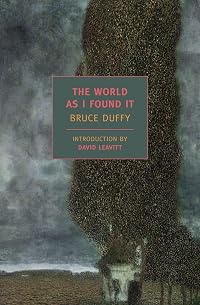
The World as I Found It
by Bruce Duffy
On This Page
Description
When Bruce Duffy's The World As I Found It was first published more than twenty years ago, critics and readers were bowled over by its daring reimagining of the lives of three very different men, the philosophers Bertrand Russell, G. E. Moore, and Ludwig Wittgenstein. A brilliant group portrait with the vertiginous displacements of twentieth-century life looming large in the background, Duffy's novel depicts times and places as various as Vienna 1900, the trenches of World War I, Bloomsbury, show more and the colleges of Cambridge, while the complicated main characters appear not only in thought and dispute but in love and despair. Wittgenstein, a strange, troubled, and troubling man of gnawing contradictions, is at the center of a novel that reminds us that the apparently abstract and formal questions that animate philosophy are nothing less than the intractable matters of life and death. show lessTags
Recommendations



























Member Recommendations
Member Reviews
Ludwig Wittgenstein is one of the most intriguing and enigmatic figures of 20th century European philosophy. And Bertrand Russell one of the most erudite, moreover an icon of rational logic. I knew that much before I started this book, and that both giants are the protagonists of course creates some expectations. But let me be clear right away: unfortunately they have not been fully met, in the end I even got a slight feeling of disappointment. Mind you, I don't want to undervalue Bruce Duffy's ‘tour de force’: he does introduce us to the rather eventful lives of both gentlemen, and makes a serious attempt to explain their philosophical (and other) work from the perspective of their life course. And it is certainly creditable that show more he uses an intermediate form between biography and fiction, which gives his story the necessary dramatic and entertaining effects. But still, I was a bit underwhelmed.
For starters, staging Bertrand Russell as the absolute opposite of Wittgenstein feels a little forced. Agreed, superficially they have were antipodes in both their work and their lives: the rationalist Russell who sought out (and got a kick out of) worldly fame, versus the complex, barely comprehensible and man-shy Wittgenstein. Duffy emphasizes the small sides of Russell very strongly: his arrogant self-righteousness, his vanity and jealousy and his womanizing are given ample attention, with the reader having difficulty suppressing some derogatory sniggering. On the other hand, he clearly puts the constantly struggling Wittgenstein on a pedestal: without discussion he is the real hero of the story, who constantly shows that Emperor Russell (and with him Western philosophy) walks without clothes. But I might be doing Duffy a little injustice here: the interaction with the apparently more colorless, more earthy philosopher George Moore is a good find to make both Wittgenstein and Russell stand out, although Moore's bedtime conversations with his wife are little more than glorified gossip.
Personally, I especially found the second part, which zooms in on Wittgenstein's traumatic experiences in the trenches of the First World War, the most interesting and the most successful. Duffy does well in explaining how Wittgenstein's foundations, which were not already made of rock, were further smashed to smithereens. That war experience – together with his complex family history and his suppressed Jewish and gay identity – seems, according to Duffy, to be the most decisive element in Wittgenstein's wayward path away from rationalistic Western philosophy. It is a pity that after this second part this book noticeably loses its suspense and even bleeds to death a bit towards the end. At that moment I also noticed that I hadn't really learned that much about the thinking of Wittgenstein and Russell. So I rate this with a rather flattering 2.5 stars, because – after all - it is about 2 giants of Western philosophy. show less
For starters, staging Bertrand Russell as the absolute opposite of Wittgenstein feels a little forced. Agreed, superficially they have were antipodes in both their work and their lives: the rationalist Russell who sought out (and got a kick out of) worldly fame, versus the complex, barely comprehensible and man-shy Wittgenstein. Duffy emphasizes the small sides of Russell very strongly: his arrogant self-righteousness, his vanity and jealousy and his womanizing are given ample attention, with the reader having difficulty suppressing some derogatory sniggering. On the other hand, he clearly puts the constantly struggling Wittgenstein on a pedestal: without discussion he is the real hero of the story, who constantly shows that Emperor Russell (and with him Western philosophy) walks without clothes. But I might be doing Duffy a little injustice here: the interaction with the apparently more colorless, more earthy philosopher George Moore is a good find to make both Wittgenstein and Russell stand out, although Moore's bedtime conversations with his wife are little more than glorified gossip.
Personally, I especially found the second part, which zooms in on Wittgenstein's traumatic experiences in the trenches of the First World War, the most interesting and the most successful. Duffy does well in explaining how Wittgenstein's foundations, which were not already made of rock, were further smashed to smithereens. That war experience – together with his complex family history and his suppressed Jewish and gay identity – seems, according to Duffy, to be the most decisive element in Wittgenstein's wayward path away from rationalistic Western philosophy. It is a pity that after this second part this book noticeably loses its suspense and even bleeds to death a bit towards the end. At that moment I also noticed that I hadn't really learned that much about the thinking of Wittgenstein and Russell. So I rate this with a rather flattering 2.5 stars, because – after all - it is about 2 giants of Western philosophy. show less
I just love this book like the good friend it is. "At the end of a life people assign it a weight or a general trend, a moral trajectory. They ask whether it was sad or happy, failed or successful, asking this as if there can be some consensus after the self as remembered is safely consigned to the common estate of history, which is ultimately everybody's destiny and therefore everybody's business. Like a willing weather, the spirit moves through time, and against its time. Thus the spirit is dry when all outside is wet, cold when all is hot and confused while all others are certain. The spirit wonders at this difference, while those outside see the spirit coming in the guise of a man and try to form an opinion of what the weather must show more be like inside, some saying calm, others saying stormy, and still others saying it is an impertinence to ask and better not to know, though in fact nobody really does. Just before he died, Wittgenstein said to Mrs. Bevans, Tell everyone that I've had a wonderful life. Of course, it wasn't like him to exaggerate, and his friends found it troubling that he would say this. To them, Wittgenstein's life seemed many things, but not wonderful, and in the end they did not know if he had merely been trying to put them at ease of if in fact he had found his troubled life wonderful. But this, in any case, is what he said." show less
It's not biography, but because it is very well researched, there's the thrill of just what is exactly true an where the fiction starts. It gets you real 'up close and personal' to a few very great but weird minds of the 20th century. Where Wittgenstein is mostly dark and tragic, tense and lonely, Russel is depicted in a sometimes quite hilarious way, adding a lighter note to the book. After reading, one thing is clear: even the great minds are just people.
a very good bio novel about wittgenstein-a very strange and trouble man, brillent but stange
History,Biography and Philosophy.The centre is Wittgenstein and his friends free- thinker Russel and Moore,a great Cambridge don.All involved in the history of WWI & WWII.
Great characterizations of the sciety at that time.
Great characterizations of the sciety at that time.
fictionalized lives of Wittgenstein and Russell
Boeiende en uitvoerige roman over de verhoudingen tussen Wittesntein, Russel en Moore in Cambridge en daarbuiten.
Erudiet en humoristisch.
Erudiet en humoristisch.
Feb 25, 2012Dutch
Members
- Recently Added By
Lists

Mustich's 1000 Books to Read Before You Die: A Life Changing List
1,001 works; 20 members
Author Information
3 Works 621 Members
Awards and Honors
Series
Belongs to Publisher Series
Common Knowledge
- Canonical title
- The World as I Found It
- Original publication date
- 1987
- People/Characters
- Ludwig Wittgenstein; Bertrand Russell; G. E. Moore
- Epigraph
- If I wrote a book called The World as I Found It, I should have to include a report on my body, and should have to say which parts were subordinate to my will, and which were not, etc., this being a method of isolating... (show all) the subject, or rather of showing that in an important sense there is no subject; for it alone could not be mentioned in that book.—
—Ludwig Wittgenstein, Tractatus Logico-Philosophicus [5.631] - Dedication
- For Marianne
- First words
- The philosopher loved the flicks, periodically needing to empty himself in that laving river of light in which he could openly gape and forget.
- Last words
- (Click to show. Warning: May contain spoilers.)Just before he died, Wittgenstein said to Mrs. Bevins, Tell everyone that I've had a wonderful life. Of course, it wasn't like him to exaggerate, and his friends found it troubling that he would say this. To them, Wittgenstein's life seemed many things, but not wonderful, and in the end they did not know if he had merely been trying to put them at ease or if in fact he had found his troubled life wonderful. But this, in any case, is what he said.
Classifications
Statistics
- Members
- 488
- Popularity
- 62,339
- Reviews
- 7
- Rating
- (4.05)
- Languages
- Dutch, English, Spanish
- Media
- Paper, Ebook
- ISBNs
- 12
- UPCs
- 1
- ASINs
- 3