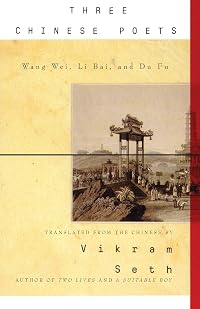
Three Chinese Poets
by Vikram Seth (Translator), Li Bai (Author), Du Fu (Author), Wang Wei (Author)
On This Page
Description
The three T'ang dynasty poets translated here are among the greatest literary figures of China, or indeed the world. Responding differently to their common times, Wang Wei, Li Bai, and Du Fu crystallize the immense variety of China and the Chinese poetic tradition and, across a distance of twelve hundred years, move the reader as it is rare for even poetry to do.Tags
Recommendations













Member Reviews
I went through to the end with this book but found only two or three spots where I enjoyed it. The translations are done in rhyme and I just can't take it. I recommend Ryokan's One Robe, One Bowl over this.
Ratings
Members
- Recently Added By
Author Information


Wang Wei is an exceptionally visual poet, and in reading his descriptions of the play of light over forest and moss, or the reflection of bamboos in a meandering stream, we can easily accept that in his lifetime he was known as much for his paintings as for his verse. In fact, there is some evidence to suggest that he was the first to paint show more landscapes on long horizontal scrolls, an innovation that brought much greater scope and complexity to Chinese painting. Originally written to accompany such a scroll of unfolding landscapes along the river is a series of poems, the "Wang River Sequence," in which Wang Wei writes of scenes near his country estate in Lan-t'ien (a day's journey in his time from the capital in Ch'ang-an). Unfortunately, though the poems survive, the paintings do not. Wang Wei had the best pedigree of all of the greatest T'ang poets. His father hailed from the T'ai-yuan (Shensi) Wang clan, one of the most powerful in the capital region, and his mother was a Ts'ui, an equally old and prominent family of accomplished literati. Therefore, it is not surprising that his talents were noticed early and that he passed the highest examinations when he was only 23. His career, however, was not outstanding. He served on and off in a number of modest posts, interspersed with periods of retirement at his beloved estate. What distinguishes Wang is that this failure to rise to high position was probably largely his own choice. While he did not shun the court and politics for the life of a total recluse, he also did not strive. He was a devout Buddhist and seems to have had as strong a pull toward passive contemplation as toward active involvement. It is his Buddhist inclinations which inspire Wang Wei's poetry; he loves natural imagery as a focus of contemplation, but it is a means for him of reaching integration and harmony with the universe and not merely an end in itself. (Bowker Author Biography) show less
Common Knowledge
- Original publication date
- 1992
Classifications
- Genres
- Poetry, Fiction and Literature
- DDC/MDS
- 895.1 — Literature & rhetoric Literatures of other languages Literatures of East and Southeast Asia Chinese
- LCC
- PL2658 .E3 .T46 — Language and Literature Languages and literatures of Eastern Asia, Africa, Oceania Languages of Eastern Asia, Africa, Oceania Chinese language and literature Chinese literature Collections
- BISAC
Statistics
- Members
- 147
- Popularity
- 223,667
- Reviews
- 1
- Rating
- (3.53)
- Languages
- English
- Media
- Paper, Ebook
- ISBNs
- 9
- ASINs
- 1