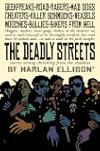
The Deadly Streets
by Harlan Ellison
On This Page
Description
Terrifying tales of teenage gangs and life on the mean streets from the multiple award-winning author of A Boy and His Dog. Remember Charles Bronson stalking the streets of New York blowing holes in muggers in Death Wish? Remember Glenn Ford standing off the vicious juvenile delinquents in Blackboard Jungle? Well, it is more than fifty years and two different worlds from 1955 to now. And something the author of these stories knows that you are scared to admit is that reality and fantasy show more have flip‑flopped. They have switched places. The stories that scare you today are the ones about rapists and thugs, psychos who will carve you for a dollar and hypes who will bust your head to get fixed. Glenn Ford's world was yesterday, and Bronson's is today. And in the stalking midnight of this book, one of America's top writers, Harlan Ellison, invades the shadows of both! show lessTags
Recommendations















Member Reviews
A set of very minor 1950s stories from Ellison, published in various less than stellar detective magazines, and even in a Men's magazine, some under pseudonyms, and a couple co-written with Robert Silverberg and Henry Slesar. The subject matter is almost invariably doomed young gang members, with a few welcome variations. While this isn't a collection to read one story after another, it is enjoyable. It is a lot more straightforward than the science fiction that made Ellison a household name (at least among science fiction writers.) This book is the work of a professional writer, churning out story after story as quickly as he could to make a living. It is a mark of Ellison's ability that despite their simplicity, there is hardly a show more false note or a bad sentence in the collection. Ellison's new introduction makes more of the stories than they are - but it is quite interesting. Written in 1983 when New York City was much more crime-ridden than in the era (1958) when The Deadly Streets was first published, it is an angry, overdone exercise in paranoia and catharsis. show less
HE can put himself in the mind of a New York street kid with violent tendencies very easily. This is a collection that first saw the book racks as an Ace paperback in 1958. It sold for 35 cents. When you couple it with "The Last Exit to Brooklyn", you have the canon as regards pre-druglord gang life. The prose is excellent, and the images it leaves you with are vivid.
For ten weeks in the early 1950s, Harlan Ellison joined a notorious Brooklyn street gang known as the Barons as part of his research for his first novel, Web of the City and later, his crime collection, The Deadly Streets.
The first edition of The Deadly Streets was released in 1958 and contained 11 hard-boiled tales about teenage street gangs. The book was re-released in 1975 with an additional five crime stories, some written in collaboration with other writers including “Ship-Shape Pay-Off” with Robert Silverberg and “Sob Story” Henry Slesar.
What sets these additional five stories apart from the original 11 is that they are much shorter and completely unrelated to the theme of teenage street gangs. Rather, they tend to focus show more on mob hits (“The Man with the Golden Tongue”), revenge (“Rat Hater”, “Hippie Slayer”) and personal vendettas (the aforementioned “Ship-Shape Pay-Off”). “Sob Story” is the weakest of the lot and barely qualifies
My personal favorites from the collection include “We Take Care of our Dead,” “The Man with the Golden Tongue,” “Johnny Slice’s Stoolie,” “Buy Me That Blade,” “Hippie Slayer,” “With a Knife in Her Hand,” “Dead Shot,” and “Students of the Assassin.”
Although the slang is outdated and the depictions of violence mild by today’s standards, each of the original 11 tales present a vivid snapshot of the bloody and ruthless street gang culture of 1950s New York. show less
The first edition of The Deadly Streets was released in 1958 and contained 11 hard-boiled tales about teenage street gangs. The book was re-released in 1975 with an additional five crime stories, some written in collaboration with other writers including “Ship-Shape Pay-Off” with Robert Silverberg and “Sob Story” Henry Slesar.
What sets these additional five stories apart from the original 11 is that they are much shorter and completely unrelated to the theme of teenage street gangs. Rather, they tend to focus show more on mob hits (“The Man with the Golden Tongue”), revenge (“Rat Hater”, “Hippie Slayer”) and personal vendettas (the aforementioned “Ship-Shape Pay-Off”). “Sob Story” is the weakest of the lot and barely qualifies
My personal favorites from the collection include “We Take Care of our Dead,” “The Man with the Golden Tongue,” “Johnny Slice’s Stoolie,” “Buy Me That Blade,” “Hippie Slayer,” “With a Knife in Her Hand,” “Dead Shot,” and “Students of the Assassin.”
Although the slang is outdated and the depictions of violence mild by today’s standards, each of the original 11 tales present a vivid snapshot of the bloody and ruthless street gang culture of 1950s New York. show less
Ratings
Members
- Recently Added By
Author Information

583+ Works 30,509 Members
Harlan Ellison was born in Cleveland, Ohio on May 27, 1934. He was the author of numerous short story collections including Strange Wine; The Beast that Shouted Love at the Heart of the World; Harlan Ellison's Watching; Deathbird Stories; Repent Harlequin! Said the Ticktockman; I Have No Mouth and I Must Scream; and Stalking the Nightmare: Stories show more and Essays. He received numerous awards including the Hugo Award, the Nebula Award, the Bram Stoker Award, the Lifetime Achievement Award from the Horror Writer's Association, the Edgar Allen Poe Award, and the Grand Master Award for lifetime achievement from the Science Fiction and Fantasy Writers of America. He was inducted into the Science Fiction Hall of Fame in 2011. He published two collections of his columns on television for the Los Angeles Free Press entitled The Glass Teat and The Other Glass Teat. He edited several anthologies including Dangerous Visions: 33 Original Stories and Medea: Harlan's World. He received the Milford Award for Lifetime Achievement in Editing. He also wrote scripts for TV series including Burke's Law, The Alfred Hitchcock Hour, Voyage to the Bottom of the Sea, and The Man from U.N.C.L.E. He served as creative consultant on the new version of The Twilight Zone in the 1980s and as conceptual consultant on Babylon 5. He won the Writer's Guild of America's Award for Most Outstanding Teleplay four times. He died on June 27, 2018 at the age of 84. (Bowker Author Biography) show less
Some Editions
Work Relationships
Is contained in
Contains
Common Knowledge
- Original publication date
- 1958
- Dedication
- in loving memory of My Father
Louis Laverne Ellison
Classifications
Statistics
- Members
- 231
- Popularity
- 140,467
- Reviews
- 3
- Rating
- (3.31)
- Languages
- English
- Media
- Paper, Ebook
- ISBNs
- 9
- ASINs
- 3