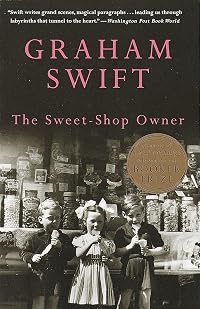
The Sweet Shop Owner
by Graham Swift
On This Page
Description
The Sweet-Shop Owner is set during a single June day in the life of an outwardly unremarkable man whose inner world proves to be exceptionally resonant. As he tends to his customers, Willy Chapman, the sweet-shop owner, confronts the specters of his beautiful and distant wife and his clever, angry daughter, the history through which he has passed, and the great, unrequited passion that has tormented him for forty years.Tags
Recommendations




















Member Recommendations
Member Reviews
I have no recollection of having read this back in 1987. Just read this strong, striking novel again.
On one day in the life of Willy Chapman, the sweet-shop owner we learn how deep but sad love can be.
And of the consequences of family silence. Irene always felt alone in her comfortable family as the beautiful only daughter with haughty expectations from her mother and father. Naive and vulnerable she tried explaining to her mother what had occurred during a date with a well-off local young man. But her mother would have none of it and so Irene kept the pain trapped inside where it did her and those around her irreparable damage. Her family saw her change and were relieved to marry her off to slow but stable Willy who felt happy and show more blessed to have wooed and won Irene. And felt glad Irene took charge of him and that her family gifted him with a sweet-shop of his own. Before long she would suffer from asthmatic episodes which kept him from revealing his need or pain. Slowing learning that Irene while intelligent could never be happy; he continued to do what was expected of him day in and out because he loved her and hoped that one day she would return his love.
When their daughter was born Willy hoped that motherhood would soften Irene; get her to feel love, enthusiasm and life but again soon he was disappointed realizing that Irene was going through the motions of wife and mother and could not demonstrate love. When Dorry was young they did go on some outings but soon even that normalcy stopped. And while Irene's health deteriorated, Dorry grew up not understanding why her mother was cold and distant, and only Willy could show her affection and nurture her. But Willy knew she grew to resent both of them and before long she moved out focussing on her education, and communicating with them only in brief spurts.
Every family has their own personality and dynamics. Only Willy's genuine love for his wife and daughter redeem the Chapman family but because Willy followed Irene's expectations, and didn't insist on change or healing, it wasn't enough to hold the family together in harmony if not happiness.
Why didn't Willy voice his emotions? Did he feel Irene wouldn't be able to handle them? And how could he explain to Dorry why their home was so unusual when he himself didn't understand?
Wonderful characterizations throughout; the sparse dialogue speaks volumes, and the many snapshots of a family in distress highlight Willy's innocence and unconditional love throughout his marriage and Irene's depression. show less
On one day in the life of Willy Chapman, the sweet-shop owner we learn how deep but sad love can be.
And of the consequences of family silence. Irene always felt alone in her comfortable family as the beautiful only daughter with haughty expectations from her mother and father. Naive and vulnerable she tried explaining to her mother what had occurred during a date with a well-off local young man. But her mother would have none of it and so Irene kept the pain trapped inside where it did her and those around her irreparable damage. Her family saw her change and were relieved to marry her off to slow but stable Willy who felt happy and show more blessed to have wooed and won Irene. And felt glad Irene took charge of him and that her family gifted him with a sweet-shop of his own. Before long she would suffer from asthmatic episodes which kept him from revealing his need or pain. Slowing learning that Irene while intelligent could never be happy; he continued to do what was expected of him day in and out because he loved her and hoped that one day she would return his love.
When their daughter was born Willy hoped that motherhood would soften Irene; get her to feel love, enthusiasm and life but again soon he was disappointed realizing that Irene was going through the motions of wife and mother and could not demonstrate love. When Dorry was young they did go on some outings but soon even that normalcy stopped. And while Irene's health deteriorated, Dorry grew up not understanding why her mother was cold and distant, and only Willy could show her affection and nurture her. But Willy knew she grew to resent both of them and before long she moved out focussing on her education, and communicating with them only in brief spurts.
Every family has their own personality and dynamics. Only Willy's genuine love for his wife and daughter redeem the Chapman family but because Willy followed Irene's expectations, and didn't insist on change or healing, it wasn't enough to hold the family together in harmony if not happiness.
Why didn't Willy voice his emotions? Did he feel Irene wouldn't be able to handle them? And how could he explain to Dorry why their home was so unusual when he himself didn't understand?
Wonderful characterizations throughout; the sparse dialogue speaks volumes, and the many snapshots of a family in distress highlight Willy's innocence and unconditional love throughout his marriage and Irene's depression. show less
Swift’s writing is beautifully restrained while perfectly descriptive. He doesn’t spell out every action or word spoken yet the reader understands the circumstances exactly. The sweet shop owner, Willy Chapman, relives his past in the course of one day. The voices of his wife, Irene, and his shop assistants occasionally cut in, providing details of which Chapman is unaware. It’s a quiet, moving story that was a pleasure to read.
I admire this deceptively simple novel. Told almost entirely from the sweet-shop owner's mild point of view, with occasional interruptions from three women: his wife--so that we learn something about her past that he has never known; and his shop assistants. The language is restrained, descriptive, evocative, and the attitudes thoroughly English at all times. I'll be looking for other works by the author, who won the Booker Prize for "Last Orders". So glad I stumbled upon this gem.
The Sweet Shop Owner tells the story of the last day in the life of Willy Chapman. On this day, which has all the outward appearances of any other day, Willy must come to terms with his employees, his rebellious daughter, and his frigid but beautiful wife.
The book is told in the first person and starts in the early morning following the day's events. While the day happens in chronological order, the tale is frequently interrupted by flashbacks and remembrances of a difficult past. At several points the text steps away from Willy and assumes the voice of his dead wife Irene.
Irene is beautiful but seems to resent her beauty and marries Willy to avoid the larger problems with her possessive and domineering family. Shortly after the show more marriage she retreats into growing illness, eventually becoming an invalid. In an attempt to buy off Willy's love she buys him a shop and makes sure that he is kept busy with running the business. Out of a sense of duty she grants Willy a child, Dorothy. Dorry can sense that her mother resents her and her father is unable to understand her emotions and intelligence, differences that neither are ever able to reconcile.
The book is also the story of a small London suburb as it grows from the devastation of WWII into modern times with not unexpected growing pains. The High Street shops evolve from family operations into corporate enterprises and along the way lose a great deal of their humanity. The evolution of the street is depicted especially well by the real estate office of Hancock, Joyce, and Jones. As the patriarchal owner of the store grows too old to run it (and eventually dies) the names on the door shift and Hancock attempts to expand it into a chain of realty stores. The only thing that remains constant through all of the change is Willy's devotion to his own store, the only way that he is allowed to demonstrate his love for Irene.
There is a subplot to the novel involving two of Willy's employees, the jealous middle-aged Mrs. Cooper and the teen-aged Sandra. The two fight for Mr. Chapman's attentions.
The novel is largely about the choices that we all make in life and how the past not only for ourselves but those around us, however much we might not wish it to, affects our present and future choices. In many respects it is a tale of how differing generations trying to break away from our predecessors influence to make our own way in life. The book is beautifully written and very touching but not overly sentimental. This was the first novel by the author and whilst not as good as his novels Waterland and Last Orders but still well worth reading. show less
The book is told in the first person and starts in the early morning following the day's events. While the day happens in chronological order, the tale is frequently interrupted by flashbacks and remembrances of a difficult past. At several points the text steps away from Willy and assumes the voice of his dead wife Irene.
Irene is beautiful but seems to resent her beauty and marries Willy to avoid the larger problems with her possessive and domineering family. Shortly after the show more marriage she retreats into growing illness, eventually becoming an invalid. In an attempt to buy off Willy's love she buys him a shop and makes sure that he is kept busy with running the business. Out of a sense of duty she grants Willy a child, Dorothy. Dorry can sense that her mother resents her and her father is unable to understand her emotions and intelligence, differences that neither are ever able to reconcile.
The book is also the story of a small London suburb as it grows from the devastation of WWII into modern times with not unexpected growing pains. The High Street shops evolve from family operations into corporate enterprises and along the way lose a great deal of their humanity. The evolution of the street is depicted especially well by the real estate office of Hancock, Joyce, and Jones. As the patriarchal owner of the store grows too old to run it (and eventually dies) the names on the door shift and Hancock attempts to expand it into a chain of realty stores. The only thing that remains constant through all of the change is Willy's devotion to his own store, the only way that he is allowed to demonstrate his love for Irene.
There is a subplot to the novel involving two of Willy's employees, the jealous middle-aged Mrs. Cooper and the teen-aged Sandra. The two fight for Mr. Chapman's attentions.
The novel is largely about the choices that we all make in life and how the past not only for ourselves but those around us, however much we might not wish it to, affects our present and future choices. In many respects it is a tale of how differing generations trying to break away from our predecessors influence to make our own way in life. The book is beautifully written and very touching but not overly sentimental. This was the first novel by the author and whilst not as good as his novels Waterland and Last Orders but still well worth reading. show less
A touching, well paced book that examines the personal tragedies of a married couple and their daughter. The wife, Irene had been raped by a friend of her brothers, blighting her capacity to live and love.
Her marriage to Willy Chapman is overshadowed by this event.
Graham Swift is a champion writer,
Her marriage to Willy Chapman is overshadowed by this event.
Graham Swift is a champion writer,
A bit of a laboured novel, but has a lovely sense of time and place - so typical of Swift's novels.
This is the story of a simple life and a marriage and a family. It made me ponder the complexities of relationships and how they work. A quiet beautiful read.
Members
- Recently Added By
Published Reviews
There is a touch of Joyce in Graham Swift's revelation of the hidden poetry of small men's lives, and ''The Sweet-Shop Owner'' joins ''Waterland'' in establishing him as one of the brightest promises the English novel has now to offer.
added by KayCliff
Author Information

21+ Works 10,727 Members
British novelist Graham Swift was born in London on May 4, 1949. He attended Cambridge University and York University. Swift has written five novels, including Waterland. (Bowker Author Biography) Novelist Graham Swift was born in London, England on May 4, 1949. He attended Cambridge University where he received a B.A. in 1970, and an M.A. in show more 1975. He also attended York University from 1970-73. He taught English part time at several London Colleges between the years 1974 to1983. Swift's fiction tends to touch upon the subject of World War II as well as exploring the larger subject of history. "Waterland" established Swift's reputation and was made into a major film. He also wrote "Last Orders" and his novels have won a variety of prestigious literary awards and have been widely translated. Swift was an avid fisherman and co-edited an anthology of fishing in literature. (Bowker Author Biography) show less
Common Knowledge
- Original publication date
- 1980
- People/Characters
- Willy Chapman; Irene Chapman
- First words
- "In the end." "In the end"? What did she mean -- in the end he would see?
- Quotations
- He didn't read [newspapers], but he liked them. Their columns, captions and neat gradations of print. The world's events were gathered into those patterns.
Classifications
Statistics
- Members
- 309
- Popularity
- 103,424
- Reviews
- 9
- Rating
- (3.49)
- Languages
- English
- Media
- Paper, Audiobook, Ebook
- ISBNs
- 23
- ASINs
- 3