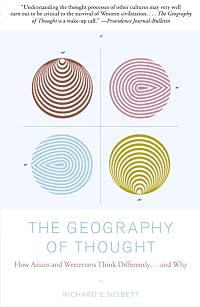
The Geography of Thought: How Asians and Westerners Think Differently...and Why
by Richard E. Nisbett
On This Page
Description
A professor of psychology examines the divergent ways in which eastern and western cultures view the world, offering suggestions about how today's interdependent global cultures may be bridged.Tags
Recommendations





Member Recommendations
Member Reviews
A thought too far. The author's overreach condemns this book to mediocrity. He is a psychology professor dabbling in philosophy, an American who proclaims to speak for "the West" who stuffs his (quite interesting) experimental evidence of cultural differences with half-baked, unscientific explanations.
The first flaw is his cafeteria approach in picking some elements of the Ancient Greeks (that fit his personal world view) to somehow define the Western mind. It would be quite difficult to authenticate the transmission mechanism that instills his Midwestern children and students with his Aristotlean perspective, especially as a majority of the US public does not exactly fit into his supposedly rational paradigm. After all, evolution is show more just a theory, right?
He commits the same error of discarding evidence that does not fit his preconceptions, when his concept of Westerners excludes Europeans and the "not real Americans" African-Americans and Hispanics when their answers do not fit into his preferred box. When women do not answer "correctly", they are discarded also. This leaves the essence of Westerness in the form of Midwestern white Americans (if his subjects were not students, I venture to say that his ideal Westerners are middle-aged, white professors). Curiously, this selectiveness does not occur on the other side. He is perfectly willing to lump Koreans, Chinese and Japanese into a giant lump of Asians who all share the same characteristics and behavior.
His bias often taints his experimental examples as his implicit American judgments color the "correctness" of the answers. The different Asian answer might be due less to cultural than political differences. There are places in this world where stricter health codes (and unions) are valued. A more Popperian approach would have curbed his confirmation bias and removed some of his logical fallacies. A discussion of the Western concepts of homo oeconomicus and homo sociologicus might have improved his cultural mental map. What remains is the repetition of the cliché of Asian holism and Western individualism. He ends his book with a wish for a cultural "stew that will contain the best of each culture". Apart from the fact that this stew can only be achieved by giving up the individualistic part, I don't believe that those that share his concept of WASP Westerness will be very enchanted by this dish. show less
The first flaw is his cafeteria approach in picking some elements of the Ancient Greeks (that fit his personal world view) to somehow define the Western mind. It would be quite difficult to authenticate the transmission mechanism that instills his Midwestern children and students with his Aristotlean perspective, especially as a majority of the US public does not exactly fit into his supposedly rational paradigm. After all, evolution is show more just a theory, right?
He commits the same error of discarding evidence that does not fit his preconceptions, when his concept of Westerners excludes Europeans and the "not real Americans" African-Americans and Hispanics when their answers do not fit into his preferred box. When women do not answer "correctly", they are discarded also. This leaves the essence of Westerness in the form of Midwestern white Americans (if his subjects were not students, I venture to say that his ideal Westerners are middle-aged, white professors). Curiously, this selectiveness does not occur on the other side. He is perfectly willing to lump Koreans, Chinese and Japanese into a giant lump of Asians who all share the same characteristics and behavior.
His bias often taints his experimental examples as his implicit American judgments color the "correctness" of the answers. The different Asian answer might be due less to cultural than political differences. There are places in this world where stricter health codes (and unions) are valued. A more Popperian approach would have curbed his confirmation bias and removed some of his logical fallacies. A discussion of the Western concepts of homo oeconomicus and homo sociologicus might have improved his cultural mental map. What remains is the repetition of the cliché of Asian holism and Western individualism. He ends his book with a wish for a cultural "stew that will contain the best of each culture". Apart from the fact that this stew can only be achieved by giving up the individualistic part, I don't believe that those that share his concept of WASP Westerness will be very enchanted by this dish. show less
I was an Asian history major once upon a time and have at least imbibed some literature on the differences between Asian and Western culture. Often I think people overstate differences and end up repeating generalizations which are not helpful, thoughtful or insightful. This book is different. Richard Nisbett reports data based on numerous studies to demonstrate how East and West process things differently. Easterners see contexts and relationships more (no surprise). They are also better at holding apparent contradictions and dialectical reasoning. Westerners are better at seeing logic and uniqueness. What is fascinating about this, is that Nisbett is able to demonstrate that Asians and Westerners see the world differently, emphasize show more different things, which accounts for different outcomes. He doesn't advocate the superiority of either but rather suggests that listening and learning from the other can be mutually beneficial.
On the critical side, I think Nisbett is great when he is talking about his own research (most of the book). He is less compelling and overly simplistic when he tries to give an account of historic reasons for the difference (beginning of book). Also because this book is really a report on various studies and research, it is not a page turner. Nisbett tends to be a bit repetitive and circles back to the same themes. I borrowed a library copy and read it a little at a time (often weeks between chapters). Still the information is facinating if you want to take a deeper look at how people think.
I am interested in what the results of his studies would be in a place like a Hawaii (whose culture is more Asian than not). At several points, Nisbett points out where Asian Americans (usually 2nd Gen) will sometimes respond like an Asian or sometimes like the typical westerner. I feel like there would be interesting data here too. show less
On the critical side, I think Nisbett is great when he is talking about his own research (most of the book). He is less compelling and overly simplistic when he tries to give an account of historic reasons for the difference (beginning of book). Also because this book is really a report on various studies and research, it is not a page turner. Nisbett tends to be a bit repetitive and circles back to the same themes. I borrowed a library copy and read it a little at a time (often weeks between chapters). Still the information is facinating if you want to take a deeper look at how people think.
I am interested in what the results of his studies would be in a place like a Hawaii (whose culture is more Asian than not). At several points, Nisbett points out where Asian Americans (usually 2nd Gen) will sometimes respond like an Asian or sometimes like the typical westerner. I feel like there would be interesting data here too. show less
This is an important work in the undermining of the universalism that has afflicted private discourse and public policy in the West since the age of Plato.
Nisbett explores a simple issue - whether, how and why East Asians and Americans (though he insists on referring to them as Westerners) think in different ways.
It is more exploratory than decisive. There is no psychological experiment that is not contingent in time and space by the very nature of its subject matter but much of his material is persuasive.
In essence, Nisbett is suggesting that East Asians in general and Americans more particularly have different modes of thought and different ways of seeing the world that inform their actions.
The implications are important in show more international relations but also in the types of respect we accord the 'other'.
The book dates from 2003 and, of course, is a thesis not a proof. It demands more research from a social science perspective but anyone involved in inter-cultural relations does not have to wait on the intellectuals.
Common sense and praxis teaches us that, while the situation is always as variable as the number of persons in the world, systems do approach problems in different ways that are fundamentally cultural.
There is, of course, little or no evidence (perhaps some at the margins in rare cases not covered in this book) that actual brain structures have evolved differently. This is not the issue by any means.
Nisbett's evidence seems to suggest quite the contrary - that people from one culture aculturate to the norms of thought of another with some ease if obliged to by circumstances.
This leads to an interesting short debate at the end about the degree to which one mode of thought (Western or East Asian) is functionally superior. It also raises questions about the benefits of cultural hybridisation that he does not address.
Naturally, there is no simple answer to 'superiority' because the types of situation that humans find themselves in could suggest an either/or or perhaps a neither/nor. Nisbett does not look into European distinctiveness, 'Latin' or Russian or African thought processes.
However, what is clear is that, once we accept one simple universal - the huge variability in problem-solving and ways of seeing the world - most of the other claimed universals start to disappear.
A paradox intrudes here. The lack of universalism in ways of seeing and thinking reinforces mutual respect at the most basic level of humanity - we really are all equal just differently circumstanced.
It also condemns all forms of aggressive mental imperialism and forces each side to adapt to the other if it wants to solve a problem involving both.
Again, we must say that Nisbett is hypothesising for further research and the social sciences are not like the hard sciences in that they are contingent and probabilistic. We must always be cautious.
We are currently in the middle of a series of crises where international relations has not yet caught up with these findings. There is often a thirty year lag between knowing amongst the few and doing amongst the many.
Most senior American policymakers, for example, are still embedded in the enlightenment liberal universalism of their schooling in the 1970s and 1980s.
The result has been the twin lunacies of multiculturalism (which is patronising) and the exports of rights ideology, sometimes through the barrel of a gun.
The last has been a consistent foreign policy disaster where it is clear that its proponents are inadequately equipped to understand why. They simply continue, creating negative reactions that undermine their own security.
The coup in Egypt and the protests in Turkey that are happening as I write this suggest that there is no simple equation between rights, democracy and freedom where democracy simply aids the arrival of obscurantism and authoritarian soldiers may be defenders of freedom.
The Middle East is distinctive but it still part of the 'Western sphere' but East Asia is different again. Relations between China and its neighbours and between China and America are probably of far more global significance even than protection of Israel and energy flows.
Nisbett's research and that of others - Nisbett has also done important work on honour cultures which could usefully inform strategy in relation to the Arab world - must now be working through the system.
The rethinking of 'universalism' should start to inform the more intelligent Westerners within a decade or two. Sadly, a lot of people may have to die before it gets to the sort of person who may be President in 2016 or, more likely, 2020.
If so, however, we may see some interesting changes in approach, especially to negotiations - continued differences of ambition, stance and opinion but mutual appropriations of method, especially when use of artificial intelligence is added to the analytical pot.
It is my own belief that the difference between, say, European and American culture is no less significant in the long term and that constant hybridisation of cultural forms, far from creating the future prospect of universalisation of culture, promises the exact opposite - almost infinite variation and 'difference'.
I see this in my own family - difference within a common core way of seeing. More widely, this owes a great deal to the sheer range of mental inputs provided by the internet.
The way that the internet 'ennobles' difference that might have been forced into a 'norm' within more rigid cultural systems - whether Western or other - is liberatory in a way that elites seem unable to cope with because their mental models belong to the past already.
This all suggests that the human mid-century will be very different, not merely from the age of competing ideologies but also from the now-rapidly degenerating age of imperial liberal universalism.
There are universal values - mutual respect, equality of persons, very basic aspirations (not rights which are after the fact inventions), maybe one or two clear rights (to cognitive freedom, the means to live reasonably well and a good death) - but these are surprisingly few.
We just need a generation of rigid thinkers, raised on post-Marxism and the rejection of Marxism, to move on and for genuinely liberal minds to resist the reactionary rise of past obscurantisms and let them die out of their own accord with prosperity and education.
As for the book, it is obviously recommended but be aware, as a general reader, that the central sections are rather dry accounts of psychological and social scientific experimentation that it will be hard to evaluate if you are a layman or laywoman. show less
Nisbett explores a simple issue - whether, how and why East Asians and Americans (though he insists on referring to them as Westerners) think in different ways.
It is more exploratory than decisive. There is no psychological experiment that is not contingent in time and space by the very nature of its subject matter but much of his material is persuasive.
In essence, Nisbett is suggesting that East Asians in general and Americans more particularly have different modes of thought and different ways of seeing the world that inform their actions.
The implications are important in show more international relations but also in the types of respect we accord the 'other'.
The book dates from 2003 and, of course, is a thesis not a proof. It demands more research from a social science perspective but anyone involved in inter-cultural relations does not have to wait on the intellectuals.
Common sense and praxis teaches us that, while the situation is always as variable as the number of persons in the world, systems do approach problems in different ways that are fundamentally cultural.
There is, of course, little or no evidence (perhaps some at the margins in rare cases not covered in this book) that actual brain structures have evolved differently. This is not the issue by any means.
Nisbett's evidence seems to suggest quite the contrary - that people from one culture aculturate to the norms of thought of another with some ease if obliged to by circumstances.
This leads to an interesting short debate at the end about the degree to which one mode of thought (Western or East Asian) is functionally superior. It also raises questions about the benefits of cultural hybridisation that he does not address.
Naturally, there is no simple answer to 'superiority' because the types of situation that humans find themselves in could suggest an either/or or perhaps a neither/nor. Nisbett does not look into European distinctiveness, 'Latin' or Russian or African thought processes.
However, what is clear is that, once we accept one simple universal - the huge variability in problem-solving and ways of seeing the world - most of the other claimed universals start to disappear.
A paradox intrudes here. The lack of universalism in ways of seeing and thinking reinforces mutual respect at the most basic level of humanity - we really are all equal just differently circumstanced.
It also condemns all forms of aggressive mental imperialism and forces each side to adapt to the other if it wants to solve a problem involving both.
Again, we must say that Nisbett is hypothesising for further research and the social sciences are not like the hard sciences in that they are contingent and probabilistic. We must always be cautious.
We are currently in the middle of a series of crises where international relations has not yet caught up with these findings. There is often a thirty year lag between knowing amongst the few and doing amongst the many.
Most senior American policymakers, for example, are still embedded in the enlightenment liberal universalism of their schooling in the 1970s and 1980s.
The result has been the twin lunacies of multiculturalism (which is patronising) and the exports of rights ideology, sometimes through the barrel of a gun.
The last has been a consistent foreign policy disaster where it is clear that its proponents are inadequately equipped to understand why. They simply continue, creating negative reactions that undermine their own security.
The coup in Egypt and the protests in Turkey that are happening as I write this suggest that there is no simple equation between rights, democracy and freedom where democracy simply aids the arrival of obscurantism and authoritarian soldiers may be defenders of freedom.
The Middle East is distinctive but it still part of the 'Western sphere' but East Asia is different again. Relations between China and its neighbours and between China and America are probably of far more global significance even than protection of Israel and energy flows.
Nisbett's research and that of others - Nisbett has also done important work on honour cultures which could usefully inform strategy in relation to the Arab world - must now be working through the system.
The rethinking of 'universalism' should start to inform the more intelligent Westerners within a decade or two. Sadly, a lot of people may have to die before it gets to the sort of person who may be President in 2016 or, more likely, 2020.
If so, however, we may see some interesting changes in approach, especially to negotiations - continued differences of ambition, stance and opinion but mutual appropriations of method, especially when use of artificial intelligence is added to the analytical pot.
It is my own belief that the difference between, say, European and American culture is no less significant in the long term and that constant hybridisation of cultural forms, far from creating the future prospect of universalisation of culture, promises the exact opposite - almost infinite variation and 'difference'.
I see this in my own family - difference within a common core way of seeing. More widely, this owes a great deal to the sheer range of mental inputs provided by the internet.
The way that the internet 'ennobles' difference that might have been forced into a 'norm' within more rigid cultural systems - whether Western or other - is liberatory in a way that elites seem unable to cope with because their mental models belong to the past already.
This all suggests that the human mid-century will be very different, not merely from the age of competing ideologies but also from the now-rapidly degenerating age of imperial liberal universalism.
There are universal values - mutual respect, equality of persons, very basic aspirations (not rights which are after the fact inventions), maybe one or two clear rights (to cognitive freedom, the means to live reasonably well and a good death) - but these are surprisingly few.
We just need a generation of rigid thinkers, raised on post-Marxism and the rejection of Marxism, to move on and for genuinely liberal minds to resist the reactionary rise of past obscurantisms and let them die out of their own accord with prosperity and education.
As for the book, it is obviously recommended but be aware, as a general reader, that the central sections are rather dry accounts of psychological and social scientific experimentation that it will be hard to evaluate if you are a layman or laywoman. show less
The TLDR of this is that 1. I wish I'd read it when it was newer. 2. I kept marking passages with bookdarts. 3. I kept talking about it to my husband and 25 yo son, who are also intrigued. 4. I recommend it, if you can read it as something to think about (as he intended) instead of as if it's a textbook statement with all the answers.
---
Thoughts as I go along first:
People have different points of view, but also surprisingly different strategies for problem solving. And learning from each other is a good thing not only for better communication but for more tools to help us with the big problems of climate change, world peace, etc.
Common sense isn't common because there's less universality to human nature than many assume.
One can make the show more divider East/West as he justifiably does. And/or one can recognize, as I do, the traits within groups of ppl within the US, for example ppl who identify as moderate are more like the East in that they are after a Middle Way and understand that context & harmony are important, whereas extremists (liberal or conservative both) are more like the West in that ambition is more individuated.
Lots of support for the author's position: anecdotes plus studies plus history...
But not counter-examples, not actual arguments to explain exceptions we might see, other fallacies.... Well, except for little bits, including a Note re' p. 170 that is interesting, & that concludes "I have no idea why."
I found it an engaging, accessible read... but there are a few bits that get a bit too academic (so I just had to keep going past them) and there's some repetition.
I note that our reading of diverse (esp. children's) literature needs to take these things into account, like the extended family that dotes on little East Asian children is teaching them harmony not spoiling them, and the second-generation Chinese immigrants break their grannies' hearts because they're not just sort of different, but to the core don't understand independence/interdependence.
In some respects it's stuff we've been thinking about for years/forever. In [b:Shield|13171873|Shield|Poul Anderson|https://i.gr-assets.com/images/S/compressed.photo.goodreads.com/books/1333331210l/13171873._SY75_.jpg|2421957], by [a:Poul Anderson|32278|Poul Anderson|https://images.gr-assets.com/authors/1218818842p2/32278.jpg], from 1963, for example, we have a character (probably speaking for the author), say, "Man is not capable of being an autonomous individual.... He needs to be part of a whole culture, with duties as well as privileges." But Nisbett brings the idea front & center, making us think it about it hard enough to see it clearly enough to be able to incorporate into our understanding of human nature & how the world works.... Well, at least those of us who read the book... which I hope is lots of people!
Note that he's not saying every Chinese person thinks only about hierarchy and contextual harmony, and every American is obedient to pure logic of separate ambitions or whatever. But my musings lead me to suggest: I bet if he did interviews of respective subjects he'd discover that more East Asians think it might be cool to live as a member of a bee colony and that more Americans & northern Europeans would get the willies at the thought.
Another thing I'm personally getting out of this is one of the reasons I don't fit in, in a lot of ways, in communities in the US. I am already more Zen than a lot of people who pay to go on yoga retreats. I'm not into dog-eat-dog, or rat-race, or winner vs. loser, or revenge. I am much more into one w/nature, we're all in this together, let's work towards a win-win. (But I admit, I do like formal Aristotelian logic.)
---
Ok done. I found the speech to text function on my PC so Imagonna give you *all* my bookdarts right now:
“There is an adage holding that every Chinese is a Confucianist when he is successful and a Taoist when he is a failure.”
“Algebra did not become deductive until Descartes. Our educational system retains the memory trace of their separation by teaching algebra and geometry as separate subjects.”
“Japanese schoolchildren are taught how to practice self-criticism both in order to improve their relations with others and to become more skilled in solving problems.“
“It should be noted that for the studies described in this section, and for all studies conducted by our research teams in which some participants were tested in English and some in another language, we used the method of “back translation” to ensure comparability.”
A visiting Japanese student attended a football game and was surprised when fans stood up out of their seats. “The American students indifference to the people behind him seemed unfathomably rude to him.”
“Surveys show that Asians feel themselves to be in less control than their western counterparts. and rather than attempting to control situations they are likely to try to adjust to them.”
Which of these two things goes with the cow? Chicken or grass? Ask yourself, then see comment below.
“Chinese remain far more committed to reasonableness than to reason.”
I want to find a book of Chinese proverbs, quotations, and or fables of the Aesop variety. Because Nisbett did and found differences between East and West.
An example of Eastern thought is the perspective that it's possible for one to posit 'A is right and B is not wrong either' even when those of us steeped in Aristotlean logic see A and B as contradictory. “This stance is captured by the Zen Buddhist dictum that 'The opposite of a great two is also true.'”
“The dialectical approach would favor finding some truth in both in a search for the Middle Way.”
“One can be a Confucion, a Buddhist, and a Christian in Korea and Japan (and in China prior to the revolution).”
“Robert Abelson Has written a lovely book describing statistics essentially as rhetoric. I believe the metaphors are deep and correct.” [b:Statistics As Principled Argument|226575|Statistics As Principled Argument|Robert P. Abelson|https://i.gr-assets.com/images/S/compressed.photo.goodreads.com/books/1348325080l/226575._SY75_.jpg|219463], I assume.
---
I will look for more recent works by the author, and check the GR Listopias to try to find other more recent & related books. show less
---
Thoughts as I go along first:
People have different points of view, but also surprisingly different strategies for problem solving. And learning from each other is a good thing not only for better communication but for more tools to help us with the big problems of climate change, world peace, etc.
Common sense isn't common because there's less universality to human nature than many assume.
One can make the show more divider East/West as he justifiably does. And/or one can recognize, as I do, the traits within groups of ppl within the US, for example ppl who identify as moderate are more like the East in that they are after a Middle Way and understand that context & harmony are important, whereas extremists (liberal or conservative both) are more like the West in that ambition is more individuated.
Lots of support for the author's position: anecdotes plus studies plus history...
But not counter-examples, not actual arguments to explain exceptions we might see, other fallacies.... Well, except for little bits, including a Note re' p. 170 that is interesting, & that concludes "I have no idea why."
I found it an engaging, accessible read... but there are a few bits that get a bit too academic (so I just had to keep going past them) and there's some repetition.
I note that our reading of diverse (esp. children's) literature needs to take these things into account, like the extended family that dotes on little East Asian children is teaching them harmony not spoiling them, and the second-generation Chinese immigrants break their grannies' hearts because they're not just sort of different, but to the core don't understand independence/interdependence.
In some respects it's stuff we've been thinking about for years/forever. In [b:Shield|13171873|Shield|Poul Anderson|https://i.gr-assets.com/images/S/compressed.photo.goodreads.com/books/1333331210l/13171873._SY75_.jpg|2421957], by [a:Poul Anderson|32278|Poul Anderson|https://images.gr-assets.com/authors/1218818842p2/32278.jpg], from 1963, for example, we have a character (probably speaking for the author), say, "Man is not capable of being an autonomous individual.... He needs to be part of a whole culture, with duties as well as privileges." But Nisbett brings the idea front & center, making us think it about it hard enough to see it clearly enough to be able to incorporate into our understanding of human nature & how the world works.... Well, at least those of us who read the book... which I hope is lots of people!
Note that he's not saying every Chinese person thinks only about hierarchy and contextual harmony, and every American is obedient to pure logic of separate ambitions or whatever. But my musings lead me to suggest: I bet if he did interviews of respective subjects he'd discover that more East Asians think it might be cool to live as a member of a bee colony and that more Americans & northern Europeans would get the willies at the thought.
Another thing I'm personally getting out of this is one of the reasons I don't fit in, in a lot of ways, in communities in the US. I am already more Zen than a lot of people who pay to go on yoga retreats. I'm not into dog-eat-dog, or rat-race, or winner vs. loser, or revenge. I am much more into one w/nature, we're all in this together, let's work towards a win-win. (But I admit, I do like formal Aristotelian logic.)
---
Ok done. I found the speech to text function on my PC so Imagonna give you *all* my bookdarts right now:
“There is an adage holding that every Chinese is a Confucianist when he is successful and a Taoist when he is a failure.”
“Algebra did not become deductive until Descartes. Our educational system retains the memory trace of their separation by teaching algebra and geometry as separate subjects.”
“Japanese schoolchildren are taught how to practice self-criticism both in order to improve their relations with others and to become more skilled in solving problems.“
“It should be noted that for the studies described in this section, and for all studies conducted by our research teams in which some participants were tested in English and some in another language, we used the method of “back translation” to ensure comparability.”
A visiting Japanese student attended a football game and was surprised when fans stood up out of their seats. “The American students indifference to the people behind him seemed unfathomably rude to him.”
“Surveys show that Asians feel themselves to be in less control than their western counterparts. and rather than attempting to control situations they are likely to try to adjust to them.”
Which of these two things goes with the cow? Chicken or grass? Ask yourself, then see comment below.
“Chinese remain far more committed to reasonableness than to reason.”
I want to find a book of Chinese proverbs, quotations, and or fables of the Aesop variety. Because Nisbett did and found differences between East and West.
An example of Eastern thought is the perspective that it's possible for one to posit 'A is right and B is not wrong either' even when those of us steeped in Aristotlean logic see A and B as contradictory. “This stance is captured by the Zen Buddhist dictum that 'The opposite of a great two is also true.'”
“The dialectical approach would favor finding some truth in both in a search for the Middle Way.”
“One can be a Confucion, a Buddhist, and a Christian in Korea and Japan (and in China prior to the revolution).”
“Robert Abelson Has written a lovely book describing statistics essentially as rhetoric. I believe the metaphors are deep and correct.” [b:Statistics As Principled Argument|226575|Statistics As Principled Argument|Robert P. Abelson|https://i.gr-assets.com/images/S/compressed.photo.goodreads.com/books/1348325080l/226575._SY75_.jpg|219463], I assume.
---
I will look for more recent works by the author, and check the GR Listopias to try to find other more recent & related books. show less
This book discusses the ways in which Chinese (or perhaps "Confucian") ways of thinking differ from American (or perhaps Western) ways.
We've all heard the standard stories about this, how East Asians have more concern with family, say things less directly, blah blah; but he goes into the issues in substantially more detail, covering not just the superficial but also much more subtle things like how East Asians, literally, do see the world differently. For example when shown two pictures with slight differences between them, Americans focus on the foreground objects and can tell you what the differences were between these foreground objects, whereas East Asians focus on the background objects and can tell you what their differences show more were.
Along the same lines, we are told that Chinese has no words for (and thus can't distinguish between) different concepts like "a duck", "the duck", or "ducks" (as a class).
[On the other hand, having read more books on language since this one, I'm now
somewhat sceptical of this sort of claim. Russian, for example, a reasonably Western language, if not a canonical one, also does not have a definite or indefinite article, but achieves the same result through word order. I suspect that Chinese likewise has its ways of making these distinctions.]
Another example was things like providing three words (say [panda, monkey, banana]) and asking which two should be grouped together.
To me (and most Americans) the natural grouping, in the absence of other information, is (panda and monkey are both animals), but for East Asians the natural grouping is (monkey eats banana).
It's not a perfect book, but I think that, to some extent reflects the newness of the field. I'd like to see another book, by a different author, in a few years, seeing what future study says. show less
We've all heard the standard stories about this, how East Asians have more concern with family, say things less directly, blah blah; but he goes into the issues in substantially more detail, covering not just the superficial but also much more subtle things like how East Asians, literally, do see the world differently. For example when shown two pictures with slight differences between them, Americans focus on the foreground objects and can tell you what the differences were between these foreground objects, whereas East Asians focus on the background objects and can tell you what their differences show more were.
Along the same lines, we are told that Chinese has no words for (and thus can't distinguish between) different concepts like "a duck", "the duck", or "ducks" (as a class).
[On the other hand, having read more books on language since this one, I'm now
somewhat sceptical of this sort of claim. Russian, for example, a reasonably Western language, if not a canonical one, also does not have a definite or indefinite article, but achieves the same result through word order. I suspect that Chinese likewise has its ways of making these distinctions.]
Another example was things like providing three words (say [panda, monkey, banana]) and asking which two should be grouped together.
To me (and most Americans) the natural grouping, in the absence of other information, is (panda and monkey are both animals), but for East Asians the natural grouping is (monkey eats banana).
It's not a perfect book, but I think that, to some extent reflects the newness of the field. I'd like to see another book, by a different author, in a few years, seeing what future study says. show less
As someone who lives in the between the words of Western and Asian thought, I had to get my hands on this book. This book had some wonderful material but could have used some just never had that WOW moment where something just clicked. It's really a shame because this topic is really just up my alley.
The difference can be summarized as follows: Eastern thought tends to be more holistic, cyclical, and relationship-oriented. While Western thought tends to be more modular, linear, and object-oriented.
The book (unintentionally?) aims for a higher-brow audience who would appreciate a more PhD vocabulary and writing style. I found it off-putting. Though I don't think the authors intentionally wrote it that way, it's just the way they think. show more Perhaps, they should write a book on PhD thought process vs. common thought process. show less
Excellent and thought-provoking summary of the claim that East and West think differently.
Anyone who has spent time in another culture quickly discovers that people are people, that there is wide variation among people and their personalities. When you try too hard to generalize, you get it wrong because you'll always find exceptions.
Also, some of the things that characterize people are, frankly, a question of modernity and development. Once you've taken a logic class, you "get it", and you'll apply its lessons through the rest of your life. If not, you may not.
I also think many of the ideas presented are true only of americans in a particular period of time. One hundred years ago, people may have been more deferrent to authority, for show more example. Americans don't seem to be as detail-oriented as the Chinese I have worked with day-to-day-- but that could be self-selection, and I bet that's a common problem in the scientific studies
This book tries to see if the generalizations have merit, summarizing the psychological studies that have been performed, and boy does it do a good job: dozens and dozens of studies.
Worth reading. I'm not sure what I think about it yet, but it's definitely shifting my conclusions. show less
Anyone who has spent time in another culture quickly discovers that people are people, that there is wide variation among people and their personalities. When you try too hard to generalize, you get it wrong because you'll always find exceptions.
Also, some of the things that characterize people are, frankly, a question of modernity and development. Once you've taken a logic class, you "get it", and you'll apply its lessons through the rest of your life. If not, you may not.
I also think many of the ideas presented are true only of americans in a particular period of time. One hundred years ago, people may have been more deferrent to authority, for show more example. Americans don't seem to be as detail-oriented as the Chinese I have worked with day-to-day-- but that could be self-selection, and I bet that's a common problem in the scientific studies
This book tries to see if the generalizations have merit, summarizing the psychological studies that have been performed, and boy does it do a good job: dozens and dozens of studies.
Worth reading. I'm not sure what I think about it yet, but it's definitely shifting my conclusions. show less
Members
- Recently Added By
Lists

Psicología - Clásicos
165 works; 2 members
Author Information

10+ Works 1,878 Members
Richard E. Nisbett is a Distinguished University Professor at the University of Michigan, Ann Arbor. He has written numerous books on intelligence and cultural psychology and is a member of the National Academy of Sciences.
Awards and Honors
Awards
Common Knowledge
- Canonical title*
- Il Tao e Aristotele. Perché asiatici e occidentali pensano in modo diverso
- Dedication
- For Matthew
Young man going east - Blurbers
- Sperber, Dan; Gardner, Howard; Sternberg, Robert J.; Shweder, Richard A.; Kitayama, Shinobu
*Some information comes from Common Knowledge in other languages. Click "Edit" for more information.
Classifications
- Genres
- Anthropology, Nonfiction, Sociology, General Nonfiction, Science & Nature, Philosophy
- DDC/MDS
- 153.4 — Philosophy & psychology Psychology Conscious mental processes and intelligence Thought, thinking, reasoning, intuition, value, judgment
- LCC
- BF311 .N565 — Philosophy, Psychology and Religion Psychology Psychology Consciousness. Cognition
- BISAC
Statistics
- Members
- 955
- Popularity
- 27,813
- Reviews
- 27
- Rating
- (3.70)
- Languages
- English, Italian, Polish
- Media
- Paper, Ebook
- ISBNs
- 12
- ASINs
- 4