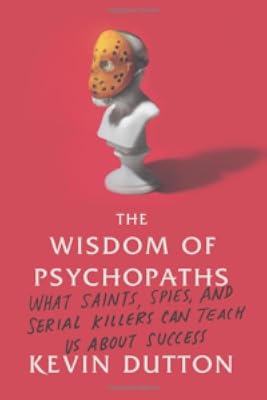
The Wisdom of Psychopaths: What Saints, Spies, and Serial Killers Can Teach Us About Success
by Kevin Dutton
On This Page
Description
In this engrossing journey into the lives of psychopaths and their infamously crafty behaviors, the renowned psychologist Kevin Dutton reveals that there is a scale of "madness" along which we all sit. Incorporating the latest advances in brain scanning and neuroscience, Dutton demonstrates that the brilliant neurosurgeon who lacks empathy has more in common with a Ted Bundy who kills for pleasure than we may wish to admit, and that a mugger in a dimly lit parking lot may well, in fact, have show more the same nerveless poise as a titan of industry. Dutton argues that there are indeed "functional psychopaths" among us-different from their murderous counterparts-who use their detached, unflinching, and charismatic personalities to succeed in mainstream society, and that shockingly, in some fields, the more "psychopathic" people are, the more likely they are to succeed. Dutton deconstructs this often misunderstood diagnosis through bold on-the-ground reporting and original scientific research as he mingles with the criminally insane in a high-security ward, shares a drink with one of the world's most successful con artists, and undergoes transcranial magnetic stimulation to discover firsthand exactly how it feels to see through the eyes of a psychopath. As Dutton develops his theory that we all possess psychopathic tendencies, he puts forward the argument that society as a whole is more psychopathic than ever: after all, psychopaths tend to be fearless, confident, charming, ruthless, and focused-qualities that are tailor-made for success in the twenty-first century. Provocative at every turn, The Wisdom of Psychopaths is a riveting adventure that reveals that it's our much-maligned dark side that often conceals the trump cards of success. show lessTags
Recommendations

Member Reviews
I enjoyed this book very much. After reading it, I am convinced that close to 25% of my friends are psychopaths. ;) None of my friends on Goodreads, of course.
Soooo...thank goodness all of my friends on Goodreads are "saints". It helps bring balance to my life. ;)
I like that this book contains scenarios & questions for you to present to someone you might think is a sociopath. I definitely picked up a question or two to ask potential boyfriends.
Asking how they would react to the 2 different train scenarios described in this book are now my go to questions.
Their response to the second scenario is not only showing you who they are, it's them telling you who they are. As Maya Angelou says, "The first time someone shows you who they show more are...believe them."
This book contains the most comprehensive list of characteristics/traits of sociopaths I've ever read including the following:
They lack of empathy, guilt & remorse. They're glib, pathological, manipulative, charming, & nomadic.
They feed off of a person's hope that next time things will be different or that they will do the right thing in the future. They use your hope to manipulate you into giving them second, third, fourth, fifth chances.
They seek out "rescuers" & overly loyal people.
They often abuse drugs and/or alcohol.
They constantly lie & exaggerate.
They cheat in relationships, in fact that's often how they find their next mark when they begin to sense they are losing control over you.
They make lots of promises but rarely is there positive action towards keeping the promise. Promises are just cons to get what they want at that moment and they don't care if they let you down later.
They're not good at holding a job, often seeking out public assistance or conning someone for money and/or shelter.
They have no direction & no personal initiative to make positive changes in their life.
If caught in a lie, they will try to manipulate out of it first, and then blame others.
It is always someone else's fault. No matter what it is, how clearly it is the predator's fault, they cannot take the blame; unless it is part of the manipulation that goes: admit/apologize/pity play/forgiven/make up.
They seem driven by convenience, access to sex, and financial interest, or using partner or kids as tools to manipulate others.
There are frequent cycles of chaos, calm, chaos, calm, in relationships.
They manipulate and pit people against each other by creating chaos and pointing fingers at those who bring up the problem. Their goal is to get everyone so confused and upset no one can even remember the predator is the root of the problem.
This book points out a few scenarios in which it's good to have sociopaths around.
For example,life or death situations that require quick decisions be made without emotions that would impact the decisions.
One example is surgeons having to make life saving decisions during surgeries. It's easier to make the decision quicker if the surgeon is not emotionally affected by knowing the patient will die if the wrong decision is made.
This book & other books I've read on the subject all agree that sociopaths can not be cured.
Like my daddy always says "You can't fix broken people, you're just gonna cut yourself on their shattered pieces." show less
Soooo...thank goodness all of my friends on Goodreads are "saints". It helps bring balance to my life. ;)
I like that this book contains scenarios & questions for you to present to someone you might think is a sociopath. I definitely picked up a question or two to ask potential boyfriends.
Asking how they would react to the 2 different train scenarios described in this book are now my go to questions.
Their response to the second scenario is not only showing you who they are, it's them telling you who they are. As Maya Angelou says, "The first time someone shows you who they show more are...believe them."
This book contains the most comprehensive list of characteristics/traits of sociopaths I've ever read including the following:
They lack of empathy, guilt & remorse. They're glib, pathological, manipulative, charming, & nomadic.
They feed off of a person's hope that next time things will be different or that they will do the right thing in the future. They use your hope to manipulate you into giving them second, third, fourth, fifth chances.
They seek out "rescuers" & overly loyal people.
They often abuse drugs and/or alcohol.
They constantly lie & exaggerate.
They cheat in relationships, in fact that's often how they find their next mark when they begin to sense they are losing control over you.
They make lots of promises but rarely is there positive action towards keeping the promise. Promises are just cons to get what they want at that moment and they don't care if they let you down later.
They're not good at holding a job, often seeking out public assistance or conning someone for money and/or shelter.
They have no direction & no personal initiative to make positive changes in their life.
If caught in a lie, they will try to manipulate out of it first, and then blame others.
It is always someone else's fault. No matter what it is, how clearly it is the predator's fault, they cannot take the blame; unless it is part of the manipulation that goes: admit/apologize/pity play/forgiven/make up.
They seem driven by convenience, access to sex, and financial interest, or using partner or kids as tools to manipulate others.
There are frequent cycles of chaos, calm, chaos, calm, in relationships.
They manipulate and pit people against each other by creating chaos and pointing fingers at those who bring up the problem. Their goal is to get everyone so confused and upset no one can even remember the predator is the root of the problem.
This book points out a few scenarios in which it's good to have sociopaths around.
For example,life or death situations that require quick decisions be made without emotions that would impact the decisions.
One example is surgeons having to make life saving decisions during surgeries. It's easier to make the decision quicker if the surgeon is not emotionally affected by knowing the patient will die if the wrong decision is made.
This book & other books I've read on the subject all agree that sociopaths can not be cured.
Like my daddy always says "You can't fix broken people, you're just gonna cut yourself on their shattered pieces." show less
Totally different take on psychopathy: essentially that a little bit can be highly adaptive (and something we can all learn from), and that the people we think of when we think of 'psychopaths' just have way too much of a good thing. Kinda scary to think of the emotional skills that I learned in my 20's (ways to reduce anxiety and gain some confidence) are essentially psychopathic, though. Occasionally, though, the writing feels like he's reaching for a 'hipper' tone, which doesn't quite work.
**Disclaimer: The publisher provided a free digital ARC of this book for review purposes.
“The Wisdom of Psychopaths” is nonfiction, and I rarely review nonfiction, but this book is one I highly recommend to writers tackling tales about the complexities of a disturbed mind. The author creates a compelling study of psychopaths. I know you’re thinking psychology is a boring read, but Dutton provides fascinating insights without bogging the reader down in technical jargon. It’s actually an enjoyable read.
The reader enters the mind of those folks we try to avoid. We’re shown that while we might not like the idea, psychopaths are all around us, and many are productive members of society. You see, the psychopathic mind is not show more limited to criminals. You can find psychopaths in high levels of society. Basically, they’re more successful than many “normals.” We don’t recognize them because, as Dutton points out, psychopaths have
“…the consummate ability to pass themselves off as normal everyday folk, while behind the façade—the brutal brilliant disguise—beats the refrigerated heart of a ruthless, glacial predator.”
Aside from the valuable information this book provided me as a writer, I found the author's writing style very easy to slip into. Dutton uses descriptive and sometimes surprising language to carry you along on what could be a very technical and mind-numbing journey. In doing so, he creates imagery that makes the information easy to digest and to remember.
Dutton has a distinct talent for teaching without lecturing, and the information in the pages of this book is fascinating and though-provoking. Also, you know you’re wondering if you’re “normal.”
Full review to come at www.onfictionwriting.com show less
“The Wisdom of Psychopaths” is nonfiction, and I rarely review nonfiction, but this book is one I highly recommend to writers tackling tales about the complexities of a disturbed mind. The author creates a compelling study of psychopaths. I know you’re thinking psychology is a boring read, but Dutton provides fascinating insights without bogging the reader down in technical jargon. It’s actually an enjoyable read.
The reader enters the mind of those folks we try to avoid. We’re shown that while we might not like the idea, psychopaths are all around us, and many are productive members of society. You see, the psychopathic mind is not show more limited to criminals. You can find psychopaths in high levels of society. Basically, they’re more successful than many “normals.” We don’t recognize them because, as Dutton points out, psychopaths have
“…the consummate ability to pass themselves off as normal everyday folk, while behind the façade—the brutal brilliant disguise—beats the refrigerated heart of a ruthless, glacial predator.”
Aside from the valuable information this book provided me as a writer, I found the author's writing style very easy to slip into. Dutton uses descriptive and sometimes surprising language to carry you along on what could be a very technical and mind-numbing journey. In doing so, he creates imagery that makes the information easy to digest and to remember.
Dutton has a distinct talent for teaching without lecturing, and the information in the pages of this book is fascinating and though-provoking. Also, you know you’re wondering if you’re “normal.”
Full review to come at www.onfictionwriting.com show less
I have mixed feelings about this book. The book is entertaining and informing and there is a lot about psychopaths that is generally not known or misunderstood by the general public, including me. Dutton's research on the subject uncovers many unknown or lesser-known attributes of psychopaths and psychopathy as a neuropsychological phenomenon. Dutton makes some good arguments based on research by himself and others on the evolutionary need for psychopaths, their prevelance in today's world and why to a good extent a level of psychopathy is healthy.
We dive right into the minds of serial criminals, business persons, anonymous test subjects, saints and politicians to understand what makes psychopaths tick and prosper. We read about, in the show more book, various personality traits that have helped shape the world and it's all fascinating and extremely interesting. Coupled with Dutton's writing style - personal, candid and humorous, it seems palatable to read a book on a subject that most people subconsciously dread.
However, I felt many times during the reading of the book that the book could have been half or even one-third its size. Dutton seems to go around in circles, often repeating the same attributes and facets of psychopathy. It seemed to me that every chapter started with or included a section that said the same things - psychopaths are devoid of emotional empathy, are cold-hearted, can make decisions that most others cannot, etc.
Moreover, (and this can be viewed as a good thing or bad) Dutton constantly reminds us of things discussed in the previous chapters by indulging into a brief description of what passed. Something that can be a little annoying, making you say, "yeah, I remember, get on with it!".
There's a lot about psychopaths one can learn about from the book. I certainly did. Though, I'd really question about the 'wisdom' end of the title. There's not much wisdom that's passed around but a scientifical explanation of psychopathy and psychopathic minds and 'knowledge' derived from various psychological research and experiments.
Nevertheless, it was an educational trip with a pinch of fun and excitement added to the mix. show less
We dive right into the minds of serial criminals, business persons, anonymous test subjects, saints and politicians to understand what makes psychopaths tick and prosper. We read about, in the show more book, various personality traits that have helped shape the world and it's all fascinating and extremely interesting. Coupled with Dutton's writing style - personal, candid and humorous, it seems palatable to read a book on a subject that most people subconsciously dread.
However, I felt many times during the reading of the book that the book could have been half or even one-third its size. Dutton seems to go around in circles, often repeating the same attributes and facets of psychopathy. It seemed to me that every chapter started with or included a section that said the same things - psychopaths are devoid of emotional empathy, are cold-hearted, can make decisions that most others cannot, etc.
Moreover, (and this can be viewed as a good thing or bad) Dutton constantly reminds us of things discussed in the previous chapters by indulging into a brief description of what passed. Something that can be a little annoying, making you say, "yeah, I remember, get on with it!".
There's a lot about psychopaths one can learn about from the book. I certainly did. Though, I'd really question about the 'wisdom' end of the title. There's not much wisdom that's passed around but a scientifical explanation of psychopathy and psychopathic minds and 'knowledge' derived from various psychological research and experiments.
Nevertheless, it was an educational trip with a pinch of fun and excitement added to the mix. show less
I've long been intrigued by the human mind and what shapes our personalities and decision-making and, as such, found this a compelling read. Kevin Dutton's research approach is far from the typical morbid fascination in the violent crimes of psychopaths. Instead, we look at what makes the psychopathic mind different from the average person's, and how some of those differences make them quite successful in certain careers.
Dutton's writing style is easy to fall into. While I wouldn't call this light reading (I can't imagine anything on this topic that would be), it doesn't read like a text book. The research is well explained without being overly detailed.
Dutton stresses that not all psychopaths are evil or murderers. We spend a lot of show more time looking at "functional" psychopaths who are nonviolent and quite successful. My one problem here is that, while we're treated to all the reasons they can be beneficial to society, Dutton doesn't examine the disastrous effects these "functional" psychopaths can have on families or even work environments.
This book brings up the entire concept of free will, which is perhaps a side effect of the exploration. While only touched on lightly here, after reading this it's impossible not to question how many of our decisions are truly free will, and how many are simply a product of our genetic makeup. show less
Dutton's writing style is easy to fall into. While I wouldn't call this light reading (I can't imagine anything on this topic that would be), it doesn't read like a text book. The research is well explained without being overly detailed.
Dutton stresses that not all psychopaths are evil or murderers. We spend a lot of show more time looking at "functional" psychopaths who are nonviolent and quite successful. My one problem here is that, while we're treated to all the reasons they can be beneficial to society, Dutton doesn't examine the disastrous effects these "functional" psychopaths can have on families or even work environments.
This book brings up the entire concept of free will, which is perhaps a side effect of the exploration. While only touched on lightly here, after reading this it's impossible not to question how many of our decisions are truly free will, and how many are simply a product of our genetic makeup. show less
I wasn't going to read this book because the main argument is silly.
Would it be nice not to feel fear sometimes?
Yes.
Would it mostly be a disadvantage though?
Yes. (the life expectancy of a psychopath is 50)
Would it be nice not to worry about how other people feel sometimes?
Yes.
Would that mostly be terrible though?
Yes.
So I figured the book would be what I said above, then yet another explanation of the Milgram and Standford experiments, bit of game theory, then something about Enron, an inverview with Robert Hare, a list of occasions when being a psychopath is helpful, the end.
Actually, even though he doesn't prove there's any wisdom in psychopathy at all, it's a really good read. Lots of science and experiments that I hadn't read show more about before and proper, full explanations that meant I learned something even when it was a topic I was already familiar with. (And he skims over the Stanford prison experiment, thank goodness, as soon as I heard the name "Zimbardo" I thought "here we go!" but it was over super quick)
There's a lot of 1 2 = 13 but that's ok, we all used a dodgy argument to tie together interesting ideas for an essay at some point, didn't we? Just me? It gives structure to the book. Daniel Goleman's book "Focus" got a lot of criticism for not doing this, for not having one unifying theme, so what can you do?
The connection between equanimity, mindfulness, and psychopathy is a very real one, it's a pity there was no nod to the people trying to make sure that "McMindnfulness" doesn't get separated from the practices of cultivating compassion. (nice free short-course that goes into this a little here: https://www.open.edu/openlearn/health-sports-psychology/mindfulness-mental-healt...
It's a bit tone deaf at times. One example is that he talks about sex workers being murdered right before a poem about a moth and a flame that goes:
we get bored with routine
and crave beauty
and excitement
fire is beautiful
and we know that if we get
too close it will kill us
but what does that matter
it is better to be happy
for a moment
and be burned up with beauty
than to live a long time
and be bored all the while
I think that would have been better after talking about Andy McNab for example. Separated from the murder of women by a whole chapter or at least a centered tilde
Over all a very nice pop psychology book, not what I expected. I suppose I would have named it "Some Stuff about Psychopaths and Psychology" and done it with no argument, but I doubt anyone would have liked that.
[ 3.5 stars.. I don't think I'll click on them because it will actually hurt the books average if I give it 3 ] show less
Would it be nice not to feel fear sometimes?
Yes.
Would it mostly be a disadvantage though?
Yes. (the life expectancy of a psychopath is 50)
Would it be nice not to worry about how other people feel sometimes?
Yes.
Would that mostly be terrible though?
Yes.
So I figured the book would be what I said above, then yet another explanation of the Milgram and Standford experiments, bit of game theory, then something about Enron, an inverview with Robert Hare, a list of occasions when being a psychopath is helpful, the end.
Actually, even though he doesn't prove there's any wisdom in psychopathy at all, it's a really good read. Lots of science and experiments that I hadn't read show more about before and proper, full explanations that meant I learned something even when it was a topic I was already familiar with. (And he skims over the Stanford prison experiment, thank goodness, as soon as I heard the name "Zimbardo" I thought "here we go!" but it was over super quick)
There's a lot of 1 2 = 13 but that's ok, we all used a dodgy argument to tie together interesting ideas for an essay at some point, didn't we? Just me? It gives structure to the book. Daniel Goleman's book "Focus" got a lot of criticism for not doing this, for not having one unifying theme, so what can you do?
The connection between equanimity, mindfulness, and psychopathy is a very real one, it's a pity there was no nod to the people trying to make sure that "McMindnfulness" doesn't get separated from the practices of cultivating compassion. (nice free short-course that goes into this a little here: https://www.open.edu/openlearn/health-sports-psychology/mindfulness-mental-healt...
It's a bit tone deaf at times. One example is that he talks about sex workers being murdered right before a poem about a moth and a flame that goes:
we get bored with routine
and crave beauty
and excitement
fire is beautiful
and we know that if we get
too close it will kill us
but what does that matter
it is better to be happy
for a moment
and be burned up with beauty
than to live a long time
and be bored all the while
I think that would have been better after talking about Andy McNab for example. Separated from the murder of women by a whole chapter or at least a centered tilde
Over all a very nice pop psychology book, not what I expected. I suppose I would have named it "Some Stuff about Psychopaths and Psychology" and done it with no argument, but I doubt anyone would have liked that.
[ 3.5 stars.. I don't think I'll click on them because it will actually hurt the books average if I give it 3 ] show less
The author begins his book by explaining that his own father was a psychopath. On what evidence? It seems that while he was driven to succeed, he was undeterred by failure, and his spirits never sank. If this seems like unsupported reasoning to you, you may find the rest of the book irritating as well. The author consistently uses the two techniques illustrated by his introduction: label anyone who strongly exhibits any trait among the many associated with sociopathic personality disorder as a "psychopath"; and burden every page with sensationalism until it groans. So the early sections of the book explain to us that many surgeons, who are masters of cold precision at the operating table, are psychopaths. Special Forces members, who show more love danger and seem fearless, are psychopaths. Anyone who succeeds at the difficult and often merciless decisions associated with growing a business is probably a psychopath.
How much more interesting this book would have been if the author had identified himself as a psychopath. I don't know whether he is, although I suspect he could be fit into his own loose definition. Unfortunately, he chooses to present himself as one of the inferior majority, doomed to approaching life with all the usual fears and hesitations. The section where he visits Broadmoor Prison, where universally acknowledged psychopaths are housed, should have been one of the strongest parts of the book, providing a little insight into the mindsets of the most remorseless killers. Instead, the visit is milked for every drop of amateur dramatics, as he describes himself quaking with fear as he gazes into the predator's steely eyes, and so on ad nauseum. It's as clumsy and shallow as a high-schooler's field trip report.
If you can wade through all the crap (the ability to do so being a psychopathic trait), there is value to be had here, particularly in the research studies cited, which you are of course free to Google and learn more about, if your curiosity hasn't been dampened by the predictable and repetitive claims that "what they found was astounding." The raw material that remains visible suggests what a good book about this subject might have been like. show less
How much more interesting this book would have been if the author had identified himself as a psychopath. I don't know whether he is, although I suspect he could be fit into his own loose definition. Unfortunately, he chooses to present himself as one of the inferior majority, doomed to approaching life with all the usual fears and hesitations. The section where he visits Broadmoor Prison, where universally acknowledged psychopaths are housed, should have been one of the strongest parts of the book, providing a little insight into the mindsets of the most remorseless killers. Instead, the visit is milked for every drop of amateur dramatics, as he describes himself quaking with fear as he gazes into the predator's steely eyes, and so on ad nauseum. It's as clumsy and shallow as a high-schooler's field trip report.
If you can wade through all the crap (the ability to do so being a psychopathic trait), there is value to be had here, particularly in the research studies cited, which you are of course free to Google and learn more about, if your curiosity hasn't been dampened by the predictable and repetitive claims that "what they found was astounding." The raw material that remains visible suggests what a good book about this subject might have been like. show less
Members
- Recently Added By
Published Reviews
The Wisdom of Psychopaths is an engaging and enlightening look at both the positive and negative sides of the personality characteristics that make up the diagnosis of psychopathy. But what [Cambridge University research psychologist] Mr. Dutton really brings to the table is a self-reflective look at what it means to be fully human, with both good and evil capacities.
added by sgump
Lists

Psicología - Clásicos
165 works; 2 members

Books Read in 2022
5,226 works; 115 members

Books Read in 2016
110 works; 1 member
Author Information

18 Works 965 Members
Some Editions
Series
Belongs to Publisher Series
dtv (34823)
Common Knowledge
- Canonical title
- The Wisdom of Psychopaths: What Saints, Spies, and Serial Killers Can Teach Us About Success
- Original title
- The Wisdom of Psychopaths: What Saints, Spies, and Serial Killers Can Teach Us About Success
- Original publication date
- 2012-10-06
Classifications
Statistics
- Members
- 662
- Popularity
- 43,303
- Reviews
- 19
- Rating
- (3.64)
- Languages
- 7 — Czech, Dutch, English, German, Polish, Spanish, Turkish
- Media
- Paper, Audiobook, Ebook
- ISBNs
- 30
- ASINs
- 12