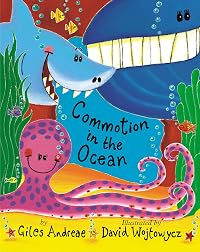
Commotion in the Ocean
by Giles Andreae
On This Page
Description
A collection of silly verses about various creatures that live in the ocean, including crabs, swordfish, whales, and polar bears.Tags
Recommendations















Member Reviews
I loved this poetry book! The first reason I liked this book is for its creative use of the A-B-C-A rhyme scheme. Each stanza throughout the book read using this rhyme scheme. For example, on the page about an octopus the text was “Having eight arms can be useful…You may think it looks a bit funny…But it helps me to hold all of my children…And tickle each one on the tummy.” This creates a fun and easy cadence to read the story to, making the book read like a song which, for me, makes reading it more fun and engaging. I also like this book for the intermittent personification of the animals mentioned throughout the book. For example, the stanza of text on the page about angelfish was written as if the angelfish itself was show more talking saying “Hello, I’m the angelfish, darling…The prettiest thing in the sea…What a shame there are no other creatures…As gorgeous and lovely as me!” By personifying the angelfish, along with other animals such as the turtles, dolphins, and even barnacles, it makes this poetry book read more like a non-fiction book in comparison to a fiction book, entrancing the reader in a world outside of their own which, for me, made the book fun to read. The big idea of this book is to educate the reader on some of the animals in the sea such a sharks, jellyfish, and whales, giving facts about each animal to be able to differentiate between all of them. show less
I really enjoyed reading the poetry book Commotion in the Ocean by Giles Andreae and David Wojtowycz. The book was engaging and had a great range of characters. The author’s poems were based off of different sea creatures, with each poem rhyming as well. The poems were also informational as they provided simple facts about these sea creatures. For example, the poem on turtles says “we crawl up the beach from the water to bury our eggs on dry land.” This is an actual fact about sea turtles which is another great way the author is able to engage readers. I think this would be a great book for students who may not enjoy poetry because the organization of the book does not appear to that of a typical poetry book. For example, each show more page has an illustration of the sea creature of topic with a corresponding poem, however the poem is not introduced as a separate poem from the others on the page. The book flows like a normal children’s reading book. I also think that since the subject of each poem correlates with one another, this helps readers stay focused on the central topic of sea creatures. The overall message of this poetry book is friendship and peacefully living among others. Though these sea creatures are different from each other, they live peacefully together in the sea. show less
A mediocre collection of rhymes featuring different ocean animals. "The crab likes walking sideways/And I think the reason why,/Is to make himself look sneaky/And pretend that he's a spy." Although the poems are short, the vocabulary will occasionally be difficult for beginning readers. The opening and closing poems state that the book explores animals that live "beneath the sea," and yet polar bears and penguins are included. The brightly colored cartoon art is playful, but uninspired. Stick with Douglas Florian's In the Swim (Harcourt, 1997) for more creative writing and clever watercolor illustrations.
Commotion in the Ocean is a poetry informational text that teaches students about the creatures that live in the ocean. The illustrator uses colorful pictures throughout the whole book. While the creatures are drawn very well, the colors seem to clash and look disorganized, and have too much contrast. Cool blues, purples, and greens are used mostly to represent the ocean; however, reds and orange and yellow colors are used to show the colors of crabs, lobsters, and other creatures. The writing the author uses is clearly presented. The author uses personification of characters when he describes the octopus by saying, "having eight arms can be useful... it helps me to hold all my children and tickle each one on the tummy." This makes the show more young readers engaged in the book because they can imagine the creatures on a more relatable level to their ages. The purpose of the story is to teach students about the sea creatures in the ocean. There are many different creatures that live in the ocean, and each one has a purpose and different characteristics. show less
This is a truly superlative pop-up picture book of life at the bottom of the ocean. Its full of hilarious little details like a pull tab to move two frightened little starfish behind some coral and out of the way of the great big shark whose jaws snap open and shut as you open/close the book.
Wonderful.
Wonderful.
I had mixed feelings about this book. Although it was informational there were portions of the book that I thought were not necessarily the best in explaining aspect of those certain creatures. The illustrations genuinely added to the text because they were colorful and eye-catching. Each page exemplified the expert written about that sea creature. I didn't agree completely with the writing samples chosen. For example, the portion talking about the dolphins says, "the wonderful thing about dolphins is hearing them trying to speak. It's not 'how do you do?' as I'd say to you. It's more of a 'click-whistle-squeak!'" I didn't believe that this information accurately described dolphins. I felt that another piece of information could have show more been better regarding dolphins. The main idea of this information text is to inform young readers about the different sea creatures in the ocean and some of the characteristics that come along with them. show less
Age of Child: Read with a 2-year-old boy.
Little Kid Reaction: We read this one multiple times. My son liked the colors in this book. He related the animals to his life - the sharks on his pajamas, his brother's stuff penguin, etc.
Big Kid Reaction: This book is entertaining but misleading from a biological standpoint. I didn't like it. Some of the information is educational: the turtles are crawling on the sand, the crabs walk sideways, etc. Some is misleading: the reasons why they do these things may be anthropomorphized through conjecture not based on science. Some of the information is downright incorrect: swordfish do not spear their prey and stingrays' barbs are not located at the tips (end) of the tail. *Disclaimer: I have a show more biology background and my grandfather was a marine biologist, so I am more sensitive to inaccuracies in ocean life depictions.
To read our full review, go to The Reading Tub®. show less
Little Kid Reaction: We read this one multiple times. My son liked the colors in this book. He related the animals to his life - the sharks on his pajamas, his brother's stuff penguin, etc.
Big Kid Reaction: This book is entertaining but misleading from a biological standpoint. I didn't like it. Some of the information is educational: the turtles are crawling on the sand, the crabs walk sideways, etc. Some is misleading: the reasons why they do these things may be anthropomorphized through conjecture not based on science. Some of the information is downright incorrect: swordfish do not spear their prey and stingrays' barbs are not located at the tips (end) of the tail. *Disclaimer: I have a show more biology background and my grandfather was a marine biologist, so I am more sensitive to inaccuracies in ocean life depictions.
To read our full review, go to The Reading Tub®. show less
Members
- Recently Added By
Lists

SantaThing 2014 Gifts
299 works; 17 members

Youth: Marine Science
83 works; 1 member
Author Information

194 Works 24,362 Members
All Editions
Some Editions
Common Knowledge
- Canonical title*
- Cyffro yn y cefnfor
- Original title
- Commotion in the ocean
- Original publication date
- 1998
- Dedication
- To Nicholas & Jonah - G. A.
Extra big thanks to Many & Jemima
love from David - First words
- There's a curious commotion
At the bottom of the ocean. - Last words
- (Click to show. Warning: May contain spoilers.)Can you name the other friends
We've made along the way?
See if you can tell me who they are. - Original language
- English
*Some information comes from Common Knowledge in other languages. Click "Edit" for more information.
Classifications
Statistics
- Members
- 2,846
- Popularity
- 6,403
- Reviews
- 29
- Rating
- (3.87)
- Languages
- English, Vietnamese, Welsh
- Media
- Paper, Audiobook, Ebook
- ISBNs
- 33
- UPCs
- 3
- ASINs
- 8