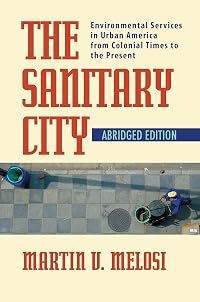
The Sanitary City: Urban Infrastructure in America from Colonial Times to the Present
by Martin V. Melosi
Creating the North American Landscape (1999)
On This Page
Description
Immersed in their on-demand, highly consumptive, and disposable lifestyles, most urban Americans take for granted the technologies that provide them with potable water, remove their trash, and process their wastewater. These vital services, however, are the byproduct of many decades of development by engineers, sanitarians, and civic planners. In The Sanitary City, Martin V. Melosi assembles a comprehensive, thoroughly researched and referenced history of sanitary services in urban America. show more He examines the evolution of water supply, sewage systems, and solid waste disposal during three distinct eras: The Age of Miasmas (pre-1880); The Bacteriological Revolution (1880-1945); and The New Ecology (1945 to present-day). Originally published in 2000, this abridged edition includes updated text and bibliographic materials. The Sanitary City is an essential resource for those interested in environmental history, environmental engineering, science and technology, urban studies, and public health. show lessTags
Recommendations
























Member Reviews
Marvin Melosi's The Sanitary City presents the ongoing attempt by Americans to create a "sanitary city" by devising methods of water supply, and wastewater and solid waste removal. The Sanitary City's major thesis is that sanitation technology was largely influenced by "the prevailing environmental theories of the day" (2). As new theories were developed, and attitudes concerning sanitation and the environment shifted, what was considered to be acceptable changed.
Early sanitation techniques rested largely upon individual households—privy closets, for example—and private enterprises such as scavengers and water contractors. Municipal sanitation was rudimentary if not outright nonexistent. Beginning in the early 1800sa new 'sanitary show more ideal' became more widespread thanks to the efforts of individuals such as Edwin Chadwick. This ideal linked filth to the spread of disease; thus more effective methods of waste removal and pure water supply would have a greater impact upon the prevention of disease (4). This ideal was refined as the nature of disease and germs became more widely known.
Because privately owned companies were either unable or unwilling to embark upon sewerage development, this became a service of the city government. Though not widely accepted at first, the idea of 'out of sight, out of mind' lent itself to the construction of underground sewage systems; eventually the idea that preventing human contact with waste to prevent disease would extend from sewage to solid waste disposal in landfills.
Melosi's groundbreaking integration of water supply, wastewater and solid waste disposal won several awards for the breadth of his scholarship. Melosi grounds his work in extensive research in both primary documents—industry documents, court cases, legislation, etc.—and the secondary literature. show less
Early sanitation techniques rested largely upon individual households—privy closets, for example—and private enterprises such as scavengers and water contractors. Municipal sanitation was rudimentary if not outright nonexistent. Beginning in the early 1800sa new 'sanitary show more ideal' became more widespread thanks to the efforts of individuals such as Edwin Chadwick. This ideal linked filth to the spread of disease; thus more effective methods of waste removal and pure water supply would have a greater impact upon the prevention of disease (4). This ideal was refined as the nature of disease and germs became more widely known.
Because privately owned companies were either unable or unwilling to embark upon sewerage development, this became a service of the city government. Though not widely accepted at first, the idea of 'out of sight, out of mind' lent itself to the construction of underground sewage systems; eventually the idea that preventing human contact with waste to prevent disease would extend from sewage to solid waste disposal in landfills.
Melosi's groundbreaking integration of water supply, wastewater and solid waste disposal won several awards for the breadth of his scholarship. Melosi grounds his work in extensive research in both primary documents—industry documents, court cases, legislation, etc.—and the secondary literature. show less
Ratings
Members
- Recently Added By
Author Information

15+ Works 215 Members
Martin V. Melosi is Distinguished University Professor of History and director of the Center for Public History at the University of Houston.
Awards and Honors
Series

Common Knowledge
- Canonical title
- The Sanitary City: Urban Infrastructure in America from Colonial Times to the Present
- Original publication date
- 1999
- Important places
- USA
- Original language
- English
Classifications
- Genres
- Nonfiction, Science & Nature, History, General Nonfiction, Technology, Politics and Government
- DDC/MDS
- 363.6 — Society, government, & culture Social problems and social services Public Safety - Police, Crime Investigation Public utilities and related services
- LCC
- TD223 .M45 — Technology Environmental technology. Sanitary engineering Environmental technology. Sanitary engineering Water supply for domestic and industrial purposes
- BISAC
Statistics
- Members
- 53
- Popularity
- 576,132
- Reviews
- 1
- Rating
- (3.00)
- Languages
- English
- Media
- Paper, Ebook
- ISBNs
- 3