City Life
by Donald Barthelme
On This Page
Tags
Recommendations




















Member Reviews
Barthelme’s erudite deadpan absurdity is a balm for jangled nerves in trying times, for, as Ramona says in the title story here—
…we are locked in the most exquisite mysterious muck. This muck heaves and palpitates. It is multi-directional and has a mayor. To describe it takes many hundreds of thousands of words. Our muck is only part of a much greater muck—the nation-state—which is itself the creation of that muck of mucks, human consciousness. Of course all these things also have a touch of sublimity—as when Moonbelly sings, for example, or all the lights go out. What a happy time that was, when all the electricity went away! If only we could re-create that paradise!
Barthelme fiddled with literary short forms, and treated show more the space between eccentric juxtapositions as a primary object. The weaker bits here include a Q & A format, amusing but forgettable (“The Explanation”), a barely clever trifle (“The Phantom of the Opera’s Friend”) and an unreadable cut-up bit (“Bone Bubbles”). All shortcomings are erased, however, by “At the Tolstoy Museum,” with those illustrations. Barthelme was both cerebral and wacky.
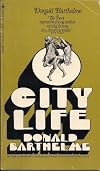
Most of the best pieces here (as good as any experimental short fiction anywhere) can be found in the collection Sixty Stories, but the cheap paper and pulpy feel give the $2.25 Pocket Books edition a stealthy talismanic quality,
…causing faint alteration in the status quo, behind your back, at various points along the periphery of community life, together with other enterprises not dissimilar in tone, such as producing films that have special qualities, or attributes, such as a film where the second half of it is a holy mystery, and girls and women are not permitted to see it, or writing novels in which the final chapter is a plastic bag filled with water, which you can touch, but not drink: in this way, or ways, the underground mental life of the collectivity is botched, or denied, or turned into something else never imagined by the planners… (“Sentence”) show less
…we are locked in the most exquisite mysterious muck. This muck heaves and palpitates. It is multi-directional and has a mayor. To describe it takes many hundreds of thousands of words. Our muck is only part of a much greater muck—the nation-state—which is itself the creation of that muck of mucks, human consciousness. Of course all these things also have a touch of sublimity—as when Moonbelly sings, for example, or all the lights go out. What a happy time that was, when all the electricity went away! If only we could re-create that paradise!
Barthelme fiddled with literary short forms, and treated show more the space between eccentric juxtapositions as a primary object. The weaker bits here include a Q & A format, amusing but forgettable (“The Explanation”), a barely clever trifle (“The Phantom of the Opera’s Friend”) and an unreadable cut-up bit (“Bone Bubbles”). All shortcomings are erased, however, by “At the Tolstoy Museum,” with those illustrations. Barthelme was both cerebral and wacky.
Most of the best pieces here (as good as any experimental short fiction anywhere) can be found in the collection Sixty Stories, but the cheap paper and pulpy feel give the $2.25 Pocket Books edition a stealthy talismanic quality,
…causing faint alteration in the status quo, behind your back, at various points along the periphery of community life, together with other enterprises not dissimilar in tone, such as producing films that have special qualities, or attributes, such as a film where the second half of it is a holy mystery, and girls and women are not permitted to see it, or writing novels in which the final chapter is a plastic bag filled with water, which you can touch, but not drink: in this way, or ways, the underground mental life of the collectivity is botched, or denied, or turned into something else never imagined by the planners… (“Sentence”) show less
The new frontier of Postmodern Paraguay requires a fearless explorer to not only sport a safari hat, beard, custom-fit jacket and fashionable scarf but also be well-versed in the latest postmodern writings of Jean-François Lyotard, Jacques Derrida, David Foster Wallace and, of course, Donald Barthelme. Those Spanish speaking natives damn well better be ready.
Nifty collection of short surreal postmodern blasters by the master of the genre. I will focus on my favorite as per below:
Paraguay
This Barthelme snapper is told in fourteen specifically labeled brief chapters. In keeping with the adventurous nature of the story and for the purposes of my review, below are a batch of my own markers as we follow our bold, gusty pathfinder roaming show more among the uncharted vistas of postmodern, postcolonial New Paraguay.
Stranger in a Strange Land: “At the summit there is a cairn on which each man threw a stone, and here it is customary to give payment to the coolies. I paid each man his agreed-upon wage, and alone, began the descent.” Not on a map, not in South America, our narrator had better be alert as he embarks solo into a country never before glimpsed by such a lover of the fresh and the new. Although we are very much rooted in the world of the postmodern, he still refers to his workers as “coolies” – such a racist, colonial term. Some things die hard, if they ever die at all.
Anima: What is an adventure to an exotic land without the appearance of a beautiful exotic woman? Sure enough, the first person he meets is “a dark girl wrapped in a red shawl.” Along the lines of coolie, right out of those sexist colonial days, he refers to her not as a young lady or a woman but as a “girl.” And, turns out, not only is this woman, Jean Mueller by name, exotic in looks but she is also highly cultured. After leading him back to her large modern house and showing him his room complete with desk, bookcases and fireplace (he is the guest of both Jean Mueller and her husband, Herko Mueller) the narrator tells us she plays a sonata by the composer Bibblemann on the piano. Sidebar: There is no such composer with the name Bibblemann. Probably the narrator misunderstood the name she gave him (Liebermann, maybe?), which is not surprising since this American appears a tad uncultured. This fact foreshadows a role reversal: in many respects, the civilization of the natives is much more culturally sophisticated and technically advanced than the explorer's.
Comedy at Room Temperature: We learn there are adjustments the inhabitants of Paraguay make in response to modest changes in weather and a few other oddities then something quite striking: Herko Mueller, who is, by the way, fond of zipper suits in brilliant colors: yellow, green, violet, is by profession an arbiter of comedy, something like an umpire, where members of the audience are given a set of rules and the rules constitute the comedy. What comes to mind for me is competitive team improv comedy. Anyway, Herko goes on, “Our comedies seek to reach the imagination. When you are looking at something, you cannot imagine it.” So, perhaps there is a good bit of miming peppered in with the improvisation. Or, maybe the men and women of Paraguay are quite advanced philosophically, keenly aware of the nuances of phenomenology and the philosophy of perception. Judging from this scant bit of information, their comedy sounds quite intriguing, certainly more captivating than the usual TV game shows we have north of the border.
Collateral Damage: A government error causing the death of a number of men and women sounds like it could have been from a Chernobyl-like radioactive fallout. The narrator’s and also Herko Mueller’s words to explain the event are unsettling, as if they are using language to cover-up an avoidable tragedy, similar to when the military refers to the death of innocent civilians as “collateral damage.” When you hear someone say, “An error has been made” watch out, someone or some institution doesn’t want to accept responsibility. Although Paraguay strikes me as very postmodern, there is that lingering noisome bureaucracy.
Art of the Comrade: Unsettling also is our explorer’s description of postmodern Paraguay art, with words like “rationalization process”, “quality control”, “central and regional art dumps” smacking of a kind of Marxist or government control. And the art process includes things like translation into symbolic logic (whatever the hell that means!), minimization and being run through heavy rollers. The final result? Two are mentioned: Sheet Art and Bulk Art. And what you may ask will such art look like? For me, at least in terms of the feeling tone of what is described, two artists come to mind: David Judd and Richard Serra.
David Judd Sculpture
Richard Serra Sculpture
Hot Spots: Our bold gallant continues on, reporting on a number of other postmodern Paraguay innovations, things that would remind us of tanning salons, white wall space, softening of language with blocks of silences, health patches, and a form of justice (or injustice) as in “There are crimes but people chosen at random are punished for them. Everyone is liable for everything.” This last point underscores how Barthelme's Paraguay might be a great place to visit briefly, but I wouldn't want to life there. Not to mention not wanting my art run through those heavy rollers.
There are enough creative ideas and themes of futuristic civilizations in this Barthelme eight-page short story to keep dozens of science fiction writers going for several years. I will conclude with what I imagine a New Paraguay apartment building and a New Paraguay garden might look like. Here they are:
Moshe Safdie's Habitat in Montreal show less
The new frontier of Postmodern Paraguay requires a fearless explorer to not only sport a safari hat, beard, custom-fit jacket and fashionable scarf but also be well-versed in the latest postmodern writings of Jean-François Lyotard, Jacques Derrida, David Foster Wallace and, of course, Donald Barthelme. Those Spanish speaking natives damn well better be ready.
Nifty collection of short surreal postmodern blasters by the master of the genre. I will focus on my favorite as per below:
Paraguay
This Barthelme snapper is told in fourteen specifically labeled brief chapters. In keeping with the adventurous nature of the story and for the purposes of my review, below are a batch of my own markers as we follow our bold, gusty pathfinder roaming show more among the uncharted vistas of postmodern, postcolonial New Paraguay.
Stranger in a Strange Land: “At the summit there is a cairn on which each man threw a stone, and here it is customary to give payment to the coolies. I paid each man his agreed-upon wage, and alone, began the descent.” Not on a map, not in South America, our narrator had better be alert as he embarks solo into a country never before glimpsed by such a lover of the fresh and the new. Although we are very much rooted in the world of the postmodern, he still refers to his workers as “coolies” – such a racist, colonial term. Some things die hard, if they ever die at all.
Anima: What is an adventure to an exotic land without the appearance of a beautiful exotic woman? Sure enough, the first person he meets is “a dark girl wrapped in a red shawl.” Along the lines of coolie, right out of those sexist colonial days, he refers to her not as a young lady or a woman but as a “girl.” And, turns out, not only is this woman, Jean Mueller by name, exotic in looks but she is also highly cultured. After leading him back to her large modern house and showing him his room complete with desk, bookcases and fireplace (he is the guest of both Jean Mueller and her husband, Herko Mueller) the narrator tells us she plays a sonata by the composer Bibblemann on the piano. Sidebar: There is no such composer with the name Bibblemann. Probably the narrator misunderstood the name she gave him (Liebermann, maybe?), which is not surprising since this American appears a tad uncultured. This fact foreshadows a role reversal: in many respects, the civilization of the natives is much more culturally sophisticated and technically advanced than the explorer's.
Comedy at Room Temperature: We learn there are adjustments the inhabitants of Paraguay make in response to modest changes in weather and a few other oddities then something quite striking: Herko Mueller, who is, by the way, fond of zipper suits in brilliant colors: yellow, green, violet, is by profession an arbiter of comedy, something like an umpire, where members of the audience are given a set of rules and the rules constitute the comedy. What comes to mind for me is competitive team improv comedy. Anyway, Herko goes on, “Our comedies seek to reach the imagination. When you are looking at something, you cannot imagine it.” So, perhaps there is a good bit of miming peppered in with the improvisation. Or, maybe the men and women of Paraguay are quite advanced philosophically, keenly aware of the nuances of phenomenology and the philosophy of perception. Judging from this scant bit of information, their comedy sounds quite intriguing, certainly more captivating than the usual TV game shows we have north of the border.
Collateral Damage: A government error causing the death of a number of men and women sounds like it could have been from a Chernobyl-like radioactive fallout. The narrator’s and also Herko Mueller’s words to explain the event are unsettling, as if they are using language to cover-up an avoidable tragedy, similar to when the military refers to the death of innocent civilians as “collateral damage.” When you hear someone say, “An error has been made” watch out, someone or some institution doesn’t want to accept responsibility. Although Paraguay strikes me as very postmodern, there is that lingering noisome bureaucracy.
Art of the Comrade: Unsettling also is our explorer’s description of postmodern Paraguay art, with words like “rationalization process”, “quality control”, “central and regional art dumps” smacking of a kind of Marxist or government control. And the art process includes things like translation into symbolic logic (whatever the hell that means!), minimization and being run through heavy rollers. The final result? Two are mentioned: Sheet Art and Bulk Art. And what you may ask will such art look like? For me, at least in terms of the feeling tone of what is described, two artists come to mind: David Judd and Richard Serra.
David Judd Sculpture
Richard Serra Sculpture
Hot Spots: Our bold gallant continues on, reporting on a number of other postmodern Paraguay innovations, things that would remind us of tanning salons, white wall space, softening of language with blocks of silences, health patches, and a form of justice (or injustice) as in “There are crimes but people chosen at random are punished for them. Everyone is liable for everything.” This last point underscores how Barthelme's Paraguay might be a great place to visit briefly, but I wouldn't want to life there. Not to mention not wanting my art run through those heavy rollers.
There are enough creative ideas and themes of futuristic civilizations in this Barthelme eight-page short story to keep dozens of science fiction writers going for several years. I will conclude with what I imagine a New Paraguay apartment building and a New Paraguay garden might look like. Here they are:
Moshe Safdie's Habitat in Montreal show less
This collection is full of experimentation and humor and probably some deep thoughts that I totally missed, and I'm glad it exists for whoever the receptive audience is.
I think this may have been a Jessamyn West recommendation. Experimental short stories written in the late 60s. The first one was heavy and boring but the next one about the falling dog, I read to myself out loud and it was fun. Some of the stories were interesting, but most just kind of weird - enumerations, odd drawings, one single sentence. (July 14, 2005)
I read this book in the early 1970's and was singularly impressed with it. This is the same time that I discovered Borges. The story, "The Glass Mountain", has stayed in my head for forty years. I will try to find this book again. My liking of urban life and some postmodern literature contribute to my wanting to restore this to my library.
Ratings
Members
- Recently Added By
Author Information

68+ Works 7,772 Members
Donald Barthelme was born on April 7, 1931, and was one of the major U.S. short story writers and novelists of the late twentieth century. Barthelme satirized American life. Born in Philadelphia, Barthelme spent part of his early life in Houston, Texas, and began to write fiction while working as a journalist, director of an art museum and show more university publicist. These occupations became fuel for his creative fire. His arsenal of techniques included parodies of television shows, radio plays and recipes, long and elaborate metaphors, complex dream sequences, and a break-neck narrative pace. After the publication of his first collection, Come Back Dr. Caligari (1964), Barthelme became a full-time writer of short stories and novels. The latter included Snow White (1967), The Dead Father (1975), and Paradise (1986). Barthelme also published three more short story collections, 60 Stories (1981), Overnight to Many Distant Cities (1983), and 40 Stories (1987). Barthelme died of cancer in 1989. (Bowker Author Biography) show less
Some Editions
Awards and Honors
Distinctions
Series
Belongs to Publisher Series
Lanterne (L 405)
Work Relationships
Is contained in
Common Knowledge
- Canonical title*
- La vita in città
- Original publication date
- 1970
*Some information comes from Common Knowledge in other languages. Click "Edit" for more information.
Classifications
Statistics
- Members
- 286
- Popularity
- 112,226
- Reviews
- 6
- Rating
- (3.97)
- Languages
- 6 — English, French, Italian, Norwegian (Bokmål), Spanish, Swedish
- Media
- Paper, Ebook
- ISBNs
- 12
- ASINs
- 8