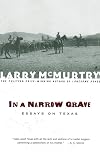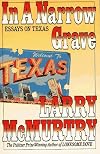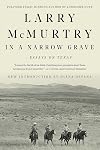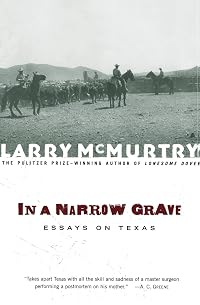
In a Narrow Grave: Essays on Texas
by Larry McMurtry
On This Page
Description
"This landmark collection, brimming with his signature wit and incomparable sensibility, is Larry McMurtry's classic tribute to his home and his people. Before embarking on what would become one of the most prominent writing careers in American literature, spanning decades and indelibly shaping the nation's perception of the West, Larry McMurtry knew what it meant to come from Texas. Originally published in 1968, In a Narrow Grave is the Pulitzer Prize-winning author's homage to the past and show more present of the Lone Star State, where he grew up a precociously observant hand on his father's ranch. From literature to rodeos, small-town folk to big city intellectuals, McMurtry explores all the singular elements that define his land and community, revealing the surprising and particular challenges in the "dying . . . rural, pastoral way of life." "The gold standard for understanding Houston's brash rootlessness and civic insecurities" (Douglas Brinkley, New York Times Book Review), In a Narrow Grave offers a timeless portrait of the vividly human, complex, full-blooded Texan."--Provided by publisher. show lessTags
Recommendations













Member Reviews
These essays about the literature, culture and mythology of Larry McMurtry's home state of Texas were originally published in 1968 and were republished, in the edition I read, in 1989. McMurtry's major theme, here, was the passing of the culture and mythology of the cowboy, to be replaced only by the culture of the oilman, but mostly without any accompanying mythology. These pieces, written nearly 50 years ago, make interesting time pieces and, due to McMurtry's wonderful writing style and sly wit, illuminating reading in and of themselves. There is an opening essay about the filming of one of his early novels, Horseman, Pass By, into the Paul Newman movie, Hud. There is a hilarious examination of the Houston Astrodome, then a show more relatively new Texas landmark (and now, already, gone). Equally entertaining is McMurtry's roadtrip through the state in which he describes what he found in small town Texas. But the most affecting essays are those dealing with the old cowboy culture and its passing. His view is clear-eyed, as in his description of the racism and savagery of the real life Texas Rangers of the late 19th and early 20th centuries. But, still, this passing affects McMurtry's own past, as his father and six uncles were cattlemen themselves. That comes across in passages like this one:
"When my father was twelve my grandfather sent him, alone, with a small herd of steers, to Graham, Texas, a town about forty miles from our ranch. He was to sell the steers, buy new cattle, drive them home, and show a profit--all of which, from all reports, he did. At twelve i would have been hard put to drive a very docile herd of steers forty years, but at twelve i did discover Don Quixote. I was permanently altered by it, and just in time, too. Even if I could have driven a herd of steers to Gram I should have had to cut a hundred fences to get there, or else open a hundred gates." show less
"When my father was twelve my grandfather sent him, alone, with a small herd of steers, to Graham, Texas, a town about forty miles from our ranch. He was to sell the steers, buy new cattle, drive them home, and show a profit--all of which, from all reports, he did. At twelve i would have been hard put to drive a very docile herd of steers forty years, but at twelve i did discover Don Quixote. I was permanently altered by it, and just in time, too. Even if I could have driven a herd of steers to Gram I should have had to cut a hundred fences to get there, or else open a hundred gates." show less
Most books of essays consist of magazine articles, newspaper columns, book introductions and the like assembled for the first time in one place. Larry McMurtry's “In a Narrow Grave: Essays on Texas” is unusual in that it was written as book of essays. The nine essays are numbered as chapters, and at the end of one McMurtry usually previews the next.
The book was published in 1968, when McMurtry was still a young Texas writer, and reprinted 50 years later. It is a little jarring when he repeatedly refers to the president from Texas and you realize he is talking about Lyndon B. Johnson. Yet otherwise these essays hardly seem dated at all. Well, there is the one about the Houston Astrodome, then the newest wonder of the world.
McMurtry's show more essays, on the whole, reflect the same theme as most of his novels: the surrender of rural Texas to urban Texas and the cowboy's flight to the city. The author comes from a family of cowboys. He writes movingly of his grandfather, father and uncles, all cowboys who lived to see the end of the cowboy era. Although he grew up practically without books, it was books and not horses and cattle that directed his own life.
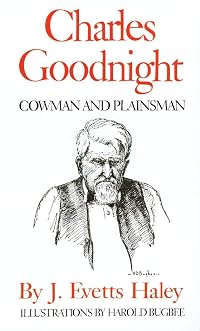
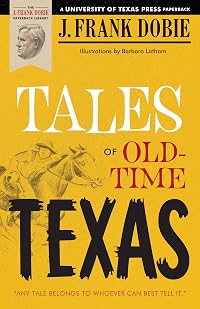
McMurtry writes about other Texas writers, and there haven't been many. He is less interested in those like Terry Southern and Katherine Anne Porter — who may have been born in Texas but you would never know it from their writing — than those like Roy Bedichek, W.P. Webb and J. Frank Dobie, who wrote about Texas, although few people outside of Texas have ever heard of them. And, he concedes, few people in Texas have actually read them. McMurtry has read them, and his essay on their books is instructive.
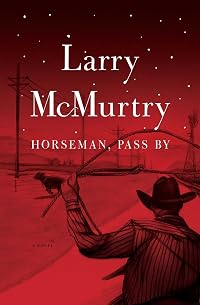
He also writes about how his novel “Horseman, Pass By” was made into the movie “Hud.” It was filmed in Texas, and McMurtry witnessed some of that filming. Having lived with real cowboys, his comments about actors like Paul Newman pretending to be cowboys are priceless. Newman actually looked more authentic than most, he says.
His reflections on western movies in general prove interesting. Is he bothered that Hollywood's vision of the West has been mostly fantasy? Not at all. Romantic movies are mostly fantasy, too. Same with war movies and gangster movies. Real cowboys, he says, have always loved cowboy movies. Who doesn't love a good fantasy?
Larry McMurtry's essays, especially a half century later, may be about as popular as the works of Bedichek, Webb and Dobie. But I found them to be rewarding reading. show less
The book was published in 1968, when McMurtry was still a young Texas writer, and reprinted 50 years later. It is a little jarring when he repeatedly refers to the president from Texas and you realize he is talking about Lyndon B. Johnson. Yet otherwise these essays hardly seem dated at all. Well, there is the one about the Houston Astrodome, then the newest wonder of the world.
McMurtry's show more essays, on the whole, reflect the same theme as most of his novels: the surrender of rural Texas to urban Texas and the cowboy's flight to the city. The author comes from a family of cowboys. He writes movingly of his grandfather, father and uncles, all cowboys who lived to see the end of the cowboy era. Although he grew up practically without books, it was books and not horses and cattle that directed his own life.
McMurtry writes about other Texas writers, and there haven't been many. He is less interested in those like Terry Southern and Katherine Anne Porter — who may have been born in Texas but you would never know it from their writing — than those like Roy Bedichek, W.P. Webb and J. Frank Dobie, who wrote about Texas, although few people outside of Texas have ever heard of them. And, he concedes, few people in Texas have actually read them. McMurtry has read them, and his essay on their books is instructive.
He also writes about how his novel “Horseman, Pass By” was made into the movie “Hud.” It was filmed in Texas, and McMurtry witnessed some of that filming. Having lived with real cowboys, his comments about actors like Paul Newman pretending to be cowboys are priceless. Newman actually looked more authentic than most, he says.
His reflections on western movies in general prove interesting. Is he bothered that Hollywood's vision of the West has been mostly fantasy? Not at all. Romantic movies are mostly fantasy, too. Same with war movies and gangster movies. Real cowboys, he says, have always loved cowboy movies. Who doesn't love a good fantasy?
Larry McMurtry's essays, especially a half century later, may be about as popular as the works of Bedichek, Webb and Dobie. But I found them to be rewarding reading. show less
Naturally the infamously unsentimental author of the "Ever a Bridegroom" essay on the deplorable state of Texas literature would be loath to contain his opinions to that single 1981 broadside. Published in 1968, this essay collection, which is really a single meandering intellectual journey occasionally interrupted by chapter breaks, moves from film to literature to travel to family history, but its subject is always McMurtry and his thoughts on Texas, both as a real place and as a subject. And, as Texas contains multitudes, so does this book, as it contains his thoughts on everything from cowboy movies, like the adaptation of his novel Horseman, Pass By into the film Hud, to cowboy cities like his own beloved Houston, at the time in show more its rapid transitional phase from collecting the dregs of the frontier to the home of the Astrodome. What makes his writing different from the countless others who have unleashed their thoughtless gushing, positive or negative, about Texas is that he's always aware that while sentimentality might be a great thing to feel, unless it's presented honestly it will always seem cheap.
For example, his decidedly equivocal thoughts on the great Texas literary trinity of Dobie, Webb, and Bedichek might have seemed sacrilegious at the time, when the three were getting schools, buildings, and professorial chairs named after them. However, the better part of a half-century later, his assessments seem pretty accurate, particularly in how difficult it can be for literary forces like Dobie to capture their spoken voices in the written word:
"From what one has heard he was a great raconteur. Unfortunately, great raconteurs who are also writers are all too often sloppy when they go to write down the stories they tell so well. At heart they are usually impatient with the written word and feel that it is a weak substitute for the human voice. In their hands it usually is. The labor of typing out a story that could be told effortlessly and pleasantly, in appreciative company, often wreaks havoc with their prose."
This is indeed a real problem for anyone wanting to capture in words the true energy of human interaction, although interestingly, McMurtry's own fiction usually features characters who are not known for their loquacity. When someone remarks on what a pleasant day it is out in the Hill Country, the conversation is easy and natural, but often when that same sentiment is put on the page it can seem contrived and artificial. This is most obvious when it comes to that "everything's bigger in Texas" style of idle braggartry, which McMurtry takes a blessedly dim view of. The contrast between how we see our state and what outsiders see is amusingly highlighted in the first essay, where the locals of a tiny Texas town are star-struck by the arrival of Paul Newman filming Hud. Even though McMurtry is from that country and culture (more specifically Wichita Falls, which stars in a moving essay on his own family history at the end), he has no illusions that the townsfolk are any kind of "salt of the earth" types.
I particularly enjoyed his roadtrip from Houston down to Brownsville and up to the Panhandle, but I was unavoidably reminded of Charles Portis' similar "An Auto Odyssey through Darkest Baja", which is quite a bit funnier, although not set in Texas (in fact McMurtry's lack of humor other than a somewhat jaded dryness will probably strike many as more condescending than anything else). Portis, who was from Arkansas, would probably be quite amused by the description of the fiddling competition in east Texas, which contains many of the same characters that Arkansas does. Beginning in Houston, the story makes a nice contrast to the essay on the Astrodome, which has a good discussion of why that ugly, sprawling, charmless city is still McMurtry's favorite town in the state. And while as an Austinite I don't appreciate his jabs at our pseudo-intellectual culture, the man has a right to his opinion (and at least he's not as scathing towards us as he is to the desperately insecure city of Dallas).
For all his strengths as an essayist, it's clear why he's felt that his main calling is as a novelist. I really enjoyed these pieces, but he finds the most appropriate analogy himself:
"To put it in imagery more appropriate to my immediate subject: nonfiction is a pleasant way to walk, but the novel puts one horseback, and what cowboy, symbolic or real, would walk when he could ride?" show less
For example, his decidedly equivocal thoughts on the great Texas literary trinity of Dobie, Webb, and Bedichek might have seemed sacrilegious at the time, when the three were getting schools, buildings, and professorial chairs named after them. However, the better part of a half-century later, his assessments seem pretty accurate, particularly in how difficult it can be for literary forces like Dobie to capture their spoken voices in the written word:
"From what one has heard he was a great raconteur. Unfortunately, great raconteurs who are also writers are all too often sloppy when they go to write down the stories they tell so well. At heart they are usually impatient with the written word and feel that it is a weak substitute for the human voice. In their hands it usually is. The labor of typing out a story that could be told effortlessly and pleasantly, in appreciative company, often wreaks havoc with their prose."
This is indeed a real problem for anyone wanting to capture in words the true energy of human interaction, although interestingly, McMurtry's own fiction usually features characters who are not known for their loquacity. When someone remarks on what a pleasant day it is out in the Hill Country, the conversation is easy and natural, but often when that same sentiment is put on the page it can seem contrived and artificial. This is most obvious when it comes to that "everything's bigger in Texas" style of idle braggartry, which McMurtry takes a blessedly dim view of. The contrast between how we see our state and what outsiders see is amusingly highlighted in the first essay, where the locals of a tiny Texas town are star-struck by the arrival of Paul Newman filming Hud. Even though McMurtry is from that country and culture (more specifically Wichita Falls, which stars in a moving essay on his own family history at the end), he has no illusions that the townsfolk are any kind of "salt of the earth" types.
I particularly enjoyed his roadtrip from Houston down to Brownsville and up to the Panhandle, but I was unavoidably reminded of Charles Portis' similar "An Auto Odyssey through Darkest Baja", which is quite a bit funnier, although not set in Texas (in fact McMurtry's lack of humor other than a somewhat jaded dryness will probably strike many as more condescending than anything else). Portis, who was from Arkansas, would probably be quite amused by the description of the fiddling competition in east Texas, which contains many of the same characters that Arkansas does. Beginning in Houston, the story makes a nice contrast to the essay on the Astrodome, which has a good discussion of why that ugly, sprawling, charmless city is still McMurtry's favorite town in the state. And while as an Austinite I don't appreciate his jabs at our pseudo-intellectual culture, the man has a right to his opinion (and at least he's not as scathing towards us as he is to the desperately insecure city of Dallas).
For all his strengths as an essayist, it's clear why he's felt that his main calling is as a novelist. I really enjoyed these pieces, but he finds the most appropriate analogy himself:
"To put it in imagery more appropriate to my immediate subject: nonfiction is a pleasant way to walk, but the novel puts one horseback, and what cowboy, symbolic or real, would walk when he could ride?" show less
Critical opinion of Texas in the mid 60's. Mostly about cowboys from the vantage of realism.
Ratings
Members
- Recently Added By
Lists

Non-Fiction Worth Reading
1,016 works; 256 members

McMurtry's Texas Literature
27 works; 1 member
Author Information

97+ Works 43,508 Members
Larry McMurtry, winner of the Pulitzer Prize for Fiction, among other awards, is the author of twenty-four novels, two collections of essays, two memoirs, more than thirty screenplays, & an anthology of modern Western fiction. He lives in Archer City, Texas. (Publisher Provided) Novelist Larry McMurtry was born June 3, 1936 in Wichita Falls, show more Texas. He received a B.A. from North Texas State University in 1958, an M.A. from Rice University in 1960, and attended Stanford University. He married Josephine Ballard in 1959, divorced in 1966, and had one son, folksinger James McMurtry. Until the age of 22, McMurtry worked on his father's cattle ranch. When he was 25, he published his first novel, "Horseman, Pass By" (1961), which was turned into the Academy Award-winning movie Hud in 1962. "The Last Picture Show" (1966) was made into a screenplay with Peter Bogdanovich, and the 1971 movie was nominated for eight Oscars, including one for best screenplay adaptation. "Terms of Endearment" (1975) received little attention until the movie version won five Oscars, including Best Picture, in 1983. McMurtry's novel "Lonesome Dove" (1985) won the Pulitzer Prize in 1986 and the Spur Award and was followed by two popular TV miniseries. The other titles in the Lonesome Dove Series are "Streets of Laredo" (1993), "Dead Man's Walk" (1995), and "Comanche Moon" (1997). The other books in his Last Picture Show Trilogy are "Texasville" (1987) and "Duane's Depressed" (1999). McMurtry suffered a heart attack in 1991 and had quadruple-bypass surgery. Following that, he suffered from severe depression and it was during this time he wrote "Streets of Laredo," a dark sequel to "Lonesome Dove." His companion Diana Ossana, helping to pull him out of his depression, collaborated with him on "Pretty Boy Floyd" (1994) and "Zeke and Ned" (1997). He co-won the Best Screenplay Golden Globe and the Academy Award for Best Adapted Screenplay for Brokeback Mountain in 2006. He made The New York Times Best Seller List with his title's Custer and The Last Kind Words Saloon. McMurtry is considered one of the country's leading antiquarian book dealers. (Bowker Author Biography) show less
Classifications
Statistics
- Members
- 271
- Popularity
- 119,509
- Reviews
- 4
- Rating
- (3.81)
- Languages
- English
- Media
- Paper, Ebook
- ISBNs
- 9
- ASINs
- 11