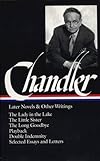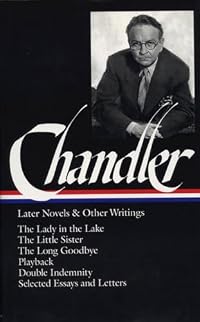
Later novels and other writings
by Raymond Chandler
On This Page
Description
Later Novels and Other Writings begins with The Lady in the Lake (1943). Written during the war, the story takes Marlowe out of the seamy L.A. streets to the deceptive tranquility of the surrounding mountains, as the search for a businessman's missing wife expands into an elegy of loneliness and loss. The darker tone typical of Chandler's later fiction is evident in The Little Sister (1949), in which an ambitious starlet, a blackmailer, and a seemingly naive young woman from Manhattan, show more Kansas, are the key players in a plot that provides fuel for a bitter indictment of Hollywood and Chandler's most savage portrayal of his adopted city. The Long Goodbye (1953), his most ambitious and self-revealing novel, uncovers a more anguished resonance in the Marlowe character, in a plot that hinges on the betrayal of friendship and the compromises of middle age. Playback (1958), written originally as a screenplay, is Chandler's seventh and last novel. A special feature of this volume is Chandler's long-unavailable screenplay for the film noir classic Double Indemnity (1944), adapted from James M. Cain's novel. Supplementing the volume, and providing a more personal glimpse of Chandler's personality, are a selection of essays - including "The Simple Art of Murder," in which Chandler muses on his pulp roots and on the special qualities of his hero and style - and eleven letters that range wittily and often sardonically over the worlds of writing, publishing, and filmmaking. show lessTags
Recommendations









Member Reviews
I have been obsessed with Chandler and his protagonist, Philip Marlowe, for most of my life. Now, I wonder if the character and the works he traipses through are best taken in dramatic form, where actors can breath life into what would now be called a Mary Sue--Chandler's Marlowe is just too good and too perfect to be believable or frankly interesting. In the correspondence in this volume Chandler lays out his fiction-writing philosophy, and for him dialogue and set pieces are more important than the overarching plot. I think the elements are too out of balance, and for most of the novels I just found myself not caring about Marlowe or the byzantine mystery he is unfolding. The best of the novels is Long Goodbye, where characterization show more and narrative are more in-synch, Chandler does not go into contortions trying to fit the narrative around what he wants to do with the characters. The Long Goodbye is also interesting because Chandler is starting to register the massive social changes of the 20th century USA, such as the rise of television and fast food, and the human wreckage left by military service during WWII. Although its probably less than 15 years since The Big Sleep, it seems like we are a long way from that novel.
In his correspondence Chandler does not come off very well; he is thin-skinned, full of false modesty and clearly thinks he is the best mystery writer (and maybe just best writer) of all time. He gives zero fucks about social issues, despite his novels' vague indictment of societal corruption. show less
In his correspondence Chandler does not come off very well; he is thin-skinned, full of false modesty and clearly thinks he is the best mystery writer (and maybe just best writer) of all time. He gives zero fucks about social issues, despite his novels' vague indictment of societal corruption. show less
THE LONG GOODBYE | read 2023-02
Two seemingly unrelated cases end up, unsurprisingly, linking together (however tangentially). Marlowe deals with two missing persons, one seemingly feeding off the wealthy ecosystem (Terry Lennox) and another a frustrated best-selling author (Roger Wade). Hollywood isn't directly in the spotlight here, but always looms in the shadows of LA and everyone living there.
Revisiting Macdonald's critique: Chandler provides plenty of meaningful observations about people and society in individual lines or in scenes. Chandler gets meaning out of his stories, it's part of why he's a good writer, but there isn't much of a theme to his stories beyond the setup of Marlowe as a realist-acting / romantic-at-heart loner in show more a society that's losing its promise. It's an exceedingly conservative and pessimistic outlook, indeed. So I'd argue not that Chandler doesn't write for meaning, rather than his theme remains consistent across all his novels.
"That's the difference between crime and business. For business you gotta have capital. Sometimes I think it's the only difference."
"A properly cynical remark," I said, "but big time crime takes capital too."
"And where does it come from, chum? Not from guys that hold up liquor stores. So long. See you soon."
[George Peters of the Carne Organization to Marlowe, 574]
THE LITTLE SISTER | read 2021-05
Features Hollywood ecosystem, and the media coverage of celebrities and murder, seemingly to show that crime is thoroughly looped into the celebrity culture. People from Manhattan KS and Cleveland OH are drawn to LA and Hollywood -- but also: stereotypes are exploited to wrong-foot the reader (never Marlowe). The country bumpkin is not the naif she pretends to be.
Some additional background on Marlowe, specifying he's 38 years old, and (already mentioned in prior novels?) fired from DA's office in a prior life. He confesses at the end that the case was always too complicated to figure, to "do the natural obvious thing" without second-guessing himself based on how that action "might affect somebody I owed something to" [415] -- when to the reader, Marlowe is always doing that natural thing, and has all the angles figured, though Chandler (and Marlowe) count on the fact that the reader does not.
"The fear of today," he said, "always overrides the fear of tomorrow. It's a basic fact of the dramatic emotions that the part is greater than the whole. If you see a glamour star on the screen in a position of great danger, you fear for her with one part of your mind, the emotional part. Notwithstanding that your reasoning mind knows that she is the star of the picture and nothing very bad is going to happen to her. If suspense and menace didn't defeat reason, there would be very little drama." [297]
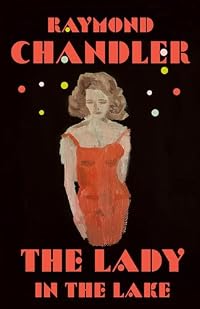
THE LADY IN THE LAKE | read 2020-12
Notwithstanding Ross Macdonald's criticism of Chandler for not using plot to deliver meaning, I'd argue Chandler does very well here: the theme of loneliness is pervasive, somehow coming through the murder and double-cross and not leaving the story as one of just thrill-seeking or harsh living. Loneliness is depicted through several characters and situations, too: not only the main storyline, adding an effective counterpoint to Marlowe's patter on the particulars of his missing persons case.
Chandler describes cultural shifts in America, alongside Marlowe's patter, and even calls attention to circumstances on the homefront in WWII: suburbia is already on the make. Overall, The Lady in the Lake is a compelling story and worth revisiting, not primarily for the mystery (though that's strong enough), but for observations on modern American society and the people dissatisfied with it.
Police business is a hell of a problem. It's a good deal like politics. It asks for the highest type of men, and there's nothing in it to attract the highest type of men. So we have to work with what we get .... [140]
//
to read:
PLAYBACK
DOUBLE INDEMNITY show less
Two seemingly unrelated cases end up, unsurprisingly, linking together (however tangentially). Marlowe deals with two missing persons, one seemingly feeding off the wealthy ecosystem (Terry Lennox) and another a frustrated best-selling author (Roger Wade). Hollywood isn't directly in the spotlight here, but always looms in the shadows of LA and everyone living there.
Revisiting Macdonald's critique: Chandler provides plenty of meaningful observations about people and society in individual lines or in scenes. Chandler gets meaning out of his stories, it's part of why he's a good writer, but there isn't much of a theme to his stories beyond the setup of Marlowe as a realist-acting / romantic-at-heart loner in show more a society that's losing its promise. It's an exceedingly conservative and pessimistic outlook, indeed. So I'd argue not that Chandler doesn't write for meaning, rather than his theme remains consistent across all his novels.
"That's the difference between crime and business. For business you gotta have capital. Sometimes I think it's the only difference."
"A properly cynical remark," I said, "but big time crime takes capital too."
"And where does it come from, chum? Not from guys that hold up liquor stores. So long. See you soon."
[George Peters of the Carne Organization to Marlowe, 574]
THE LITTLE SISTER | read 2021-05
Features Hollywood ecosystem, and the media coverage of celebrities and murder, seemingly to show that crime is thoroughly looped into the celebrity culture. People from Manhattan KS and Cleveland OH are drawn to LA and Hollywood -- but also: stereotypes are exploited to wrong-foot the reader (never Marlowe). The country bumpkin is not the naif she pretends to be.
Some additional background on Marlowe, specifying he's 38 years old, and (already mentioned in prior novels?) fired from DA's office in a prior life. He confesses at the end that the case was always too complicated to figure, to "do the natural obvious thing" without second-guessing himself based on how that action "might affect somebody I owed something to" [415] -- when to the reader, Marlowe is always doing that natural thing, and has all the angles figured, though Chandler (and Marlowe) count on the fact that the reader does not.
"The fear of today," he said, "always overrides the fear of tomorrow. It's a basic fact of the dramatic emotions that the part is greater than the whole. If you see a glamour star on the screen in a position of great danger, you fear for her with one part of your mind, the emotional part. Notwithstanding that your reasoning mind knows that she is the star of the picture and nothing very bad is going to happen to her. If suspense and menace didn't defeat reason, there would be very little drama." [297]
THE LADY IN THE LAKE | read 2020-12
Notwithstanding Ross Macdonald's criticism of Chandler for not using plot to deliver meaning, I'd argue Chandler does very well here: the theme of loneliness is pervasive, somehow coming through the murder and double-cross and not leaving the story as one of just thrill-seeking or harsh living. Loneliness is depicted through several characters and situations, too: not only the main storyline, adding an effective counterpoint to Marlowe's patter on the particulars of his missing persons case.
Chandler describes cultural shifts in America, alongside Marlowe's patter, and even calls attention to circumstances on the homefront in WWII: suburbia is already on the make. Overall, The Lady in the Lake is a compelling story and worth revisiting, not primarily for the mystery (though that's strong enough), but for observations on modern American society and the people dissatisfied with it.
Police business is a hell of a problem. It's a good deal like politics. It asks for the highest type of men, and there's nothing in it to attract the highest type of men. So we have to work with what we get .... [140]
//
to read:
PLAYBACK
DOUBLE INDEMNITY show less
The Lady in the Lake, Raymond Chandler’s fourth Philip Marlowe novel, was written just a few months after Pearl Harbor (published in 1943) but there are surprisingly few references to the war in it. Perhaps this reflects Chandler’s take on how the war affected Americans of the day – that, unless a son or husband was in the military, everyday life went on pretty much as normal. Or maybe he simply did not want to clutter up his murder mystery with too many references to such a catastrophic world event. Whatever his reasoning may have been, The Lady in the Lake still holds up well when compared to most of the crime fiction being produced today.
Philip Marlowe has been hired by Derace Kingsley, a perfume company tycoon, to find his show more missing wife, a woman Kingsley believes has run off to Mexico with her lover. As a place to begin his search, Kingsley points Marlowe in the direction of the couple’s remote getaway cabin located in the California hills on Little Fawn Lake. While being shown around the site, Chandler and the property’s caretaker, Bill Chess, spot a woman’s body in the shallow waters of the lake. That is when Chandler realizes that he is dealing with something much more complicated than the search for a man’s runaway wife.
Raymond Chandler is deservedly well known for his noir fiction and The Lady in the Lake is representative of that style. The novel is filled with strong characters bordering on what have become almost stereotypical types in noir fiction, all of whom play their parts well but offer little in the way of surprises. Derace Kingsley is the hard headed businessman who has little time or respect for those who do not play in his league. Al Degarmo is a brutal cop so confident and high on himself because of his unchallenged power on the streets that he has no fear of ever being exposed. On the other hand, two of Chandler’s characters do have a nice feel of authenticity about them: Bill Chess, the cantankerous caretaker at Little Fawn Lake, and Sheriff Jim Patton whose jurisdiction includes the lake area. Patton, in particular, is one of those memorable characters with whom most readers will easily identify.
The flaw in The Lady in the Lake appears late. As the book nears its finish, Chandler’s hardcore style morphs into what more resembles the Agatha Christie school of cozy detective fiction endings. Trapped in a small cabin with the person he believes is a coldblooded killer and the lawman that can make the arrest, Marlowe begins a monologue during which he notes and eliminates, one-by-one, the possible suspects. Marlowe does manage to spook his suspect into a fatal mistake, but it is always a letdown to the reader to have so much action take place “offstage.”
The Lady in the Lake is not considered classic Chandler in the way that The Big Sleep, The Long Goodbye, and Farewell, My Lovely are, but Chandler fans will not want to miss it.
Rated at: 4.0
(This Library of America edition is 5 stars all the way - The Lady in the Lake is a 4-star novel.) show less
Philip Marlowe has been hired by Derace Kingsley, a perfume company tycoon, to find his show more missing wife, a woman Kingsley believes has run off to Mexico with her lover. As a place to begin his search, Kingsley points Marlowe in the direction of the couple’s remote getaway cabin located in the California hills on Little Fawn Lake. While being shown around the site, Chandler and the property’s caretaker, Bill Chess, spot a woman’s body in the shallow waters of the lake. That is when Chandler realizes that he is dealing with something much more complicated than the search for a man’s runaway wife.
Raymond Chandler is deservedly well known for his noir fiction and The Lady in the Lake is representative of that style. The novel is filled with strong characters bordering on what have become almost stereotypical types in noir fiction, all of whom play their parts well but offer little in the way of surprises. Derace Kingsley is the hard headed businessman who has little time or respect for those who do not play in his league. Al Degarmo is a brutal cop so confident and high on himself because of his unchallenged power on the streets that he has no fear of ever being exposed. On the other hand, two of Chandler’s characters do have a nice feel of authenticity about them: Bill Chess, the cantankerous caretaker at Little Fawn Lake, and Sheriff Jim Patton whose jurisdiction includes the lake area. Patton, in particular, is one of those memorable characters with whom most readers will easily identify.
The flaw in The Lady in the Lake appears late. As the book nears its finish, Chandler’s hardcore style morphs into what more resembles the Agatha Christie school of cozy detective fiction endings. Trapped in a small cabin with the person he believes is a coldblooded killer and the lawman that can make the arrest, Marlowe begins a monologue during which he notes and eliminates, one-by-one, the possible suspects. Marlowe does manage to spook his suspect into a fatal mistake, but it is always a letdown to the reader to have so much action take place “offstage.”
The Lady in the Lake is not considered classic Chandler in the way that The Big Sleep, The Long Goodbye, and Farewell, My Lovely are, but Chandler fans will not want to miss it.
Rated at: 4.0
(This Library of America edition is 5 stars all the way - The Lady in the Lake is a 4-star novel.) show less
Other than Playback, which is a rejected screenplay turned into a novel that can't stand side by side with his other works, everything in this book is classic. I like the Long Goodbye the best. It is Chandler's longest novel, probably the most unguarded and truly meaningful. This makes it rise a bit above the other works, which are all perfectly crafted but rather inscrutable.
After reading all of Chandler's novels, it is clear that he didn't vary much as a writer. But his sheer talent for putting words together was so great that he stands as one of the geniuses of American literature. Comparing him to Hammett, he is completely unadventurous, both in subject matter and style, but he nevertheless emerges as his equal.
There are no excuses show more for not reading every word Chandler wrote! Let's be honest: even among us avid readers, we still rarely encounter those writers whose books are so much pleasure to read. show less
After reading all of Chandler's novels, it is clear that he didn't vary much as a writer. But his sheer talent for putting words together was so great that he stands as one of the geniuses of American literature. Comparing him to Hammett, he is completely unadventurous, both in subject matter and style, but he nevertheless emerges as his equal.
There are no excuses show more for not reading every word Chandler wrote! Let's be honest: even among us avid readers, we still rarely encounter those writers whose books are so much pleasure to read. show less
It was long and mystifying. I am a hardcore Chandler fan, but this one was difficult to finish.
The novels are excellent, of course, and available elsewhere, but this edition also has letters and essay that add to my appreciation of Chandler.
Members
- Recently Added By
Lists

American Lit for Eng 11 Research Project
368 works; 6 members
Author Information

278+ Works 47,969 Members
Raymond Chandler was born in Chicago, Illinois on July 23, 1888. Before becoming a professional writer in 1933, he worked as a reporter, an accountant, bookkeeper, and auditor. He wrote several novels featuring private detective Philip Marlowe including The Big Sleep, The High Window, The Lady in the Lake, The Little Sister, and The Long Goodbye. show more In addition to novels and short stories, he wrote screenplays. He won two academy awards, for Double Indemnity (1944) and The Blue Dahlia (1946). He died on March 26, 1959. (Bowker Author Biography) show less
Series
Belongs to Publisher Series
Library of America (080)
Work Relationships
Common Knowledge
- Canonical title
- Later novels and other writings
- Original publication date
- 1995-10-01
- Publisher's editor
- MacShane, Frank
- Disambiguation notice
- This is an omnibus unique to the Library of America; therefore, all CK facts apply to this publication only.
Classifications
Statistics
- Members
- 783
- Popularity
- 35,496
- Reviews
- 7
- Rating
- (4.54)
- Languages
- English, Spanish
- Media
- Paper
- ISBNs
- 2
- ASINs
- 3