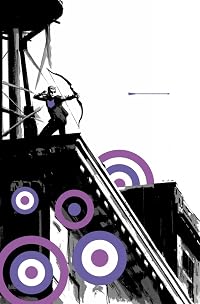
Hawkeye, Vol. 1: My Life as a Weapon
by Matt Fraction, David Aja (Illustrator), Alan Davis (Illustrator), Javier Pulido (Illustrator)
Hawkeye (Marvel Comics, 2012) (Collections and Selections — 1-5, Young Avengers Presents 6)
On This Page
Description
Also collects the Young Avengers Presents #6. The breakout star of this summer's blockbuster Avengers film, Clint Barton - aka the self-made hero Hawkeye - fights for justice! With ex-Young Avenger Kate Bishop by his side, he's out to prove himself as one of Earth's Mightiest Heroes! SHIELD recruits Clint to intercept a packet of incriminating evidence - before he becomes the most wanted man in the world.Tags
Recommendations










Member Reviews
From the get-go this Hawkeye series is impressive. David Aja's art is stylish, bold, and slightly abstract - matching in tone Matt Fraction's characterization of the titular hero. Clint Barton is a fantastic "Every Man" who just happens to moonlight as a superhero. The new landlord and dog owner is charming, slightly goofy, and as accident prone as any of us. His lack of organization and tendency to leap without looking echoes that of his young protege Kate, who's only a bit more put together than her teacher. The friendship and duel mentorship between Clint and Kate is endearing and hilarious at the same time, and Clint's feelings about and interactions with his Avengers teammates are complicated and tinged with a slight loneliness. show more It's easy to tell that Clint doesn't fit neatly into either the "normal" or "superhero" worlds - a trend that continues later in the series when *SPOILER* Clint loses his hearing and is returned to the duality of both the hearing and Deaf worlds in issue #19. *END SPOILER*
Overall masterfully written in a grounded and believable manner with a lot of humor and charm, with characters made vibrantly colorful from both writer and illustrator. This is the perfect comic for someone wanting to be introduced to Hawkeye, wanting to start reading about individual Avengers, or to just start reading comics in general. show less
Overall masterfully written in a grounded and believable manner with a lot of humor and charm, with characters made vibrantly colorful from both writer and illustrator. This is the perfect comic for someone wanting to be introduced to Hawkeye, wanting to start reading about individual Avengers, or to just start reading comics in general. show less
I will forever live in confusion regarding why hawkeye is altered so much in the mcu from his comic version because WOW.
This was honestly one of the best comics I've ever read, let alone a marvel comic. The way they artwork was detailed yet not with its sketch based style was so unique, and the use of colour helped to almost build atmosphere in the story.
AND CAN WE JUST
AT THE SCENES WITH THE DOG AND HAWKEYE LIKE OMG YES PUPPY
This was just so amazing I need to buy myself copy asap please and thank you.
This was honestly one of the best comics I've ever read, let alone a marvel comic. The way they artwork was detailed yet not with its sketch based style was so unique, and the use of colour helped to almost build atmosphere in the story.
AND CAN WE JUST
AT THE SCENES WITH THE DOG AND HAWKEYE LIKE OMG YES PUPPY
This was just so amazing I need to buy myself copy asap please and thank you.
I usually find Marvel graphic novels to be a complete fail (cheesy storylines, male-centric characters, too much cross-referencing other series, etc), but I had heard so many good things about this series that I figured I would try it out. I'm definitely glad that I did, because Clint Barton aka Hawkeye is one entertaining dude when he's not playing Legloas with the other Avengers. He still has that good guy vibe, but his concerns tend to be personal rather than world-centric; case and point, he goes up against the neighbourhood gangster who's raising extortionist rents, and he rescues a dog who helps him get out of a jam. Who am I kidding, I'm just reading the series for his adorable friendship with "Pizza Dog" and general snarkiness show more (haha). show less
Oh, Clint Barton. You adorable, awkward, totally kick-ass man, you! I'm so glad that my co-worker convinced me to read this! What does Hawkeye do when he's not with the Avengers? That's what this book sets out to show, and it does an excellent job.
First off, Matt Fraction's writing is superb. He gives Clint this perfect balance between sarcastic and sweet. It's hard not to fall head over heels in love with him. Watching him put on himself on the line for other people, lament the fact that he has no actual superpowers, and flirt awkwardly with Kate Bishop was all kinds of fun. I cracked up laughing more than once at the things that come out of this man's mouth. He really needs a better filter.
In terms of art, it's pure perfection here! show more It's not the most crisp art ever, and it has the tendency to be a bit duochrome, but it suits the story just fine. I especially loved all the panels where pizza dog made his debut! It's impressive that these amazing illustrators were able to bring an entire story line to life with nothing but wordless panels. LOVE! show less
First off, Matt Fraction's writing is superb. He gives Clint this perfect balance between sarcastic and sweet. It's hard not to fall head over heels in love with him. Watching him put on himself on the line for other people, lament the fact that he has no actual superpowers, and flirt awkwardly with Kate Bishop was all kinds of fun. I cracked up laughing more than once at the things that come out of this man's mouth. He really needs a better filter.
In terms of art, it's pure perfection here! show more It's not the most crisp art ever, and it has the tendency to be a bit duochrome, but it suits the story just fine. I especially loved all the panels where pizza dog made his debut! It's impressive that these amazing illustrators were able to bring an entire story line to life with nothing but wordless panels. LOVE! show less
I'll read anything if I think it's a good and avoid anything is bad like the plague, and since I like to like what I'm reading I'll usually try to find something positive about whatever I read, which is part of the reason why I give every damn thing five stars and say nice things about most things. I got over my snobbishness about superhero comics a while ago, but no way in hell will I follow a character or team just because, it's always about who's writing and drawing. Maybe it's projection but I sometimes think that this is an attitude some part of the superhero world is beginning to share, hence this, the famous Fraction/Aja run on Hawkeye - or Hawkguy as they started calling it.
With an exquisitely composed iconic opening action shot show more of Hawkeye falling backwards towards a distant street, firing an arrow towards the reader, framed in splinters of broken glass, Fraction and Aja seem to be setting out their stall with a typical, if beautiful, superhero action spectacular. Then he lands and spends six months in hospital and when he gets out pettishly kicks a wheelchair into traffic. There we go.
There are superhero shenanigans, but the heart of this story is the apartment block where he lves and the other inhabitants and the tracksuited Russian heavies who own the building and make life hard for everyone. There's also the dog, and Kate Bishop, the other Hawkeye. Clint Barton here is a good-hearted-slob and slacker, bit of a screw-up, but an Avenger with no superpowers so also kind of amazing, in a low-key embarrassed-to-be-amazing way. Hawkeye doesn't so much explore this dichotomy as gleefully mess around with it.
The Aja issues are a kind of giddy perfection comic readers dream about, a post-millennial update of the noir stylings of Mazzuchelli on Born Again and Year One. Javier Pulido is no slouch either, and the Bagley issue ends up being kind of sweet and somehow gets past a whole load of superhero shenanigans to make it work. A classic. show less
With an exquisitely composed iconic opening action shot show more of Hawkeye falling backwards towards a distant street, firing an arrow towards the reader, framed in splinters of broken glass, Fraction and Aja seem to be setting out their stall with a typical, if beautiful, superhero action spectacular. Then he lands and spends six months in hospital and when he gets out pettishly kicks a wheelchair into traffic. There we go.
There are superhero shenanigans, but the heart of this story is the apartment block where he lves and the other inhabitants and the tracksuited Russian heavies who own the building and make life hard for everyone. There's also the dog, and Kate Bishop, the other Hawkeye. Clint Barton here is a good-hearted-slob and slacker, bit of a screw-up, but an Avenger with no superpowers so also kind of amazing, in a low-key embarrassed-to-be-amazing way. Hawkeye doesn't so much explore this dichotomy as gleefully mess around with it.
The Aja issues are a kind of giddy perfection comic readers dream about, a post-millennial update of the noir stylings of Mazzuchelli on Born Again and Year One. Javier Pulido is no slouch either, and the Bagley issue ends up being kind of sweet and somehow gets past a whole load of superhero shenanigans to make it work. A classic. show less
So my wife introduced me to this graphic novel, and since then, I've decided that marrying her was a brilliant choice.
One of my favourite things about this comic is it's about Clint's life when he's not being an Avenger. He's just being Barton. He's depressed, he's moping around a shitty apartment in Brooklyn and normal life is fucking hard for him.
I quote some lines from this comic, and this comic regularly inspires me to write. I love the art style. It's inspired by that old, gritty noir-esque comic book art that I love. The colour palettes are perfect (and purple) and I adore them.
Am I on this bandwagon? Hell yeah I am, I'll ride the goddamned bandwagon right into the sun. I didn't really care about Hawkeye much before, right? To show more me, he was an Avenger who was sometimes in the comics with a whole swathe of other Avengers who was really good with a bow and arrow and who had the occasional speech bubble.
But now? Now I love this guy, and I love this comic. show less
One of my favourite things about this comic is it's about Clint's life when he's not being an Avenger. He's just being Barton. He's depressed, he's moping around a shitty apartment in Brooklyn and normal life is fucking hard for him.
I quote some lines from this comic, and this comic regularly inspires me to write. I love the art style. It's inspired by that old, gritty noir-esque comic book art that I love. The colour palettes are perfect (and purple) and I adore them.
Am I on this bandwagon? Hell yeah I am, I'll ride the goddamned bandwagon right into the sun. I didn't really care about Hawkeye much before, right? To show more me, he was an Avenger who was sometimes in the comics with a whole swathe of other Avengers who was really good with a bow and arrow and who had the occasional speech bubble.
But now? Now I love this guy, and I love this comic. show less
My Life as a Weapon is the first volume in Matt Fraction’s series about Clint Barton, also known as Hawkeye, a non-super powered super-hero who spends most of his time with the Avengers. The stories presented in this series are about what Hawkeye does when he is not working alongside Iron Man, Thor, and Captain America, and it turns out that the answer is mostly “gets in way over his head and gets injured”.
The interesting thing about Barton is that he’s pretty much simply an ordinary person with an extraordinary talent for archery. He isn’t super strong, he isn’t super durable, and he doesn’t have any high-tech equipment to help him out: He is, as is pointed out in the first pages of this volume, just a guy fighting crime show more with a weapon that dates to the Paleolithic era. The fact that he often stands shoulder-to-shoulder with medically enhanced super soldiers and literal gods while fighting cosmically powerful threats that could destroy all of humanity and doesn’t die in the process is probably the most remarkable aspect of Hawkeye’s existence.
Fraction begins each of the first three parts of this volume with Barton saying to the reader, in what amounts to a voice over narration, “Okay, this looks bad”. Each time Barton follows this up with an admission that the situation doesn’t just look bad, it actually is bad. Each time Barton proceeds to get the crap beat out of him, in some cases almost immediately thereafter, in others he can stave off the inevitable for a bit, but he winds up unconscious at least once in every sections of the story, and twice in two of them. In one incident, Barton ends up severely injured and hospitalized for an extended period of time. The running theme that underlies everything else in this volume is that the human body is simply too fragile for the life that Barton is leading. Despite his somewhat half-hearted protestations otherwise, Barton often gets himself into trouble because he thinks more like Captain America than he would care to admit. Though he often tries to adopt the pose of being indifferent, Barton always gives in to the pleas for help aired by those he comes into contact with, or, as in the case of Pizza Dog, acts to help those who happen to be near him when they are in need. His aid is often accompanied by his complaints, and is always well-meaning, but another theme that runs through this volume is that Barton is just not very good at solving problems. Fortunately, for the most part, the villains in the book aren't really all that much better at planning schemes. Much of the volume involves Barton essentially bumbling his way into foiling schemes formulated by criminals who are, at best, marginally competent themselves.
In the first section, Barton first winds up in the hospital as a result of literally falling off of a building, and upon being released he almost immediately walks into a local mob boss and his "tracksuit Mafia" evicting Barton's neighbors from their apartments when they can't pay the rent he recently tripled. Hawkeye's solution to the problem turns out to be to march down to the illegal gambling den that the mafia boss haunts and try to pay the rent for everyone in the building, and when that fails, try to fight his way through all of the boss's henchmen (which goes about as well as one would expect). This story is intercut with scenes of Barton demanding that a veterinarian treat Pizza Dog after the dog had been hurt very badly by being hit by a car, all the while insisting that Pizza Dog is not his dog. There is a rather obvious parallel drawn in the way the story is framed between Pizza Dog, who is thrown out into traffic by the tracksuit Mafia after it comes to Barton's aid, and Barton himself, and Barton's need to have Pizza Dog survive suggests that Barton knows this. In the end, Barton forces the mafia boss to sell him the building for a rather generous price (although one does have to wonder why Barton has $12.7 million in cash on hand), while the mafia boss protests that he did nothing illegal. In fact, the only person who has done something overtly illegal in this part of the story is actually Barton, but the reader is clearly supposed to side with him, as his illegal acts are in support of a noble cause, while the tracksuit Mafia's perfectly legal actions were intended to make people homeless.
The next section features Kate Bishop, who had once held the title of Hawkeye, as Barton tries to figure out what the warning signs in carney code that have been cropping up across town might mean. Barton figures out who the villains are when he and Bishop attend a gala performance of "Cirque du Nuit", and the story starts to resemble a traditional super-hero story except that Barton leads off by getting knocked out, captured, and then jumping out of a window into a swimming pool. It is up to Bishop to save his bacon, and while Clint rallies late to defeat the ringleader of the band of thieves, this is almost an anti climatic moment following Kate's heroics. Further, Barton manages to screw even this victory up, as he makes some rather powerful enemies in the process. This section further cements the pattern that Fraction's stories about Hawkeye will follow for the most part: Barton stumbles into a sticky situation, maneuvers his way through it by the skin of his teeth, and manages to somehow screw up the win.
The third section follows pretty much this established pattern, with Barton finding himself in a high-speed car chase through the streets of New York after he went out to get some tape and picked up a woman for a quick afternoon fling instead. She, of course, turns out to be on the run, and Barton manages to get knocked out, has to call upon Bishop for assistance, and winds up running through pretty much his entire inventory of gimmick arrows fending off their pursuers. True to form, Barton manages to get knocked out and captured again, and true to form, Kate saves the day. This section features two interesting twists - first, Barton never finds out what his paramour did, why she is on the run, or who exactly is pursuing her, and consequently neither does the reader. This further reinforces the almost bumbling nature of Barton's non-Avengers heroics. Second, Barton manages to unknowingly throw a wrench into his relationship with Bishop, and as usual, his screw-up is the result of his good intentions.
The final section of the main story is a two part piece that is probably the most "super-heroish" of anything in the volume. Barton is whisked away from a rooftop party by S.H.I.E.L.D. and sent to Madripoor with the organizations Amex Black and instructions to recover a videotape in which Barton was filmed committing a political assassination. This story is convoluted, full of twists and turns, with a veritable gallery of nefarious villains cropping up, as well as some unexpected allies. As I noted earlier, this story line adheres most closely to the the traditional "super-hero" style, and yet it is also the least satisfying section of the book. The plot is overly convoluted, and even though the situation ends up more or less where the good guys want it to be, the way they got there is so byzantine and depends on a couple of unexpected and entirely unpredictable developments that one is left wondering what the actual plan was. On the one hand, having no discernable plan seems entirely in character for Barton, but on the other, it seems entirely out of character for S.H.I.E.L.D., especially when one considers just how critically important Agent Hill insists that the mission is to everyone involved all the way up to the President of the United States. leaving this oddness aside, the real flaw in this story line is that Fraction simply doesn't play fair with the reader. The "big reveal" that comes at the end of the story makes several key scenes and conversations that happened earlier into nonsense. In short, Fraction was only able to preserve his surprise by not merely hiding information from the reader, but by having characters have discussions with one another that simply make no sense for them to have.
The final pages of this volume are dedicated to an installment of Young Avengers in which Barton, in his Ronin persona, tests Bishop as she is set to take over the mantle of Hawkeye. For her part, Bishop is dealing with some complicated romantic feelings for fellow Young Avengers Patriot and Speed, and is somewhat distracted throughout the story. To be blunt, this portion of the book is simply not as good as the rest, and even the artwork, which is fairly standard for comic books, feels jarring and out of place after an entire book of Aja and Pulido's almost impressionistic artwork in the main portion of the book. Putting an unrelated story at the end of a graphic novel collecting several issues seems to be a pattern for Marvel, and in my experience the added story always seems to fall short of the main work, and this book is no exception to that rule.
Hawkeye, as a non-super-powered super-hero, is somewhat unique among the Avengers, and this volume is somewhat unique among super-hero stories. Fraction, Aja, and Pulido have taken what could have been a bland and uninteresting character and breathed life into him by emphasizing his very mundane nature, and in the process highlighting what an exceptional individual he is as a result. Fraction is one of the few writers working in comics today whose work I will buy simply based upon his involvement in a project, and this volume is an example of the reason why that is so.
This review has also been posted to my blog Dreaming About Other Worlds. show less
The interesting thing about Barton is that he’s pretty much simply an ordinary person with an extraordinary talent for archery. He isn’t super strong, he isn’t super durable, and he doesn’t have any high-tech equipment to help him out: He is, as is pointed out in the first pages of this volume, just a guy fighting crime show more with a weapon that dates to the Paleolithic era. The fact that he often stands shoulder-to-shoulder with medically enhanced super soldiers and literal gods while fighting cosmically powerful threats that could destroy all of humanity and doesn’t die in the process is probably the most remarkable aspect of Hawkeye’s existence.
Fraction begins each of the first three parts of this volume with Barton saying to the reader, in what amounts to a voice over narration, “Okay, this looks bad”. Each time Barton follows this up with an admission that the situation doesn’t just look bad, it actually is bad. Each time Barton proceeds to get the crap beat out of him, in some cases almost immediately thereafter, in others he can stave off the inevitable for a bit, but he winds up unconscious at least once in every sections of the story, and twice in two of them. In one incident, Barton ends up severely injured and hospitalized for an extended period of time. The running theme that underlies everything else in this volume is that the human body is simply too fragile for the life that Barton is leading. Despite his somewhat half-hearted protestations otherwise, Barton often gets himself into trouble because he thinks more like Captain America than he would care to admit. Though he often tries to adopt the pose of being indifferent, Barton always gives in to the pleas for help aired by those he comes into contact with, or, as in the case of Pizza Dog, acts to help those who happen to be near him when they are in need. His aid is often accompanied by his complaints, and is always well-meaning, but another theme that runs through this volume is that Barton is just not very good at solving problems. Fortunately, for the most part, the villains in the book aren't really all that much better at planning schemes. Much of the volume involves Barton essentially bumbling his way into foiling schemes formulated by criminals who are, at best, marginally competent themselves.
In the first section, Barton first winds up in the hospital as a result of literally falling off of a building, and upon being released he almost immediately walks into a local mob boss and his "tracksuit Mafia" evicting Barton's neighbors from their apartments when they can't pay the rent he recently tripled. Hawkeye's solution to the problem turns out to be to march down to the illegal gambling den that the mafia boss haunts and try to pay the rent for everyone in the building, and when that fails, try to fight his way through all of the boss's henchmen (which goes about as well as one would expect). This story is intercut with scenes of Barton demanding that a veterinarian treat Pizza Dog after the dog had been hurt very badly by being hit by a car, all the while insisting that Pizza Dog is not his dog. There is a rather obvious parallel drawn in the way the story is framed between Pizza Dog, who is thrown out into traffic by the tracksuit Mafia after it comes to Barton's aid, and Barton himself, and Barton's need to have Pizza Dog survive suggests that Barton knows this. In the end, Barton forces the mafia boss to sell him the building for a rather generous price (although one does have to wonder why Barton has $12.7 million in cash on hand), while the mafia boss protests that he did nothing illegal. In fact, the only person who has done something overtly illegal in this part of the story is actually Barton, but the reader is clearly supposed to side with him, as his illegal acts are in support of a noble cause, while the tracksuit Mafia's perfectly legal actions were intended to make people homeless.
The next section features Kate Bishop, who had once held the title of Hawkeye, as Barton tries to figure out what the warning signs in carney code that have been cropping up across town might mean. Barton figures out who the villains are when he and Bishop attend a gala performance of "Cirque du Nuit", and the story starts to resemble a traditional super-hero story except that Barton leads off by getting knocked out, captured, and then jumping out of a window into a swimming pool. It is up to Bishop to save his bacon, and while Clint rallies late to defeat the ringleader of the band of thieves, this is almost an anti climatic moment following Kate's heroics. Further, Barton manages to screw even this victory up, as he makes some rather powerful enemies in the process. This section further cements the pattern that Fraction's stories about Hawkeye will follow for the most part: Barton stumbles into a sticky situation, maneuvers his way through it by the skin of his teeth, and manages to somehow screw up the win.
The third section follows pretty much this established pattern, with Barton finding himself in a high-speed car chase through the streets of New York after he went out to get some tape and picked up a woman for a quick afternoon fling instead. She, of course, turns out to be on the run, and Barton manages to get knocked out, has to call upon Bishop for assistance, and winds up running through pretty much his entire inventory of gimmick arrows fending off their pursuers. True to form, Barton manages to get knocked out and captured again, and true to form, Kate saves the day. This section features two interesting twists - first, Barton never finds out what his paramour did, why she is on the run, or who exactly is pursuing her, and consequently neither does the reader. This further reinforces the almost bumbling nature of Barton's non-Avengers heroics. Second, Barton manages to unknowingly throw a wrench into his relationship with Bishop, and as usual, his screw-up is the result of his good intentions.
The final section of the main story is a two part piece that is probably the most "super-heroish" of anything in the volume. Barton is whisked away from a rooftop party by S.H.I.E.L.D. and sent to Madripoor with the organizations Amex Black and instructions to recover a videotape in which Barton was filmed committing a political assassination. This story is convoluted, full of twists and turns, with a veritable gallery of nefarious villains cropping up, as well as some unexpected allies. As I noted earlier, this story line adheres most closely to the the traditional "super-hero" style, and yet it is also the least satisfying section of the book. The plot is overly convoluted, and even though the situation ends up more or less where the good guys want it to be, the way they got there is so byzantine and depends on a couple of unexpected and entirely unpredictable developments that one is left wondering what the actual plan was. On the one hand, having no discernable plan seems entirely in character for Barton, but on the other, it seems entirely out of character for S.H.I.E.L.D., especially when one considers just how critically important Agent Hill insists that the mission is to everyone involved all the way up to the President of the United States. leaving this oddness aside, the real flaw in this story line is that Fraction simply doesn't play fair with the reader. The "big reveal" that comes at the end of the story makes several key scenes and conversations that happened earlier into nonsense. In short, Fraction was only able to preserve his surprise by not merely hiding information from the reader, but by having characters have discussions with one another that simply make no sense for them to have.
The final pages of this volume are dedicated to an installment of Young Avengers in which Barton, in his Ronin persona, tests Bishop as she is set to take over the mantle of Hawkeye. For her part, Bishop is dealing with some complicated romantic feelings for fellow Young Avengers Patriot and Speed, and is somewhat distracted throughout the story. To be blunt, this portion of the book is simply not as good as the rest, and even the artwork, which is fairly standard for comic books, feels jarring and out of place after an entire book of Aja and Pulido's almost impressionistic artwork in the main portion of the book. Putting an unrelated story at the end of a graphic novel collecting several issues seems to be a pattern for Marvel, and in my experience the added story always seems to fall short of the main work, and this book is no exception to that rule.
Hawkeye, as a non-super-powered super-hero, is somewhat unique among the Avengers, and this volume is somewhat unique among super-hero stories. Fraction, Aja, and Pulido have taken what could have been a bland and uninteresting character and breathed life into him by emphasizing his very mundane nature, and in the process highlighting what an exceptional individual he is as a result. Fraction is one of the few writers working in comics today whose work I will buy simply based upon his involvement in a project, and this volume is an example of the reason why that is so.
This review has also been posted to my blog Dreaming About Other Worlds. show less
Members
- Recently Added By
Lists

Recommended Comics / Graphic Novels
595 works; 122 members

Books Read in 2020
4,379 works; 124 members

Books Read in 2021
5,361 works; 114 members

Top Five Books of 2025
954 works; 303 members
Author Information

548+ Works 16,329 Members


All Editions
Some Editions
Awards and Honors
Awards
Distinctions
Notable Lists
Series

Belongs to Publisher Series
Work Relationships
Is contained in
Common Knowledge
- Canonical title
- Hawkeye, Vol. 1: My Life as a Weapon
- Original title
- Hawkeye, Vol. 1: My Life as a Weapon
- Original publication date
- 2013
- People/Characters
- Hawkeye I (Clint Barton); Hawkeye II (Kate Bishop); Swordsman; Madame Masque; Ronin II (Clint Barton); Lucky the Pizza Dog
- Important places
- New York, New York, USA
- Related movies
- The Avengers (2012 | IMDb)
- First words
- Okay... this looks bad.
- Last words
- (Click to show. Warning: May contain spoilers.)I'm not going anywhere.
- Original language
- English
Classifications
- Genres
- Graphic Novels & Comics, Teen
- DDC/MDS
- 741.5 — Arts & recreation Drawing & decorative arts Drawing Comic books, graphic novels, fotonovelas, cartoons, caricatures, comic strips
- LCC
- NC1639 .P85 — Fine Arts Drawing. Design. Illustration Drawing. Design. Illustration Pictorial humor, caricature, etc.
- BISAC
Statistics
- Members
- 1,425
- Popularity
- 16,566
- Reviews
- 69
- Rating
- (4.20)
- Languages
- 7 — English, French, German, Spanish, Turkish, Portuguese (Portugal), Portuguese (Brazil)
- Media
- Paper, Ebook
- ISBNs
- 12
- UPCs
- 1
- ASINs
- 5