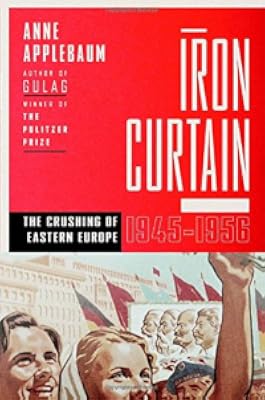
Iron Curtain: The Crushing of Eastern Europe, 1944-1956
by Anne Applebaum
On This Page
Description
In the long-awaited follow-up to her Pulitzer Prize-winning Gulag, acclaimed journalist Anne Applebaum delivers a groundbreaking history of how Communism took over Eastern Europe after World War II and transformed in frightening fashion the individuals who came under its sway.At the end of World War II, the Soviet Union to its surprise and delight found itself in control of a huge swath of territory in Eastern Europe. Stalin and his secret police set out to convert a dozen radically show more different countries to Communism, a completely new political and moral system. In Iron Curtain, Pulitzer Prize-winning journalist Anne Applebaum describes how the Communist regimes of Eastern Europe were created and what daily life was like once they were complete. She draws on newly opened East European archives, interviews, and personal accounts translated for the first time to portray in devastating detail the dilemmas faced by millions of individuals trying to adjust to a way of life that challenged their every belief and took away everything they had accumulated. Today the Soviet Bloc is a lost civilization, one whose cruelty, paranoia, bizarre morality, and strange aesthetics Applebaum captures in the electrifying pages of Iron Curtain.
. show less
Tags
Recommendations
















Member Recommendations
Member Reviews
Appelbaum dissects the way that civil society in Eastern Europe was eradicated in the years following WWII, and replaced by a monolithic, state-run apparatus that controlled all aspects of peoples' lives. In her epilogue, she uses the example of the reemergence of the Polish Women's League in Lodz to show how freedom and democracy require groups such as these - non-profit advocacy groups that are dedicated to accomplishing what the state cannot. Appelbaum aptly points out that the Russian government still persecutes many of these groups within their own country.
What was most shocking to me was the way that the Red Army and the Soviet government treated potential allies in the Polish Home Army, and other anti-Nazi leftists. Some of the show more concentration camps used in the Holocaust were reused to imprison political dissidents. Some people who were liberated from concentration camps were then sent to the Gulag for not being "politically correct". The communist project in Eastern Europe might have been more successful if they had not sown such bitter seeds at the beginning. show less
What was most shocking to me was the way that the Red Army and the Soviet government treated potential allies in the Polish Home Army, and other anti-Nazi leftists. Some of the show more concentration camps used in the Holocaust were reused to imprison political dissidents. Some people who were liberated from concentration camps were then sent to the Gulag for not being "politically correct". The communist project in Eastern Europe might have been more successful if they had not sown such bitter seeds at the beginning. show less
Life under Nazi overlords during World War II was horrific for the peoples of Eastern Europe, but it didn’t improve all that much once the Red Army arrived, ostensibly as “liberators.” Anne Applebaum’s Iron Curtain is an account (in great and graphic detail) of how the Soviets imposed their will on Eastern Europe, particularly in Poland, East Germany, and Hungary.
Applebaum is fluent in Polish and Hungarian, and so she has been able to utilize sources inaccessible to most western historians. The result is a much more comprehensive narrative of the imposition of Soviet style communism on what became the Eastern Bloc than has hitherto been available to the general reader in the West. And what a sad tale of woe it is!
Stalin was not show more about to allow unfriendly states exist on his western border. Accordingly, the Soviet government began planning how to control the small countries of Eastern Europe once it became apparent that the Red Army would sweep into Germany. Negotiations with the western allies (the U.S. and Britain) for a post-war settlement at Teheran, Yalta, and Potsdam conferences proved to be just window dressing, as the Soviets did pretty much what they wanted in areas controlled by their armed forces irrespective of the agreements arrived at the conferences.
Pockets of armed resistance to Soviet rule continued for several years after the war against Germany had ended in 1945. Ukrainians fought Poles for control of disputed territory before new national boundaries were finalized under Russian supervision. The Polish “Home Army,” an anti-communist group that had formed while the Nazis were still in power, fought the Soviet-imposed government on into the early 1950s before they were finally suppressed.
Mass deportations were effected immediately after the German surrender as Stalin sought to change the boundaries of Europe by relocating Poland several hundred miles to the west. This was “ethnic cleansing” writ large. Millions of people were put on trains and shipped out of their native countries. Germans living in what had been East Prussia were shipped west to a shrunken Germany while their former homeland became part of Poland. Whole groups of Poles and Ukrainians were in essence “swapped” – Poles living in the Soviet Union were shipped west, and Ukrainians in Poland were sent east.
As the Red Army poured into Eastern Europe, it was accompanied by the NKVD (the predecessor to the KGB) and a cadre of Moscow-trained communist nationals of each conquered country. The tightening of the Soviet grip was gradual, except in Germany. The Soviets even allowed relatively fair elections to take place in Hungary and Czechoslovakia in 1946 and 1947. The communists expected to win since they viewed themselves to be liberators of those countries. They were stunned to find out that they were very unpopular, garnering only small minorities of the votes. How then did the Soviets impose “totalitarianism” on the societies they conquered? Applebaum puts forth a number of explanations:
Most saliently, there were life-threatening repercussions to disobedience. The NKVD maintained control of the security apparatus and established Gestapo-like secret police institutions in all the occupied countries. They then employed intimidation, beatings, transportation to the Gulag, and executions of anti-communists to impose Stalin’s will on the general populace of all the eastern European countries except Yugoslavia, which, although communist, had not been “liberated” by the Red Army.
In addition, the Soviets immediately took control over the radio broadcasting capacity of each country. (They believed strongly in the power of propaganda and at that time, radio was the most powerful broadcast medium.) They took advantage of the natural tendency of people to defer to authority. Also, like the Nazis and early Soviet communists, the East European communists organized the youth into propaganda-driven organizations with putative goals of social or intellectual or physical achievement. And finally, after years of the war and depredations of World War II, East Europeans just wanted to return to normalcy, even if the new “normal” wasn’t very good.
Two other important considerations kept the otherwise not-very-workable system going. On the one hand, elites had many special privileges not available to the masses to keep them happy and in line. They therefore had a vested interest in maintaining the system. On the other hand, the hoi polloi had a number of well-established ways to get around the strictures and hardships of the Communist regimes. Even if you couldn’t find anything in the notoriously empty grocery stores, it wasn’t impossible to get what you wanted “na leva” (literally, “on the left” – i.e., outside of normal channels.) Furthermore, while you couldn’t get access to anything interesting to read in regular book shops, “samizdat,” or censored publications reproduced by hand and passed from reader to reader, still allowed those who could work the system to get information from the world on the other side of the curtain.
Most of Applebaum's book, however, is not about why the takeover happened, but rather what it was like, and what the nature was of the system the Communists sought to impose in East Germany, Poland, and Hungary.
After she describes the process of the takeovers, Applebaum details the careers of several “mini-Stalins,” who were put in charge of various governments by the Soviets. All of them were nationals of the countries they came to rule, but had been communists before the war, and received rigorous training in Stalinist statecraft in the Soviet Union. She also gives an account of ordinary life in the communist countries, bleak from consumer goods shortages, dreary propaganda-laden “entertainment,” and virtually complete lack of political choice.
Applebaum ends the history in 1956 with the Polish and Hungarian uprisings, although that was far from the end of the Iron Curtain. But there was in fact a sea change then. Stalin had died in 1953, and the Kremlin was trying to stabilize its satellites. Presumably, she will continue the saga with another volume.
Evaluation: Applebaum’s prose is readable and her historical research is very thorough. To some extent, the book drags on because the story is so depressing. But for anyone who wonders how people could live so long under the adverse conditions of communist-ruled Eastern Europe, this book provides a very complete explanation.
The author is what we might label a “neo-con” on the political spectrum. She currently directs political studies at the Legatum Institute, and before that worked for the American Enterprise Institute. She is also married to a fierce anti-communist Polish politician. While I could see how her background may have colored her presentation, I could not quarrel with the facts she presented.
I listened to the unabridged audio version. The narrator, Cassandra Campbell, seemed quite competent, particularly in her fluent pronunciation of foreign words and names. Nevertheless, the unrelenting progression of depressing events caused the listening experience to be a downer. Moreover, some readers less familiar with the time and geography under consideration might miss the maps, photos, and footnotes that accompany the written book.
(JAB) show less
Applebaum is fluent in Polish and Hungarian, and so she has been able to utilize sources inaccessible to most western historians. The result is a much more comprehensive narrative of the imposition of Soviet style communism on what became the Eastern Bloc than has hitherto been available to the general reader in the West. And what a sad tale of woe it is!
Stalin was not show more about to allow unfriendly states exist on his western border. Accordingly, the Soviet government began planning how to control the small countries of Eastern Europe once it became apparent that the Red Army would sweep into Germany. Negotiations with the western allies (the U.S. and Britain) for a post-war settlement at Teheran, Yalta, and Potsdam conferences proved to be just window dressing, as the Soviets did pretty much what they wanted in areas controlled by their armed forces irrespective of the agreements arrived at the conferences.
Pockets of armed resistance to Soviet rule continued for several years after the war against Germany had ended in 1945. Ukrainians fought Poles for control of disputed territory before new national boundaries were finalized under Russian supervision. The Polish “Home Army,” an anti-communist group that had formed while the Nazis were still in power, fought the Soviet-imposed government on into the early 1950s before they were finally suppressed.
Mass deportations were effected immediately after the German surrender as Stalin sought to change the boundaries of Europe by relocating Poland several hundred miles to the west. This was “ethnic cleansing” writ large. Millions of people were put on trains and shipped out of their native countries. Germans living in what had been East Prussia were shipped west to a shrunken Germany while their former homeland became part of Poland. Whole groups of Poles and Ukrainians were in essence “swapped” – Poles living in the Soviet Union were shipped west, and Ukrainians in Poland were sent east.
As the Red Army poured into Eastern Europe, it was accompanied by the NKVD (the predecessor to the KGB) and a cadre of Moscow-trained communist nationals of each conquered country. The tightening of the Soviet grip was gradual, except in Germany. The Soviets even allowed relatively fair elections to take place in Hungary and Czechoslovakia in 1946 and 1947. The communists expected to win since they viewed themselves to be liberators of those countries. They were stunned to find out that they were very unpopular, garnering only small minorities of the votes. How then did the Soviets impose “totalitarianism” on the societies they conquered? Applebaum puts forth a number of explanations:
Most saliently, there were life-threatening repercussions to disobedience. The NKVD maintained control of the security apparatus and established Gestapo-like secret police institutions in all the occupied countries. They then employed intimidation, beatings, transportation to the Gulag, and executions of anti-communists to impose Stalin’s will on the general populace of all the eastern European countries except Yugoslavia, which, although communist, had not been “liberated” by the Red Army.
In addition, the Soviets immediately took control over the radio broadcasting capacity of each country. (They believed strongly in the power of propaganda and at that time, radio was the most powerful broadcast medium.) They took advantage of the natural tendency of people to defer to authority. Also, like the Nazis and early Soviet communists, the East European communists organized the youth into propaganda-driven organizations with putative goals of social or intellectual or physical achievement. And finally, after years of the war and depredations of World War II, East Europeans just wanted to return to normalcy, even if the new “normal” wasn’t very good.
Two other important considerations kept the otherwise not-very-workable system going. On the one hand, elites had many special privileges not available to the masses to keep them happy and in line. They therefore had a vested interest in maintaining the system. On the other hand, the hoi polloi had a number of well-established ways to get around the strictures and hardships of the Communist regimes. Even if you couldn’t find anything in the notoriously empty grocery stores, it wasn’t impossible to get what you wanted “na leva” (literally, “on the left” – i.e., outside of normal channels.) Furthermore, while you couldn’t get access to anything interesting to read in regular book shops, “samizdat,” or censored publications reproduced by hand and passed from reader to reader, still allowed those who could work the system to get information from the world on the other side of the curtain.
Most of Applebaum's book, however, is not about why the takeover happened, but rather what it was like, and what the nature was of the system the Communists sought to impose in East Germany, Poland, and Hungary.
After she describes the process of the takeovers, Applebaum details the careers of several “mini-Stalins,” who were put in charge of various governments by the Soviets. All of them were nationals of the countries they came to rule, but had been communists before the war, and received rigorous training in Stalinist statecraft in the Soviet Union. She also gives an account of ordinary life in the communist countries, bleak from consumer goods shortages, dreary propaganda-laden “entertainment,” and virtually complete lack of political choice.
Applebaum ends the history in 1956 with the Polish and Hungarian uprisings, although that was far from the end of the Iron Curtain. But there was in fact a sea change then. Stalin had died in 1953, and the Kremlin was trying to stabilize its satellites. Presumably, she will continue the saga with another volume.
Evaluation: Applebaum’s prose is readable and her historical research is very thorough. To some extent, the book drags on because the story is so depressing. But for anyone who wonders how people could live so long under the adverse conditions of communist-ruled Eastern Europe, this book provides a very complete explanation.
The author is what we might label a “neo-con” on the political spectrum. She currently directs political studies at the Legatum Institute, and before that worked for the American Enterprise Institute. She is also married to a fierce anti-communist Polish politician. While I could see how her background may have colored her presentation, I could not quarrel with the facts she presented.
I listened to the unabridged audio version. The narrator, Cassandra Campbell, seemed quite competent, particularly in her fluent pronunciation of foreign words and names. Nevertheless, the unrelenting progression of depressing events caused the listening experience to be a downer. Moreover, some readers less familiar with the time and geography under consideration might miss the maps, photos, and footnotes that accompany the written book.
(JAB) show less
Perhaps what is most fascinating about the strange episode of human history under which the communist oppression of Eastern Europe falls is that it has gone so long without a comprehensive history of how it occurred. Anne Applebaum's Iron Curtain: The Crushing of Eastern Europe, 1944-1956 appears to step into that gap, providing in-depth research and a vividly written history of the period that saw the Soviet oppression and domination through totalitarian regimes of what would come to be known as the Communist Bloc and comprising the countries in Central and Eastern Europe with communist regimes.
Uniquely, the communist dictatorships that lasted, roughly speaking, from the end of World War II until the fall of the Berlin Wall were based, show more at least in theory, on an ideology rather than nationalism or, as in the case of Germany, racism. Applebaum traces the oppression of Eastern Europe and the rise of the Iron Curtain to "zero hour," that moment of silence between the retreat of the German war machine and the invasion of the Russian army on its way to Berlin. The fighting had ended, and life was to begin again, but in Eastern Europe, where the carnage was worse than anything on the western half of the continent, there was no fresh start. People slipped from labor camps to make their way home, others began long migrations back to their homeland (or further if their homeland was now held by others), and still others continued fighting, shifting focus from the Nazis to the occupying Russian Army. The destruction left not a blank slate, but a gap of order, and into this gap the Soviets dictated the new order at the point of the Russian soldier's gun.
Applebaum's writing is vivid and clear, making colorful even the grey oppression of the dark communist decades. Here's an example from the beginning of the book that I think typifies her writing and which kept be reading to the end:
Lending an image both of the vast and the specific simultaneously, it's an apt start to Applebaum's endeavour to examine the methods and means by which communists, largely directed and guided from Moscow, set up and took control of the governments and people of Eastern and Central Europe, first under the guise of democratic elections and then, as necessary, with the assistance of secret police and tank columns.
As she details the fall and decline of civil society to the relentless oppression, Applebaum walks through how communists took control of and used the police, youth organizations, the media (which meant radio in those days), politics, and the economies of Central and Eastern Europe, but especially with a focus on Poland and Hungary. Her examination isn't directed so much as communism--China, Cuba, North Korea, and Russia (but for its role dominating the Soviet bloc) are not address--but totalitarianism. American "Cold Warriors" positioned themselves, as Applebaum puts it, as opponents to it, and Applebaum sets out to examine whether it was a real threat or just a ruse and exaggeration. Today, the threat of totalitarianism may seem silly, but in a time when Hitler was fresh on the mind and while Stalin's personality cult raged, the possibility of that the USSR would turn Eastern Europe into an ideologically and politically homogenous region seemed real.
Gone the way of history though it may be, Applebaum succeeds in bringing the period to life, drawing on new resources and documents to tell the stories of the post-World War II Poles, Hungarians, and others trapped behind the Iron Curtain. After reading it earlier this year, I have found myself turning back to Iron Curtain's pages on more than one occasion to refresh my memory on details and discussions that Applebaum's book holds. Not only is it a fascinating, if dark, period of history, but it is a saga we would be wise to learn from and retain. Applebaum does it justice in her account, and it should be a part of the library of any person with even the slightest interest in history of Eastern Europe and the brave people who endured the totalitarian oppression of communism and Soviet Russia. show less
Uniquely, the communist dictatorships that lasted, roughly speaking, from the end of World War II until the fall of the Berlin Wall were based, show more at least in theory, on an ideology rather than nationalism or, as in the case of Germany, racism. Applebaum traces the oppression of Eastern Europe and the rise of the Iron Curtain to "zero hour," that moment of silence between the retreat of the German war machine and the invasion of the Russian army on its way to Berlin. The fighting had ended, and life was to begin again, but in Eastern Europe, where the carnage was worse than anything on the western half of the continent, there was no fresh start. People slipped from labor camps to make their way home, others began long migrations back to their homeland (or further if their homeland was now held by others), and still others continued fighting, shifting focus from the Nazis to the occupying Russian Army. The destruction left not a blank slate, but a gap of order, and into this gap the Soviets dictated the new order at the point of the Russian soldier's gun.
Applebaum's writing is vivid and clear, making colorful even the grey oppression of the dark communist decades. Here's an example from the beginning of the book that I think typifies her writing and which kept be reading to the end:
Explosions echoed throughout the night, and artillery fire could be heard throughout the day. Across Eastern Europe, the noise of falling bombs, rattling machine guns, rolling tanks, churning engines, and burning buildings heralded the approach of the Red Army. As the front line drew closer, the ground shook, the walls shivered, the children screamed. And then it stopped.
Lending an image both of the vast and the specific simultaneously, it's an apt start to Applebaum's endeavour to examine the methods and means by which communists, largely directed and guided from Moscow, set up and took control of the governments and people of Eastern and Central Europe, first under the guise of democratic elections and then, as necessary, with the assistance of secret police and tank columns.
As she details the fall and decline of civil society to the relentless oppression, Applebaum walks through how communists took control of and used the police, youth organizations, the media (which meant radio in those days), politics, and the economies of Central and Eastern Europe, but especially with a focus on Poland and Hungary. Her examination isn't directed so much as communism--China, Cuba, North Korea, and Russia (but for its role dominating the Soviet bloc) are not address--but totalitarianism. American "Cold Warriors" positioned themselves, as Applebaum puts it, as opponents to it, and Applebaum sets out to examine whether it was a real threat or just a ruse and exaggeration. Today, the threat of totalitarianism may seem silly, but in a time when Hitler was fresh on the mind and while Stalin's personality cult raged, the possibility of that the USSR would turn Eastern Europe into an ideologically and politically homogenous region seemed real.
Gone the way of history though it may be, Applebaum succeeds in bringing the period to life, drawing on new resources and documents to tell the stories of the post-World War II Poles, Hungarians, and others trapped behind the Iron Curtain. After reading it earlier this year, I have found myself turning back to Iron Curtain's pages on more than one occasion to refresh my memory on details and discussions that Applebaum's book holds. Not only is it a fascinating, if dark, period of history, but it is a saga we would be wise to learn from and retain. Applebaum does it justice in her account, and it should be a part of the library of any person with even the slightest interest in history of Eastern Europe and the brave people who endured the totalitarian oppression of communism and Soviet Russia. show less
In this popular history of the imposition of Stalinist culture and control in the Soviet regime’s World War II conquests, Applebaum aims to provide anecdote and example to how this process took place. To a large degree Applebaum seems to be clearly reacting to the failures of creating more humane and open cultures in the wake of the fall of the Soviet system, and she places these failures squarely on an unwillingness to forthrightly remember and analyze how this state of affairs came to pass.
Concentrating in particular on the experience of Stalinization in the German Democratic Republic, Poland and Hungary, several thoughts come to mind.
Having not followed the latest scholarship on the ethnic cleansing that took place, coverage of show more that process was perhaps the biggest revelation for me in this work (the chapters being essentially organized on a thematic basis). Besides providing an overview of the whole unpleasant business, Applebaum makes the useful point that the oppression and expulsion of minority populations in the countries in question provided a trial run for the subjugation of the rest of the population, if only by creating the cadre of willing collaborators needed to make Stalinization work.
Going hand in hand with this is perhaps the biggest flaw in the work, in that Applebaum essentially starts with the “Zero Hour” motif of a slate swept clean, which (intentionally or not) allows her to gloss over the failings of (particularly) Polish and Hungarian society before the Second World War. Even before the impact of Nazi tyranny there was much that was not admirable about those states, even if they had the sort of viable civil societies that the Stalinist system of total politicization tried to co-opt or destroy. This is particularly unfortunate seeing as for most readers this might be their initial and only exposures to these histories. While it would make a long book even longer, it would be helpful for the general reader to know of, say, the Polish-Czech border disputes that helped to confuse the response to Nazi imperialism, or of the authoritarian and nationalistic culture that marginalized the Jewish population of Hungary even before the Second World War. If part of the goal of this book is to bring back memory it also has to include the debunking of the misplaced sense of victimhood that still pervades many of these countries in the Post-Soviet era.
That said, this is still a very readable account of a period that has not been that well understood, at least due to the number of languages and areas of expertise that are required to even give a cursory overview. show less
Concentrating in particular on the experience of Stalinization in the German Democratic Republic, Poland and Hungary, several thoughts come to mind.
Having not followed the latest scholarship on the ethnic cleansing that took place, coverage of show more that process was perhaps the biggest revelation for me in this work (the chapters being essentially organized on a thematic basis). Besides providing an overview of the whole unpleasant business, Applebaum makes the useful point that the oppression and expulsion of minority populations in the countries in question provided a trial run for the subjugation of the rest of the population, if only by creating the cadre of willing collaborators needed to make Stalinization work.
Going hand in hand with this is perhaps the biggest flaw in the work, in that Applebaum essentially starts with the “Zero Hour” motif of a slate swept clean, which (intentionally or not) allows her to gloss over the failings of (particularly) Polish and Hungarian society before the Second World War. Even before the impact of Nazi tyranny there was much that was not admirable about those states, even if they had the sort of viable civil societies that the Stalinist system of total politicization tried to co-opt or destroy. This is particularly unfortunate seeing as for most readers this might be their initial and only exposures to these histories. While it would make a long book even longer, it would be helpful for the general reader to know of, say, the Polish-Czech border disputes that helped to confuse the response to Nazi imperialism, or of the authoritarian and nationalistic culture that marginalized the Jewish population of Hungary even before the Second World War. If part of the goal of this book is to bring back memory it also has to include the debunking of the misplaced sense of victimhood that still pervades many of these countries in the Post-Soviet era.
That said, this is still a very readable account of a period that has not been that well understood, at least due to the number of languages and areas of expertise that are required to even give a cursory overview. show less
In this book, Anne Applebaum presents overwhelming evidence that the Soviet takeover of Eastern Europe after WW2 was just that -- a carefully planned and brutally executed Soviet program. This isn't exactly new news. But she presents the story in a new way, framing it in the institutions of totalitarianism, and ticking off one by one the areas in which the USSR reshaped (or destroyed) institutions in eastern European countries to produce states modeled on the USSR itself. Unquestionable, she has a strongly anti-communist view. Her evidence, however, is so compelling that this view becomes a very convincing narrative of what happened, and how it happened. Moreover, she writes very well, so that what could have been an important but show more turgid framework for footnotes becomes a powerful narrative. For me, her compelling arguments and her crushing pile of evidence moved at least this reader away from the standard old liberal view of "well, yeah, but the U.S. did lots of bad things too". What happened in Eastern Europe was not an accident, and it didn't reflect the wishes of most of the people in the region. The fall of Communism in Eastern Europe, after reading this account of its beginnings, looks like a very good thing indeed. show less
In her excellent book Gulag: A History, Anne Applebaum briefly summarizes the Soviet takeover of Eastern Europe with a note that she can’t give it the attention it deserves. In this book, she has returned to the subject. While Applebaum starts at “zero hour” – the moment German troops withdrew and the Red Army replaced them – she notes that unsurprisingly the past continued to affect how things developed. She mainly focuses on three areas – Poland, Hungary and East Germany – and uses them to illustrate differences and similarities in the Soviet approach. For example, in many cases Soviet authority could be asserted openly in East Germany, as it had been agreed that it would be under their control. However, the proximity to show more the West and the worries of defection affected other aspects – no show trials in Germany. Sometimes this approach leads to some jumping around – through time and from country to country. In the second half of the book, life under Communist rule is examined, with more personal stories and descriptions of daily life. Some of the topics are so broad – socialist realist art, for example - that Applebaum can only choose a few examples. Still, everything is quite interesting, and this is an engrossing and informative work on an important, if extremely unpleasant, topic.
After World War II, the population of Eastern Europe was traumatized and many had been displaced – Applebaum provides statistics indicating an extreme disruption. Many no longer had any faith in their government, previous beliefs or nationalist ideas. Theft and violence were almost a way of life or at least no longer extraordinary. There was initial enthusiasm for the Soviets and at least at first, some people could come out of hiding or return. The notorious acts of theft, rape and violence perpetrated by the soldiers were not only in Germany but Hungary, which had been on the German side, and Poland, which had been oppressed by the Germans. No efforts were made to address the crimes, with soldiers who protested accused of siding with a German woman over their countrymen and higher ups indifferent or accepting – Stalin shrugged it off. Large-scale looting – of factories, valuables and documents – occurred as part of “reparations” which had more planning than the sporadic personal violence but was also haphazard. Applebaum describes the political maneuvering by Churchill and Roosevelt. Both took a pragmatic and cautious approach – they didn’t want another costly war. Roosevelt seemed convinced of Stalin’s good intentions and Churchill recognized that it would be hard to force out the Red Army when they were already occupying Eastern Europe.
The “little Stalins” of East Germany, Hungary and Poland are described. Walter Ulbrecht was a dull true believer who came to power after purges removed many charistmatic and better-educated German Communists. Boleslaw Bierut, a shady Polish Communist, seemingly came out of nowhere but had many links to the Soviets. There were speculations of collaborating with both the Nazis and Soviets – as Applebaum notes “[a]nyone can lose their faith in communism, but blackmail is forever.” Matyas Rakosi was a well-known, rather notorious Hungarian Communist who tangled with the pre-war authorities. All three, along with other “little Stalins” (Klement Gottwald in Czechoslovakia, Josip Tito in Yugoslavia, Georgi Dimitrov of Bulgaria) had ties to the Soviet Union, had often been protected by them during the war, were trained in and sent their children to Soviet schools and were all deferential to Stalin. These “Moscow communists” were trusted over local. The Soviet Union sent their puppets out to form coalitions with other communist, socialist and leftist groups, camouflaging their Soviet allegiance.
While the governments initially seemed to be outside the Soviet influence, the secret police were not. In all the territories, Soviet agents, the NKVD and Soviet-trained Communists formed a group modeled on the NKVD (later the KGB). Sometimes the development of these programs sounded like something out of a spy novel – a big, overarching conspiracy of Communists seeking to infiltrate other countries, many people describing the day they were randomly picked up and given an assignment to the Communist party or sent the Soviet training schools. The partisans and underground Communists were likely used to this covert way of operating – others that were recruited were young and ignorant which was why they were chosen over older, experienced Communists. Violence was used to maintain control of the populations – it had started even before the end of WWII. The Red Army initially collaborated with the Polish Home Army but quickly betrayed them, arresting or killing the leaders and sending many to the Gulag. There were obvious targets of arrests and violence in Germany, but the Nazi label could and was extended to anyone. Usually the typical political/social enemies of Communism as well as those considered community leaders were targeted. In Hungary, many greeted the Soviets as liberators and enemies had to be made up. Applebaum relates stories about many innocent people caught up in the violence. It created an atmosphere of fear and the threat that anyone who didn’t conform would be next.
Applebaum looks at the ethnic cleansing that took place after WWII, a slight side trip as the influence of the Soviets isn’t the focus here, but rather the tensions between different groups. The post-WWII deportation of ethnic Germans is well-known outside of Eastern Europe. Applebaum provides a nuanced look at the situation as unsurprisingly many innocent people with roots in the respective countries or those who supported the Nazis under coercion were swept up with Germans who came to settle along with the Nazis, often taking over Jewish-owned homes. The brutal exchanges between Poles and Western Ukrainians are hard to read about but Applebaum clearly wanted to highlight this lesser known episode of violence and the resulting deportation. The uneasy existence of Jews in the destroyed landscapes of Eastern Europe is also covered. The personal stories made this section an engrossing read, if occasionally hard to stomach. For example, Lola Potok “a Jewish woman who had survived Auschwitz but lost most of her family, including her mother, her siblings, and an infant son – interrogated Germans about their Nazi affiliations, whipping them both when they confessed and when they didn’t, on the grounds that if they didn’t admit to collaboration they were lying. By her own account, she ‘recovered’ after several months, regained her composure, and began to treat the Germans like human beings. This was not because she forgave them but because, she said, she didn’t want to become like them.” The examination of the situation of Jews is illustrated by the life of Solomon Morel, who was accused of war crimes and started a conflict between Poland and Israel. “He was a Holocaust victim, a communist criminal, a man who lost his entire family to the Nazis, and a man consumed by a sadistic fury against Germans and Poles – a fury that may or may not have originated from his victimhood, and may or may not have been connected to his communism…In the end his life story proves nothing about Jews or Poles at all. It only proves how difficult it is to pass judgment on the people who lived in the most shattered part of Europe in the worst decades of the twentieth century.”
Besides the secret police, the Soviets and Moscow Communists targeted youth and civil organizations and worked to control the radio. They were naturally suspicious of other organizations – who could tell what anti-Communist things they were planning – and also saw young people as a group that needed to be controlled. The story is the same for the Polish YMCA, the East German Catholic youth group and Kalot, the Hungarian Catholic youth group. As the Communist youth groups had a later start and much less grassroots support, they languished in comparison to other groups. Their leaders tried to organize an umbrella youth group or tried to take over leadership of other groups, but this proved fruitless. The opposing group members were then persecuted and arrested or the group would simply be banned. The overt efforts of the Communist leaders would almost be funny and pathetic, a bit like astroturfing, if not for their methods and the unhappy ends. Not only youth organizations were seen as dangerous – chess clubs, adult education courses, folk dancing groups were all under a cloud of suspicion. The radio was also an area of concern – the Soviets immediately took control of East German facilities, rebuilt Poland’s destroyed radio stations and transmitters and dispatched Gyula Ortutay, a Moscow communist, to control Hungarian radio. A quick summary is provided, and I was amused by reading about the programming concerns of East German radio – listeners would write in and the reaction to the growing Communist propaganda was negative. “‘Dear Radio,’ wrote a listener in 1947, ‘you have slowly started to become boring.” The response to this was often more ideology, not less.
Controlling the radio and other organizations, the Soviet-backed Communists thought they had a good chance to win in elections though some states – Bulgaria and Yugoslavia – made it a one-choice election. One of Applebaum’s main points is that it was not the Cold War that led to the overt oppression but the loss of elections which decided it. The Communist party often had little support before the war and the candidates were unknown to the general public. The economy was still bad and many were naturally suspicious of the Soviets for their actions during and after the war. After losing elections – or proxy elections meant to show Communist support – the opposing candidates and party members were persecuted and driven out or arrested. Applebaum looks at the imitation Gulags that sprung up in the countries, singling out for shame Rudolf Garasin, the Hungarian communist who imported the Soviet gulag system, and Recsk, the most notorious labor camp.
In the second section, Applebaum examines life under Stalinist regimes through personal stories. Sometimes this meant that less was covered but the stories were always interesting and made me want to read more on a variety of topics. Persecution, as in the USSR, could affect anyone, rightwing, leftwing, ordinary people or the highest officials. For reactionary enemies, Applebaum only looks at the church but her comparison of the Cardinal Mindszenty of Hungary and Cardinal Wyszynski Poland is very good. They took opposite courses. Mindszenty publicly denounced the government and fought against them at every turn. He was subjected to a show trial and imprisoned for years, emerging as a hero later on. Wyszynski compromised as much as he could and tried to work with the Communists while attempting to maintain some independence. The author notes the pros and cons of each approach, and, as in earlier case of Solomon Morel, is remarkably nonjudgmental. For the chapter on internal enemies, Applebaum looks at the attacks on Communist party members and government officials. For example, Gomulka, the longtime rival of Bierut who would eventually replace him, was arrested and repeatedly interrogated. Many in the Eastern European satellites were targeted and a bizarre conspiracy was formed around Noel Field, an American State Department official who had worked for the NKVD. The whole thing seems so farfetched, like something out of fiction. But it was probably not out of the ordinary given the destruction and betrayals of the war and the Communist efforts to undermine all aspects of society. Applebaum also tells the sad story of an ordinary man who happened to be a Freemason, a suspicious group. Someone close to him regularly informed and his last years were poisoned with fear and suspicion.
Children were blank slates that could be turned into ideal Communists and the nonstop educational propaganda that was designed is described. Workers were also idealized, with extremely productive “shock workers” something to aspire to. The planned cities also demonstrate on one hand the idealism but on the other, the rejection of the past. Planned cities were supposed to be Communist utopias, built from scratch, away from the actual cities filled with so much inappropriate history. Sites were chosen often haphazardly and build around steel mills or other industrial workplaces. Unsurprisingly, things did not turn out to be ideal and Applebaum details the problems – outdated plans, crowding, inefficiency. The socialist realism movement was pretty much the only artistic movement that was allowed under Stalin though, like everything, the meaning was amorphous. Applebaum looks at several artists and movements – Max Lingner’s cartoonish mural Aufbau der Republik, the Polish arts and crafts movement led enthusiastically by Wanda Telakowska, Polish architecture, dominated by the Stalinist Palace of Culture, and the Hungarian film industry. Obviously there was a lot more that could have been covered, but all the stories were interesting, illustrated different trajectories and compromises (for example, folk art got a boost under the Soviets, Hungarian films refined the art of nonverbal messages).
The majority of the population just wanted to get on with their lives, working, supporting a family, going about their daily business. Applebaum describes many who realized the falseness of the regime but stayed quiet out of fear, not only of the authorities, but of others who they thought actually believed the messages. All the stories are involving and range from well-known opposition politician Boleslaw Piasecki, whose public Catholicism and regime collaboration caused many to hate and fear him but allowed him to survive, to the obscure. Collaboration could be anything from informing, to being a mouthpiece for the regime, to singing and marching in the nonstop parades. Applebaum’s descriptions make one wonder how they would behave. For example, a printer had to comply with the censors – “He could comply with the law and print only what was permitted. Or he could break the law and lose his printer’s license, and therefore his livelihood. For most people, it just wasn’t worth it…He might dislike communist ideology, but when presented with the collected works of Stalin, he would agree to print them. He might dislike communist economics, but when presented with a Marxist textbook, he’d probably go ahead and print that too. Why not? There were no consequences: no one would be hurt or go to jail. But if he said no, then he and his family could have real problems, and someone else would soon print it in any case.” Opposition was often low-level and passive – jokes, fashion, spontaneous religious outburst. Escapes were possible but most likely in Berlin. In the end, Applebaum gives a quick summary of the revolutions that followed the death of Stalin in 1953 and the differing paths taken by the countries. One hopes she will write another book describing this later period as well. show less
After World War II, the population of Eastern Europe was traumatized and many had been displaced – Applebaum provides statistics indicating an extreme disruption. Many no longer had any faith in their government, previous beliefs or nationalist ideas. Theft and violence were almost a way of life or at least no longer extraordinary. There was initial enthusiasm for the Soviets and at least at first, some people could come out of hiding or return. The notorious acts of theft, rape and violence perpetrated by the soldiers were not only in Germany but Hungary, which had been on the German side, and Poland, which had been oppressed by the Germans. No efforts were made to address the crimes, with soldiers who protested accused of siding with a German woman over their countrymen and higher ups indifferent or accepting – Stalin shrugged it off. Large-scale looting – of factories, valuables and documents – occurred as part of “reparations” which had more planning than the sporadic personal violence but was also haphazard. Applebaum describes the political maneuvering by Churchill and Roosevelt. Both took a pragmatic and cautious approach – they didn’t want another costly war. Roosevelt seemed convinced of Stalin’s good intentions and Churchill recognized that it would be hard to force out the Red Army when they were already occupying Eastern Europe.
The “little Stalins” of East Germany, Hungary and Poland are described. Walter Ulbrecht was a dull true believer who came to power after purges removed many charistmatic and better-educated German Communists. Boleslaw Bierut, a shady Polish Communist, seemingly came out of nowhere but had many links to the Soviets. There were speculations of collaborating with both the Nazis and Soviets – as Applebaum notes “[a]nyone can lose their faith in communism, but blackmail is forever.” Matyas Rakosi was a well-known, rather notorious Hungarian Communist who tangled with the pre-war authorities. All three, along with other “little Stalins” (Klement Gottwald in Czechoslovakia, Josip Tito in Yugoslavia, Georgi Dimitrov of Bulgaria) had ties to the Soviet Union, had often been protected by them during the war, were trained in and sent their children to Soviet schools and were all deferential to Stalin. These “Moscow communists” were trusted over local. The Soviet Union sent their puppets out to form coalitions with other communist, socialist and leftist groups, camouflaging their Soviet allegiance.
While the governments initially seemed to be outside the Soviet influence, the secret police were not. In all the territories, Soviet agents, the NKVD and Soviet-trained Communists formed a group modeled on the NKVD (later the KGB). Sometimes the development of these programs sounded like something out of a spy novel – a big, overarching conspiracy of Communists seeking to infiltrate other countries, many people describing the day they were randomly picked up and given an assignment to the Communist party or sent the Soviet training schools. The partisans and underground Communists were likely used to this covert way of operating – others that were recruited were young and ignorant which was why they were chosen over older, experienced Communists. Violence was used to maintain control of the populations – it had started even before the end of WWII. The Red Army initially collaborated with the Polish Home Army but quickly betrayed them, arresting or killing the leaders and sending many to the Gulag. There were obvious targets of arrests and violence in Germany, but the Nazi label could and was extended to anyone. Usually the typical political/social enemies of Communism as well as those considered community leaders were targeted. In Hungary, many greeted the Soviets as liberators and enemies had to be made up. Applebaum relates stories about many innocent people caught up in the violence. It created an atmosphere of fear and the threat that anyone who didn’t conform would be next.
Applebaum looks at the ethnic cleansing that took place after WWII, a slight side trip as the influence of the Soviets isn’t the focus here, but rather the tensions between different groups. The post-WWII deportation of ethnic Germans is well-known outside of Eastern Europe. Applebaum provides a nuanced look at the situation as unsurprisingly many innocent people with roots in the respective countries or those who supported the Nazis under coercion were swept up with Germans who came to settle along with the Nazis, often taking over Jewish-owned homes. The brutal exchanges between Poles and Western Ukrainians are hard to read about but Applebaum clearly wanted to highlight this lesser known episode of violence and the resulting deportation. The uneasy existence of Jews in the destroyed landscapes of Eastern Europe is also covered. The personal stories made this section an engrossing read, if occasionally hard to stomach. For example, Lola Potok “a Jewish woman who had survived Auschwitz but lost most of her family, including her mother, her siblings, and an infant son – interrogated Germans about their Nazi affiliations, whipping them both when they confessed and when they didn’t, on the grounds that if they didn’t admit to collaboration they were lying. By her own account, she ‘recovered’ after several months, regained her composure, and began to treat the Germans like human beings. This was not because she forgave them but because, she said, she didn’t want to become like them.” The examination of the situation of Jews is illustrated by the life of Solomon Morel, who was accused of war crimes and started a conflict between Poland and Israel. “He was a Holocaust victim, a communist criminal, a man who lost his entire family to the Nazis, and a man consumed by a sadistic fury against Germans and Poles – a fury that may or may not have originated from his victimhood, and may or may not have been connected to his communism…In the end his life story proves nothing about Jews or Poles at all. It only proves how difficult it is to pass judgment on the people who lived in the most shattered part of Europe in the worst decades of the twentieth century.”
Besides the secret police, the Soviets and Moscow Communists targeted youth and civil organizations and worked to control the radio. They were naturally suspicious of other organizations – who could tell what anti-Communist things they were planning – and also saw young people as a group that needed to be controlled. The story is the same for the Polish YMCA, the East German Catholic youth group and Kalot, the Hungarian Catholic youth group. As the Communist youth groups had a later start and much less grassroots support, they languished in comparison to other groups. Their leaders tried to organize an umbrella youth group or tried to take over leadership of other groups, but this proved fruitless. The opposing group members were then persecuted and arrested or the group would simply be banned. The overt efforts of the Communist leaders would almost be funny and pathetic, a bit like astroturfing, if not for their methods and the unhappy ends. Not only youth organizations were seen as dangerous – chess clubs, adult education courses, folk dancing groups were all under a cloud of suspicion. The radio was also an area of concern – the Soviets immediately took control of East German facilities, rebuilt Poland’s destroyed radio stations and transmitters and dispatched Gyula Ortutay, a Moscow communist, to control Hungarian radio. A quick summary is provided, and I was amused by reading about the programming concerns of East German radio – listeners would write in and the reaction to the growing Communist propaganda was negative. “‘Dear Radio,’ wrote a listener in 1947, ‘you have slowly started to become boring.” The response to this was often more ideology, not less.
Controlling the radio and other organizations, the Soviet-backed Communists thought they had a good chance to win in elections though some states – Bulgaria and Yugoslavia – made it a one-choice election. One of Applebaum’s main points is that it was not the Cold War that led to the overt oppression but the loss of elections which decided it. The Communist party often had little support before the war and the candidates were unknown to the general public. The economy was still bad and many were naturally suspicious of the Soviets for their actions during and after the war. After losing elections – or proxy elections meant to show Communist support – the opposing candidates and party members were persecuted and driven out or arrested. Applebaum looks at the imitation Gulags that sprung up in the countries, singling out for shame Rudolf Garasin, the Hungarian communist who imported the Soviet gulag system, and Recsk, the most notorious labor camp.
In the second section, Applebaum examines life under Stalinist regimes through personal stories. Sometimes this meant that less was covered but the stories were always interesting and made me want to read more on a variety of topics. Persecution, as in the USSR, could affect anyone, rightwing, leftwing, ordinary people or the highest officials. For reactionary enemies, Applebaum only looks at the church but her comparison of the Cardinal Mindszenty of Hungary and Cardinal Wyszynski Poland is very good. They took opposite courses. Mindszenty publicly denounced the government and fought against them at every turn. He was subjected to a show trial and imprisoned for years, emerging as a hero later on. Wyszynski compromised as much as he could and tried to work with the Communists while attempting to maintain some independence. The author notes the pros and cons of each approach, and, as in earlier case of Solomon Morel, is remarkably nonjudgmental. For the chapter on internal enemies, Applebaum looks at the attacks on Communist party members and government officials. For example, Gomulka, the longtime rival of Bierut who would eventually replace him, was arrested and repeatedly interrogated. Many in the Eastern European satellites were targeted and a bizarre conspiracy was formed around Noel Field, an American State Department official who had worked for the NKVD. The whole thing seems so farfetched, like something out of fiction. But it was probably not out of the ordinary given the destruction and betrayals of the war and the Communist efforts to undermine all aspects of society. Applebaum also tells the sad story of an ordinary man who happened to be a Freemason, a suspicious group. Someone close to him regularly informed and his last years were poisoned with fear and suspicion.
Children were blank slates that could be turned into ideal Communists and the nonstop educational propaganda that was designed is described. Workers were also idealized, with extremely productive “shock workers” something to aspire to. The planned cities also demonstrate on one hand the idealism but on the other, the rejection of the past. Planned cities were supposed to be Communist utopias, built from scratch, away from the actual cities filled with so much inappropriate history. Sites were chosen often haphazardly and build around steel mills or other industrial workplaces. Unsurprisingly, things did not turn out to be ideal and Applebaum details the problems – outdated plans, crowding, inefficiency. The socialist realism movement was pretty much the only artistic movement that was allowed under Stalin though, like everything, the meaning was amorphous. Applebaum looks at several artists and movements – Max Lingner’s cartoonish mural Aufbau der Republik, the Polish arts and crafts movement led enthusiastically by Wanda Telakowska, Polish architecture, dominated by the Stalinist Palace of Culture, and the Hungarian film industry. Obviously there was a lot more that could have been covered, but all the stories were interesting, illustrated different trajectories and compromises (for example, folk art got a boost under the Soviets, Hungarian films refined the art of nonverbal messages).
The majority of the population just wanted to get on with their lives, working, supporting a family, going about their daily business. Applebaum describes many who realized the falseness of the regime but stayed quiet out of fear, not only of the authorities, but of others who they thought actually believed the messages. All the stories are involving and range from well-known opposition politician Boleslaw Piasecki, whose public Catholicism and regime collaboration caused many to hate and fear him but allowed him to survive, to the obscure. Collaboration could be anything from informing, to being a mouthpiece for the regime, to singing and marching in the nonstop parades. Applebaum’s descriptions make one wonder how they would behave. For example, a printer had to comply with the censors – “He could comply with the law and print only what was permitted. Or he could break the law and lose his printer’s license, and therefore his livelihood. For most people, it just wasn’t worth it…He might dislike communist ideology, but when presented with the collected works of Stalin, he would agree to print them. He might dislike communist economics, but when presented with a Marxist textbook, he’d probably go ahead and print that too. Why not? There were no consequences: no one would be hurt or go to jail. But if he said no, then he and his family could have real problems, and someone else would soon print it in any case.” Opposition was often low-level and passive – jokes, fashion, spontaneous religious outburst. Escapes were possible but most likely in Berlin. In the end, Applebaum gives a quick summary of the revolutions that followed the death of Stalin in 1953 and the differing paths taken by the countries. One hopes she will write another book describing this later period as well. show less
Anne Applebaum has written another thoughtful, readable, and important book, although one that is not quite as impressive and moving as Gulag: A History. Through a focus on three countries -- East Germany, Poland, and Hungary -- she tells the story of how the Soviet Union engineered and then maintained a communist takeover of eastern Europe starting before World War II was over and continuing, not to the fall of the Wall in 1989, but to the rebellions and the somewhat relaxed control after the death of Stalin. She chose these three countries, although she refers to others, "because they were so very different," particularly with respect to their roles in the war and their histories in preceding centuries.
Applebaum starts the book with a show more look at "zero hour," the moment when bombs stopped falling and the guns stopped shooting, and at the physical and psychological devastation spread across eastern Europe. Not only did the victorious Red Army take revenge by looting and raping its way through the liberated/conquered territories, but the communist leaders in Moscow had already been training eastern European communists both in ideology and practical matters (including the importance of secret police), and also in their "peculiar culture and rigid structures . . . (and) strictly hierarchical organization and nomenclature." These leaders were to become known as "Moscow communists" (as opposed to those who sprang up in their own countries) and were flown back to their home countries on Soviet planes to play their role in the communist takeovers.
With chapters on the secret police, continuing military activities, occupation and ethnic transfers/"cleansing" (where she notes "ethnic conflict -- deep, bitter, violent ethnic conflict, between many different kinds of groups in many countries -- was Hitler's true legacy"), an emphasis on youth indoctrination and organization, the central importance of radio, international and national politics, and efforts to force Marxist economics, including nationalization and industrial growth, on the various countries, Applebaum demonstrates how the Soviets were able to take control in eastern Europe. In the second part of the book, she focuses on these countries a few years later, in the period of "high Stalinism." Here she discusses how the countries dealt with the church and with internal "enemies," the role and nature of education for both children and workers, socialist realist art and the impact on writers, artists, and musicians, and the building of new "ideal" cities and how they led to the perpetuation of a class system in a "classless" society.
Towards the end of the book, Applebaum turns to how such an oppressive system could have been maintained for so long, discussing, in turn, "reluctant collaborators" and "passive opponents," before turning to "revolutions." For the reluctant collaboraters, she notes:
"Yet most people in the communist regimes did not succumb to dramatic bribes, furious threats, or elaborate rewards. Most people wanted to be neither party bosses nor angry dissidents. They wanted to get on with their lives, rebuild their countries, educate their children, feed their families, and stay far away from those in power. But the culture of High Stalinist Eastern Europe made it impossible to do so in silent neutrality. No one could be apolitical: the system demanded that all citizens constantly sing its praises, however reluctantly. And so the vast majority of Eastern Europeans did not make a pact with the devil or sell their souls to become informers but rather succumbed to constant, all-encompassing, everyday psychological and economic pressure. The Soviet system excelled at creating large groups of people who disliked the regime and knew the propaganda was false, but who nevertheless felt compelled by circumstances to go along with it." (p. 392)
In the passive opponent chapter, she examines the role of jokes (and tells some of them), of odd clothing choices, and of escape. Finally, she discusses the impact of the stunning news of Stalin's death in March 1953, and the changes this caused over the next several years -- the slight lessening of control, the impact of communist visitors from around the world and especially from the west, the new feelings of freedom -- that led ultimately to Soviet tanks rolling into Budapest in 1956.
In her epilogue, Applebaum briefly covers what happened in eastern Europe between 1956 and 1989, and subsequently. She notes that as time passed, the countries began to have much less in common with each other, and that groups engaged in an "independent life of society" began to flourish, such as unofficial "peace" groups, underground Scout troops, poetry readings, independent trade unions, and more, and that these posed "a fundamental -- and unanswerable -- challenge to regimes that strove, in Mussolini's words, to be "all-embracing.""
In writing this book, Applebaum had access to recently released documents from eastern Europe, and was able to interview aging survivors of the Iron Curtain years. As with Gulag, these help to bring the general and the political back to the personal, although she does not, in this book, include nearly as many literary quotes.
Finally, a warning.
"In their drive for power, the Bolsheviks, their Eastern European acolytes, and their imitators farther afield attacked not only their political opponents but also peasants, priests, schoolteachers, traders, journalists, writers, small businessmen, students, and artists, along with institutions such people had built and maintained over centuries. They damaged, undermined, and sometimes eliminated churches, newspapers, literary and educational societies, companies and retail shops, stock markets, banks, sports clubs, and universities. Their success reveals an unpleasant truth about human nature: if enough people are sufficiently determined, and if they are backed by adequate resources and force, then they can destroy ancient and apparently permanent legal, political, educational, and religious institutions, sometimes for good. And if civil society could be so deeply damaged in nations as disparate, as historic, and as culturally rich as those of Eastern Europe, then it can be similarly damaged anywhere. If nothing else, the history of postwar Stalinization proves how fragile civilization can turn out to be." pp. 467-468 show less
Applebaum starts the book with a show more look at "zero hour," the moment when bombs stopped falling and the guns stopped shooting, and at the physical and psychological devastation spread across eastern Europe. Not only did the victorious Red Army take revenge by looting and raping its way through the liberated/conquered territories, but the communist leaders in Moscow had already been training eastern European communists both in ideology and practical matters (including the importance of secret police), and also in their "peculiar culture and rigid structures . . . (and) strictly hierarchical organization and nomenclature." These leaders were to become known as "Moscow communists" (as opposed to those who sprang up in their own countries) and were flown back to their home countries on Soviet planes to play their role in the communist takeovers.
With chapters on the secret police, continuing military activities, occupation and ethnic transfers/"cleansing" (where she notes "ethnic conflict -- deep, bitter, violent ethnic conflict, between many different kinds of groups in many countries -- was Hitler's true legacy"), an emphasis on youth indoctrination and organization, the central importance of radio, international and national politics, and efforts to force Marxist economics, including nationalization and industrial growth, on the various countries, Applebaum demonstrates how the Soviets were able to take control in eastern Europe. In the second part of the book, she focuses on these countries a few years later, in the period of "high Stalinism." Here she discusses how the countries dealt with the church and with internal "enemies," the role and nature of education for both children and workers, socialist realist art and the impact on writers, artists, and musicians, and the building of new "ideal" cities and how they led to the perpetuation of a class system in a "classless" society.
Towards the end of the book, Applebaum turns to how such an oppressive system could have been maintained for so long, discussing, in turn, "reluctant collaborators" and "passive opponents," before turning to "revolutions." For the reluctant collaboraters, she notes:
"Yet most people in the communist regimes did not succumb to dramatic bribes, furious threats, or elaborate rewards. Most people wanted to be neither party bosses nor angry dissidents. They wanted to get on with their lives, rebuild their countries, educate their children, feed their families, and stay far away from those in power. But the culture of High Stalinist Eastern Europe made it impossible to do so in silent neutrality. No one could be apolitical: the system demanded that all citizens constantly sing its praises, however reluctantly. And so the vast majority of Eastern Europeans did not make a pact with the devil or sell their souls to become informers but rather succumbed to constant, all-encompassing, everyday psychological and economic pressure. The Soviet system excelled at creating large groups of people who disliked the regime and knew the propaganda was false, but who nevertheless felt compelled by circumstances to go along with it." (p. 392)
In the passive opponent chapter, she examines the role of jokes (and tells some of them), of odd clothing choices, and of escape. Finally, she discusses the impact of the stunning news of Stalin's death in March 1953, and the changes this caused over the next several years -- the slight lessening of control, the impact of communist visitors from around the world and especially from the west, the new feelings of freedom -- that led ultimately to Soviet tanks rolling into Budapest in 1956.
In her epilogue, Applebaum briefly covers what happened in eastern Europe between 1956 and 1989, and subsequently. She notes that as time passed, the countries began to have much less in common with each other, and that groups engaged in an "independent life of society" began to flourish, such as unofficial "peace" groups, underground Scout troops, poetry readings, independent trade unions, and more, and that these posed "a fundamental -- and unanswerable -- challenge to regimes that strove, in Mussolini's words, to be "all-embracing.""
In writing this book, Applebaum had access to recently released documents from eastern Europe, and was able to interview aging survivors of the Iron Curtain years. As with Gulag, these help to bring the general and the political back to the personal, although she does not, in this book, include nearly as many literary quotes.
Finally, a warning.
"In their drive for power, the Bolsheviks, their Eastern European acolytes, and their imitators farther afield attacked not only their political opponents but also peasants, priests, schoolteachers, traders, journalists, writers, small businessmen, students, and artists, along with institutions such people had built and maintained over centuries. They damaged, undermined, and sometimes eliminated churches, newspapers, literary and educational societies, companies and retail shops, stock markets, banks, sports clubs, and universities. Their success reveals an unpleasant truth about human nature: if enough people are sufficiently determined, and if they are backed by adequate resources and force, then they can destroy ancient and apparently permanent legal, political, educational, and religious institutions, sometimes for good. And if civil society could be so deeply damaged in nations as disparate, as historic, and as culturally rich as those of Eastern Europe, then it can be similarly damaged anywhere. If nothing else, the history of postwar Stalinization proves how fragile civilization can turn out to be." pp. 467-468 show less
Members
- Recently Added By
Published Reviews
ThingScore 92
Anne Applebaum, Iron Curtain: The Crushing of Eastern Europe, 1944-1956 (2012). Applebaum’s tour-de-force describes how the Iron Curtain descended on Eastern Europe. What distinguishes her writing is that she goes beyond describing how Josef Stalin succeeded in imposing his domination over Eastern Europe to describe the lives of ordinary people suddenly forced to live under Soviet rule.
added by jasbro
The Polish story is the heart of Anne Applebaum’s remarkable book, “Iron Curtain: The Crushing of Eastern Europe” (Doubleday), a book that reanimates a world that was largely hidden from Western eyes, and that many people who lived and suffered in it would prefer to forget.
added by DieFledermaus
Applebaum writes movingly and with insight into the “tiny compromises” made by ordinary people, not to say the terrors they faced. She uses the stories of everyday life, gleaned from a huge range of sources and interviews, to show how tyranny insinuates itself into societies and how people learnt to survive. Applebaum takes us into the dark heart of totalitarianism.
added by DieFledermaus
Lists

Top Five Books of 2013
1,562 works; 721 members

Top Five Books of 2018
802 works; 265 members

Favorite Books Published in 2012
57 works; 17 members

r/History Recommended Reading List
603 works; 12 members
Author Information

14+ Works 8,169 Members
Anne Applebaum is a columnist and member of the editorial board of the Washington Post.
Some Editions
Awards and Honors
Awards
Distinctions
Series
Belongs to Publisher Series
Common Knowledge
- Canonical title
- Iron Curtain: The Crushing of Eastern Europe, 1944-1956
- Original title
- Iron Curtain: The Crushing of Eastern Europe 1944-56
- Original publication date
- 2012
- Important places
- Eastern Europe; Hungary; Poland; Czechoslovakia; Soviet Union
- Important events
- Cold War; Hungarian Revolution of 1956; Post World War II
- Epigraph
- The loss of freedeom, tyranny, abuse, hunger would all have been easier to bear if not for the compulsion to call them freedom, justice, the good of the people . . . Lies, by their very nature partial and ephemeral, are re... (show all)vealed as lies when confronted with language's striving for truth. But here all the means of disclosure had been permanently confiscated by the police.
- Aleksander Wat, My Century
Individuals need not believe all these mystifications, but they must behave as though they did, or they must at least tolerate them in silence, or get along well with those who work with them. For this reason, however, th... (show all)ey must live within a lie. - Vaclav Havel, "The Power of the Powerless - Dedication
- This book is dedicated to those Eastern Europeans who refused to live within a lie.
- First words
- (Introduction) Among many other things, the year 1945 marked one of the most extraordinary population movements in European history.
Explosions echoed throughout the night, and artillery fire could be heard throughout the day. - Last words
- (Click to show. Warning: May contain spoilers.)And even when it seems as if they are in full agreement with the most absurd propaganda - even if they are marching in parades, chanting slogans, singing that the party is always right - the spell can suddenly, unexpectedly, dramatically be broken.
(Click to show. Warning: May contain spoilers.)Only then is it possible, slowly, to rebuild. - Blurbers
- Ferguson, Niall; Beevor, Antony; Foreman, Amanda; Zakaria, Fareed; Ash, Timothy Garton
- Original language*
- Anglais
- Canonical DDC/MDS
- 947.0009045
- Canonical LCC
- DJK45.S65
*Some information comes from Common Knowledge in other languages. Click "Edit" for more information.
Classifications
- Genres
- History, General Nonfiction, Politics and Government, Nonfiction
- DDC/MDS
- 947.0009045 — History & geography History of Europe Eastern European Counties and Russia Russian & Slavic History by Period Russia
- LCC
- DJK45 .S65 — History of Europe, Asia, Africa and Oceania Eastern Europe (General) History of Eastern Europe (General) History
- BISAC
Statistics
- Members
- 1,639
- Popularity
- 13,735
- Reviews
- 28
- Rating
- (4.12)
- Languages
- 15 — Czech, Danish, Dutch, English, Estonian, French, German, Hungarian, Italian, Lithuanian, Polish, Romanian, Spanish, Swedish, Portuguese (Portugal)
- Media
- Paper, Audiobook, Ebook
- ISBNs
- 47
- ASINs
- 16