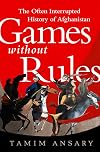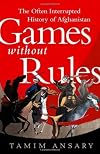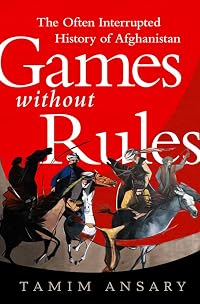
Games without Rules: The Often-Interrupted History of Afghanistan
by Tamim Ansary
On This Page
Description
Today, most Westerners still see the war in Afghanistan as a contest between democracy and Islamist fanaticism. That war is real, but it sits atop an older struggle between Kabul and the countryside, between order and chaos, between a modernist impulse to join the world and the pull of an older Afghanistan—a tribal universe of village republics permeated by Islam.Now, Tamim Ansary draws on his Afghan background, Muslim roots, and Western and Afghan sources to explain history from the show more inside out and illuminate the long, internal struggle that the outside world has never fully understood. It is the story of a nation struggling to take form, a nation undermined by its own demons while, every forty to sixty years, a great power crashes in and disrupts whatever progress has been made. Told in conversational, storytelling style and focusing on key events and personalities, Games without Rules provides revelatory insight into a country at the center of political debate.
. show less
Tags
Recommendations



Member Reviews
This is a book which could only be written by someone with a foot in both camps. Tamim Ansary is an Afghan who has spent many years living in America. He produces an excellent book which neither denigrates one, or the other culture and provides an insight to Westerners as to the mindset of the Afghan people.
Mr. Ansary is a realist but, quietly confident that, left to her own devices, Afghanistan will develop into a modern country. This, of course, leads to interesting questions: is it acceptable to stand aside and watch women being exploited because it is for a country to progress at its own speed? Strangely, this seems to be considered permissible but, when South Africa held a racist position, liberal voices did not suggest that we show more should allow them to come to terms with their racial mix at their own speed. There is a fine line between interfering within another country's affairs, and accepting intolerable behaviour.
This book explains what any rational person must know: that the ordinary Afghan is not a ranting, gun toting thug, desperate to kill the infidels. The most important point of which it reminds us, is one that journalistic shorthand so often leads us to forget - namely, that the Taliban is not a highly organised single military unit, but a term used to cover everyone who stands against the country's government and which ever major power is poking their nose in at the moment. The reasons for dissent may be as varied as the uneducated country folk fearing that the 'sophisticated' townies are destroying the religious beliefs that are held so dear, or an argument between two opium producers.
Tamim Ansary is too wise to wrap this book up with a final chapter setting out a couple of simple stages that will lead to an enlightened Afghanistan living happily ever after, but he does offer a glimmer of hope that things may, slowly, be moving towards a better tomorrow: let us all prey that he is correct. show less
Mr. Ansary is a realist but, quietly confident that, left to her own devices, Afghanistan will develop into a modern country. This, of course, leads to interesting questions: is it acceptable to stand aside and watch women being exploited because it is for a country to progress at its own speed? Strangely, this seems to be considered permissible but, when South Africa held a racist position, liberal voices did not suggest that we show more should allow them to come to terms with their racial mix at their own speed. There is a fine line between interfering within another country's affairs, and accepting intolerable behaviour.
This book explains what any rational person must know: that the ordinary Afghan is not a ranting, gun toting thug, desperate to kill the infidels. The most important point of which it reminds us, is one that journalistic shorthand so often leads us to forget - namely, that the Taliban is not a highly organised single military unit, but a term used to cover everyone who stands against the country's government and which ever major power is poking their nose in at the moment. The reasons for dissent may be as varied as the uneducated country folk fearing that the 'sophisticated' townies are destroying the religious beliefs that are held so dear, or an argument between two opium producers.
Tamim Ansary is too wise to wrap this book up with a final chapter setting out a couple of simple stages that will lead to an enlightened Afghanistan living happily ever after, but he does offer a glimmer of hope that things may, slowly, be moving towards a better tomorrow: let us all prey that he is correct. show less
(Perseus Books Group kindly gave me a pre-publication galley of this book, but it will be available to the general public on 27 November 2012.)
Of all the histories I have read on Afghanistan, and I have read more than a few, Tamim Ansary’s is absolutely the best. Whether your knowledge is a clean slate and you are looking for one book that will explain this complex nation, or you are fairly conversant in the country, but want a brief refresher, Mr. Ansary will lay out everything you need to know in his latest offering. [b]Games without Rules[/b] begins with the rise of the Durrani line and brings the reader up through the present, with reporting through May of 2012.
Tamim Ansary does a number of things in his book that make it show more especially accessible for readers, but chief among them is linking events in Afghanistan to events with which his readers might be more familiar, such as the fact that the opening of his work, the dawning of the Durrani Empire, with its founder Ahmad Shah Baba, known as Afghanistan’s Founding Father, happened in 1747, roughly the same time as the founding of the United States of America. Over the course of reading the book the reader will also learn a great deal about the histories of India, Pakistan, and the neighboring central Asian republics, as the destinies of these nations and that of Afghanistan are all inter-linked. Another fact about Mr. Ansary’s writing that becomes quickly apparent is that this is not the writing of a dry, boring scholar of a historian. While never stooping to comedy or disdain, he manages to always keep a storyteller’s mien, full of adventure and humor and at times even anger and despair.
In addition to being written in an easily accessible style, this history is very well organized, carrying the reader seamlessly from one era into the next, clearly illustrating how each event, and not always those occurring solely within Afghanistan’s borders, caused the next to proceed. Perhaps most valuable is Mr. Ansary’s explanation of Afghanistan’s placement upon the world stage-the role that it has played over the last two hundred years, so often caught up geographically in the maelstrom between world powers, for instance, between Russia and British India.
As he takes his reader along on a journey through the various powers, foreign and domestic, who have vied for power over her people, Tamim Ansary, in a marvelously conversant manner, gives a cultural education that is unparalleled. From the cities to the furthest reaches of the valleys, the governance and social customs of the country are explained, and he uses this information to break down for the reader exactly why he feels that attempts by various foreign powers over the centuries to govern the Afghani people have not succeeded. His analysis is insightful and well-laid-out, and for those not well-versed in the subject, this book will prove especially useful in helping you to understand exactly why the political and social situation there is so complex.
My one very slight reservation for my conservative readership is that Mr. Ansary is very clearly a liberal, and that does bleed through, especially with regards to our current president. He is quite a fan of the president’s policies with regards to Afghanistan, something with which most conservatives do not agree. To give credit where credit is due, he also admits that Clinton made errors while in office. However, for the most part he does strive for partiality and is generally successful. No matter how conservative your leanings, you would be doing yourself a disservice not to read this book-Mr. Ansary’s political views only come into play in the very last section and are toned down enough that even this conservative reviewer did not find them obtrusive enough to overwhelm all the excellent material contained within the rest of the book. And I personally found his views even here to be insightful and interesting, even if I might not agree with them.
In four hundred pages of reading a person’s time will be well vested here. I give Tamim Ansary’s newest history my highest endorsement, not only for the knowledge it imparts, but for its readability. If you read one book on the modern history of Afghanistan, her culture, her politics, and her role in our global peace (or otherwise), this should be the one you reach for. show less
Of all the histories I have read on Afghanistan, and I have read more than a few, Tamim Ansary’s is absolutely the best. Whether your knowledge is a clean slate and you are looking for one book that will explain this complex nation, or you are fairly conversant in the country, but want a brief refresher, Mr. Ansary will lay out everything you need to know in his latest offering. [b]Games without Rules[/b] begins with the rise of the Durrani line and brings the reader up through the present, with reporting through May of 2012.
Tamim Ansary does a number of things in his book that make it show more especially accessible for readers, but chief among them is linking events in Afghanistan to events with which his readers might be more familiar, such as the fact that the opening of his work, the dawning of the Durrani Empire, with its founder Ahmad Shah Baba, known as Afghanistan’s Founding Father, happened in 1747, roughly the same time as the founding of the United States of America. Over the course of reading the book the reader will also learn a great deal about the histories of India, Pakistan, and the neighboring central Asian republics, as the destinies of these nations and that of Afghanistan are all inter-linked. Another fact about Mr. Ansary’s writing that becomes quickly apparent is that this is not the writing of a dry, boring scholar of a historian. While never stooping to comedy or disdain, he manages to always keep a storyteller’s mien, full of adventure and humor and at times even anger and despair.
In addition to being written in an easily accessible style, this history is very well organized, carrying the reader seamlessly from one era into the next, clearly illustrating how each event, and not always those occurring solely within Afghanistan’s borders, caused the next to proceed. Perhaps most valuable is Mr. Ansary’s explanation of Afghanistan’s placement upon the world stage-the role that it has played over the last two hundred years, so often caught up geographically in the maelstrom between world powers, for instance, between Russia and British India.
As he takes his reader along on a journey through the various powers, foreign and domestic, who have vied for power over her people, Tamim Ansary, in a marvelously conversant manner, gives a cultural education that is unparalleled. From the cities to the furthest reaches of the valleys, the governance and social customs of the country are explained, and he uses this information to break down for the reader exactly why he feels that attempts by various foreign powers over the centuries to govern the Afghani people have not succeeded. His analysis is insightful and well-laid-out, and for those not well-versed in the subject, this book will prove especially useful in helping you to understand exactly why the political and social situation there is so complex.
My one very slight reservation for my conservative readership is that Mr. Ansary is very clearly a liberal, and that does bleed through, especially with regards to our current president. He is quite a fan of the president’s policies with regards to Afghanistan, something with which most conservatives do not agree. To give credit where credit is due, he also admits that Clinton made errors while in office. However, for the most part he does strive for partiality and is generally successful. No matter how conservative your leanings, you would be doing yourself a disservice not to read this book-Mr. Ansary’s political views only come into play in the very last section and are toned down enough that even this conservative reviewer did not find them obtrusive enough to overwhelm all the excellent material contained within the rest of the book. And I personally found his views even here to be insightful and interesting, even if I might not agree with them.
In four hundred pages of reading a person’s time will be well vested here. I give Tamim Ansary’s newest history my highest endorsement, not only for the knowledge it imparts, but for its readability. If you read one book on the modern history of Afghanistan, her culture, her politics, and her role in our global peace (or otherwise), this should be the one you reach for. show less
This is a book I needed to read if was to get beyond the cable news sound-bites, and slanted political rhetoric of our Central Asian conflicts and Afghanistan in particular. I have previously read several books covering Iraq, Afghanistan, and Pakistan, but they were not comprehensive and were often biased to a particular way. While it is not superbly written, this book is quite competent and fills an important need for anyone wanting a view of the whole. The author was born and raised in Afghanistan, but left and came to America several years ago. The volume is essentially three different works. The first is early Afghanistan history, and the author plays the role of an entertaining and highly personable lecturer on the subject. I found show more myself wishing I had him teaching me in other classes. As time continues, the events in Afghanistan start to touch on things on which the author's father or other relatives were personally involved or that the author remembers directly from his youth. As such, the narrative starts to take on a more personal, less scholarly tone. Finally, the reporting comes to more recent times, times in which the author was an adult in America, like me, and thus, had cable news, the Internet, and some relatives still in Afghanistan to color his narrative. In essence, if this had been about a sport, like baseball, the early part would have been about things such as how many home runs Babe Ruth had and the later part would have been about what a bum the current Yankee manager was and what they needed to do to win this year's World Series; quite different creatures. In the end, the author fully justifies a simple conclusion about present day Afghanistan: working for a "neutral-Afghanistan-serving-nobody's-interest-fully" or "awful-quagmire-Afghanistan-sucking-down-yet-another-hapless-great-power". He actually offers a solution, but you must read the book to find it and decide for yourself if it is viable. show less
An easy to swallow and leisurely read that I would recommend to Anyone who wants a basic idea about Afghan history without having to read a giant tome and becoming bogged down by minute detail and names you probably can't pronounce. He is a great writer and so easy to read. He injects humor into the story and is adept at pointing out absurdities and ironies. This is not just "the facts", it is also full of interesting analysis an opinions on the shape of Afghan culture. Once again, an excellent book that is perfect for the casual reader of history and the serious student as well. Enjoy!
This book was a good balance of armchair historian (simplified and easy to follow) and academic for someone like me, who is relatively educated but out of practice, and completely a noob at knowing anything about the area in question. For me, the light and approachable manner in which this was written was crucial to my understanding. For those with more background, it would be infuriatingly simplistic. For myself I’m very glad I found this book.
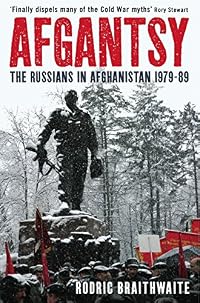
Okay, I read chapters 19-22 of this book, because I wanted to get as much coverage of the Soviet-Afghan War as possible. Yet what I read was far from an unbiased narrative. So far I can see that Sir Roderic Braithwaite's turn-pager is much more balanced and authoritative source on this conflict. Don't know if I should trust the rest of Mr. Ansary's creation. Let me illustrate with just one concrete example. Ansary presents mines mimicking children toys as a diabolical Soviet ploy to undermine Afghan families. Here's the coverage of the same topic by Braithwaite. Draw your own conclusions:
There were stories that both sides used booby traps and explosive devices disguised to look like everyday objects such as watches and pens. Much play show more was made with the story, which figured in a UN report of 1985 as well as in Western propaganda, that the KGB deliberately designed mines to look like children’s toys, in order to sow a particularly vicious kind of terror among ordinary Afghans. The Russians countered with stories that this was a tactic of the mujahedin and published photographs to back their claim. The story may have had its origin in the tiny ‘butterfly’ mines made of brightly coloured plastic, which were scattered from helicopters along rebel trails and supply routes. They were supposed to deactivate themselves after a given period, but often the deactivation mechanism did not work. But these devices were not the product of the twisted imagination of the KGB’s engineers. They were directly copied from the American Dragontooth BLU-43/B and BLU-44/B mines, used in very large numbers in Indo-China. They were intended to maim rather than to kill, since a wounded soldier is more trouble to his comrades than a dead one. The official name of the Soviet version was PFM-1, but the soldiers called them lepestki (petals). It is not surprising that children should have found them attractive, and that they and their parents should have reported them to journalists as disguised toys. But the experts in the Mine Action Coordination Centre of Afghanistan, whose job it was to know about these things, believed that the story ‘gained a life for obvious journalist reasons – but it has we think no basis in widespread fact’.24
24 - Alan A. H. Macdonald, Chief of Staff , Mine Action Coordination Centre of Afghanistan, email to author, 4 May 2009.
Afgantsy: The Russians In Afghanistan, 1979-1989 by Rodric Braithwaite, рp.234-5 show less
There were stories that both sides used booby traps and explosive devices disguised to look like everyday objects such as watches and pens. Much play show more was made with the story, which figured in a UN report of 1985 as well as in Western propaganda, that the KGB deliberately designed mines to look like children’s toys, in order to sow a particularly vicious kind of terror among ordinary Afghans. The Russians countered with stories that this was a tactic of the mujahedin and published photographs to back their claim. The story may have had its origin in the tiny ‘butterfly’ mines made of brightly coloured plastic, which were scattered from helicopters along rebel trails and supply routes. They were supposed to deactivate themselves after a given period, but often the deactivation mechanism did not work. But these devices were not the product of the twisted imagination of the KGB’s engineers. They were directly copied from the American Dragontooth BLU-43/B and BLU-44/B mines, used in very large numbers in Indo-China. They were intended to maim rather than to kill, since a wounded soldier is more trouble to his comrades than a dead one. The official name of the Soviet version was PFM-1, but the soldiers called them lepestki (petals). It is not surprising that children should have found them attractive, and that they and their parents should have reported them to journalists as disguised toys. But the experts in the Mine Action Coordination Centre of Afghanistan, whose job it was to know about these things, believed that the story ‘gained a life for obvious journalist reasons – but it has we think no basis in widespread fact’.24
24 - Alan A. H. Macdonald, Chief of Staff , Mine Action Coordination Centre of Afghanistan, email to author, 4 May 2009.
Afgantsy: The Russians In Afghanistan, 1979-1989 by Rodric Braithwaite, рp.234-5 show less
In "Games Without Rules", Tamim Ansary describes the history of modern Afghanistan leading up to the recent war years in the Country. We hear of the strong family, clan, and tribal ties of the Afghan people, and Ansary provides further clarity regarding the deep-seated Afghan traditions and culture and how it impacts the current conflict in the region.
Members
- Recently Added By
Published Reviews
ThingScore 100
Tamim Ansary’s new book is about the “often interrupted” history of Afghanistan, focusing on the past 250 years. “Five times in the last two centuries,” he writes in the introduction, “some great power has tried to invade, occupy, conquer or otherwise take control of Afghanistan . . . These interventions have all come to grief in much the same way and for much the same show more reasons.”
Oh no, I thought, another book about that? There have been almost as many “graveyard of empires” books as there have been soldiers’ own accounts of the six-months-in-hell variety, and rarely does either offer anything new.
I needn’t have worried... show less
Oh no, I thought, another book about that? There have been almost as many “graveyard of empires” books as there have been soldiers’ own accounts of the six-months-in-hell variety, and rarely does either offer anything new.
I needn’t have worried... show less
added by Donogh
Lists

Afghanistan
16 works; 1 member
Author Information

70+ Works 3,290 Members
Common Knowledge
- Original publication date
- 2012
- Important places
- Afghanistan
Classifications
Statistics
- Members
- 183
- Popularity
- 178,317
- Reviews
- 7
- Rating
- (4.16)
- Languages
- English
- Media
- Paper, Audiobook, Ebook
- ISBNs
- 11
- UPCs
- 1
- ASINs
- 4