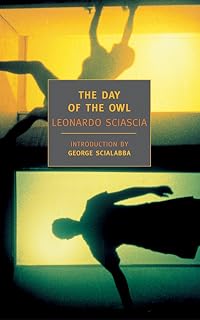
The Day of the Owl
by Leonardo Sciascia
On This Page
Description
In the piazza, a man lies dead. No one will say if they witnessed his killing. This presents a challenge to the investigating officer, a man who earnestly believes in the values of a democratic and modern society. Indeed, his enquiries are soon blocked off by wall of silence and vested interests; he must work against the very community to save it and expose the truth.The narrative moves on two levels: that of the investigator, who reveals a chain of savage crimes; and that of the bystanders show more and watchers, of those complicit with secret power, whose gossipy, furtive conversations have only one end: to stop the truth coming out. This novel about the mafia is also a mesmerizing demonstration of how that organization sustains itself. It is both a beautifully, tautly written story and a brave act of denunciation. show lessTags
Recommendations

















Member Recommendations

Member Reviews
Sono passati 52 anni, niente è cambiato, compreso il fatto che qualcuno, agli alti livelli della politica, cerchi di dire che la mafia non esiste.
Ci sono stati morti, umili ed eccelletnti, c'è stata una commissione parlamentare, ci sono condanne definitive che non hanno tolto i politici condannati dal loro posto, ma l'intreccio tra affari e mafia si è sempre più rinsaldato, e i corretti metodi di indagine sono ancora quelli suggeriti da Sciascia, e ancora non messi in opera, sebbene ce ne si riempia la bocca.
E intanto i quaraquaquà proliferano.
Libro importantissimo per capire la nostra nazione, e opera letteraria di alto livello.
Ci sono stati morti, umili ed eccelletnti, c'è stata una commissione parlamentare, ci sono condanne definitive che non hanno tolto i politici condannati dal loro posto, ma l'intreccio tra affari e mafia si è sempre più rinsaldato, e i corretti metodi di indagine sono ancora quelli suggeriti da Sciascia, e ancora non messi in opera, sebbene ce ne si riempia la bocca.
E intanto i quaraquaquà proliferano.
Libro importantissimo per capire la nostra nazione, e opera letteraria di alto livello.
Il giorno della civetta is an unusual sort of crime novel - it comes with an afterword in which the author explains that he spent nearly a year on "making it shorter", and it's hard to spot anything in this 140-page story that isn't absolutely essential. We don't get to see the detective choosing his lunch, rippling his chest muscles or juggling four girlfriends (as we would expect to in a Montalbano story), characters simply don't exist outside the context of the case (and in many cases don't even have names), and descriptions of people and places are stripped down to the barest minimum we need to follow the story. In the one place where Sciascia allows himself to dwell for a paragraph or so on the architecture of a police station it show more turns out that it's crucial for us to know that you can see into one particular room from another, for example.
In the fifties and sixties the received opinion in northern Italy seems to have been that the Sicilian Mafia had been wiped out before the War, under the Fascist police chief Mora (who was not bound by any finicky little constitutional limitations of power), and that Sicily was now a quiet, civilised province, albeit not the sort of place respectable people were likely to have any reason to visit. If northern Italians ever thought about the Mafia at all, then it was as operatic brigands or as a kind of rural benevolent society helping peasant farmers to survive.
What Sciascia wants to do with this book is to shake that complacency and show people outside Sicily what organised crime really means, and the nasty things that happen to a society when a criminal organisation is allowed to take over the role normally filled by government and the rule of law. And how difficult it is to get out of that situation.
A local building contractor is gunned down in a Sicilian village square on his way to take the early-morning bus into town (fascinating to reflect that there was a time before the age of the White Van when builders actually travelled on public transport...). The Carabinieri investigate, and soon find out that he has been shot after refusing an invitation to pay protection money. They get a name for the assassin, and Captain Bellodi arrests him and even manages to persuade him to make a statement confessing the murder, but then the case hits a brick wall - any further action by the police is blocked by politicians in Rome who clearly owe favours to the same people as paid for the killing. Bellodi quietly goes on sick-leave whilst his deputy recategorises the crime as the result of sexual jealousy.
But this isn't just a political lesson - Sciascia is clearly a very competent writer, and sometimes - as in the dialogues between Bellodi and the three Mafia figures he has to interrogate - displays remarkable technical skill as well as subtlety and efficiency in the way he characterises people.
I was impressed by a wonderful description of a farcical parliamentary debate in which the secretary of state barefacedly denies the existence of the Mafia (we have previously seen the same man giving a speech on a balcony with the local Capo on one side of him and a notorious hitman on the other) and is saved from any actual questioning when the right-wing deputies get into a slanging match with the Communists. This struck me as owing a lot to Zola when I read it, but according to Sciascia it's the one scene in the book that was taken directly from life. show less
In the fifties and sixties the received opinion in northern Italy seems to have been that the Sicilian Mafia had been wiped out before the War, under the Fascist police chief Mora (who was not bound by any finicky little constitutional limitations of power), and that Sicily was now a quiet, civilised province, albeit not the sort of place respectable people were likely to have any reason to visit. If northern Italians ever thought about the Mafia at all, then it was as operatic brigands or as a kind of rural benevolent society helping peasant farmers to survive.
What Sciascia wants to do with this book is to shake that complacency and show people outside Sicily what organised crime really means, and the nasty things that happen to a society when a criminal organisation is allowed to take over the role normally filled by government and the rule of law. And how difficult it is to get out of that situation.
A local building contractor is gunned down in a Sicilian village square on his way to take the early-morning bus into town (fascinating to reflect that there was a time before the age of the White Van when builders actually travelled on public transport...). The Carabinieri investigate, and soon find out that he has been shot after refusing an invitation to pay protection money. They get a name for the assassin, and Captain Bellodi arrests him and even manages to persuade him to make a statement confessing the murder, but then the case hits a brick wall - any further action by the police is blocked by politicians in Rome who clearly owe favours to the same people as paid for the killing. Bellodi quietly goes on sick-leave whilst his deputy recategorises the crime as the result of sexual jealousy.
But this isn't just a political lesson - Sciascia is clearly a very competent writer, and sometimes - as in the dialogues between Bellodi and the three Mafia figures he has to interrogate - displays remarkable technical skill as well as subtlety and efficiency in the way he characterises people.
I was impressed by a wonderful description of a farcical parliamentary debate in which the secretary of state barefacedly denies the existence of the Mafia (we have previously seen the same man giving a speech on a balcony with the local Capo on one side of him and a notorious hitman on the other) and is saved from any actual questioning when the right-wing deputies get into a slanging match with the Communists. This struck me as owing a lot to Zola when I read it, but according to Sciascia it's the one scene in the book that was taken directly from life. show less
The continuous denial of the existence of the Mafia, by those in charge reminded me of the parallel situation in the United States where J. Edgar Hoover, consistently had the same line with regard to organized crime in the United States. Why Hoover is still regarded with reverence in the United States and why they haven't renamed the building with his name on it in Washington has always eluded me. But that is not what this book is about. While the author in very few pages outlines the problems of the State within the State, it is the observations on the human condition that I found most enjoyable in the book. Well worth reading.
Sciascia runs a scapel through Sicilian society and political intrigue once again, this time particularly careful where not to name the mafia links that taint every interaction (a recurrent joke is that there is not real evidence of the mafia anyway, and Sciascia himself had to tread carefully around very real threats). A construction contractor is murdered in a city square, of course no one sees a thing and the carabinieri captain from Parma has to fight his own forces as much as the criminal networks to investigate the case. All the while, anonymous voices in the halls of power in Rome observe and plot. The only downside was that the translation seemed clunky at times, although this may also reflect how Sciascia aimed to keep the text show more obtuse and sparing. Otherwise it is a brilliant, wry novella that packs far more psychology and culture into 100 pages than many would manage in 1000 pages. show less
I wouldn't really recommend this to someone as a novel, but as a kind of j'accuse poem, it's very nice. I imagine it having a long life in University courses on 20th century Italian History and Culture, but not literature.
On the other hand, maybe it's expanding what you can do with a novel; it does away with names, for the most part, and character, and narrative coherence, but it does a great deal with conspiracy, the personal cost of chasing the Mafia in post-war Italy, and almost total minimalism in everything else. It's also a nice counterpoint to the American mythologization of the Mafia thanks to, e.g., The Godfather and its sequels. Brando and his offspring are variations on the show more American-immigrant-just-struggling-to-make-it-in-this-crazy-world; individualists kind of sort of living out the American dream. In Day of the Owl, mafia types are one more part of a corrupt, not entirely post-fascist system.
It's also interesting to read this with Kushner's 'Flamethrowers' and Ferrante's work still hovering in my mind. Late 20th century Italy is a truly fascinating place, though not one I'd really want to have lived in. Sciascia, like Ferrante after him, does a particularly good job showing how the communist/fascist faultlines make everyday life treacherous even for basically good people. show less
On the other hand, maybe it's expanding what you can do with a novel; it does away with names, for the most part, and character, and narrative coherence, but it does a great deal with conspiracy, the personal cost of chasing the Mafia in post-war Italy, and almost total minimalism in everything else. It's also a nice counterpoint to the American mythologization of the Mafia thanks to, e.g., The Godfather and its sequels. Brando and his offspring are variations on the show more American-immigrant-just-struggling-to-make-it-in-this-crazy-world; individualists kind of sort of living out the American dream. In Day of the Owl, mafia types are one more part of a corrupt, not entirely post-fascist system.
It's also interesting to read this with Kushner's 'Flamethrowers' and Ferrante's work still hovering in my mind. Late 20th century Italy is a truly fascinating place, though not one I'd really want to have lived in. Sciascia, like Ferrante after him, does a particularly good job showing how the communist/fascist faultlines make everyday life treacherous even for basically good people. show less
A small town in Sicily. In plain view of many witnesses one early morning, a man is gunned down as he was boarding a bus. Nobody claims to have seen it. The bus conductor merely says, "They've killed him." Who are "they"? Surely somebody knows something? But nobody is talking. Captain Bellodi, an antifascist partisan, cultivated, dedicated professional, is new to the place. He comes from the wealthier regions in the northern part of the country, and as an outsider, was thought by the higher authorities, to be good in bringing some movement to disturb the inertia of this backward region. Early in his investigations, two more deaths occur, one after the other. Everyone knew it was no coincidence. People are called in to the precinct, show more including the brothers and business partners of Salvatore Calasberna, the first deceased. He learns that Calasberna had been assiduously courted by the mob, but never succumbed to their demands, mistakenly believing he needed no protection. The captain amazes the people around him with his courtesy, quick mind, and impartial handling of "interested persons", his clear, direct language, all of which personified a system of justice and authority totally unfamiliar to them, and unknown in this place. But the wall of silence, ignorance, and fear is very strong. Here, nothing is either black or white, and different rules govern. It does not take him long to learn this. But he is willing to persevere.
The owl of the title refers to a Sicilian saying about the owl symbolizing death. Sciascia's brilliant portrayal of the Mafia is unique in that he does not write directly about the Mafia. What we see instead is a delicate unpeeling of layers -- perceptions, suppositions, hesitations -- forming a subtle but nonetheless sharp characterization of what is hidden but strongly felt. There is no blood and gore, but danger is an ever-present element, and Sciascia does not make us forget that. This is a short but intense novel, a rich portrayal of the psychology of fear, a marvelous read. show less
The owl of the title refers to a Sicilian saying about the owl symbolizing death. Sciascia's brilliant portrayal of the Mafia is unique in that he does not write directly about the Mafia. What we see instead is a delicate unpeeling of layers -- perceptions, suppositions, hesitations -- forming a subtle but nonetheless sharp characterization of what is hidden but strongly felt. There is no blood and gore, but danger is an ever-present element, and Sciascia does not make us forget that. This is a short but intense novel, a rich portrayal of the psychology of fear, a marvelous read. show less
While apparently a straightforward murder mystery, this novel deals with the stranglehold exerted by the mafia over Italy in general and Sicily in particular. The protagonist, an Inspector (and outsider since he's from 'the north') is thwarted repeatedly by the reluctance and inertia of the citizens; just as he believes he has the murderer, the proof melts away and he's left only with the dubious respect of the man he almost convicted.
Cleanly written, concise and expressive, the story enfolds the reader and, like a good dinner guest, leaves before it outstays its welcome. You are left simultaneously a little depressed and uplifted, just like the Inspector who knows that, despite the frustration and aggravation he found there, he has no show more choice but to return to the island. show less
Cleanly written, concise and expressive, the story enfolds the reader and, like a good dinner guest, leaves before it outstays its welcome. You are left simultaneously a little depressed and uplifted, just like the Inspector who knows that, despite the frustration and aggravation he found there, he has no show more choice but to return to the island. show less
Members
- Recently Added By
Lists

Books Set in Italy
167 works; 19 members

Italian Literature
556 works; 41 members

1960s, Best books published therein
254 works; 22 members

Canon de la narrativa universal del siglo XX
254 works; 6 members

Short and Sweet
243 works; 23 members

1960s
281 works; 16 members

Harold Bloom - The Western Canon: D. The Chaotic Age
833 works; 24 members

Bibliografia essenziale
86 works; 2 members

Canon de la narrativa universal del s. XX (cicutadry)
499 works; 3 members
Lista dei 100 migliori libri italiani degli ultimi 200 anni
100 works; 1 member

Finished in 2025
23 works; 1 member

Books Read in 2026
1,823 works; 65 members
Author Information

Born in Sicily, Sciascia was a literary and critical genius as well as a best-selling activist-writer. In the tradition of such Sicilian writers as Luigi Pirandello and Giuseppe Di Lampedusa, he explored in neorealist novels the island's impact on its inhabitants' lives: how they coped with crime, the Mafia, and corruption. His best-known works show more include The Day of the Owl, The Sicilian Relatives, and the collection of short stories The Wine-Dark Sea. In his most controversial work, The Moro Affair, he implicated Italy's leaders in the 1978 kidnapping and murder of former premier Aldo Moro by the leftist terrorist group, the Red Brigade. Though a long-time Communist, Sciascia eventually left the party to become a member of the Radical party, whose tenets were closer to his own anarchist leanings. As a representative of the party, Sciascia was elected to both the Italian and European Parliaments. (Bowker Author Biography) show less
Some Editions
Awards and Honors
Series
Belongs to Publisher Series
Empúries Narrativa (36)
Fabula [Adelphi] (66)
GF Flammarion (461)
I coralli [Einaudi] (122)
Keltainen kirjasto (187)
Work Relationships
Is contained in
Has the adaptation
Has as a student's study guide
Common Knowledge
- Canonical title
- The Day of the Owl
- Original title
- Il giorno della civetta
- Alternate titles
- Mafia Vendetta
- Original publication date
- 1961
- People/Characters
- Capitano Bellodi; Calogero Dibella; Diego Marchica (Zicchinetta); Sergeant-Major Arturo Ferlisi; Rosario Pizzuco; Mariano Arena (show all 11); Carabinieri Sposito; Salvatore Colasberna; Guiseppe Colasberna; Paolo Nicolosi; Sergeant D'Antona
- Important places
- Sicily, Italy; Rome, Italy; Parma, Emilia-Romagna, Italy
- Related movies
- Il giorno della civetta (1968 | IMDb)
- Epigraph*
- ... come la civetta quando/ di giorno compare. SHAKESPEARE, Enrico VI
- First words
- The bus was just about to leave, amid rumbles and sudden hiccups and rattles.
- Last words
- (Click to show. Warning: May contain spoilers.)But before reaching home he knew, with utter lucidity, that he loved Sicily and was going back. 'Even if it's the end of me', he said aloud.
- Original language
- Italian
- Canonical DDC/MDS
- 853.08721
- Disambiguation notice
- "The Day of the Owl" was published in an English translation by Archibald Colquhoun and Arthur Oliver in 1964 (NY: Alfred A. Knopf). It appeared under the title "Mafia Vendetta".
*Some information comes from Common Knowledge in other languages. Click "Edit" for more information.
Classifications
- Genres
- Fiction and Literature, General Fiction, Mystery
- DDC/MDS
- 853.08721 — Literature & rhetoric Italian, Romanian & related literatures Italian fiction By Type Genre Fiction Adventure Fiction Mystery Fiction Detective fiction
- LCC
- PQ4879 .C54 .G413 — Language and Literature French, Italian, Spanish and Portuguese literatures Italian literature Individual authors, 1961-2000
- BISAC
Statistics
- Members
- 1,637
- Popularity
- 13,688
- Reviews
- 38
- Rating
- (3.89)
- Languages
- 12 — Catalan, Dutch, English, Finnish, French, German, Italian, Russian, Spanish, Swedish, Turkish, Portuguese (Portugal)
- Media
- Paper, Audiobook, Ebook
- ISBNs
- 47
- ASINs
- 19