America's Great Depression
by Murray Rothbard
On This Page
Description
Applied Austrian economics doesn't get better than this. Murray N. Rothbard's America's Great Depression is a staple of modern economic literature and crucial for understanding a pivotal event in American and world history. The Great Depression was not a crisis for capitalism but merely an example of the downturn part of the business cycle, which was generated by government intervention in the economy. Had the book appeared in the 1940s, it might have spared the world much grief. Even so, show more its appearance in 1963 meant that free-market advocates had their first full-scale treatment of this crucial subject. The damage to the intellectual world inflicted by Keynesian- and socialist-style treatments would be limited from that day forward. show lessTags
Recommendations



























Member Recommendations

Member Reviews
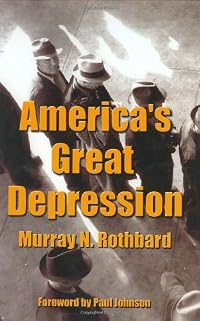
This book is very misleading in title and cover. Admittedly, I wanted some disaster porn: Hoovervilles, bread lines, and Wall Street fat cats jumping from windows. Now, I feel like I was sold a Hustler to find it was just a cover glued onto a copy of The Economist. The actual Great Depression is a side bar to this screed on Hoover-Roosevelt (government actions can be variously socialist and fascist) and fractional banking. Like a wild-eyed radical this work, which never should have been an audiobook given all the tables, extols the Austrian School of economics as dogma and yearns nostalgically for the gold standard.
I read this book in the late 1970s (I'm guessing about 1977), along with competing analyses by Milton Friedman and John Kenneth Galbraith, among others. In my view, Rothbard's principal contribution is his demonstration that it was the deliberate governmental inflation of the money supply during the 1920s that led to the 1929 stock market crash. As President Calvin Coolidge famously said, "The business of America is business," and the Republican administrations of the 1920s did everything they could to stimulate business by using inflationary policies to create an artificial boom. The chickens came home to roost in 1929. Whether or not the Austrian School's disagreement with Keynesianism (increasing government spending and money supply show more during recessions and decreasing same during booms) is correct I leave to the economists. The Keynesian approach makes sense to me, but I am not an economic expert. show less
Simply the best economic history of the 1929 depression. Rothbard's Austrian analysis is superb and counters the economic analyses of Galbraith and others.
Durante o resto da década 1920, o Banco Central americano reverteu sua postura até então conservadora e adotou uma política monetária muito mais expansionista: em 1920, os juros estavam em 6% ao ano. Ao final de 1927, eles já haviam caído para 3,5%. Uma redução de 42%. Essa política monetária expansionista foi a principal responsável por sustentar a febre especulativa dos "loucos anos 20". A contínua criação de dinheiro pelo Federal Reserve permitia que os bancos concedessem, de forma contínua e aparentemente sem limites, empréstimos fartos e baratos para especuladores, os quais utilizavam esse dinheiro barato para comprar ações e, em seguida, revendê-las a preços muito maiores. A expansão monetária feita pelo Fed show more garantia que os preços das ações subissem continuamente. (Tudo isso está documentado em detalhes neste livro).
Vale ressaltar que é impossível preços de ativos subirem continuamente sem que esteja havendo uma grande expansão monetária, que dê sustentação a esse processo de alta nos preços. Sem expansão monetária é impossível preços subirem eternamente. E quem controla o processo de expansão monetária de um país é o seu Banco Central. E assim foram os loucos anos 1920.
Até que, em fevereiro de 1928, o Fed, assustado com toda aquela febre especulativa, reverteu sua postura e, contrariamente às expectativas, começou a subir os juros. E o fez por três vezes seguidas. Em um período de 5 meses, ele elevou os juros de 3,50% para 5%. Pode parecer pouco, mas esse aumento de 43% em 5 meses bastou para interromper toda a farra especulativa.
Com o crédito mais caro, os especuladores começaram a ter dificuldades em auferir lucros em suas ações. Pegar dinheiro emprestado para comprar ações (um processo conhecido como "alavancagem") tornou-se 43% mais caro em 5 meses. Com menos empréstimos sendo tomados, a quantidade de dinheiro na economia parou de aumentar. (De novo, todas essas estatísticas estão documentadas neste livro). Com essa interrupção no crescimento da quantidade de dinheiro na economia, a própria atividade especulativa perdeu a potência. Os preços das ações pararam de subir.
Uma correção na bolsa de valores era inevitável. show less
Vale ressaltar que é impossível preços de ativos subirem continuamente sem que esteja havendo uma grande expansão monetária, que dê sustentação a esse processo de alta nos preços. Sem expansão monetária é impossível preços subirem eternamente. E quem controla o processo de expansão monetária de um país é o seu Banco Central. E assim foram os loucos anos 1920.
Até que, em fevereiro de 1928, o Fed, assustado com toda aquela febre especulativa, reverteu sua postura e, contrariamente às expectativas, começou a subir os juros. E o fez por três vezes seguidas. Em um período de 5 meses, ele elevou os juros de 3,50% para 5%. Pode parecer pouco, mas esse aumento de 43% em 5 meses bastou para interromper toda a farra especulativa.
Com o crédito mais caro, os especuladores começaram a ter dificuldades em auferir lucros em suas ações. Pegar dinheiro emprestado para comprar ações (um processo conhecido como "alavancagem") tornou-se 43% mais caro em 5 meses. Com menos empréstimos sendo tomados, a quantidade de dinheiro na economia parou de aumentar. (De novo, todas essas estatísticas estão documentadas neste livro). Com essa interrupção no crescimento da quantidade de dinheiro na economia, a própria atividade especulativa perdeu a potência. Os preços das ações pararam de subir.
Uma correção na bolsa de valores era inevitável. show less
May 23, 2019Portuguese (Brazil)
Ratings
Members
- Recently Added By
Lists

BEST BOOKS TO UNDERSTAND XX CENTURY'S HISTORY
63 works; 3 members

Books I Would Like to Acquire
20 works; 1 member
Author Information

121+ Works 4,743 Members
Some Editions
Awards and Honors
Notable Lists
Common Knowledge
- Canonical title
- America's Great Depression
- Original publication date
- 1963
- People/Characters
- Herbert Hoover
- Important events
- Great Depression
- Dedication
- TO JOEY,
the indispensable framework - First words
- The Wall Street collapse of September–October 1929 and the Great Depression which followed it were among the most important events of the twentieth century.
- Last words
- (Click to show. Warning: May contain spoilers.)And in any other depression, past or future, the story will be the same.
Classifications
Statistics
- Members
- 377
- Popularity
- 82,796
- Reviews
- 4
- Rating
- (4.19)
- Languages
- 6 — Chinese, English, Italian, Polish, Portuguese, Spanish
- Media
- Paper, Audiobook, Ebook
- ISBNs
- 32
- ASINs
- 10