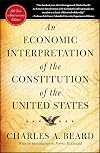
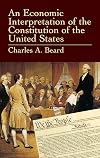
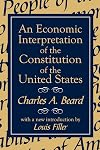
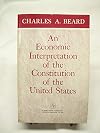
An Economic Interpretation of the Constitution of the United States
by Charles A. Beard
On This Page
Description
"In his piercing introduction to An Economic Interpretation the author wrote that 'whoever leaves economic pressures out of history or out of discussion of public questions is in mortal peril of substituting mythology for reality.' It was Beard's view that the founding fathers, especially Madison, Jay, and Hamilton, never made such a miscalculation. Indeed, these statesmen placed themselves among the great practitioners of all ages and gave instructions to succeeding generations in the art show more of government by their vigorous deployment of classical political economy.In this new printing of a major classic in American historiography, Louis Filler provides a sense of the person behind the book, the background that enabled Beard to move well beyond the shibboleths of the second decade of the twentieth century. While the controversies over Beard's book have quieted, the issues which it raised have hardly abated. Indeed, one can say that just about every major work in the politics and economics of the American nation must contend with Beard's classic work. Beard's work rests on an examination of primary documents: land and slave owners, geographic distribution of money, ownership of public securities, the specific condition of those who were disenfranchised as well as those who were in charge of the nascent American economy.The great merit of Beard's work is that despite its incendiary potential, he himself viewed An Economic Interpretation in coldly analytical terms, seeing such a position as giving comfort to neither revolutionaries nor reactionaries. Attacked by Marxists for being too mechanical, and by conservatives as being blind to the moral purposes of the framers of the constitution, the work continues to exercise a tremendous influence on all concerned. The fact that Beard wrote with a scalpel-like precision that gripped the attention of those in power no less than the common man is, it should be added, no small element in the enduring forces of this work."--Provided by publisher. show lessTags
Recommendations










Member Recommendations
Member Reviews
Fascinating deconstruction of the motivations of the delegates to the Constitutional Convention. Beard carries his thesis that the US Constitution did not originate out of high-minded, disinterested patriotism, but rather from practical, economic interests. Even though this was a cursory look intended to spur further inquiry, Beard delves relatively deeply into the data. This was the other facet of the book that really appealed to me, it's data driven rather than narrative driven. (Or, couched that way, at least).
At the very least, I'd recommend this as a counterpoint to too brief history of the constitution I received in high school.
At the very least, I'd recommend this as a counterpoint to too brief history of the constitution I received in high school.
This is a classic text but now seriously criticized, rightfully so, for its limited view that the Founders were more simply interested in their own financial advantage in the drafting of the Constitution. If that were true, then why did many of them lose their fortunes, Robert Morris the financier comes to mind, and they sacrificed their lives,their fortunes, and their sacred honor in the cause of Revolution.
My rating is probably partially the result of the fact that the copy I read, the Kindle eBook copy, was horribly formatted. It was a straight-up scan, with footnotes mixed directly into the text and no spacing between chapter titles, subsections and the text itself. It was very difficult to read, on top of the material itself just being terribly dry and horribly organized. The author addressed different topics in a list format, turning entire chapters into something akin to encyclopedia entries. He would have been better off addressing each state in turn, in a flowing, linear narrative.
As for what he proposes, it's very interesting and it's a take on American history that I haven't seen before, not that I'm particularly well read in show more American history. Every course I've taken up to now has been on Middle Eastern and South Asian history. It is very unfortunate that my first intro to college level American history is a graduate historiography course. That being said, I can't tell if his arguments are valid or not, but from the information he presents, it's certainly something worth looking into more, and something that probably has been addressed by later authors. I would not recommend this as a starter book on American constitutional history though. show less
As for what he proposes, it's very interesting and it's a take on American history that I haven't seen before, not that I'm particularly well read in show more American history. Every course I've taken up to now has been on Middle Eastern and South Asian history. It is very unfortunate that my first intro to college level American history is a graduate historiography course. That being said, I can't tell if his arguments are valid or not, but from the information he presents, it's certainly something worth looking into more, and something that probably has been addressed by later authors. I would not recommend this as a starter book on American constitutional history though. show less
Beard's 1913 history is a classic of historical revisionism. The author puts down his thesis that the context of the constitution is to be found in economic phenomena. It was a fad in all history at that time, and the book is now very dated.
Seems a rather obvious argument today that is made in excessive detail, but it was quite controversial when it was published. Still, the delegate by delegate asset summaries could have been shortened.
A very old book that had an intro full of a kind of pre-Communist Socialist thinking; wasn't too sure I wanted to wade through that. Didn't finish.
A very old book that had an intro full of a kind of pre-Communist Socialist thinking; wasn't too sure I wanted to wade through that. Didn't finish.
Members
- Recently Added By
Lists

Books Read in 2018
4,360 works; 110 members
Author Information

75+ Works 2,225 Members
Indiana-born Charles A. Beard studied at Oxford, Cornell, and Columbia universities, where he taught history and politics for more than a decade. One of the founders of the New School for Social Research, he also served as director of the Training School for Public Service in New York. A political scientist whose histories were always written from show more an economic perspective, Beard was an authority on U.S. politics and government. Yet his great survey history, The Rise of American Civilization, published in 1927, deals with the whole range of human experience-war, imperialism, literature, art, music, religion, the sciences, the press, and women-as well as politics and economics. Collaborating with Beard on this and other books was his wife, Mary Ritter Beard. Charles Beard described their coauthorship as a "division of argument." An able historian in her own right, Mary Ritter Beard took a special interest in the labor movement and feminism, subjects on which she produced several works. The Beards's books are scholarly, well written, and often witty, though sometimes a bit ponderous. Yet they stand the test of time well. Some critics agree that their Basic History can be considered the best one-volume history that has ever been written about the United States. (Bowker Author Biography) show less
Some Editions
Work Relationships
Common Knowledge
- Original publication date
- 1913
- People/Characters
- Charles A. Beard
- Important events
- Constitutional Convention (1787)
- First words
- The following pages are frankly fragmentary. They are designed to suggest new ideas of historical research rather than to treat the subject in an exhaustive fashion.
- Last words
- (Click to show. Warning: May contain spoilers.)The Consitution was not create by "the whole people" as the jurists have said; neither was it created by "the states" as Southern nullifiers long contend; but it was the work of a consolidated group who interests knew no state boundries and were truly national in their scope.
Classifications
- Genres
- Economics, Politics and Government, History, Nonfiction, General Nonfiction
- DDC/MDS
- 342.73 — Society, government, & culture Law U.S. Constitution - Bill of Rights, Amendments North America Constitutional law--United States
- LCC
- KF4541 .B317 — Law Law of the United States Law of the United States (Federal) Constitutional law Constitutional history of the United States
- BISAC
Statistics
- Members
- 580
- Popularity
- 50,871
- Reviews
- 6
- Rating
- (3.54)
- Languages
- Chinese, Dutch, English
- Media
- Paper, Ebook
- ISBNs
- 23
- UPCs
- 2
- ASINs
- 17