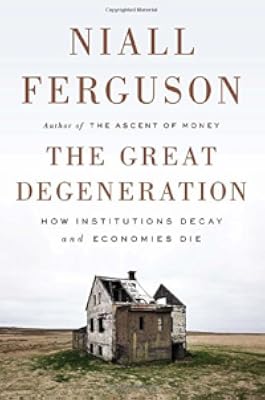
The Great Degeneration: How Institutions Decay and Economies Die
by Niall Ferguson
On This Page
Description
Business. History. Politics. Nonfiction. Bestselling author and world-renowned historian Niall Ferguson has won widespread acclaim for thought-provoking works such as Civilization and High Financier. The Great Degeneration tackles nothing less than the decline of Western civilization. Ferguson posits that slowing growth, outrageous debt, and antisocial behavior are contributing to the erosion of the West's once rock-solid foundations. Ferguson excavates the causes and shows how heroic show more leadership and radical reform are needed to right the course. show lessTags
Recommendations














Member Reviews
Mr Ferguson is a rigorously right wing historian, but useful to read. He is adamant that the retention of property is fundamental to the advance of civilization, and that Social programs had best be left to the actions of charity rather than governmental actions. Private home ownership by the bulk of the population seems to him, to be an unsuatanable posture. Well so the universe might seem to a child of a professional level household. But to those who really have nothing but their educations and sweat to survive, he seems a very shallow person. But, his arguments advanced in this book are quite popular with the better off part of our society. Read it to be forewarned.
I started this book with great gusto. It felt good to be reading about the world, our politics and economies. But as I read on I started to have some concern about the author's tone. A few comments here and there started sounding very subjective, and then dismissive. And then when he started quoting Donald Rumsfeld as some sort of heroic genius, it was all over for me and for the content.
The book itself tries to describe the rise and fall of economies in general, and how an economy (read: country) can become static. It makes a few interesting points, but the right wing rhetoric started to overtake the theme and when the theme itself was messy and loose to begin with, there was little room for greatness.
The book itself tries to describe the rise and fall of economies in general, and how an economy (read: country) can become static. It makes a few interesting points, but the right wing rhetoric started to overtake the theme and when the theme itself was messy and loose to begin with, there was little room for greatness.
I like Niall Ferguson, as a historian, as a writer, as a theorist. So, of course I'd like this. This slim volume serves as a companion piece to his Civilization book and television series. Why did the West achieve so much? And then why does the West seem to be faltering today. Short answer: the West is not doing what it used to do (and, in fact, some are actively fighting against the institutions and actions that spurred that achievement.) I won't bore with details. But there are nice snippets of fact, excellent quotes from historians, economists, and thinkers from today and yesterday. Buy it if you can get it. If you liked Civilization, get it.
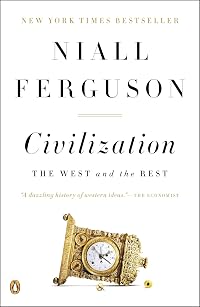
One of the most interesting books I've read in recent years was [a:Niall Ferguson|5790|Niall Ferguson|https://d202m5krfqbpi5.cloudfront.net/authors/1248268930p2/5790.jpg]'s [b:Civilization: The West and the Rest|10475421|Civilization The West and the Rest|Niall Ferguson|https://d202m5krfqbpi5.cloudfront.net/books/1347777341s/10475421.jpg|15380749], an examination of the extraordinary rise of Western Civilization relative to the rest of the world and the causes that seem to be at the root of its apparent decline. Ferguson's newest book--[b:The Great Degeneration: How Institutions Decay and Economies Die|16129479|The Great Degeneration How Institutions Decay and Economies Die|Niall show more Ferguson|https://d202m5krfqbpi5.cloudfront.net/books/1372541698s/16129479.jpg|21954506]--continues that examination, looking at why rich countries, as he puts it, "lose their way."
With a page count a bit lower than [b:Civilization|10475421|Civilization The West and the Rest|Niall Ferguson|https://d202m5krfqbpi5.cloudfront.net/books/1347777341s/10475421.jpg|15380749], [b:The Great Degeneration|16129479|The Great Degeneration How Institutions Decay and Economies Die|Niall Ferguson|https://d202m5krfqbpi5.cloudfront.net/books/1372541698s/16129479.jpg|21954506] is based on his 2012 "Reith Lectures" on the BBC and walks through four institutions that Ferguson sees as crucial to the prosperity of the modern state. Faced with growing symptoms of decline, such as slowing growth, crushing debts, increasing inequality, aging populations, antisocial behavior, Ferguson believes that our institutional degeneration may be the major cause.
Ferguson opens by first addressing other arguments about why wealthy countries have declined. China and India's impressive economic growth, in contrast to relative stagnation in western democracies, is not a matter of the rest of the world catching up to the West, but is also a result of actual decline in real terms in western countries of certain institutions, especially in the decline of political, economic, legal and social institutions.
The west's success, relative to "the rest," over the last few centuries has been in large part due to four institutions: democracy, capitalism, the rule of law, and civil society.
Democracy has deteriorated not so much due to access, but rather due to the breakdown of the social contract between generations, says Ferguson. For this, he cites the expensive benefits that older generations have voted themselves to be left to the next generation to pay for, noting that Edmund Burke, in his [b:Reflections On The Revolution In France|2168825|Reflections On The Revolution In France|Edmund Burke|/assets/nocover/60x80.png|154445] saw the generations as an important part of the social contract. By taking on astronomical amounts of debt, we have put future generations on the hook for our expensive lifestyles.
When it comes to capitalism, Ferguson is not so much anti-regulation as he is anti-bad regulation. There is not such thing as a market without some kind of regulation, he says, but the regulation must makes sense and malefactors must be made to pay. On the contrary, in the recent recession, Wall Street came out ahead, despite risky behavior and dangerous bets, while average Americans bailed them out with giant debt producing stimulus packages.
Where once the rule of law protected contracts and property rights, tort law has slowed down the legal system, raised the costs of doing business, increased the costs of products, and failed to produce a corresponding benefit, stifling innovation and creativity.
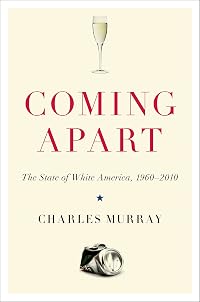
It is when Ferguson reaches civil society that I am most intrigued. He quotes from both [b:Bowling Alone: The Collapse and Revival of American Community|478|Bowling Alone The Collapse and Revival of American Community|Robert D. Putnam|https://d202m5krfqbpi5.cloudfront.net/books/1347842732s/478.jpg|4743] by Robert Putnam and [b:Coming Apart: The State of White America, 1960-2010|12031563|Coming Apart The State of White America, 1960-2010|Charles Murray|https://d202m5krfqbpi5.cloudfront.net/books/1333576558s/12031563.jpg|16997889] by Charles Murray, both landmark works on the dramatic decrease in voluntary associations over the last century. Where as at one point both wealthy and poor attended the same churches, participated in the same organizations (think Lions Club or Rotary or even Boy Scouts), and lived in the same neighborhoods, recent decades have seen lower and lower membership and participation in these voluntary associations that have brought people together for a common purpose. Instead, government has replaced these voluntary associations in many cases as the source of resort and not often with improved results. We may have more "Friends" on Facebook, but the relationships there are no more substantial than the effort to click "Like." The result is less civic-mindedness and less civic-participation.
And no, showing up to vote does not reflect civic participation. Voter turnout is merely a symptom of increased, or decreased, civic engagement.
Since I listened to the book over the course of several days commute and while doing a bit of home improvement, I found the shorter analysis and references to other works useful and was unsurprised to hear, as Ferguson closed up the book, that it was based on a series of lectures. While The Great Degeneration is a fascinating, if bite-sized, look at the problems assailing western civilization, it proceeds along lines that are more prescriptive than proscriptive. As a gateway, however, it is a starting point, and on that score, I recommend it as a place to begin your examination of the future of our democracy. show less
With a page count a bit lower than [b:Civilization|10475421|Civilization The West and the Rest|Niall Ferguson|https://d202m5krfqbpi5.cloudfront.net/books/1347777341s/10475421.jpg|15380749], [b:The Great Degeneration|16129479|The Great Degeneration How Institutions Decay and Economies Die|Niall Ferguson|https://d202m5krfqbpi5.cloudfront.net/books/1372541698s/16129479.jpg|21954506] is based on his 2012 "Reith Lectures" on the BBC and walks through four institutions that Ferguson sees as crucial to the prosperity of the modern state. Faced with growing symptoms of decline, such as slowing growth, crushing debts, increasing inequality, aging populations, antisocial behavior, Ferguson believes that our institutional degeneration may be the major cause.
Ferguson opens by first addressing other arguments about why wealthy countries have declined. China and India's impressive economic growth, in contrast to relative stagnation in western democracies, is not a matter of the rest of the world catching up to the West, but is also a result of actual decline in real terms in western countries of certain institutions, especially in the decline of political, economic, legal and social institutions.
The west's success, relative to "the rest," over the last few centuries has been in large part due to four institutions: democracy, capitalism, the rule of law, and civil society.
Democracy has deteriorated not so much due to access, but rather due to the breakdown of the social contract between generations, says Ferguson. For this, he cites the expensive benefits that older generations have voted themselves to be left to the next generation to pay for, noting that Edmund Burke, in his [b:Reflections On The Revolution In France|2168825|Reflections On The Revolution In France|Edmund Burke|/assets/nocover/60x80.png|154445] saw the generations as an important part of the social contract. By taking on astronomical amounts of debt, we have put future generations on the hook for our expensive lifestyles.
When it comes to capitalism, Ferguson is not so much anti-regulation as he is anti-bad regulation. There is not such thing as a market without some kind of regulation, he says, but the regulation must makes sense and malefactors must be made to pay. On the contrary, in the recent recession, Wall Street came out ahead, despite risky behavior and dangerous bets, while average Americans bailed them out with giant debt producing stimulus packages.
Where once the rule of law protected contracts and property rights, tort law has slowed down the legal system, raised the costs of doing business, increased the costs of products, and failed to produce a corresponding benefit, stifling innovation and creativity.
It is when Ferguson reaches civil society that I am most intrigued. He quotes from both [b:Bowling Alone: The Collapse and Revival of American Community|478|Bowling Alone The Collapse and Revival of American Community|Robert D. Putnam|https://d202m5krfqbpi5.cloudfront.net/books/1347842732s/478.jpg|4743] by Robert Putnam and [b:Coming Apart: The State of White America, 1960-2010|12031563|Coming Apart The State of White America, 1960-2010|Charles Murray|https://d202m5krfqbpi5.cloudfront.net/books/1333576558s/12031563.jpg|16997889] by Charles Murray, both landmark works on the dramatic decrease in voluntary associations over the last century. Where as at one point both wealthy and poor attended the same churches, participated in the same organizations (think Lions Club or Rotary or even Boy Scouts), and lived in the same neighborhoods, recent decades have seen lower and lower membership and participation in these voluntary associations that have brought people together for a common purpose. Instead, government has replaced these voluntary associations in many cases as the source of resort and not often with improved results. We may have more "Friends" on Facebook, but the relationships there are no more substantial than the effort to click "Like." The result is less civic-mindedness and less civic-participation.
And no, showing up to vote does not reflect civic participation. Voter turnout is merely a symptom of increased, or decreased, civic engagement.
Since I listened to the book over the course of several days commute and while doing a bit of home improvement, I found the shorter analysis and references to other works useful and was unsurprised to hear, as Ferguson closed up the book, that it was based on a series of lectures. While The Great Degeneration is a fascinating, if bite-sized, look at the problems assailing western civilization, it proceeds along lines that are more prescriptive than proscriptive. As a gateway, however, it is a starting point, and on that score, I recommend it as a place to begin your examination of the future of our democracy. show less
This small volume delivered as lectures are a distillation of most of Ferguson's main points. He demonstrates how institutions decay and an economy, particular the U.S., has degenerated. It could serve as a précis for students unfamiliar with his work to appreciate his more lengthy and substantial works. This is not to suggest that the work is thematically deficient. It is, as in his other works, cogently argued and articulately expressed.
The book touches on three aspects of "degenration" of Western nations: civil society, the rule of law, economics. He will no doubt be accused of being right-wing, which for Ferguson appears unlikely. His points seem self-evident. The weight of regulation is pulling our various countries down - check. He doesn't argue against regulation, but its excesses. The weight of debt is an inter-generational trojan horse - check. I think it self-evident that we baby boomers are using our governments to indebt our countries to enjoy a lifestyle that we could not otherwise afford. The rule of law has become the rule of lawyers - check. One has only to read the news to see disconnects between reality and justice. No one important from any bank or show more investment firm after 2008 but we continually jail for petty crimes. Finally, the squeezing out of civil society by government - check. Where are the volunteers now?
Not a happy book, but one worth reading. show less
Not a happy book, but one worth reading. show less
A rather loose ramble across the subject, covering democracy, the law, civil society and something else he called the human hive, but I forgot what it meant. The book grew out of series of lectures he gave, and it reads that way. Whilst interesting, it's not very inspiring and ones left a little lost as to what the message and the conclusions are.
Members
- Recently Added By
Lists

Política - Clásicos
164 works; 2 members
Author Information

53+ Works 18,138 Members
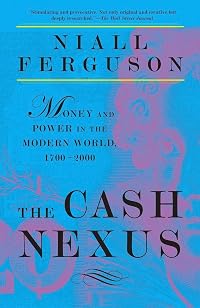
Niall Ferguson was born April 18, 1964, in Glasgow. He is a Scottish historian. He specializes in financial and economic history as well as the history of empire. He is the Laurence A. Tisch Professor of History at Harvard University and the William Ziegler Professor of Business Administration at Harvard Business School. His books include Paper show more and Iron: Hamburg Business and German Politics in the Era of Inflation 1897-1927 (1993), Virtual History: Alternatives and Counterfactuals (1997), The Pity of War: Explaining World War One (1998), The World's Banker: The History of the House of Rothschild (1998), The Cash Nexus: Money and Power in the Modern World, 1700-2000 (2001), Empire: The Rise and Demise of the British World Order and the Lessons for Global Power (2003), Colossus: The Rise and Fall of the American Empire (2004), The War of the World: Twentieth-Century Conflict and the Descent of the West (2006) and The Ascent of Money: A Financial History of the World (2008), Civilization: The West and the Rest (2011) , The Great Degeneration: How Institutions Decay and Economies Die, and The Square and the Tower: Networks and Power, from the Freemasons to Facebook. (Bowker Author Biography) show less
Some Editions
Common Knowledge
- Canonical title*
- Der Niedergang des Westens. Wie Institutionen verfallen und Ökonomien sterben
- Original publication date
- 2012
*Some information comes from Common Knowledge in other languages. Click "Edit" for more information.
Classifications
- Genres
- Economics, Sociology, Nonfiction, General Nonfiction, History, Politics and Government, Business
- DDC/MDS
- 306.09172 — Society, government, & culture Social sciences, sociology & anthropology Social Behavior - Dating, Marriage, Divorce Social history
- LCC
- HN19 .F47 — Social sciences Social history and conditions. Social problems. Social reform Social history and conditions. Social problems.
- BISAC
Statistics
- Members
- 577
- Popularity
- 51,181
- Reviews
- 10
- Rating
- (3.15)
- Languages
- 7 — Czech, English, German, Italian, Portuguese, Russian, Spanish
- Media
- Paper, Audiobook, Ebook
- ISBNs
- 26
- ASINs
- 10