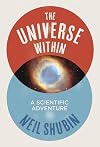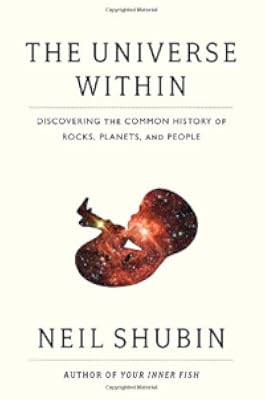
The Universe Within: Discovering the Common History of Rocks, Planets, and People
by Neil Shubin
On This Page
Description
Shubin shows how the entirety of the universe's fourteen-billion-year history can be seen in our bodies as he moves from our very molecular composition (a result of stellar events at the origin of our solar system) through the workings of our eyes.Tags
Recommendations






Member Reviews
As Shubin traced the 3.5-billion-year history of evolutionary biology in Your Inner Fish, here he traces the ~14-billion-year history of … evolutionary cosmology? … from the big bang and coalescence of our solar system, through the separation of Earth’s crust into continents that created the oceans which released oxygen, to the evolution of life as we know it, practically to the point in time of reading this LibraryThing screen today. It’s a science ballet whose cast includes almost every scientific specialty, plus science history and biography and personal experience. And it’s fascinating.
I remember how gobsmacked I was when I learned that the material of our bodies originated in stars, and I felt a dozen similar occasions of show more awe here while reading about the right-place-right-time fortuitousness of life on Earth. For example, this from the long-ago:
Since {a mammalian fetus} receives all of its oxygen from the mother, there needs to be a way that oxygen can be transferred from the mother’s blood. The transfer is facilitated by a steep gradient between the concentration of oxygen in the maternal blood and that of the fetus: under these conditions, oxygen will travel into the fetus. Importantly, the oxygen content of the mother’s blood has to be sufficiently high to enable this transfer in the first place. This constraint means that mammals with a placenta do not easily develop above fifteen thousand feet altitude. Tellingly, the oxygen {above fifteen thousand feet} is equivalent to that in the atmosphere at sea level 200 million years ago, before the Atlantic Ocean formed {and increased atmospheric oxygen, making mammalian life possible}.
And this, about evolution right now:
In the developed world {…} most evolutionary pressure is on aspects of fertility: when we have offspring and how many we have. In the developing world things are very different: passing on one’s genes is about mortality, particularly that of children. In one world, evolutionary success is derived from the age at which people have babies; in the other, such success is derived from survival itself. Socioeconomic, cultural, and technological differences mediate the ways evolution acts in human populations.
Shubin’s scope is enormous and he covers quite a bit of it in ~200 pages of simple, captivating language; my only quibble is a bit of disorganization -- maybe the result of the survey nature of the material -- that made it difficult for me to neatly file the info into memory. But he whets the appetite for more, which for me will be David Christian's Maps of Time.
(Review based on an advance reading copy provided by the publisher.) show less
I remember how gobsmacked I was when I learned that the material of our bodies originated in stars, and I felt a dozen similar occasions of show more awe here while reading about the right-place-right-time fortuitousness of life on Earth. For example, this from the long-ago:
Since {a mammalian fetus} receives all of its oxygen from the mother, there needs to be a way that oxygen can be transferred from the mother’s blood. The transfer is facilitated by a steep gradient between the concentration of oxygen in the maternal blood and that of the fetus: under these conditions, oxygen will travel into the fetus. Importantly, the oxygen content of the mother’s blood has to be sufficiently high to enable this transfer in the first place. This constraint means that mammals with a placenta do not easily develop above fifteen thousand feet altitude. Tellingly, the oxygen {above fifteen thousand feet} is equivalent to that in the atmosphere at sea level 200 million years ago, before the Atlantic Ocean formed {and increased atmospheric oxygen, making mammalian life possible}.
And this, about evolution right now:
In the developed world {…} most evolutionary pressure is on aspects of fertility: when we have offspring and how many we have. In the developing world things are very different: passing on one’s genes is about mortality, particularly that of children. In one world, evolutionary success is derived from the age at which people have babies; in the other, such success is derived from survival itself. Socioeconomic, cultural, and technological differences mediate the ways evolution acts in human populations.
Shubin’s scope is enormous and he covers quite a bit of it in ~200 pages of simple, captivating language; my only quibble is a bit of disorganization -- maybe the result of the survey nature of the material -- that made it difficult for me to neatly file the info into memory. But he whets the appetite for more, which for me will be David Christian's Maps of Time.
(Review based on an advance reading copy provided by the publisher.) show less
When the continent of India slammed into Asia creating the Himalayas it changed the world climate which altered the plants available for food eventually leading to our ability to perceive color. How? This fascinating book, a sort of big history/big science blend, is exactly as its title describes it. The Universe Within: Discovering the Common History of Rocks, Planets and People explores how the properties of our bodies and the course of our lives have been affected by the universe we live in, beginning with the big bang. It also includes some science history with personality filled stories of how plate tectonics and other scientific theories were first hypothesized, and it gives a taste of how current scientists in in the author’s show more field of biological sciences work, for instance dropping to all fours to hunt for tiny fossils that shed light on the evolution of our Earth. The tone is enthusiastic, and the endnotes include lots of suggestions for further reading. My copy of the book is decked with post it flags marking sections I have already reread several times, often sharing them with whoever happens to be around me at the time. show less
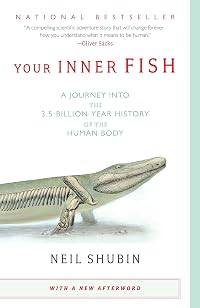
Neal Shubin is the guy who found the fossils of Tiktaalik, the “fish with hands,” a possible link between sea and land animals. His last book, Your Inner Fish: A Journey into the 3.5-Billion-Year History of the Human Body, was all about how humanity developed out of earlier forms.
In The Universe Within: Discovering the Common History of Rocks, Planets and People, Shubin takes a look at the bigger picture. Yes, it does get bigger than 3.5 billion years; in this case, he’s looking at how puny little humans are actually part of the more than 14 billion-year history of the universe.
The key here is that Shubin—like Neil DeGrasse Tyson, for instance, and the late Carl Sagan—has a real knack for making science not only understandable show more but amusing and interesting. He writes anti-fables, but the narrative remains fabulous.
Reviewed on Lit/Rant: http://litrant.tumblr.com/post/51781909883/the-antidote-to-mythology show less
In The Universe Within: Discovering the Common History of Rocks, Planets and People, Shubin takes a look at the bigger picture. Yes, it does get bigger than 3.5 billion years; in this case, he’s looking at how puny little humans are actually part of the more than 14 billion-year history of the universe.
The key here is that Shubin—like Neil DeGrasse Tyson, for instance, and the late Carl Sagan—has a real knack for making science not only understandable show more but amusing and interesting. He writes anti-fables, but the narrative remains fabulous.
Reviewed on Lit/Rant: http://litrant.tumblr.com/post/51781909883/the-antidote-to-mythology show less
A bit of a letdown after his previous book Your Inner Fish: a Journey into the 3.5-Billion-Year History of the Human Body. This one takes a much wider view, touching on everything from The Big Bang to plate tectonics. There's a lot of interesting stuff, but the links to human biology are often extremely tenuous, and there are insufficient connections between the various topics.
Still, it's an entertaining and informative read, touching on a bunch of fascinating fields with great anecdotes on the people that made the discoveries.
Still, it's an entertaining and informative read, touching on a bunch of fascinating fields with great anecdotes on the people that made the discoveries.
In a nutshell, this is just another brief history of the world. As with many authors (and their respective) books, Neil Shubin and The Universe Within attempt sketching the vast history from Big Bang to modern times.
However, the book is not dull or uneducating. Linking mundane things that we take for granted and drawing a line to connect all the dots may be easy in today's expanded and connected scientific world, but explaining it with simplicity that (perhaps) even a high-schooler can understand is a feat in itself for a scientist or science-writer.
If someone wants a crash course (this book is tiny compared to many scientific books) in the history of themselves and the universe around and within, this book should be on their to-read show more list. No other book that I have recently read can boast of bringing someone up to date in such short time. show less
However, the book is not dull or uneducating. Linking mundane things that we take for granted and drawing a line to connect all the dots may be easy in today's expanded and connected scientific world, but explaining it with simplicity that (perhaps) even a high-schooler can understand is a feat in itself for a scientist or science-writer.
If someone wants a crash course (this book is tiny compared to many scientific books) in the history of themselves and the universe around and within, this book should be on their to-read show more list. No other book that I have recently read can boast of bringing someone up to date in such short time. show less
This work is more about how science can and should be interrelated to make discoveries and present understanding than how the cosmos is present in our bodies. My favorite example is of Chet Raymo's daughter Maureen's hypothosis that the Indian subcontinent pushing up the Himalayas created global cooling 40 million years ago. The new exposed rock had a chemical reaction with rain taking CO2 out of the atmosphere. Geology, paleontology, climatology and more. It is less clear to me how that shows up in our DNA.
This work is more about how science can and should be interrelated to make discoveries and present understanding than how the cosmos is present in our bodies. My favorite example is of Chet Raymo's daughter Maureen's hypothosis that the Indian subcontinent pushing up the Himalayas created global cooling 40 million years ago. The new exposed rock had a chemical reaction with rain taking CO2 out of the atmosphere. Geology, paleontology, climatology and more. It is less clear to me how that shows up in our DNA.
Members
- Recently Added By
Author Information

13 Works 3,819 Members
Awards and Honors
Distinctions
Notable Lists
Common Knowledge
- Canonical title
- The Universe Within: Discovering the Common History of Rocks, Planets, and People
- Original title
- The Universe Within: Discovering the Common History of Rocks, Planets, and People
- Original publication date
- 2013-01-08
- People/Characters
- Farish A. Jenkins; Marie Tharp; Alfred Wegener
- Dedication
- FOR MICHELE, NATHANIEL, AND HANNAH
- First words
- PROLOGUE
Having spent the better part of my working life staring at rocks on the ground, I've gained a certain perspective on life and the universe. - Blurbers
- Krauss, Lawrence M.; Zimmer, Carl; Carroll, Sean
Classifications
Statistics
- Members
- 395
- Popularity
- 78,861
- Reviews
- 15
- Rating
- (3.74)
- Languages
- Dutch, English, Finnish, German
- Media
- Paper, Audiobook, Ebook
- ISBNs
- 13
- ASINs
- 8