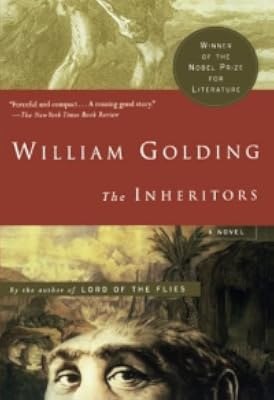
The Inheritors
by William Golding
On This Page
Description
In The Inheritors, William Golding masterfully reimagines the prehistoric world, crafting a deeply moving narrative about the fragile balance between innocence and ambition, survival and destruction. The story unfolds through the perspective of a small Neanderthal tribe, portrayed as gentle, empathetic beings who live in harmony with their environment. Their simple lives are upended with the arrival of a new species: Homo sapiens. The Homo sapiens, more technologically advanced and cunning, show more represent the dawn of a new era. Golding contrasts the innocence of the Neanderthals with the calculated aggression of their successors, capturing the inherent violence and ambition that would come to define humanity's future. Through vivid and poetic prose, he immerses readers in the Neanderthals' sensory and emotional world, allowing us to experience their confusion, fear, and awe as they encounter the alien ways of the newcomers. This gripping narrative is more than a story of survival; it is an allegory about the loss of innocence and the relentless march of progress. Golding challenges readers to reflect on the costs of evolution and what it means to be human. The Inheritors is a haunting, thought-provoking novel that lingers in the mind long after the final page. show lessTags
Recommendations




















Member Recommendations
themulhern Neandertals are displaced by Cro-Magnons.
Member Reviews
I am in awe of this book, Golding's craft, and his work in general (I have also read "Lord of the Flies" and "Darkness Visible"). The writing itself, whatever one thinks of the plot, is transcendent. I am impressed by what must have been prodigious research on Golding’s part to gain insight in the world of the Neanderthals, about whose specific reality modern man can only speculate. Whatever the Neanderthals lacked in intellectual capability, they more than made up for in their ability to use their senses, especially that of smell. As well as their possible telekinetic activity, which would have been unencumbered by more advanced intellectual processes. Golding's Neanderthals have an intuitive grasp of their world that is lacking in show more the modern human; on the other hand, the Neanderthals also live more wholly at the mercy of "Oa" (Mother Earth). The innocence of the Neanderthals is endearing, the "new people" Homo sapiens are dangerous and menacing. I felt compassion for the Neanderthals, and contempt for "the new people". The emotion that binds both species together is fear; -IE- Homo sapiens refer to the Neanderthals as "devils"; Fa tells Lok that “the new people are frightened of the air”.
The prose within "The Inheritors" is highly poetic; Golding paints an intricate portrait of a primeval landscape, such as our planet will probably never experience again; this description in itself adds to the atmosphere of suspense the author creates in this novel. It is not just that landscape in itself that is impressionable, but also how it is perceived by the Neanderthals and their "mind-dream-pictures"; -IE- the heightened colors seen by Lok during his hangover from the honey-drink. Golding shrouds his worlds in mystery to create a background of heightened effect, which becomes an integral part of the story; Richard Wagner used a similar technique by employing the orchestra as an additional "voice" in “Der Ring des Nibelungen”. One of the major themes of this book focuses on the evolution of innocence into corruption; a problem that unfortunately still exists in humans today. Another theme is that of the Machiavellian nature of mankind as a whole, specifically in how that behaviour was starting to evolve in Golding's portrait of Homo sapiens. I actually think this work is more engaging than the more commercially accessible LOTF (and certainly more so than the experimental-yet-inconsistent "Darkness Visible”). Golding is a recent discovery of mine, and I am looking forward to reading more of his work. show less
The prose within "The Inheritors" is highly poetic; Golding paints an intricate portrait of a primeval landscape, such as our planet will probably never experience again; this description in itself adds to the atmosphere of suspense the author creates in this novel. It is not just that landscape in itself that is impressionable, but also how it is perceived by the Neanderthals and their "mind-dream-pictures"; -IE- the heightened colors seen by Lok during his hangover from the honey-drink. Golding shrouds his worlds in mystery to create a background of heightened effect, which becomes an integral part of the story; Richard Wagner used a similar technique by employing the orchestra as an additional "voice" in “Der Ring des Nibelungen”. One of the major themes of this book focuses on the evolution of innocence into corruption; a problem that unfortunately still exists in humans today. Another theme is that of the Machiavellian nature of mankind as a whole, specifically in how that behaviour was starting to evolve in Golding's portrait of Homo sapiens. I actually think this work is more engaging than the more commercially accessible LOTF (and certainly more so than the experimental-yet-inconsistent "Darkness Visible”). Golding is a recent discovery of mine, and I am looking forward to reading more of his work. show less
Where his first book exposed the fundamental nastiness of humans by taking a bunch of children away from the constraints of adult society, Golding's second novel shows us an equally bleak view of the species from the point of view of the hominids we displaced. His Neanderthals are gentle, cooperative, and committed — through a simple, all-embracing, Mother Goddess cult — to sustainable use of what the forest has to offer them. When they first come into contact with a group of the new-fangled homo sapiens that have strayed into their area, both sides panic, but the result is mildly awkward for the ruthless and resourceful new people and disastrous for the delicately-balanced Neanderthal clan.
The message may be quite simplistic, but show more Golding handles it just as brilliantly as you would expect, developing a stripped-down language free from cultural and technological images to show us the world — and the puzzling behaviours of the new people — from the Neanderthals' perspective and engage our sympathy with their struggle to survive. It is only right at the end of the book that the main viewpoint character, Lok, discovers the power of simile and starts applying it to everything around him. Obviously it is all a trick: we don't really know anything about how Neanderthals used language or how sophisticated their culture was, apart from a few slim clues in the artefacts they did or (mostly) didn't leave behind. But Golding creates a plausible and self-consistent view of the world, and it is quite a shock when the perspective suddenly shifts to the new people in the closing chapter and a half. show less
The message may be quite simplistic, but show more Golding handles it just as brilliantly as you would expect, developing a stripped-down language free from cultural and technological images to show us the world — and the puzzling behaviours of the new people — from the Neanderthals' perspective and engage our sympathy with their struggle to survive. It is only right at the end of the book that the main viewpoint character, Lok, discovers the power of simile and starts applying it to everything around him. Obviously it is all a trick: we don't really know anything about how Neanderthals used language or how sophisticated their culture was, apart from a few slim clues in the artefacts they did or (mostly) didn't leave behind. But Golding creates a plausible and self-consistent view of the world, and it is quite a shock when the perspective suddenly shifts to the new people in the closing chapter and a half. show less
It must be horrible to have had a distinguished career as a writer, but people only know you from your first novel. Which for Golding was Lord of the Flies; and even now 64 years after its publication, and 25 years after Golding’s death, if you asked anyone to name a novel by him they’d name his first novel. But to then follow Lord of the Flies with something as frankly weird as The Inheritors… Now, I know Golding was not that odd. I’ve read his Rites of Passage, which is brilliant, and I have The Spire on the TBR, but The Inheritors is by any yardstick an odd book. It tells of the end of the Neanderthals at the hands of the Cro-Magnons, and is told entirely from the point-of-view of the former. The main characters are a small show more group of Neanderthals, comprising a young male, an old male, an old woman, two young women, one of which carries a baby, and a young child. The old woman is described at one point as the young male’s mother, so it’s likely they’re all related. The old man dies – of pneumonia? – after falling into a river, and then other members of the family disappear under mysterious circumstances. The young male discovers some men have settled an island in a nearby river, but they are not men like himself – nor women, for that matter (Golding was an old school misogynist). The two survivors of the family hide out in a tree and witness the Cro-Magnons at work and play. It’s a novel in which very little happens for pages and pages, and what does happen is filtered through Golding’s idea of a Neanderthal worldview. It works because the prose is so good. There’s something about Golding’s writing that oozes authority, and I’m not entirely sure what it is. His prose is not lush, nor is it stripped back. But there’s a clarity and confidence to it that many writers would do well to emulate – especially in these days of MFAs and CWAs and creative writing courses. I can think of several recent highly-praised novels where if the author really had applied “kill your darlings”, the novel would be considerably shorter. Had Golding done the same to The Inheritors, it would be precisely the same length. show less
In The Inheritors, William Golding has condensed into one story the death of a lesser race as it gives way to a stronger, more intelligent, better adapted race. As a small band of Neanderthals come into contact with a group of Homo Sapiens, their doom is fore-ordained. The story unfolds through the eyes of Lok, a slightly simple-minded, gentle fellow who, in the pecking order of the tribe, is the lowest man. Lok has trouble putting the pictures that his brain forms into words for everyone to understand, and when the two lead males die, he is unable to process his thoughts and lead the remaining tribe members to safety.
This is a sad story, but a familiar one in the history of the world. As the story is told mostly from the show more Neanderthal’s point of view, one is inclined to dislike the Homo Sapiens, until the final chapter when the point of view switches and we reach the sad understanding that ignorance, misunderstanding, and fear of the unknown all to often lead to hasty judgements.
This is a powerful story told in a picturesque, lyrical style that touches the reader and stirs the imagination. The Inheritors is William Golding’s eulogy to these unusual beings that existed and then were so effectively wiped out. show less
This is a sad story, but a familiar one in the history of the world. As the story is told mostly from the show more Neanderthal’s point of view, one is inclined to dislike the Homo Sapiens, until the final chapter when the point of view switches and we reach the sad understanding that ignorance, misunderstanding, and fear of the unknown all to often lead to hasty judgements.
This is a powerful story told in a picturesque, lyrical style that touches the reader and stirs the imagination. The Inheritors is William Golding’s eulogy to these unusual beings that existed and then were so effectively wiped out. show less
The Inheritors is an astonishing novel. I picked it up from the library shelves on the strength of William Golding’s name because Lord of the Flies is unforgettable and Pincher Martin took my breath away. But even so, the imaginative power of The Inheritors floored me. I’ve never read anything like it.
This is the blurb:
I had thought that this was going to be a kind of First Contact book, and in some ways it is. But what I had not expected was that Golding tells the story through beings so like and yet unlike ourselves, that the narration is like reading not just a language that I only poorly understand but of a being who does not think as we do. Golding has not just imagined a language which, as John Carey says in the Introduction, incorporates gesture, dance and a kind of telepathy>/I>, but also a different way of thinking. The small, fragile band of Neanderthals think in pictures which they can share; they scent like animals do; but they can’t connect thoughts or sequence ideas. Carey explains it better than I can:
This, in Chapter One, shows the reaction to a log bridge rotting in the middle and floating away:
Ha is more thoughtful than Lok, the man for an emergency, but when Fa and Nil share a picture of what Ha is thinking, it was this:
To read the rest of my review please visit https://anzlitlovers.com/2018/12/22/the-inheritors-by-william-golding/ show less
This is the blurb:
When the spring came the people – what was left of them – moved back by the old paths from the sea. But this year strange things were happening, terrifying things that had never happened before. Inexplicable sounds and smells; new, unimaginable creatures half glimpsed through the leaves. Seen through the eyes of a small tribe of Neanderthals whose world is hanging in the balance, The Inheritors explores theshow more
emergence of a new race — ourselves, Homo sapiens — whose growing dominance threatens an entire way of life.
I had thought that this was going to be a kind of First Contact book, and in some ways it is. But what I had not expected was that Golding tells the story through beings so like and yet unlike ourselves, that the narration is like reading not just a language that I only poorly understand but of a being who does not think as we do. Golding has not just imagined a language which, as John Carey says in the Introduction, incorporates gesture, dance and a kind of telepathy>/I>, but also a different way of thinking. The small, fragile band of Neanderthals think in pictures which they can share; they scent like animals do; but they can’t connect thoughts or sequence ideas. Carey explains it better than I can:
The greatness of The Inheritors does not depend, however, on Golding imagining what Neanderthals might have been like. It depends on the language he fashions to express it. He accepts the colossal stylistic challenge of seeing everything from a Neanderthal point of view. By feats of language that are at first bewildering he takes us inside a being whose senses, especially smell and hearing, are acute, but who cannot connect sensations into a train of thought. This is a being whose awareness is a stream of metaphors and for whom everything is alive. Intricate verbal manoeuvres force us to share the adventures — and the pathos and the tragedy — of a consciousness that is fearless, harmless, loving, minutely observant and incapable of understanding anything. (John Carey, Introduction, p xi)
This, in Chapter One, shows the reaction to a log bridge rotting in the middle and floating away:
The onyx marsh water was spread before them, widening into the river. The trail along by the river began again on the other side on ground that rose until it was lost in the trees. Lok, grinning happily, took two paces towards the water and stopped. The grin faded and his mouth opened till the lower lip hung down. Liku slid to his knee then dropped to the ground. She put the little Oa’s head to her mouth and looked over her.
Lok laughed uncertainly.
“The log has gone away.”
He shut his eyes and frowned at the picture of the log. It had lain in the water from this side to that, grey and rotting. When you trod the centre you could feel the water that washed beneath you, horrible water, as deep in places as a man’s shoulder. The water was not awake like the river or the fall but asleep, spreading there to the river and waking up, stretching on the right into wildernesses of impassable swamp and thicket and bog. So sure was he of this log the people always used that he opened his eyes again, beginning to smile as if he were waking out of a dream; but the log was gone. (p.2)
Ha is more thoughtful than Lok, the man for an emergency, but when Fa and Nil share a picture of what Ha is thinking, it was this:
He had thought that he must make sure the log was still in position because if the water had taken the log or if the log had crawled off on business of its own then the people would have to trek a day’s journey round the swamp and that meant danger or even more discomfort than usual. (p.4)
To read the rest of my review please visit https://anzlitlovers.com/2018/12/22/the-inheritors-by-william-golding/ show less
This is my first reading of a novel by William Golding. I heard The Inheritors discussed on the brilliant podcast Backlisted, and their appreciation of the book was borne out for me in the reading of it. Briefly, it is the story of the tragic encounter between a small band (perhaps a last remnant) of Neanderthals and a more advanced group of Homo Sapiens. Golding is so brilliant at having the reader experience the story through the senses and mind of Lok, the main character. The Neanderthals are small, hirsute, emerging from all fours and into language and the way you experience this in the reading seems nothing short of miraculous. As the encounter between the two groups unfolds, you too will experience Lok’s confusion, fear and show more attraction to these strange New People. In this way the book can be challenging as you try to understand what is going on, but simultaneously there is tremendous narrative drive and suspense. Plus the writing is beautiful.
I have always been fascinated by early human and prehistoric time. It’s what we come from, as though you could encounter in such stories a possible distillation of what humans are and what we could be. Or where we went wrong, or if we ever lived in a sort of Eden. The Inheritors succeeds in all these ways. I loved the book. show less
I have always been fascinated by early human and prehistoric time. It’s what we come from, as though you could encounter in such stories a possible distillation of what humans are and what we could be. Or where we went wrong, or if we ever lived in a sort of Eden. The Inheritors succeeds in all these ways. I loved the book. show less
William Golding is best known for the enduring classic Lord of the Flies. However, he considered The Inheritors to be his best novel. I first read this book when I was in college. On rereading it, I find it to be an almost perfect book.
The novel is about a brief but disasterous encounter between a small group of Neanderthals and a small group of the more advanced Cro Magnon or Homo Sapiens. (There is some dispute about some of the anthropological aspects of this book, but these critics seem to forget this is a novel, with characters and a plot, not a textbook on human development.)
Most of the novel is narrated from the pov of Lok, one of the younger Neanderthal men, whose mate is Fa. (A final short chapter is narrated from the pov of show more the new people.) We are aware from the beginning that Lok is not as mentally sophisticated as Fa, although under the group's traditions, Lok will succeed to leadership of the group after the elder, Mal, dies.
The people are gentle, loving and peaceful. Instead of thinking or reading, they "see pictures," and they can communicate with each other nonverbally. They do not hunt, but gather their food, although they will eat meat if they come across an animal that is already dead. They are unable to make fire, and must keep their fire always alive. They have no tools or implements, and, for example, must carry water in their hands.
Into this innocence the "new ones" intrude. They have fire and weapons. They have fashioned boats, tools and other implements. They wear clothes and have alcohol. They are sometimes violent.
In narrating the novel, Golding presents things and events as these primitive people perceive them, and we may sometimes have difficulty determining what they are actually observing or experiencing. Here, for example, is the description of Lok's first encounter with one of the new ones; Lok is curious, the new one attacks him with a bow and arrow:
"The man had white bone things above his eyes and under his mouth so that his face was longer than a face should be. The man turned sideways in the bushes and looked at Lok along his shoulder. A stick rose upright and there was a lump of bone in the middle. Lok peered at the stick and the lump of bone and the small eyes in the bone things over the face. Suddenly Lok understood that the man was holding the stick out to him but neither he nor Lok could reach across the river. He would have laughed if it were not for the echo of the screaming in his head. The stick began to grow shorter at both ends. Then it shot out to full length again.
"The dead tree by Lok's ear acquired a voice.
"'Clop!'
"His ears twitched and he turned to the tree. By his face there had grown a twig; a twig that smelt of other, and of goose, and of the bitter berries that Lok's stomach told him he must not eat. This twig had a white bone at the end. There were hooks in the bone and sticky brown stuff hung in the crooks. His nose examined this stuff and did not like. He smelled along the shaft of the twig. The leaves on the twig were red feathers and reminded him of goose. He was lost in a generalized astonishment and excitement."
I loved this book and highly recommend it.
4 1/2 stars show less
The novel is about a brief but disasterous encounter between a small group of Neanderthals and a small group of the more advanced Cro Magnon or Homo Sapiens. (There is some dispute about some of the anthropological aspects of this book, but these critics seem to forget this is a novel, with characters and a plot, not a textbook on human development.)
Most of the novel is narrated from the pov of Lok, one of the younger Neanderthal men, whose mate is Fa. (A final short chapter is narrated from the pov of show more the new people.) We are aware from the beginning that Lok is not as mentally sophisticated as Fa, although under the group's traditions, Lok will succeed to leadership of the group after the elder, Mal, dies.
The people are gentle, loving and peaceful. Instead of thinking or reading, they "see pictures," and they can communicate with each other nonverbally. They do not hunt, but gather their food, although they will eat meat if they come across an animal that is already dead. They are unable to make fire, and must keep their fire always alive. They have no tools or implements, and, for example, must carry water in their hands.
Into this innocence the "new ones" intrude. They have fire and weapons. They have fashioned boats, tools and other implements. They wear clothes and have alcohol. They are sometimes violent.
In narrating the novel, Golding presents things and events as these primitive people perceive them, and we may sometimes have difficulty determining what they are actually observing or experiencing. Here, for example, is the description of Lok's first encounter with one of the new ones; Lok is curious, the new one attacks him with a bow and arrow:
"The man had white bone things above his eyes and under his mouth so that his face was longer than a face should be. The man turned sideways in the bushes and looked at Lok along his shoulder. A stick rose upright and there was a lump of bone in the middle. Lok peered at the stick and the lump of bone and the small eyes in the bone things over the face. Suddenly Lok understood that the man was holding the stick out to him but neither he nor Lok could reach across the river. He would have laughed if it were not for the echo of the screaming in his head. The stick began to grow shorter at both ends. Then it shot out to full length again.
"The dead tree by Lok's ear acquired a voice.
"'Clop!'
"His ears twitched and he turned to the tree. By his face there had grown a twig; a twig that smelt of other, and of goose, and of the bitter berries that Lok's stomach told him he must not eat. This twig had a white bone at the end. There were hooks in the bone and sticky brown stuff hung in the crooks. His nose examined this stuff and did not like. He smelled along the shaft of the twig. The leaves on the twig were red feathers and reminded him of goose. He was lost in a generalized astonishment and excitement."
I loved this book and highly recommend it.
4 1/2 stars show less
Members
- Recently Added By
Lists

Best Prehistoric Novels
64 works; 10 members

1950s
340 works; 22 members
David Pringle's Science Fiction: The 100 Best Novels
101 works; 9 members

Publisher's Weekly Bestsellers - Part II - 1940 - 1979
355 works; 6 members

SHOULD Read Books!
354 works; 9 members

Five star books
1,767 works; 110 members

Nifty Fifties
129 works; 14 members

Prehistoric Peoples and Animals
10 works; 3 members

Books Read in 2010
631 works; 10 members

A Good Read (Radio 4)
287 works; 1 member
Talk Discussions
Past Discussions
Happy 100th to The Lord of the Fly in the Ointment, Sir William Golding in Nobel Laureates in Literature (March 2013)
Author Information

77+ Works 69,003 Members
William Golding was born in Cornwall, England on September 19, 1911. Although educated to be a scientist at the request of his father, he developed an interest in literature. At Oxford University, he studied natural science for two years and then transferred to a program for English literature and philosophy. He eventually became a schoolmaster at show more Bishop Wordsworth's School in Salisbury. During World War II, he joined the Royal Navy and was involved in the sinking of the German battleship Bismarck. After the war, he returned to Bishop Wordsworth's School and taught there until 1962. His first novel, Lord of the Flies, was published in 1954 and was made into a film in 1963. His other novels include The Inheritors, Free Fall, The Spire, The Pyramid, The Paper Men, Close Quarters, and Fire down Below. He won the Booker Prize for Rites of Passage in 1980 and the Nobel Prize for Literature in 1983. He also wrote plays, essays, and short stories. He was knighted by Queen Elizabeth II in 1988. He died on June 19, 1993. (Bowker Author Biography) show less
Some Editions
Awards and Honors
Series
Belongs to Publisher Series
Work Relationships
Is contained in
Has as a study
Has as a student's study guide
Common Knowledge
- Canonical title*
- Los herederos
- Original title
- The Inheritors
- Original publication date
- 1955
- People/Characters
- Lok; Liku; Fa
- Important places
- the shelter under the overhang
- Epigraph
- "We know very little of the appearance of the Neanderthal man, but this . . . seems to suggest an extreme hairiness, an ugliness, or a repulsive strangeness in his appearance over and above his low forehead, his beetle... (show all) brows, his ape neck, and his inferior stature . . . Says Sir Harry Johnston, in a survey of the rise of modern man in his Views and Reviews: 'The dim racial remembrance of such gorilla-like monsters, with cunning brains, shambling gait, hairy bodies, strong teeth, and possibly cannibalistic tendencies, may be the germ of the ogre in folklore . . .' "
H. G. Wells, Outlines of History - Dedication
- For Ann
- First words
- Lok was running as fast as he could.
- Last words
- (Click to show. Warning: May contain spoilers.)He peered forward past the sail to see what lay at the other end of the lake, but it was so long, and there was such a flashing from the water that he could not see if the line of darkness had an ending.
- Blurbers
- Koestler, Arthur; Roffey, Monique
- Original language
- English
*Some information comes from Common Knowledge in other languages. Click "Edit" for more information.
Classifications
- Genres
- Fiction and Literature, General Fiction, Science Fiction, Historical Fiction
- DDC/MDS
- 823.914 — Literature & rhetoric English & Old English literatures English fiction 1900- 1901-1999 1945-1999
- LCC
- PZ4 .G63 .I — Language and Literature Fiction and juvenile belles lettres Fiction and juvenile belles lettres Fiction in English
- BISAC
Statistics
- Members
- 1,718
- Popularity
- 12,969
- Reviews
- 52
- Rating
- (3.51)
- Languages
- 16 — Czech, English, Finnish, French, German, Hungarian, Italian, Norwegian (Bokmål), Norwegian, Polish, Portuguese, Romanian, Serbian, Spanish, Swedish, Turkish
- Media
- Paper, Ebook
- ISBNs
- 48
- ASINs
- 36