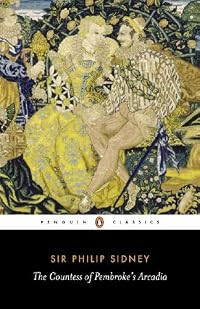
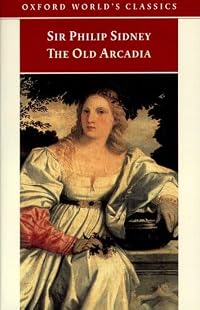
The Countess of Pembroke's Arcadia
by Philip Sidney
On This Page
Description
Basilus, a foolish old duke, consults an oracle as he imperiously wishes to know the future, but he is less than pleased with what he learns. To escape the oracle's horrific prophecies about his family and kingdom he withdraws into pastoral retreat with his wife and two daughters. When a pair of wandering princes fall in love with the princesses and adopt disguises to gain access to them, all manner of complications, both comic and serious, ensue. Part-pastoral romance, part-heroic epic, show more Sidney's long narrative work was hugely popular for centuries after its first publication in 1593, inspiring two sequels and countless imitations, and contributing greatly to the development of the novel. show lessTags
Recommendations

















Member Reviews
Not the most straightforward of books to review. To enjoy Arcadia you first have to accept a style which has gone deeply out of favour. It is highly, intricately rhetorical with sentences which build up, Pelion on Ossa, to very long, elaborate creations whilst meandering in and out of parentheses.
The actual descriptions of places, armour, dress, building etc are hugely decorative and literally gorgeous - gleaming and glistening with bright colours, jewels and fabrics. Sidney loves dwelling on the details of a suit of a knight's equipage and armour, for instance.
The characters don't so much have conversations as make speeches at another - presenting a case forensically very often. Again you grow accustomed to this as you realise the show more book and plot move forward in away which is different from the modern novel. Action is deliberate, thought out, analysed. When, on a couple of occasions, badly or un- thought out actions are undertaken they end in disaster. Evidently Sidney believed in knowing where you were going.
The plot - well it's a semi-pastoral, semi-heroic/epic story - that means princes disguised as shepherds or Amazons, kidnap, heroic battles and tourneys, reliance on coincidence (otherwise known as divine providence).
I loved it. Having worked my way into it and letting it wash over and through you, you come to appreciate its colour and stately procession and the way the language winds its way through the plot. I did wonder how far it reflected actual life at royal and aristocratic courts as experienced by Sidney. For instance you didn't have the luxury of free speech. No saying "God, the king has really cocked things up again, hasn't he!". That way led to the block. So you were more circumspect in what you said, and made considered pronouncements statements even when talking to one's peers. Imagine a super hyper-polite version of Jane Austen. Again how you performed at a tourney, how elaborately you were dressed (and what signals you were sending by dressing just so) and how far people respected you or thought you flighty or steady, all of which are evident in the book, could have reflected court life. show less
The actual descriptions of places, armour, dress, building etc are hugely decorative and literally gorgeous - gleaming and glistening with bright colours, jewels and fabrics. Sidney loves dwelling on the details of a suit of a knight's equipage and armour, for instance.
The characters don't so much have conversations as make speeches at another - presenting a case forensically very often. Again you grow accustomed to this as you realise the show more book and plot move forward in away which is different from the modern novel. Action is deliberate, thought out, analysed. When, on a couple of occasions, badly or un- thought out actions are undertaken they end in disaster. Evidently Sidney believed in knowing where you were going.
The plot - well it's a semi-pastoral, semi-heroic/epic story - that means princes disguised as shepherds or Amazons, kidnap, heroic battles and tourneys, reliance on coincidence (otherwise known as divine providence).
I loved it. Having worked my way into it and letting it wash over and through you, you come to appreciate its colour and stately procession and the way the language winds its way through the plot. I did wonder how far it reflected actual life at royal and aristocratic courts as experienced by Sidney. For instance you didn't have the luxury of free speech. No saying "God, the king has really cocked things up again, hasn't he!". That way led to the block. So you were more circumspect in what you said, and made considered pronouncements statements even when talking to one's peers. Imagine a super hyper-polite version of Jane Austen. Again how you performed at a tourney, how elaborately you were dressed (and what signals you were sending by dressing just so) and how far people respected you or thought you flighty or steady, all of which are evident in the book, could have reflected court life. show less
I've been looking forward to reading this work for years after dropping it once due to the complexity of the prose that made it too challenging for good old me. Ironically I am dropping it once again because I found the text subpar in terms of content and style, and after reading a variety of works written by pastoral authors I can assert that this novel is nothing more than a product of the Elizabethan society under the guise of a bucolic romance, a wannabe Sannazaro's Arcadia loaded with petty moralism and anecdotes about virtue and sin all too divorced from the real intent of the pastoral genre. Despite the impressive length of his work, Sidney drops the facade quite early in the novel and has no qualms about slapping 17th century show more quirks and literary tropes in his romance, which leaves us with a disappointing pseudo-historical Renaissance soap opera where respecting the importance of historical accuracy doesn't even cross the mind of the author. If this novel was written solely for entertainment purposes, it failed to deliver even that. show less
This is my personal candidate as the first Fantasy book written in English. I don't call it a medieval romance, because it's set in a deliberately invented background, the poetic kingdom of Arcadia. And, as it was cleared for publication by the Lord chancellor in 1593, it's not medieval in date, and the combats in it are sword and shield, not rapier and dagger. Is it in Elizabethan prose? Yesiree, Bob! But the spelling is regularized, so it's more readable than Spencer's Fairie Queene.
Eventually i finished it and it does have some entertaining content, but it was so successful in seizing the popular taste of the time, that now it's full of cliches, both plotwise and in figures of speech. I think it is still worth a look at by moderns, show more and it is due to be ripped off again by some Science fiction guy looking to revamp a classic with a "modern Re-Telling'. show less
Eventually i finished it and it does have some entertaining content, but it was so successful in seizing the popular taste of the time, that now it's full of cliches, both plotwise and in figures of speech. I think it is still worth a look at by moderns, show more and it is due to be ripped off again by some Science fiction guy looking to revamp a classic with a "modern Re-Telling'. show less
800-odd pages of dense Elizabethan prose and poetry telling the story of two princes, Musidorus and Pyrocles, who are travelling under the aliases Palladius and Daiphantus and fall in love with two sister princesses, Pamela (apparently Sir Philip Sidney made the name up) and Philoclea. Eventually of course after many vicissitudes true love finds a way.
I did find this very heavy going, reading very slowly, due to the very ornate language. Unfortunately the slow pace meant I'd often forgotten earlier episodes by the time they were referred to again.
I did find this very heavy going, reading very slowly, due to the very ornate language. Unfortunately the slow pace meant I'd often forgotten earlier episodes by the time they were referred to again.
Reprint with portions of the introduction removed
Reprint with portions of the introduction removed
Includes, with separate title page: A sixth book of the Countess of Pembroke's Arcadia / written by R. B. of Lincoln's Inn Esquire. -- London : George Calvert, 1674. Includes Defence of Poesie, Sonnets, Astrophel and Stella, and A supplement to the third book of Arcadia, etc.
Members
- Recently Added By
Lists

Early Modern (Shakesperean)
64 works; 2 members

Harold Bloom - The Western Canon: B. The Aristocratic Age
231 works; 13 members
Author Information

23+ Works 959 Members
Some Editions
Series
Belongs to Publisher Series
Work Relationships
Is contained in
Is an adaptation of
Has the adaptation
Inspired
Has as a commentary on the text
Common Knowledge
- Canonical title
- The Countess of Pembroke's Arcadia
- Original publication date
- 1590
- Disambiguation notice
- Sidney wrote The Arcadia twice. Some years after he finished the original version he began a thorough re-writing, in some places altering plot and characters, but died before he could finish it. Since the revised version is g... (show all)enerally regarded as an improvement, that's the version usually published (sometimes with the last few books of the original version appended to "complete" it). However, the so-called "Old Arcadia" is sometimes published by itself (for instance in the Oxford World Classics edtions with the isbns 019283956X, 0199549842, 0198118554 and 019281690X; the Cambridge edition isbn 0521064716; or in volume four of Feuillerat's Complete Prose Works of Sidney). The Old Arcadia is essentially a different "work" and (where identifiable) should not be combined with the main Arcadia work.
Classifications
Statistics
- Members
- 361
- Popularity
- 86,837
- Reviews
- 10
- Rating
- (3.53)
- Languages
- English
- Media
- Paper, Ebook
- ISBNs
- 20
- ASINs
- 8