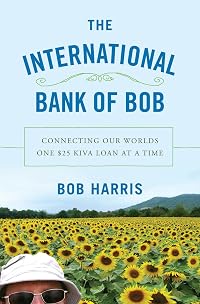
The International Bank of Bob: Connecting Our Worlds One $25 Kiva Loan at a Time
by Bob Harris
On This Page
Description
Hired to review some of the most luxurious accommodations on Earth, and then inspired by a chance encounter in Dubai with the impoverished workers whose backbreaking jobs create such opulence, Bob Harris had an epiphany: he would turn his own good fortune into an effort to make lives like theirs better. Bob found his way to Kiva.org, the leading portal through which individuals make microloans all over the world: for as little as $25-50, businesses are financed and people are uplifted. show more Astonishingly, the repayment rate was nearly 99%, so he re-loaned the money to others over and over again. After making hundreds of microloans online, Bob wanted to see the results first-hand, and in this book he travels from Peru and Bosnia to Rwanda and Cambodia, introducing us to some of the most inspiring and enterprising people we've ever met, while illuminating day-to-day life--political and emotional--in a world that Americans never see.--From publisher description. show lessTags
Recommendations























Member Recommendations
Member Reviews
In The International Bank of Bob, Bob Harris takes lending through international platform Kiva.org one step further: after providing funds for men and women in Africa, Morocco, Cambodia and more to buy supplies for shops, purchase cows or help with schooling, Harris journeys to meet borrowers face-to-face. Via translators and Kiva workers, Harris finds himself in all manner of locales to meet the people who benefit daily from the faith of strangers. And if he's helped change their lives in any small way, well . . . they're changing his, too.
What struck me immediately in this thorough, honest and fascinating travel and humanitarian memoir is Harris' steadfast belief that one person really can make a difference. Never does he judge or show more condescend, and Bob is incredibly humble. His painstakingly cautious approach to telling others' stories is further proof of his sincerity, and I couldn't help but admire him -- as a person and a writer -- for the lengths to which he strove to make the story about others, not himself. No small feat for a personal memoir.
The armchair travel opportunities are plentiful here, absolutely, and Harris paints many a beautiful picture as he travels seeking to better understand microcredit. But Kiva and microlending -- and those they benefit -- are the stars of this story. For someone who walked into Harris' story without any knowledge of microlending, I emerged with a much clearer understanding of the process. He explains everything well and kept it from getting boring.
I also really appreciated the balanced perspective Harris offers in . . . well, every aspect of the book. While microlending has been life-changing for some and most local partner agencies are working toward the common good, Harris doesn't paint over the messier parts: like the organizations shut down for veritable loan sharking. He talks of the joys and the trade-offs. And though he is a champion for Kiva, he doesn't work for Kiva; he's free to discuss what he wants. His story never reads like a rampant endorsement for the site, though he never puts it down.
This is a story of money: who has it, who doesn't. Harris often discusses "the birth lottery" -- how the circumstances of our lives are so often dictated by forces out of our control. God, destiny, science, karma . . . however you view it, somehow we got here. What are the odds I would be born a white American woman in a middle-class family, for example? (Pretty low.) Who's to say I am more "worthy" of a warm dinner and clean bed than a little boy in India, or a young mother in Vietnam? (No one.)
Harris doesn't dwell on the sad or the unpleasant. He mixes his personal history -- and his father's hardscrabble Appalachian roots -- with the stories of those he encounters, which lends an authenticity to his adventures. He isn't a poverty voyeur, zipping around the world to gawk at others' troubles and flip them into a fat book advance. He never seems boastful, which is pretty amazing if you consider he and members of his Kiva group have, to date, made more than 121,000 loans totaling upwards of $3.4 million through Kiva.
If ever there was something to brag about, well -- that would be it.
But Bob doesn't. Bob is funny. Bob is awesome. I finished this book feeling buoyant and hopeful and happy. It gave me a warm, humanity-doesn't-completely-suck feeling often missing from my everyday life. With the evening news so often full of pain and chaos, The International Bank of Bob reminded me that through laptops in random laps across the globe, so many people are working toward a greater tomorrow by making a small and generous move today.
What a beautiful thing. What a beautiful book. show less
What struck me immediately in this thorough, honest and fascinating travel and humanitarian memoir is Harris' steadfast belief that one person really can make a difference. Never does he judge or show more condescend, and Bob is incredibly humble. His painstakingly cautious approach to telling others' stories is further proof of his sincerity, and I couldn't help but admire him -- as a person and a writer -- for the lengths to which he strove to make the story about others, not himself. No small feat for a personal memoir.
The armchair travel opportunities are plentiful here, absolutely, and Harris paints many a beautiful picture as he travels seeking to better understand microcredit. But Kiva and microlending -- and those they benefit -- are the stars of this story. For someone who walked into Harris' story without any knowledge of microlending, I emerged with a much clearer understanding of the process. He explains everything well and kept it from getting boring.
I also really appreciated the balanced perspective Harris offers in . . . well, every aspect of the book. While microlending has been life-changing for some and most local partner agencies are working toward the common good, Harris doesn't paint over the messier parts: like the organizations shut down for veritable loan sharking. He talks of the joys and the trade-offs. And though he is a champion for Kiva, he doesn't work for Kiva; he's free to discuss what he wants. His story never reads like a rampant endorsement for the site, though he never puts it down.
This is a story of money: who has it, who doesn't. Harris often discusses "the birth lottery" -- how the circumstances of our lives are so often dictated by forces out of our control. God, destiny, science, karma . . . however you view it, somehow we got here. What are the odds I would be born a white American woman in a middle-class family, for example? (Pretty low.) Who's to say I am more "worthy" of a warm dinner and clean bed than a little boy in India, or a young mother in Vietnam? (No one.)
Harris doesn't dwell on the sad or the unpleasant. He mixes his personal history -- and his father's hardscrabble Appalachian roots -- with the stories of those he encounters, which lends an authenticity to his adventures. He isn't a poverty voyeur, zipping around the world to gawk at others' troubles and flip them into a fat book advance. He never seems boastful, which is pretty amazing if you consider he and members of his Kiva group have, to date, made more than 121,000 loans totaling upwards of $3.4 million through Kiva.
If ever there was something to brag about, well -- that would be it.
But Bob doesn't. Bob is funny. Bob is awesome. I finished this book feeling buoyant and hopeful and happy. It gave me a warm, humanity-doesn't-completely-suck feeling often missing from my everyday life. With the evening news so often full of pain and chaos, The International Bank of Bob reminded me that through laptops in random laps across the globe, so many people are working toward a greater tomorrow by making a small and generous move today.
What a beautiful thing. What a beautiful book. show less
I have nothing but praise for this book.
I had heard of Kiva and always intended to try it. I must admit that I chose this book under the mistaken impression that Bob Harris had something to do with the founding of Kiva. The opening chapter quickly corrects that impression.
Bob Harris landed a job traveling to some of the world's most luxurious accommodations and reviewing them. But at the same time he came face to face with some of the world's poorest people. It struck him as so unfair that people's lives could be so different simply based on "birth lottery" that he started to wonder if anything could be done about it.
He ultimately decided to take the money he had earned traveling amount the wealthy and investing it in loans to some of show more the world's poorest people via Kiva.org. And then he took it one step further. He visited Kiva headquarters and traveled around the globe, visiting micro-lenders and some of the clients who lent from Kiva. He saw firsthand the changes these loans made in their lives and the lives of their families.
This book is not a light read. There is a lot of information here. I learned about Kiva, I learned about micro-finance, I learned about conflicts and wars in countries all around the globe...but it was done in a down to earth, friendly, even funny style.
There were many times when I laughed out loud in this book. Bob Harris' writing reminds me of Bill Bryson - another author who makes me laugh and teaches me at the same time.
In the end, I was inspired to start an account at Kiva, something I'd always intended to do "one day".
I would definitely recommend this book.
(I received this book via Amazon's Vine Program.) show less
I had heard of Kiva and always intended to try it. I must admit that I chose this book under the mistaken impression that Bob Harris had something to do with the founding of Kiva. The opening chapter quickly corrects that impression.
Bob Harris landed a job traveling to some of the world's most luxurious accommodations and reviewing them. But at the same time he came face to face with some of the world's poorest people. It struck him as so unfair that people's lives could be so different simply based on "birth lottery" that he started to wonder if anything could be done about it.
He ultimately decided to take the money he had earned traveling amount the wealthy and investing it in loans to some of show more the world's poorest people via Kiva.org. And then he took it one step further. He visited Kiva headquarters and traveled around the globe, visiting micro-lenders and some of the clients who lent from Kiva. He saw firsthand the changes these loans made in their lives and the lives of their families.
This book is not a light read. There is a lot of information here. I learned about Kiva, I learned about micro-finance, I learned about conflicts and wars in countries all around the globe...but it was done in a down to earth, friendly, even funny style.
There were many times when I laughed out loud in this book. Bob Harris' writing reminds me of Bill Bryson - another author who makes me laugh and teaches me at the same time.
In the end, I was inspired to start an account at Kiva, something I'd always intended to do "one day".
I would definitely recommend this book.
(I received this book via Amazon's Vine Program.) show less
This book is about micro-lending, but even more it is about people who give so much to be the ones on the scene to facilitate the loans of people like me who put up a bit of cash and receive a lot of joy in watching that cash go out, come back, and go out to someone else. It is also about people who receive those loans and how that money makes a huge difference in their lives and spreads out to others as well.
My hat's off to Bob Harris for all he did in order to get these first-hand accounts. He then did a wonderful job of writing in such an interesting and often humorous way. This book is a great read. I learned so much about various places and customs and rejoiced that there are so many exceptional people in our world. "You love show more more, you win." show less
My hat's off to Bob Harris for all he did in order to get these first-hand accounts. He then did a wonderful job of writing in such an interesting and often humorous way. This book is a great read. I learned so much about various places and customs and rejoiced that there are so many exceptional people in our world. "You love show more more, you win." show less
Really liked, not perfect but a good mix of stuff. Funny, absorbing, educational, and inspirational.
Bob Harris was writing an article on the world's most luxurious hotels. Appalled at the waste he saw and the gulf between the lives of the richest and the poorest--Bob decided to take the fees he earned and do something good with it. He researched and began loaning funds out through Kiva and other micro-lending organizations. He then traveled the world and met some of the real individuals who are recipients of those funds to hear their stories and find out how those relatively small loans can make a huge difference downstream.
In his book International Bank of Bob: Connecting Our Worlds One $25 Kiva Loan at a Time, Harris connects the story to his own background--from roots in Appalachian poverty his own parents moved up for a better show more opportunity. He describes the long hours his own father put in--and how he sees that and his mother time and again reflected in these hard working individuals around the world.
He also tells the bigger story of micro lending in the book--of Kiva and other organizations--their successes and failures. This is as much a travelogue of the world's poorest regions. He does it with humor and respect for those he meets (except in a couple cases the individuals are not told that he was their benefactor).
I've been a big fan myself of Kiva, and also organizations like D-Rev and Room to Read that are on the ground solving real problems.
In this vein, here are other books I would recommend on globalization and giving back:
Travels of a T-Shirt in a Global Economy by Pietra Rivoli
An economics professor chases the economics of a simple t-shirt around the world and it's effect on the economy--from it's creation in a factory to a used clothing economy in Africa.
Leaving Microsoft to Change the World by John Wood
John Wood left his career at Microsoft to start and fund Room to Read and libraries all over the world.
The World is Flat by Thomas Friedmann
Friedmann explains the economics of globalization.
Guns, Germs and Steel by Jared Diamond
Diamond explains how history and resources has benefited some groups over others.
The Soul of Money by Lynn Twist
Lessons on how to give back.
Nickel and Dimed: On Not Getting By in America by Barbara Ehrenreich
Ehrenreich joins the working poor working for minimum wage to show the endless cycle of poverty. show less
The author had a free lance assignment for Forbes Travel and got to travel ,stay at high class locations& hobnob with the rich. While in Dubai he encountered some foreign laborers who were hardworkers but very poor . With all the wealth surrounding these workers who were doing the actual construction of all the fantastic buildings in Dubai the author had enough of the opulence connected to the Forbes assignment found out about Kiva, an organization that makes microloans to individuals all over the world in increments of $25.00. So he took all the money from the Forbes assignment and loaned it through Kiva to a number of different individuals around the world. And he visited many of the people who received the loans to see the story and show more the results. I wanted to read this book because I had also have loaned money through Kiva and have always been repaid. The actual repayment rate for these microloans is about 99%. Most of the loans that people ask for are rather small and you are helping someone start a business, maybe buy supplies for a small business. It's a feel good project to be able to help another person. show less
I haven't quite finshed reading this but already know it's a 5 rating. Wonderfully well written and a compelling overview of how microfinancing helps individuals improve their lives. I've long been a supporter of Kiva, and this book affirms my committment.
Members
- Recently Added By
Author Information

4 Works 545 Members
Bob Harris has had a diverse career as a TV writer, TV and radio personality, and political columnist. He has appeared on Jeopardyexcl; thirteen times, staging some of the most memorable upsets and collapses in the show's history. His first book, Prisoner of Trebekistan, chronicling his jeopardyexcl; experience, was widely praised, as was his show more second, Who Hates Whom, a pocket summary of more than thirty conflicts around the world. Bob lives in Los Angeles. Visit his website at www.bobharris.com. show less
Common Knowledge
- Canonical title
- The International Bank of Bob: Connecting Our Worlds One $25 Kiva Loan at a Time
- People/Characters
- Bob Harris
- Important places
- Marrakech, Morocco; Dubai; New York, New York, USA; San Francisco, California, USA; Cambodia; India (show all 8); Vietnam; Nepal
- First words
- It was an unexpected journey among the world's richest people that brought me face-to-face with some of the world's hardest-working poor.
Classifications
Statistics
- Members
- 140
- Popularity
- 233,861
- Reviews
- 9
- Rating
- (3.93)
- Languages
- English
- Media
- Paper, Ebook
- ISBNs
- 3
- UPCs
- 1
- ASINs
- 1