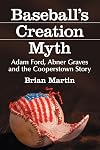
Baseball's Creation Myth: Adam Ford, Abner Graves and the Cooperstown Story
by Brian Martin
On This Page
Description
"The story about baseball's being invented in Cooperstown, New York, in 1839 by Civil War hero Abner Doubleday seemed to prove America's national pastime was an American game, not derived from the English children's game of rounders as had been believed. This book provides a surprising answer about the origins of America's most durable myth"--Provided by publisher.Tags
Recommendations


















Member Recommendations
Member Reviews
Not only did George Washington not cut down that cherry tree, it turns out that Abner Doubleday did not invent baseball. What is this world coming to? While I was aware that there were some questions about the origins of "Americas's pastime" is it really possible that baseball came to America from Great Britain? Was it first played in North America in Canada? Brian Martin provides a full background of several theories about the origins of the game. What is most fascinating is how Albert Spalding convinced just about everyone that the game was "invented" in Cooperstown by a future Civil War general. While Martin provides some excruciating detail about such people as Abner Graves and Adam Ford, they are critical to the understanding of show more this story. Spalding's quest to make baseball uniquely American came at a time when American Exceptionalism was at a fever pitch. The Spanish-American war had ended and Theodore Roosevelt was in the White House. To believe, as was written by the editor (and employee) of Spalding, Alexander Cartwright at the time that baseball was nothing more than an extension of the British game "rounders" was downright unAmerican. Baseball's Creation Myth is a worthy read for baseball fans everywhere. show less
 This review was written for LibraryThing Early Reviewers.
In Baseball's Creation Myth: Adam Ford, Abner Graves, and the Cooperstown Story Brian Martin takes a look at the men behind the story of baseball's supposed invention in Cooperstown, New York by Abner Doubleday in 1839. It is generally accepted that the story of Doubleday's invention of the game is a hoax that began with a letter from Abner Graves to a commission that was created by AG Spalding to prove that baseball had American origins. Martin accepts this. His purpose is to explore why Graves might have written the letter that enabled the hoax.
The greatest strength of Martin's work is how much history outside or organized baseball he includes. In telling about Graves and Adam Ford, who wrote a similar story about an early game of show more baseball played in Canada that Graves might have plagiarized for this Cooperstown story, Martin interweaves the history of the two men, the two countries involved, and all of the different locales that the two men called home during their lives. It turns out that these two men would both be interesting to read about if they had never written letters about baseball. There stories are stories of the old west, speculation, poison, murder, civic duty, success, and failure. Putting it all together makes for a very interesting book. show less
The greatest strength of Martin's work is how much history outside or organized baseball he includes. In telling about Graves and Adam Ford, who wrote a similar story about an early game of show more baseball played in Canada that Graves might have plagiarized for this Cooperstown story, Martin interweaves the history of the two men, the two countries involved, and all of the different locales that the two men called home during their lives. It turns out that these two men would both be interesting to read about if they had never written letters about baseball. There stories are stories of the old west, speculation, poison, murder, civic duty, success, and failure. Putting it all together makes for a very interesting book. show less
This review was written for LibraryThing Early Reviewers.This book is an important step in our understanding of the development of baseball, and in our understanding of how the long-accepted "official version" of that history came to be. The book is about that "official version," but unfortunately can provide no definitive answers. It does, however, raise many more questions, and is a starting point for a reconsideration of the truth.
The circumstantial evidence provided is strong, and this book is fabulously researched. The stories of Ford and Graves alone make fabulous biographies in themselves. However, the heart of his thesis - that Abner Graves, the man who supplied the story, adapted a story told by Adam Ford about his hometown in Ontario, to his own hometown of Cooperstown, NY - remains show more only circumstantial, and he cannot provide Graves's motivation or how on earth such a blatantly fabricated story held on for as long as it did.
Martin seems to be frustrated by this as well, and mentions several times that he can't say for sure whether Graves and Ford even were aware of each other, but that it seems likely. I believe that Martin is on to the right pathway to the truth, but questions remain, and the truth remains a mystery. Further research may provide more answers.
I'd recommend this book for anyone interested in baseball history, or even as a fine example of microhistory. Just be aware that you may come out more befuddled than you were before. show less
The circumstantial evidence provided is strong, and this book is fabulously researched. The stories of Ford and Graves alone make fabulous biographies in themselves. However, the heart of his thesis - that Abner Graves, the man who supplied the story, adapted a story told by Adam Ford about his hometown in Ontario, to his own hometown of Cooperstown, NY - remains show more only circumstantial, and he cannot provide Graves's motivation or how on earth such a blatantly fabricated story held on for as long as it did.
Martin seems to be frustrated by this as well, and mentions several times that he can't say for sure whether Graves and Ford even were aware of each other, but that it seems likely. I believe that Martin is on to the right pathway to the truth, but questions remain, and the truth remains a mystery. Further research may provide more answers.
I'd recommend this book for anyone interested in baseball history, or even as a fine example of microhistory. Just be aware that you may come out more befuddled than you were before. show less
This review was written for LibraryThing Early Reviewers.On a day in 1839 in Cooperstown, New York, the game of baseball was invented by General Abner Doubleday. How did this myth get so wide acceptance in the early part of the twentieth century and why? The story involves three men, none of which were Abner Doubleday. Adam Ford wrote a letter to an early sports publication in 1866 describing an early baseball game he saw played in his hometown of Beechville, Canada. He did not imply this was the first game; he was pointing out the differences between the game of his time and the modern game with rules drawn up by Alexander Cartwright in the 1840s. In 1905, Albert G. Spaulding, who wanted to disprove the theory that baseball grew out of the British children’s game rounders and make it show more totally American, asked for anyone with knowledge to come forth and give evidence to a commission he established. Abner Graves did so and credited the first game to Doubleday and the place to Cooperstown, New York. With no other information, the commission decided that this was the origin of the game and so they stated without checking the facts or naming Abner Graves. Surprising!
In Baseball's creation myth : Adam Ford, Abner Graves and the Cooperstown story, journalist Brian Martin explores all the facets of this story: the challenge, the lives of the three men involved, early baseball and many others. He attempts to discover the truth behind the legend. Although Martin is not a academic, his book is well researched and documented, as expected in any book that is published by McFarland. It is also easy to read. There are copious endnotes along with an excellent bibliography and index. Also included are photographs, a map and an appendix with the challenge, Abner Graves’ reply and the older article by Adam Ford. In later years, the facts have been checked and found to be factual in the Ford account. The Graves account does not fare as well with many inconsistencies. Also, Mr. Graves tended to embellish the story as the years went by. The author states the facts but also tries to fill in the gaps with plausible answers. (One interesting fact: both Graves and Ford were in Denver over a span of years and probably knew one another. Could the story from Ford have been changed by Graves. And did Graves confuse the General with his cousin also named Abner Doubleday who lived in Cooperstown?) Martin has asked more questions than could be answered.
Every baseball fan who has visited Cooperstown and the Hall of Fame knows the fable. Most do not know the story behind it all. This book is essential reading for anyone who wants to delve into the early history of baseball. show less
In Baseball's creation myth : Adam Ford, Abner Graves and the Cooperstown story, journalist Brian Martin explores all the facets of this story: the challenge, the lives of the three men involved, early baseball and many others. He attempts to discover the truth behind the legend. Although Martin is not a academic, his book is well researched and documented, as expected in any book that is published by McFarland. It is also easy to read. There are copious endnotes along with an excellent bibliography and index. Also included are photographs, a map and an appendix with the challenge, Abner Graves’ reply and the older article by Adam Ford. In later years, the facts have been checked and found to be factual in the Ford account. The Graves account does not fare as well with many inconsistencies. Also, Mr. Graves tended to embellish the story as the years went by. The author states the facts but also tries to fill in the gaps with plausible answers. (One interesting fact: both Graves and Ford were in Denver over a span of years and probably knew one another. Could the story from Ford have been changed by Graves. And did Graves confuse the General with his cousin also named Abner Doubleday who lived in Cooperstown?) Martin has asked more questions than could be answered.
Every baseball fan who has visited Cooperstown and the Hall of Fame knows the fable. Most do not know the story behind it all. This book is essential reading for anyone who wants to delve into the early history of baseball. show less
This review was written for LibraryThing Early Reviewers.This is a tremendously well-researched look at the men who shaped our (mis)understanding of baseball's origin story. Brian Martin details the lives of those making competing claims of baseball's invention and explores the motives of those pushing for adherence to the "Cooperstown Myth."
Despite not being particularly interested in the nuances of the 19th Century history, I can appreciate what Martin does with this text. It is precise, well-written, and a very unique account of baseball history. Those who are interested in a detailed account of the early days of baseball should not pass this book up.
Despite not being particularly interested in the nuances of the 19th Century history, I can appreciate what Martin does with this text. It is precise, well-written, and a very unique account of baseball history. Those who are interested in a detailed account of the early days of baseball should not pass this book up.
This review was written for LibraryThing Early Reviewers.Good stuff here. It's a well-researched tale that sheds light on the origin story of son of Laertes, favorite of Zeus, ingenious Odysseus. But besides the general greatness of the telling, there were two things that really popped out to me as I herculeaned my way through. One - the Canadian connection. I grew up near Beachville and somehow never saw (or noticed) the city's wonderfully wonderful welcoming sign. Two - the moustaches. Every now and then a good one appears, which, I think, adds a little something to the tale. Also, Fagles would approve of the endnotes. It's good stuff all round.
This review was written for LibraryThing Early Reviewers.Brian Martin's book, Baseball's Creation Myth, is not really about the origins of baseball. Martin does not credit the Cooperstown/Doubleday story, nor does he attempt attempt to prove a different historical account. His interest is in following the origins of the Doubleday story and its persuasiveness in the popular mind. Thus he follows the lives of the two men who told "first baseball ever" stories showing that they both had considerable skills as story-crafters, and detailing the cultural context (mid -to-late 19th century) in which the stories flourished and took root.
Well-researched, perceptive, continuously engaging, though it is sometimes so attentive to personal lives that the reader may forget the connection to the myth. The show more personal details, however are fascinating on their own--suicides, possible murders, gold and silver mines, among others. I like it. show less
Well-researched, perceptive, continuously engaging, though it is sometimes so attentive to personal lives that the reader may forget the connection to the myth. The show more personal details, however are fascinating on their own--suicides, possible murders, gold and silver mines, among others. I like it. show less
This review was written for LibraryThing Early Reviewers.Members
- Recently Added By
Lists

Books We Discovered On LibraryThing
530 works; 130 members
Author Information
5 Works 58 Members
Award-winning journalist Brian Martin lives in London, Ontario. He is a member of the selection committee of the Canadian Baseball Hall of Fame and the Society for American Baseball Research.
Classifications
- Genres
- Sports and Leisure, Nonfiction, History, General Nonfiction
- DDC/MDS
- 796.35709747 — Arts & recreation Recreation, sports, and performing arts Athletic and outdoor sports and games Ball sports Ball and stick sports Baseball Biography And History North America
- LCC
- GV863 .N72 .M37 — Geography, Anthropology and Recreation Recreation. Leisure Recreation. Leisure Sports Ball games: Baseball, football, golf, etc.
- BISAC
Statistics
- Members
- 37
- Popularity
- 783,321
- Reviews
- 25
- Rating
- (3.52)
- Languages
- English
- Media
- Paper, Ebook
- ISBNs
- 2