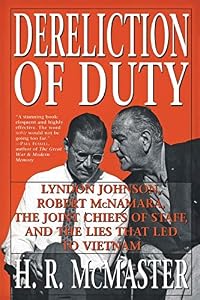
Dereliction of Duty: Johnson, McNamara, the Joint Chiefs of Staff, and the Lies That Led to Vietnam
by H. R. McMaster
On This Page
Description
Dereliction Of Duty is a stunning analysis of how and why the United States became involved in an all-out and disastrous war in Southeast Asia. Fully and convincingly researched, based on transcripts and personal accounts of crucial meetings, confrontations and decisions, it is the only book that fully re-creates what happened and why. McMaster pinpoints the policies and decisions that got the United States into the morass and reveals who made these decisions and the motives behind them, show more disproving the published theories of other historians and excuses of the participants. A page-turning narrative, Dereliction Of Duty focuses on a fascinating cast of characters: President Lyndon Johnson, Robert McNamara, General Maxwell Taylor, McGeorge Bundy and other top aides who deliberately deceived the Joint Chiefs of Staff, the U.S. Congress and the American public. McMaster's only book, Dereliction of Duty is an explosive and authoritative new look at the controversy concerning the United States involvement in Vietnam. show lessTags
Recommendations
























Member Reviews
The definitive account of America's slow slide into the Vietnam War, McMaster explores how the Kennedy administration disabled the formal Joint Chief's advising process in favor of ad hoc committees of civilian advisers, cutting the military out of the decision-making loop. This insularity, coupled with President Johnson's duplicity and Secretary McNamara's arrogance lead America into war without a real decision on "why", or "how much." The consensus demanded by Johnson to foster his domestic agenda concealed a lack of strategic thought, a desire to avoid making any decision until it was too late. McNamara's strategy of "graduated pressure" was fundamentally flawed, and the outmaneuvered JCS were unable to force the issue. But by buying show more into the administrations lies, in the 1965 Congressional hearings on the war, the JCS fundamentally abrogated their duty to the American people and Constitution.
The topic of America's entry into Vietnam is complex, McMaster's account is readable, but frequently repetitive, and occasionally more opinionated than history warrants. On the other hand, it beats going to the primary source material. show less
The topic of America's entry into Vietnam is complex, McMaster's account is readable, but frequently repetitive, and occasionally more opinionated than history warrants. On the other hand, it beats going to the primary source material. show less
I saw Dereliction of Duty many years ago in my library (back when it was a relatively new book), and only now got around to reading it (remembering it probably because the author, General H.R. McMaster, worked for President Trump for a while).
Well before I finished Dereliction of Duty at this moment, I had already figured out that it is an essential history book and I would like to own a copy after I turn this back in. The book told me everything I wanted to know about the political (mis)management of the Vietnam War, beginning in the Kennedy administration and continuing into the Johnson administration. I would feel incredulous if I didn't already know the most basic political problems (mainly from hearing my Vietnam veteran father's show more explanation).
I sent a recommendation to everyone on my list who cites history as an interest. show less
Well before I finished Dereliction of Duty at this moment, I had already figured out that it is an essential history book and I would like to own a copy after I turn this back in. The book told me everything I wanted to know about the political (mis)management of the Vietnam War, beginning in the Kennedy administration and continuing into the Johnson administration. I would feel incredulous if I didn't already know the most basic political problems (mainly from hearing my Vietnam veteran father's show more explanation).
I sent a recommendation to everyone on my list who cites history as an interest. show less
This non-fiction book examines how the Vietnam War was managed, offering some eye-opening insights. It starts by highlighting the contrast between Kennedy's success during the Cuban Missile Crisis—where his advisors were experienced politicians and statesmen—and the failure of the Bay of Pigs invasion, where his advisors were primarily from the Joint Chiefs of Staff (JCS). From that point, both Kennedy and Johnson increasingly relied on heads of state and other political figures for advice on handling the Vietnam conflict. The book suggests that the attack on the USS Maddox was likely instigated, possibly even a hoax. While many historians view the incident as suspicious, they stop short of definitively claiming it never happened. show more The author argues that President Johnson, preoccupied with his domestic agenda, "The Great Society," didn't engage deeply in Vietnam. Instead, he allowed figures like Robert McNamara and the Bundy brothers to make most of the key decisions, with minimal input from the JCS. 480 pages 4 stars show less
I read this book for one purpose: the author is now President Trump's National Security Advisor. Early reports are that he is pretty tough. After reading the book, I endorse that conclusion. What sort of a person, in a comparatively lowly rank (Major), would seriously attack a system in which he was a part? McMaster's book is not political. His approach is straightforward. His focus is on the period between 1963 and 1965 so the main actors are President Johnson, Secretary of Defense Robert McNamara, and the Joint Chiefs of Staff. These folks and others were ambiguous with each other, the American people, and each other. This is a thoroughly researched book. As told, the conclusion is inescapable. I suspect McMasterr knew what he was show more going say even before he began to write but that takes nothing away from his scholarship.
It was hard to read this book. While there is much that has been in the public domain for 45+ years, it was still hard to get over the near total lack of concern by any of these folks about the lives that would be involved. That observation needs repeating. Dereliction of Duty is almost an inadequate conclusion. Lying and misdirection was practiced to such an extent that it is not possible to comment about competence. show less
It was hard to read this book. While there is much that has been in the public domain for 45+ years, it was still hard to get over the near total lack of concern by any of these folks about the lives that would be involved. That observation needs repeating. Dereliction of Duty is almost an inadequate conclusion. Lying and misdirection was practiced to such an extent that it is not possible to comment about competence. show less
I picked up a copy of H.R. McMaster's 1997 book "Dereliction of Duty" after he was named as President Trump's second National Security Advisor. While the book was written twenty years ago, I hoped the book would provide some insights into how General McMaster looks at the role of a presidential advisor and that relationship with a President during time of war. McMaster was critical of LBJ's military and security advisors in their dealing President Johnson and in their advice during the Vietnam War. President Johnson's advisors proved unwilling or unable to provide clear, honest advice. According to McMaster, they lied to the President, to the Nation, and possibly even to themselves. Apparently more interested in holding onto their show more jobs, their power, and their prestige, they failed to challenge the president, to set goals and objectives in the war, and told the President pretty much what he wanted to hear.
Fast forward twenty years, and now General McMaster is in the same position as some of the people he was critical of during the Vietnam War. I now wonder if he's taken the lessons of his book to heart, and will be willing and able to provide sound military and security advice to President Trump. I'm leaning to the belief that he will. However, McMaster was sent out to meet with the media and speak the party line after President Trump apparently revealed intelligence about ISIS when meeting with the Russians, possibly endangering foreign intelligence sources and relationships. On the other hand, there have been stories of Trump and McMaster having yelling matches behind closed doors, certainly making it sound like the General is doing his best to provide honest and sound advice to the President, even if it runs contrary to the President's beliefs and ideology. show less
Fast forward twenty years, and now General McMaster is in the same position as some of the people he was critical of during the Vietnam War. I now wonder if he's taken the lessons of his book to heart, and will be willing and able to provide sound military and security advice to President Trump. I'm leaning to the belief that he will. However, McMaster was sent out to meet with the media and speak the party line after President Trump apparently revealed intelligence about ISIS when meeting with the Russians, possibly endangering foreign intelligence sources and relationships. On the other hand, there have been stories of Trump and McMaster having yelling matches behind closed doors, certainly making it sound like the General is doing his best to provide honest and sound advice to the President, even if it runs contrary to the President's beliefs and ideology. show less
Great history of the complete failure and arrogance of McNamara and the weakness of LBJ during Vietnam War interactions, 1963-65.. McMaster clarifies what we already knew...micromanagement was the order of the day for LBJ. Further, his domestic programs seemed to drive foreign policy, causing secrecy in the creation of a war posture without consent of Congress. Strategy creation, or lack of it, also comes under scrutiny. It also demonstrates how the JCS was marginalized by a master politician (LBJ) and that resulted in later legislation requiring the JCS to provide their views in planning military operations. That's not to say that the Joint Chiefs did not push their own agendas--they did; to the detriment of the USA. Great research by show more the author about lying, cheating politicians. show less
This was an important book to have published (a pretty clear indictment of specific bureaucratic failures which led to the mess of the Vietnam War), but was a very boring read -- in 2017 we know most of this and have seen it happen again and again.
Members
- Recently Added By
Lists

THE WAR ROOM
813 works; 24 members
Author Information

7 Works 1,173 Members
Herbert Raymond McMaster was born on July 24, 1962 in Philadelphia. He is a U.S. Army lieutenant general and the 26th National Security Advisor. His military assignments include Director of Army Capabilities Integration Center and Deputy Commanding General, Futures, U.S. Army Training and Doctrine Command. McMaster earned a Master of Arts and show more Ph.D. in American history from the University of North Carolina at Chapel Hill. His thesis was critical of American strategy in the Vietnam War, which was further detailed in his 1997 book Dereliction of Duty. In this book McMaster's explores the military's role in the policies of the Vietnam War. The book criticized high-ranking officers of that era, arguing that they inadequately challenged Defense Secretary Robert McNamara and President Lyndon Johnson on their Vietnam strategy. His other titles include The Art of Command: Military Leadership from George Washington to Colin Powell, Lesson for a Long War: How America can Win on New Battlefields and Ideas and Weapons: Influence and Perception in Modern Warfare. (Bowker Author Biography) show less
Common Knowledge
- Original publication date
- 1997
- People/Characters
- Lyndon Baines Johnson; Robert S. McNamara
- Important events
- Vietnam War (1959-1975)
- Dedication
- For Katie
- First words
- Preface: Despite scores of books on the subject, the why and how of direct U.S. intervention in the Vietnam War remains unclear.
- Last words
- (Click to show. Warning: May contain spoilers.)The failings were many and reinforcing, weakness, lying in the pursuit of self-interest, and, above all, the abdication of responsibility to the American people.
Classifications
- Genres
- History, Nonfiction, General Nonfiction
- DDC/MDS
- 959.704 — History & geography History of Asia Southeast Asia: Myanmar, Thailand, Laos, Cambodia, Vietnam Vietnam 1949-
- LCC
- DS558 .M43 — History of Europe, Asia, Africa and Oceania Asia History of Asia Southeast Asia French Indochina Vietnam. Annam Vietnamese Conflict
- BISAC
Statistics
- Members
- 858
- Popularity
- 31,625
- Reviews
- 17
- Rating
- (3.96)
- Languages
- English
- Media
- Paper, Audiobook, Ebook
- ISBNs
- 12
- UPCs
- 1
- ASINs
- 10