On This Page
Description
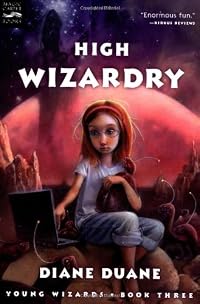
When her younger sister uses the family computer with its special wizard software to travel to worlds light years away, Nita uses her wizardry to try to find her.Tags
Recommendations








Member Recommendations


Member Reviews
It's good, but not nearly as good - not nearly as gripping - as the first two. This is, I think, partly because it's Dairine and not Nita (and Kit) who is the protagonist - I identify with Nita (bookish, shy, competent but not visibly so, wants to understand things) a lot more than with Dairine (too smart for everyone else's good, pushy, wants a lot of control). It's also too big. Yet another confrontation with the Lone Power, this one more or less head-on...and Dair wins. Sort of. It doesn't actually solve anything, but still...she wins, he/it/she leaves/wins/is redeemed. Permanently. I mean...too much! Talk about saving the universe. Peach doesn't help, either - too much, too powerful. The motherboard and the mobiles are at least show more learning rather than starting with all the knowledge (though they learn hella fast!). It feels awkward - too large for its space, and not quite fitting the rest of the series. It's still a good story - there are some deep bits, and some really funny ones; I enjoy reading it. But it doesn't resonate with me the way SYWTBAW does, so it's _only_ good. show less
Wow. Easily my favourite book of the series so far.
We get: character development for everybody (except maybe the advisory wizards, they got theirs last time). Dairine is obviously front and center for this, but Kit and Nita get to explore their feelings for each other, and Nita's parents get to deal with computers and even more wizardry.
I really wonder how I would have reacted to this book as a child. Would it have been to complex or abstract? By now, I just love it. I love the inclusion of computers in a book from 1990, I love how it reminds me of Stross (computers can work magic), and HPMOR (magic has a system that gets more clear as the books carry on). I love how we deal with the implications of creating a true AI in a book from show more 1990. For children. This book went in a different direction than I thought and wasn't just a copy of the first two books, including Dairine as protagonist. It explores a different theme entirely, and does it well. Will re-read, and it easily deserved my five stars. show less
We get: character development for everybody (except maybe the advisory wizards, they got theirs last time). Dairine is obviously front and center for this, but Kit and Nita get to explore their feelings for each other, and Nita's parents get to deal with computers and even more wizardry.
I really wonder how I would have reacted to this book as a child. Would it have been to complex or abstract? By now, I just love it. I love the inclusion of computers in a book from 1990, I love how it reminds me of Stross (computers can work magic), and HPMOR (magic has a system that gets more clear as the books carry on). I love how we deal with the implications of creating a true AI in a book from show more 1990. For children. This book went in a different direction than I thought and wasn't just a copy of the first two books, including Dairine as protagonist. It explores a different theme entirely, and does it well. Will re-read, and it easily deserved my five stars. show less
High Wizardry is the third book in Diane Duane’s Young Wizards series, and it focuses mostly on Nita’s younger sister Dairine, who has just become a wizard. Because of this and the stand alone plot, you could pick it up without having read the first books. If you want to read the first one, it’s So You Want to Be A Wizard.
Early on in her life Dairine made the decision to know everything that she possibly could. When she finds out about wizardry and the secret powers and knowledge that underlies the universe, how could she not take the oath and hope to become a wizard herself? She soon finds that the family’s new computer is actually a wizard’s manual, made for her. Dairine immediately sets off site seeing, heading first to show more Mars and from there to the greater universe beyond. Then she suddenly finds herself being chased by agents of the Lone Power, the being who created death and entropy. She becomes stranded half way across the universe on a seemingly barren planet, desperately trying to think of some way to defeat the Power who’s chasing her…
Nita and Kit set off to rescue her, but their thread of the story is not what’s important. This is Dairine’s story, and I think it’s my favorite of the first three. Unfortunately, so much of what makes me love this book comes from the second half when Dairine’s actually on the planet, and I don’t want to include a bunch of spoilers in this review.
The soul of the Young Wizards series is the mythology and ethics of wizardry. The Powers That Be created the universe of these books, but then the Lone Power went of by Its self and created death and entropy. Every new species to gain sentience is given a choice, but the Lone Power has always managed to trick them into accepting death and fear. Wizards swear to protect life and fight against entropy. Their magic is largely based on knowledge and their ability to interact with the world. They can convince air molecules to become solid enough to walk on, and they can hold conversations with a tree or stone. Wizards exist across the universe, not just on Earth.
If you couldn’t gather it from my initial description, High Wizardry melds fantasy and science fiction. There might be magic and mythology, but there’s also aliens and far away planets. High Wizardry also deals a lot with computers. Unfortunately, I was reading the original 1993 edition and most of the information here was outdated. I know that Diane Duane rewrote this book and the rest of the series to put it all in the 2000s and that the updated version is available through ebook.
High Wizardry is also a very fast read and a lot shorter than you might be expecting. It’s sort of amazing that so much is packed into such a tiny book. I was able to read it start to finish within just a few hours. Also, Diane Duane can sure write. She’s got some magnificent prose, especially when it comes to the climatic parts of the book.
I definitely recommend High Wizardry. I had positive memories of it, and I am glad that it was able to hold up years later on reread. Diane Duane’s seamlessly merged fantasy and science fiction to create something new, embedded with plenty of powerful questions and ideas.
Originally posted at The Illustrated Page. show less
Early on in her life Dairine made the decision to know everything that she possibly could. When she finds out about wizardry and the secret powers and knowledge that underlies the universe, how could she not take the oath and hope to become a wizard herself? She soon finds that the family’s new computer is actually a wizard’s manual, made for her. Dairine immediately sets off site seeing, heading first to show more Mars and from there to the greater universe beyond. Then she suddenly finds herself being chased by agents of the Lone Power, the being who created death and entropy. She becomes stranded half way across the universe on a seemingly barren planet, desperately trying to think of some way to defeat the Power who’s chasing her…
Nita and Kit set off to rescue her, but their thread of the story is not what’s important. This is Dairine’s story, and I think it’s my favorite of the first three. Unfortunately, so much of what makes me love this book comes from the second half when Dairine’s actually on the planet, and I don’t want to include a bunch of spoilers in this review.
“Powers,” Nita heard her father say behind her. “Creation. Forces from before time. This is – this is business for saints, not children!”
“Even saints have to start somewhere,” Carl said softly. “And it’s always been the children who have saved the universe from the previous generation and remade the universe in their own image.”
The soul of the Young Wizards series is the mythology and ethics of wizardry. The Powers That Be created the universe of these books, but then the Lone Power went of by Its self and created death and entropy. Every new species to gain sentience is given a choice, but the Lone Power has always managed to trick them into accepting death and fear. Wizards swear to protect life and fight against entropy. Their magic is largely based on knowledge and their ability to interact with the world. They can convince air molecules to become solid enough to walk on, and they can hold conversations with a tree or stone. Wizards exist across the universe, not just on Earth.
“The Crossings Hypergate Facility on Rirhath B is renowned among the Billion Homeworlds for its elegant classical Lilene architecture and noble proportions; but Dairne’s only cogent thought for several minutes was that she had never imagined being in an airline terminal the size of New Jersey.”
If you couldn’t gather it from my initial description, High Wizardry melds fantasy and science fiction. There might be magic and mythology, but there’s also aliens and far away planets. High Wizardry also deals a lot with computers. Unfortunately, I was reading the original 1993 edition and most of the information here was outdated. I know that Diane Duane rewrote this book and the rest of the series to put it all in the 2000s and that the updated version is available through ebook.
High Wizardry is also a very fast read and a lot shorter than you might be expecting. It’s sort of amazing that so much is packed into such a tiny book. I was able to read it start to finish within just a few hours. Also, Diane Duane can sure write. She’s got some magnificent prose, especially when it comes to the climatic parts of the book.
I definitely recommend High Wizardry. I had positive memories of it, and I am glad that it was able to hold up years later on reread. Diane Duane’s seamlessly merged fantasy and science fiction to create something new, embedded with plenty of powerful questions and ideas.
Originally posted at The Illustrated Page. show less
A third book in Duane's wizard series, this one features a new addition to the wizarding family: Nita's little sister, Dairine. Dairine has been envious of her sister's new skills since she learned about them; as a voracious devourer of knowledge, she was incensed to learn that a whole field of discovery, the biggest one of all, was unavailable to her. Lucky for her, the wizard world chooses her, but not through a book in the library, like with Nita. No, Dairine unwittingly uploads her manual on a special computer after carelessly taking the oath from her sister's book. Being a huge Star Wars fan, her Ordeal takes her to far regions of space, past even where her inventive mind has imagined before.
This book is the shortest in the series show more thus far, but since I haven't read them for a while, I didn't mind. It was like a quick refresher to her fictional world. Her integration of computer technology and wizardry was clever, and a new approach to magic fantasy that I had never read before. Yes, much of the technology is already outdated by now, but it was a fresh approach to a genre that can easily become cliched. I also liked watching Dairine mature on her Ordeal. She transforms from a selfish and manipulative child (even if she did have her reasons) into a more open and sympathetic person. Still a child, Dairine had positive growth. The story was a very quick read for me, both because of the short content and because of a fast-flowing narrative pace.
My only disappointment was how quickly the novel flashed past some amazing outer space scenes. The intergalactic travel hub, for instance, was fascinating. We did spend some time here, as Dairine was chased by aliens and Nita and Kit later investigated her whereabouts, but with the wealth of aliens and novelties present in this location, I though significantly more narrative space should have been dedicated to it. I wouldn't have minded seeing Dairine have smaller adventures on some of the planets she flashed to. Yes, yes, this actually would have made the novel a lot longer, and I was just writing that I enjoyed the short length. I'm being contradictory, I know. I wanted to see more galaxies developed, but I was happy with a quick read, so in the end, I was satisfied even if I felt the book had potential left undeveloped. I enjoyed my foray in to the lives of these young wizards, and am again interested in reading more. Which is a good thing, since I received the fourth book as a gift (prompting me to dig out and read this third one) and I plan on plunging straight ahead to the next book in the series. show less
This book is the shortest in the series show more thus far, but since I haven't read them for a while, I didn't mind. It was like a quick refresher to her fictional world. Her integration of computer technology and wizardry was clever, and a new approach to magic fantasy that I had never read before. Yes, much of the technology is already outdated by now, but it was a fresh approach to a genre that can easily become cliched. I also liked watching Dairine mature on her Ordeal. She transforms from a selfish and manipulative child (even if she did have her reasons) into a more open and sympathetic person. Still a child, Dairine had positive growth. The story was a very quick read for me, both because of the short content and because of a fast-flowing narrative pace.
My only disappointment was how quickly the novel flashed past some amazing outer space scenes. The intergalactic travel hub, for instance, was fascinating. We did spend some time here, as Dairine was chased by aliens and Nita and Kit later investigated her whereabouts, but with the wealth of aliens and novelties present in this location, I though significantly more narrative space should have been dedicated to it. I wouldn't have minded seeing Dairine have smaller adventures on some of the planets she flashed to. Yes, yes, this actually would have made the novel a lot longer, and I was just writing that I enjoyed the short length. I'm being contradictory, I know. I wanted to see more galaxies developed, but I was happy with a quick read, so in the end, I was satisfied even if I felt the book had potential left undeveloped. I enjoyed my foray in to the lives of these young wizards, and am again interested in reading more. Which is a good thing, since I received the fourth book as a gift (prompting me to dig out and read this third one) and I plan on plunging straight ahead to the next book in the series. show less
Nita is just starting to become comfortable with her wizardly abilities. She and her best friend Kit work carefully around their community, getting the feel for being wizards.
But Nita's canny little sister Dairine can't leave the idea of wizardry alone. Now that she knows her sister's secret, Dairine wants the power herself. Smart, abrasive, tough, and with big dreams of adventure, Dairine sneaks into Nita's room one night and reads the Oath. The next day, via the women's restroom at the space museum...she finds herself on Mars.
Whisked away on an Ordeal that is possibly even more dangerous and pivotal than Nita and Kit's, Dairine will set in motion an intergalatic race between the forces of darkness and the wizards of Earth hot on her show more tail; namely Nita, Kit, and a mouthy macaw named Peach.
With only an unusually sentient computer manual and her own brains and bravery to aid her, this is where Dairine steps up to take her rightful place as a wonderful, naive, brilliant character in this amazing series. show less
But Nita's canny little sister Dairine can't leave the idea of wizardry alone. Now that she knows her sister's secret, Dairine wants the power herself. Smart, abrasive, tough, and with big dreams of adventure, Dairine sneaks into Nita's room one night and reads the Oath. The next day, via the women's restroom at the space museum...she finds herself on Mars.
Whisked away on an Ordeal that is possibly even more dangerous and pivotal than Nita and Kit's, Dairine will set in motion an intergalatic race between the forces of darkness and the wizards of Earth hot on her show more tail; namely Nita, Kit, and a mouthy macaw named Peach.
With only an unusually sentient computer manual and her own brains and bravery to aid her, this is where Dairine steps up to take her rightful place as a wonderful, naive, brilliant character in this amazing series. show less
Although the scientific element forms a strong background to the magic in the previous two books, this one takes a large step from fantasy towards science fiction. It starts as a merry romp about a precocious kid sister, but picks up the theme of moral decision on a grand scale. The author manages to keep her light touch and creative imagination intact, even while loading spadefuls of philosophical theology into the reader's lap. Again the tale invites comparison with Philip Pullman (though not a match for The Golden Compass in style or inventiveness)... except that Duane clearly takes a positive angle on the Christian cosmological myths. Imagine if C. S. Lewis had written Perelandra not for adults, but for the young audience of his show more Narnia tales, and done so with the benefit of several more decades of astronomical discovery. Enjoyable and thought-provoking. MB 21-iii-2008 show less
This third installment in Duane's Young Wizards series was, I have to say, not quite as enjoyable for me as the first two. I think that a lot of what distanced from me from the novel is that, for the first time, this one felt dated. The story was, I am sure, cutting edge for the early 1990s and is chock-full of pop culture and computer/technology references... and that is the problem. Instead of being absorbed into universal themes as in the previous books, the reader is frequently jarred by the outmoded computer details. Not enough time has passed to make such details quaint or "period", so the effect isn't great.
In addition, instead of focusing on Nita and Kit, our two young magical heroes from the first books, this volume adds Nita's show more younger sister Dairine in a major way. Dairine is a little more difficult to relate to, and becomes even more so as the book progresses, but I don't wish to give anything away, so I will skip the details.
Even with these issues, this is still a fun novel and one that is definitely worth reading to the end; it is in the last quarter of the book that Duane's usual rich, universal themes finally come into play in a major way and some interesting things happen in that eternal battle between... well, you know.
So, while not the best of the series, in my opinion, High Wizardry is still a pleasant read. show less
In addition, instead of focusing on Nita and Kit, our two young magical heroes from the first books, this volume adds Nita's show more younger sister Dairine in a major way. Dairine is a little more difficult to relate to, and becomes even more so as the book progresses, but I don't wish to give anything away, so I will skip the details.
Even with these issues, this is still a fun novel and one that is definitely worth reading to the end; it is in the last quarter of the book that Duane's usual rich, universal themes finally come into play in a major way and some interesting things happen in that eternal battle between... well, you know.
So, while not the best of the series, in my opinion, High Wizardry is still a pleasant read. show less
Members
- Recently Added By
Lists

Female Protagonist
1,056 works; 56 members

Travel from real to fantasy world -- children's/young adult fiction
125 works; 11 members

Books Read in 2014
2,341 works; 89 members
Author Information

135+ Works 35,839 Members
Author Diane Duane was born in New York City on May 18, 1952, and grew up in Roosevelt, Long Island. She is an American science fiction and fantasy author. Duane studied nursing in college and became a psychiatric nurse. She began writing full time in 1980 and has published numerous novels, including several with her husband, Peter Morwood. She show more also writes screenplays, served as senior writer for the BBC-TV education series "Science Challenge," and writes scripts for CD-ROM computer games. Her "Young Wizards" series won a special commendation in the Anne Spencer Lindbergh Prize in Children's Literature, 2003. She currently lives in County Wicklow, Ireland. (Bowker Author Biography) show less

Diane Duane is a LibraryThing Author, an author who lists their personal library on LibraryThing.
Some Editions
Awards and Honors
Awards
Series


Work Relationships
Common Knowledge
- Canonical title
- High Wizardry
- Original title
- High wizardry
- Alternate titles
- High Wizardry: New Millenium Edition
- Original publication date
- 1990
- People/Characters
- Betty Callahan; Dairine Callahan; Harold Edward Callahan; Nita Callahan; Kit Rodriguez; Apple IIIc (show all 14); Gigo; Logo; the Lone One; the Motherboard; Macchu Picchu (Peach); Carl Romeo; Tom Swale; Spot [Dairine Callahan's companion] (Apple computer)
- Important places
- Mars; the Crossings; American Museum of Natural History, New York, New York, USA; Hempstead, New York, USA; Long Island, New York, USA; Nassau County, New York, USA (show all 8); New York, USA; New York, New York, USA
- Epigraph
- I'd like to get away from Earth awhile
And then come back to it and begin over.
May no fate willfully misunderstand me
And half grant what I wish and snatch me away
Not to return. Earth's the right place for l... (show all)ove:
I don't know where it's likely to go better.
(Robert Frost, "Birches")
Where, except in the present, can the Eternal be met?
--C.S. Lewis, "Historicism"
Those who refuse to serve the Powers,
become the tools of the Powers.
Those who agree to serve the Powers,
Themselves become the Powers.
Beware the Choice! Beware refusing it!
--Book of Night wit... (show all)h Moon
Tetrastych XIV: "Fire Over Heaven" - Dedication
- For my dear master, from someone nearly as surprised
Once again,
for C. S. Lewis:
after thirty years,
still just as surprised by the joy
as he was - First words
- "Hey, there’s somebody in the driveway!"
“Hey, there’s somebody in the driveway! It’s UPS! Mom! Mom, the computer’s here!” - Last words
- (Click to show. Warning: May contain spoilers.)Nita glanced at Kit, and together, as usual, they sat down to face the music.
- Original language
- English
- Disambiguation notice
- High Wizardry: New Millenium Edition is a revised version, updating the timeline to use modern tech.
Classifications
- Genres
- Fiction and Literature, Fantasy, Teen, Young Adult
- DDC/MDS
- 813.54 — Literature & rhetoric American literature in English American fiction in English 1900-1999 1945-1999
- LCC
- PZ7 .D84915 .H — Language and Literature Fiction and juvenile belles lettres Fiction and juvenile belles lettres Juvenile belles lettres
- BISAC
Statistics
- Members
- 2,156
- Popularity
- 9,391
- Reviews
- 31
- Rating
- (3.94)
- Languages
- 5 — Dutch, English, Finnish, French, Russian
- Media
- Paper, Audiobook, Ebook
- ISBNs
- 26
- ASINs
- 8