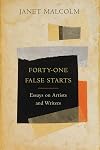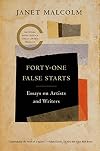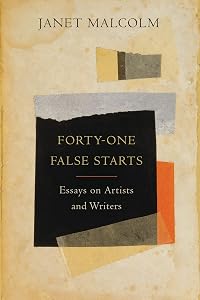
Forty-one False Starts: Essays on Artists and Writers
by Janet Malcolm
On This Page
Description
In this book, the author brings together essays published over the course of several decades that reflect her preoccupation with artists and their work. Her subjects are painters, photographers, writers, and critics. The title essay, with its forty-one "false starts," depicts her serial attempts to capture the essence of the painter David Salle.Tags
Recommendations









Member Recommendations
Member Reviews
Janet Malcolm is a wonderful writer who uses no words lightly and who casts a clear unblinking eye on the painters, photographers, and writers she discusses in these essays, written over several decades and collected here for the first time. For the painters and photographers, the internet was a great resource for me as I was able to look at some of the art Malcolm wrote about.
Of course, some of the pieces spoke to me more than others. The centerpiece of the volume is "A Girl of the Zeitgeist," a 75-page essay on Ingrid Sischy and her editorship of Artforum; Malcolm interviewed her and met with her and artists and writers over the course of a year. She writes about Sischy: "She sees moral dilemmas everywhere -- and of course there are show more moral dilemmas everywhere, only most of us prefer not to see them as such and simply accept the little evasions, equivocations, and compromises that soften the fabric of social life, that grease the machinery of living and working, that make reality less of a constant struggle with ourselves and with others." But the essay is not just "about" Sischy (in fact, many pages go by before the reader "meets" Sischy); it is also about the New York art world (and art criticism world) of the 80s, about differences of opinions, about controversies (one in particular) over public art, about styles of criticism and styles of editing, and about clashing personalities. "I ponder anew the question of authenticity that has been reverberating through the art world of the eighties." It is a tour de force.
But so are many of the other, shorter pieces. In the first, title piece, Malcolm "starts" her portrait of painter David Salle in 41 different ways. In "A House of One's Own," her portrait of Bloomsbury but particularly of Vanessa, she addresses the challenges of writing biography: "Life is infinitely less orderly and more bafflingly ambiguous than any novel . . . we have to face the problem that every biographer faces and none can solve; namely that he is standing on quicksand as he writes. There is no floor under his enterprise, no basis for moral certainty." Among the other authors she writes about are Salinger and Wharton ("The Woman Who Hated Women"); among the photographers, Julia Margaret Cameron, Diane Arbus, and Edward Weston.
I like that she doesn't restrict to her focus to "high art" -- for example, she discusses the "capitalist pastorale" of Gene Stratton-Porter]] whose A Girl of the Limberlost she loved as a girl of 10. But it is her essay about the Gossip Girls series that is truly delightful, starting from its opening line which references Lolita commenting on the moccasin worn the victim when she and Humbert drive past a terrible accident. As she writes about the author of the series:
"The heartlessness of youth is von Ziegesar's double-edged theme, the object of her mockery -- and sympathy. She understands that children are a pleasure-seeking species, and that adolescence is a delicious last gasp (the light is most golden just before the shadows fall) of rightful selfishness and cluelessness. . . Von Ziegesar pulls off the tour de force of wickedly satirizing the young while amusing them. Her designated audience is an adolescent girl, but the reader she seems to have firmly in mind as she writes is a literate, even literary, adult." p. 275.
And "What makes classic children's literature so appealing (to all ages) is its undeviating loyalty to the world of the child. In the best children's books, parents never share the limelight with their children; if they are not killed off on page 1, they are cast in the pitifully minor roles that actual parents play in their children's imaginative lives. That von Ziegesar's parents are as ridiculous as they are insignificant in the eyes of their children only adds to the sly truthfulness of her comic fairy tale." p. 282.
Malcolm almost (that's almost) makes me want to read Gossip Girls, but I would definitely read anything Malcolm herself writes. show less
Of course, some of the pieces spoke to me more than others. The centerpiece of the volume is "A Girl of the Zeitgeist," a 75-page essay on Ingrid Sischy and her editorship of Artforum; Malcolm interviewed her and met with her and artists and writers over the course of a year. She writes about Sischy: "She sees moral dilemmas everywhere -- and of course there are show more moral dilemmas everywhere, only most of us prefer not to see them as such and simply accept the little evasions, equivocations, and compromises that soften the fabric of social life, that grease the machinery of living and working, that make reality less of a constant struggle with ourselves and with others." But the essay is not just "about" Sischy (in fact, many pages go by before the reader "meets" Sischy); it is also about the New York art world (and art criticism world) of the 80s, about differences of opinions, about controversies (one in particular) over public art, about styles of criticism and styles of editing, and about clashing personalities. "I ponder anew the question of authenticity that has been reverberating through the art world of the eighties." It is a tour de force.
But so are many of the other, shorter pieces. In the first, title piece, Malcolm "starts" her portrait of painter David Salle in 41 different ways. In "A House of One's Own," her portrait of Bloomsbury but particularly of Vanessa, she addresses the challenges of writing biography: "Life is infinitely less orderly and more bafflingly ambiguous than any novel . . . we have to face the problem that every biographer faces and none can solve; namely that he is standing on quicksand as he writes. There is no floor under his enterprise, no basis for moral certainty." Among the other authors she writes about are Salinger and Wharton ("The Woman Who Hated Women"); among the photographers, Julia Margaret Cameron, Diane Arbus, and Edward Weston.
I like that she doesn't restrict to her focus to "high art" -- for example, she discusses the "capitalist pastorale" of Gene Stratton-Porter]] whose A Girl of the Limberlost she loved as a girl of 10. But it is her essay about the Gossip Girls series that is truly delightful, starting from its opening line which references Lolita commenting on the moccasin worn the victim when she and Humbert drive past a terrible accident. As she writes about the author of the series:
"The heartlessness of youth is von Ziegesar's double-edged theme, the object of her mockery -- and sympathy. She understands that children are a pleasure-seeking species, and that adolescence is a delicious last gasp (the light is most golden just before the shadows fall) of rightful selfishness and cluelessness. . . Von Ziegesar pulls off the tour de force of wickedly satirizing the young while amusing them. Her designated audience is an adolescent girl, but the reader she seems to have firmly in mind as she writes is a literate, even literary, adult." p. 275.
And "What makes classic children's literature so appealing (to all ages) is its undeviating loyalty to the world of the child. In the best children's books, parents never share the limelight with their children; if they are not killed off on page 1, they are cast in the pitifully minor roles that actual parents play in their children's imaginative lives. That von Ziegesar's parents are as ridiculous as they are insignificant in the eyes of their children only adds to the sly truthfulness of her comic fairy tale." p. 282.
Malcolm almost (that's almost) makes me want to read Gossip Girls, but I would definitely read anything Malcolm herself writes. show less
Janet Malcolm is a genius. Her gifts are on full, and often chilling, display here. Full of erudition, razor-sharp judgments, icy observations. Learned and scary and admirable. Would not want to be on her bad side. Agree with other readers that the last two "chapters" are disastrous additions--are there any editors left? The chapter on Bloomsbury perhaps the best. I have read this collection over a day or so and feel as if run over by a truck--in a good way.
Could have used another edit as there's at least three essays here that are giants (60 pages or more) that throw the collection out of balance (most of the other pieces are around 12-15 pages). But Janet Malcolms eye and prose-- piercing, probing, curious, and singular-- makes just about anything she writes beautiful. And a little scary.
Some say the best-written reviews and critiques reveal something about the critic as much as the subject being reviewed. With that criteria, you would think Forty-one False Starts by Janet Malcolm would be brilliant, the writing being so self-absorbed.
To be fair, the title essay was fascinating and engaging, a critique of the larger-than-life artist David Salle told in 41 short sections that give us different facets and points of view on Salle; its unique form is a commentary on the writing/creative process itself. But all the other essays in the collection didn't really keep my attention. It could be my limited knowledge of the contemporary art world, which is Malcolm's area, and is a world itself that is self-absorbed and insular. show more Sorry, this book wasn't for me, though I may not have been registering the writerly brilliance in its full form due to my lukewarm interest in the subject matter. show less
To be fair, the title essay was fascinating and engaging, a critique of the larger-than-life artist David Salle told in 41 short sections that give us different facets and points of view on Salle; its unique form is a commentary on the writing/creative process itself. But all the other essays in the collection didn't really keep my attention. It could be my limited knowledge of the contemporary art world, which is Malcolm's area, and is a world itself that is self-absorbed and insular. show more Sorry, this book wasn't for me, though I may not have been registering the writerly brilliance in its full form due to my lukewarm interest in the subject matter. show less
A collection of essays about artists and their work; this doesn't sound like much, but Malcolm could write about painting the wall of your bedroom and make it seem transcendental.
Terrific article on Bloomsbury.
Ratings
Members
- Recently Added By
Author Information

20+ Works 4,213 Members
Janet Malcolm is the acclaimed author of many books, including In the Freud Archives; Two Lives: Gertrude and Alice; and Burdock, a volume of her photographs of a "rank weed." She is a frequent contributor to The New Yorker and The New York Review of Books.
Some Editions
Awards and Honors
Awards
Distinctions
Classifications
- Genres
- Literature Studies and Criticism, Nonfiction, Art & Design, Fiction and Literature
- DDC/MDS
- 808.02 — Literature & rhetoric Literature, rhetoric & criticism Composition Rhetoric and anthologies Authorship techniques, plagiarism, editorial techniques
- LCC
- PN453 .M35 — Language and Literature Literature (General) Literature (General) Literary history Biography
- BISAC
Statistics
- Members
- 310
- Popularity
- 102,549
- Reviews
- 6
- Rating
- (4.00)
- Languages
- English, Portuguese, Spanish
- Media
- Paper, Ebook
- ISBNs
- 10
- ASINs
- 5