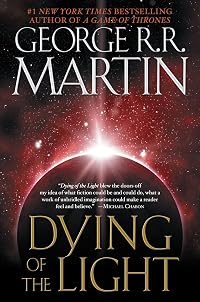
Dying of the Light
by George R. R. Martin
On This Page
Description
In this unforgettable space opera, #1 New York Times bestselling author George R. R. Martin presents a chilling vision of eternal night—a volatile world where cultures clash, codes of honor do not exist, and the hunter and the hunted are often interchangeable.A whisperjewel has summoned Dirk t’Larien to Worlorn, and a love he thinks he lost. But Worlorn isn’t the world Dirk imagined, and Gwen Delvano is no longer the woman he once knew. She is bound to another man, and to a dying show more planet that is trapped in twilight. Gwen needs Dirk’s protection, and he will do anything to keep her safe, even if it means challenging the barbaric man who has claimed her. But an impenetrable veil of secrecy surrounds them all, and it’s becoming impossible for Dirk to distinguish between his allies and his enemies. In this dangerous triangle, one is hurtling toward escape, another toward revenge, and the last toward a brutal, untimely demise.
Praise for Dying of the Light
“Dying of the Light blew the doors off of my idea of what fiction could be and could do, what a work of unbridled imagination could make a reader feel and believe.”—Michael Chabon
“Slick science fiction . . . the Wild West in outer space.”—Los Angeles Times
“Something special which will keep Worlorn and its people in the reader’s mind long after the final page is read.”—Galileo magazine
“The galactic background is excellent. . . . Martin knows how to hold the reader.”—Asimov’s
“George R. R. Martin has the voice of a poet and a mind like a steel trap.”—Algis Budrys. show less
Tags
Recommendations




















Member Reviews
Before the vast political architecture of epic fantasy made him widely known, Martin wrote Dying of the Light—a quieter, more intimate science fiction novel steeped in melancholy.
Set on Worlorn, a planet drifting away from its parent star and sliding toward irreversible darkness, the novel uses astrophysical decay as emotional metaphor. Civilizations that once flourished during the planet’s brief warmth are now relics. Cultures linger in ritualized forms, holding onto identity even as the physical conditions that sustained them vanish. The setting is not merely backdrop; it is thesis.
At the center is Dirk t’Larien, summoned by a cryptic jewel sent years after a failed romance. His journey to Worlorn becomes less a rescue mission show more than a confrontation with irretrievable past choices. The emotional core of the novel is not action but regret. Martin dissects longing with clinical patience—how love curdles into pride, how pride ossifies into silence.
The novel’s most compelling dimension lies in its exploration of cultural absolutism. The Kavalar, with their rigid honor codes and possessive social structures, embody a form of aristocratic fatalism. Their society is internally coherent yet ethically unsettling. Martin resists caricature; he presents them neither as simple villains nor as misunderstood heroes. Instead, he examines how ideology shapes intimacy and constrains freedom.
Stylistically, the prose is restrained, occasionally austere. Action sequences are secondary to atmosphere. The pacing is deliberate, even slow, emphasizing inevitability over surprise. Readers expecting kinetic space opera may find it subdued. Those attentive to psychological texture will find it absorbing.
Unlike Martin’s later sprawling narratives, Dying of the Light is focused and almost theatrical in its structure. The darkness advancing across Worlorn mirrors the narrowing possibilities of its characters. The novel does not offer cathartic triumph. It offers recognition: that some worlds—personal and planetary—cannot be restored once their moment has passed.
It is a somber, introspective debut, notable for emotional seriousness rather than spectacle. show less
Set on Worlorn, a planet drifting away from its parent star and sliding toward irreversible darkness, the novel uses astrophysical decay as emotional metaphor. Civilizations that once flourished during the planet’s brief warmth are now relics. Cultures linger in ritualized forms, holding onto identity even as the physical conditions that sustained them vanish. The setting is not merely backdrop; it is thesis.
At the center is Dirk t’Larien, summoned by a cryptic jewel sent years after a failed romance. His journey to Worlorn becomes less a rescue mission show more than a confrontation with irretrievable past choices. The emotional core of the novel is not action but regret. Martin dissects longing with clinical patience—how love curdles into pride, how pride ossifies into silence.
The novel’s most compelling dimension lies in its exploration of cultural absolutism. The Kavalar, with their rigid honor codes and possessive social structures, embody a form of aristocratic fatalism. Their society is internally coherent yet ethically unsettling. Martin resists caricature; he presents them neither as simple villains nor as misunderstood heroes. Instead, he examines how ideology shapes intimacy and constrains freedom.
Stylistically, the prose is restrained, occasionally austere. Action sequences are secondary to atmosphere. The pacing is deliberate, even slow, emphasizing inevitability over surprise. Readers expecting kinetic space opera may find it subdued. Those attentive to psychological texture will find it absorbing.
Unlike Martin’s later sprawling narratives, Dying of the Light is focused and almost theatrical in its structure. The darkness advancing across Worlorn mirrors the narrowing possibilities of its characters. The novel does not offer cathartic triumph. It offers recognition: that some worlds—personal and planetary—cannot be restored once their moment has passed.
It is a somber, introspective debut, notable for emotional seriousness rather than spectacle. show less
An interesting, complex debut novel from George RR Martin, Dying Of The Light is an old-school planetary romance that reminded me quite strongly of both Cordwainer Smith and CJ Cherryh, oddly enough, though the setting is pure Jack Vance. Worlorn is a wandering world that enjoyed a brief heydey when, passing near a specatcular star system, it was transformed into a festival world where all the primary centres of human civilisation built cities to house thousands and even millions of inhabitants in an extravagant display of wealth and technology. Now the planet is drifting back into the dark and the cold is closing in and only a few last remnants of the festival throngs remain.
One of those remnants, a former lover, summons Dirk t'Larien show more to Worlorn. Gwen is caught in an odd marriage to a Kavalar, a marriage that in the eyes of Kavalar society, reduces her to the status of property. Furthermore, a particular faction of a die-hard conservative Kavalar holdfast are on Worlorn hoping to revive a forbidden tradition: the hunting of humans for sport. Caught between his love for Gwen, his growing respect for her husband, who is on Worlorn to thwart the hunters and his troubled search for his own sense of self, Dirk becomes enmeshed in the struggle and the divided loyalties and the battle between the old and the new, haunted by the spectre of death on a dying planet.
Martin's strengths as a world-builder and a story-teller are on full display here. The universe he creates is far bigger, richer and deeper than the planet of Worlorn, though nearly all the action takes place there. Did he ever revisit it, I wonder? Did he intend to? His facility for conjuring history and romance and mystery out of a few brief asides and suggestive comments and names is part of what makes him such a pleasure to read. His frank examination of a martial culture, bound by codes of honour and formal bonds and the attraction it holds for both the romantically inclined and the aimless and the lost prefigures the proud medieval chivalric culture of the Seven Kingdoms, as does his unflinching study of its dark side: the horrifying misogyny and the violence inflicted on those deemed unworthy or outside that culture.
The books ends oddly: after a frantic, edge-of-the-seat hunt, there is a period of waiting and then an anti-climax, followed by a coda that ends without a resolution, though not without resolve. It fits the setting and the theme perfectly, though, and speaks to Martin's integrity as a writer and fidelity to his vision. I hope that once the Song is finished he might consider a return to science fiction. It's clearly his first love. show less
One of those remnants, a former lover, summons Dirk t'Larien show more to Worlorn. Gwen is caught in an odd marriage to a Kavalar, a marriage that in the eyes of Kavalar society, reduces her to the status of property. Furthermore, a particular faction of a die-hard conservative Kavalar holdfast are on Worlorn hoping to revive a forbidden tradition: the hunting of humans for sport. Caught between his love for Gwen, his growing respect for her husband, who is on Worlorn to thwart the hunters and his troubled search for his own sense of self, Dirk becomes enmeshed in the struggle and the divided loyalties and the battle between the old and the new, haunted by the spectre of death on a dying planet.
Martin's strengths as a world-builder and a story-teller are on full display here. The universe he creates is far bigger, richer and deeper than the planet of Worlorn, though nearly all the action takes place there. Did he ever revisit it, I wonder? Did he intend to? His facility for conjuring history and romance and mystery out of a few brief asides and suggestive comments and names is part of what makes him such a pleasure to read. His frank examination of a martial culture, bound by codes of honour and formal bonds and the attraction it holds for both the romantically inclined and the aimless and the lost prefigures the proud medieval chivalric culture of the Seven Kingdoms, as does his unflinching study of its dark side: the horrifying misogyny and the violence inflicted on those deemed unworthy or outside that culture.
The books ends oddly: after a frantic, edge-of-the-seat hunt, there is a period of waiting and then an anti-climax, followed by a coda that ends without a resolution, though not without resolve. It fits the setting and the theme perfectly, though, and speaks to Martin's integrity as a writer and fidelity to his vision. I hope that once the Song is finished he might consider a return to science fiction. It's clearly his first love. show less
I had absolutely no issues in giving this a full 5 star rating, because even though the novel was nominated in '78 for the Hugo, that it comes out of the mind of one of the more well-beloved SF/F authors of our times, the novel is absolutely gorgeous all on its own.
Why? Because we're getting such depth of world-building, from the science of the solar/planetary, to the culture it spawned, to an absolutely amazing depth of social explorations, to a very cool discourse on the sexes as seen from multiple cultures and their conflicts.
Sound impressive? It only gets better, because the story is oh so solid and very complex. This is the novel highlights all the things we truly love about his SoIaF series, establishing characters as one thing show more only to break the mold completely, crossing all the boundaries of evil to good and back again. No one is a secondary character, either. This is the precursor to the series we know, only it's Science Fiction.
It's easy to get carried away with the misogynic society of men and the desire of a single woman to free herself after having got caught, and it is a major theme, at first, but then we begin to see how truly disturbing the society is not because it does such male-centered things, but because of it's tragic history and how it had almost died out because it had lost most of its females, and as such, had changed them into true treasures and communal properties over a few generations despite the original star-faring society being perfectly egalitarian. It sounds bad, but then you start to see a particularly complex bond/love relationships between men, almost like honor, almost like romance, and it's made even more complex by the deep rules of duels, warfare, and conquest, all while having such strange mixes of old and rediscovered tech.
And of course we get to see and explore it all through both their eyes and an outsider's eyes in the greater galactic civilization, full of misunderstandings, surprises, hate, love, little heroisms and subversions.
Sound like a deeply complex storyline full of surprises and adventure? Well it is, and we get to see a deeply imagined physical world, too, not just of the people and the social structures. The planet is within a strange and chaotic start system and they cannot even see more than twelve stars. With so many multiple suns, we also discover that the planet had a near brush with a sun and is now on it's way out of the system entirely. The planet will go from great heat into an eventual iceball. See a theme? Only this time, it's explained in science, even if the inhabitants truly have little recourse or satisfaction in the knowledge.
When I first read SoIaF, I loved to speculate about the planetary system that would cause centuries of winter and a few small generations of summer. It's a very SF thing to do for an epic fantasy. Imagine how delighted I am to learn that he'd been long thinking of these specific plans within his fantasy? It's obvious from this book. :)
This should be a must read for all his fans, and even of fans of LeGuin. The deeper social aspects are quite fascinating, indeed. :)
show less
Why? Because we're getting such depth of world-building, from the science of the solar/planetary, to the culture it spawned, to an absolutely amazing depth of social explorations, to a very cool discourse on the sexes as seen from multiple cultures and their conflicts.
Sound impressive? It only gets better, because the story is oh so solid and very complex. This is the novel highlights all the things we truly love about his SoIaF series, establishing characters as one thing show more only to break the mold completely, crossing all the boundaries of evil to good and back again. No one is a secondary character, either. This is the precursor to the series we know, only it's Science Fiction.
It's easy to get carried away with the misogynic society of men and the desire of a single woman to free herself after having got caught, and it is a major theme, at first, but then we begin to see how truly disturbing the society is not because it does such male-centered things, but because of it's tragic history and how it had almost died out because it had lost most of its females, and as such, had changed them into true treasures and communal properties over a few generations despite the original star-faring society being perfectly egalitarian. It sounds bad, but then you start to see a particularly complex bond/love relationships between men, almost like honor, almost like romance, and it's made even more complex by the deep rules of duels, warfare, and conquest, all while having such strange mixes of old and rediscovered tech.
And of course we get to see and explore it all through both their eyes and an outsider's eyes in the greater galactic civilization, full of misunderstandings, surprises, hate, love, little heroisms and subversions.
Sound like a deeply complex storyline full of surprises and adventure? Well it is, and we get to see a deeply imagined physical world, too, not just of the people and the social structures. The planet is within a strange and chaotic start system and they cannot even see more than twelve stars. With so many multiple suns, we also discover that the planet had a near brush with a sun and is now on it's way out of the system entirely. The planet will go from great heat into an eventual iceball. See a theme? Only this time, it's explained in science, even if the inhabitants truly have little recourse or satisfaction in the knowledge.
When I first read SoIaF, I loved to speculate about the planetary system that would cause centuries of winter and a few small generations of summer. It's a very SF thing to do for an epic fantasy. Imagine how delighted I am to learn that he'd been long thinking of these specific plans within his fantasy? It's obvious from this book. :)
This should be a must read for all his fans, and even of fans of LeGuin. The deeper social aspects are quite fascinating, indeed. :)
show less
Written well (1977) before Martin's highly-acclaimed but not-yet-with-an-end-in-sight Song of Ice and Fire series, Dying of The Light is a novel that shows many of the skills that that series has been appreciated for - complex interpersonal relationships, deft characterizations, believable world-building, to the degree that you want to just step right in and look around the corners to see what else is there - because you *know* that something is...
I actually finished this book really wishing that Martin had written other books in this universe because it was so fascinating - even though the story itself takes place in an extremely small, isolated sphere.
The scenario, I thought, was very Iain Banks-ish...
A 'rogue' planet in a show more parabolic(?) orbit is only swinging close enough to its stars to support life for 50 years. The civilized universe decides to take advantage of this and throw a festival much like a World's Fair, each planet displaying their arts, technology and unique culture - but only for a brief time.
At the time of the book, the festival is over. The vast majority of the participants have left, as the planet slowly plunges back into cold and night.
But one man (Dirk T'Larien) races through space to that planet - because he has received a token from an old love, one that he had promised, no matter what, to answer...
But when he arrives, things are not as he expected. His welcome is odd. His old lover, an ecologist, is busy studying the dying of the planet's ecosystems.
She's married - or 'betheyn' - to Vikary, a man from a harsh, warlike culture, and is also bound sexually and culturally to his partner.
But another old friend of hers is also there - and he speaks, in confidence, telling Dirk that she really wants to be rescued - that she is enslaved and oppressed.
A psychosexual drama ensues between these four - one with plenty of action and violence, but also dealing with the frictions and attractions between personalities, the complexities of human relationships and the differences between cultures.
Really a great book. show less
I actually finished this book really wishing that Martin had written other books in this universe because it was so fascinating - even though the story itself takes place in an extremely small, isolated sphere.
The scenario, I thought, was very Iain Banks-ish...
A 'rogue' planet in a show more parabolic(?) orbit is only swinging close enough to its stars to support life for 50 years. The civilized universe decides to take advantage of this and throw a festival much like a World's Fair, each planet displaying their arts, technology and unique culture - but only for a brief time.
At the time of the book, the festival is over. The vast majority of the participants have left, as the planet slowly plunges back into cold and night.
But one man (Dirk T'Larien) races through space to that planet - because he has received a token from an old love, one that he had promised, no matter what, to answer...
But when he arrives, things are not as he expected. His welcome is odd. His old lover, an ecologist, is busy studying the dying of the planet's ecosystems.
She's married - or 'betheyn' - to Vikary, a man from a harsh, warlike culture, and is also bound sexually and culturally to his partner.
But another old friend of hers is also there - and he speaks, in confidence, telling Dirk that she really wants to be rescued - that she is enslaved and oppressed.
A psychosexual drama ensues between these four - one with plenty of action and violence, but also dealing with the frictions and attractions between personalities, the complexities of human relationships and the differences between cultures.
Really a great book. show less
When Dirk T'Larien receives a mysterious summons to the side of his former love, he wonders whether there's anything to salvage from the wreck of their romance. What he discovers about himself is more important, in the end, than either love or life . . .
Everything about this book is decadent, from its dying-world setting to its adjectival excesses. Even the relationships in the book are in a state of decay. The author struggles a bit to maintain urgency in the face of this creeping homeostasis, but persistent readers will be rewarded with a truly hair-raising chase scene and some gripping emotional drama near the end of the book.
The book also seems to be a response to the wave of feminist sf at the time, and Suzy McKee Charnas in show more particular. There's a lot of pondering about women, honor, freedom and masculinity. Not a lot gets resolved, but it's interesting nevertheless. show less
Everything about this book is decadent, from its dying-world setting to its adjectival excesses. Even the relationships in the book are in a state of decay. The author struggles a bit to maintain urgency in the face of this creeping homeostasis, but persistent readers will be rewarded with a truly hair-raising chase scene and some gripping emotional drama near the end of the book.
The book also seems to be a response to the wave of feminist sf at the time, and Suzy McKee Charnas in show more particular. There's a lot of pondering about women, honor, freedom and masculinity. Not a lot gets resolved, but it's interesting nevertheless. show less
Es un libro que se pone bueno comoa los 3/4 del relato, que se toma un tiempo enorme para construír su universo, lo cual está muy bien, pero siendo que se queda en lo anecdótico la verdad que no me cautivó demasiado durante el viaje. A Martin evidentemente se le da muy bien construír culturas y linajes, pero por algo metió un glosario al final que sinceramente no leí porque todo lo que necesitaba saber sobre lo historia me lo había dicho durante el relato. Entiendo por qué ganó un Hugo pero también entiendo por qué no es particularmente un clásico. Construír una mitología mayor desde esto seguramente fue tentador pero después vino canciión de hielo y fuego y ni siquiera puede terminar eso, así que lo que nos dejó en show more este relato, con el foco corrido de la historia de un planeta agonizante para tratar de ubicarnos junto a un protagonista tirando a olvidable (aunque con una personalidad ponele que sólida) está muy bien pero dudo que me deje mella.
Y las referencias políticas de Estados Unidos armando países de medio oriente que se le vienen en contra más tarde son tan escuetas que mejor ni hubieran estado. show less
Y las referencias políticas de Estados Unidos armando países de medio oriente que se le vienen en contra más tarde son tan escuetas que mejor ni hubieran estado. show less
This is the first novel by George R. R. Martin that I have read and I was not sure what to expect since he has become so successful in the last decade with the Game of Thrones series. Dying of the Light was George RR Martin's first novel, published in 1977. It is set in his SF 'Thousand World's' milieu. The edition I read included a glossary that was helpful to some extent, but I found some terms that were annoyingly not included in the glossary. As a first novel it exhibits some of the typical weaknesses of the genre, especially as regards to pacing. The first half of the novel is terribly drawn out. There are some moments when Worlorn, the dying planet on which the action of the novel takes place, and its flora , fauna, and dying show more cities are beautifully described. However, I felt that the plot meandered around without a purpose for a while. In the second half, the book's various story lines coalesced into a much more driven narrative and the pacing ramps up to an ambiguous finale.
The action takes place on Worlorn, a world without a sun, ejected from its home system by a supernova millions of years ago and now hurtling out of the Galaxy. For a few years as it passed the colossal red super-giant star, Fat Satan, and Worlon became a Festival Planet, with millions flocking from the outer worlds to spend a decade partying before it passed beyond the edge of the Galaxy. Now the Festival is over, most of its inhabitants departed, leaving behind a remainder determined to stay as long as possible before the planet freezes and becomes cloaked in eternal night. The story begins when the protagonist, Dirk t'Larien, is summoned to Worlorn by his former lover, Gwen Delvano, for a reason she will not identify. On Worlorn Dirk finds that Gwen is the lover and bonded partner of Jaantony Riv Wolf high-Ironjade Vikary, a visionary leader from the barbarous world of High Kavalaan. And, as he learns more about the Kavalar he becomes convinced that Gwen is ensnared in an unwanted situation. However, as Worlon passes into the night, greater stakes are raised and Dirk becomes caught in a desperate struggle for survival. This abridged version of the plot only hints at the surprising complexity that is encompassed in a novel of less than two hundred fifty pages.
The main characters are well-drawn. However the relationship between Dirk and Gwen seems a slight basis for such an elaborate setting. The Kavalar species have complex codes of honor that seem to alternately control the story and get in its way. The plot also relies too much on coincidence. For example, during a critical passage for Dirk when he is in extreme danger he just 'happens' upon another person who has been killed, thus allowing him to appropriate a weapon that is critical for his continued survival. Without giving anything away I must comment that the ending is weak as well. Overall I was disappointed in Martin's first foray into the Science Fiction novel. The pacing in the first half of the book has a tendency to drag somewhat and I was particularly disappointed at the lack of depth in the narrative given the elaborate nature of the setting. His more recent work has received the imprimatur of popularity and that suggests that he may have improved as a writer. show less
The action takes place on Worlorn, a world without a sun, ejected from its home system by a supernova millions of years ago and now hurtling out of the Galaxy. For a few years as it passed the colossal red super-giant star, Fat Satan, and Worlon became a Festival Planet, with millions flocking from the outer worlds to spend a decade partying before it passed beyond the edge of the Galaxy. Now the Festival is over, most of its inhabitants departed, leaving behind a remainder determined to stay as long as possible before the planet freezes and becomes cloaked in eternal night. The story begins when the protagonist, Dirk t'Larien, is summoned to Worlorn by his former lover, Gwen Delvano, for a reason she will not identify. On Worlorn Dirk finds that Gwen is the lover and bonded partner of Jaantony Riv Wolf high-Ironjade Vikary, a visionary leader from the barbarous world of High Kavalaan. And, as he learns more about the Kavalar he becomes convinced that Gwen is ensnared in an unwanted situation. However, as Worlon passes into the night, greater stakes are raised and Dirk becomes caught in a desperate struggle for survival. This abridged version of the plot only hints at the surprising complexity that is encompassed in a novel of less than two hundred fifty pages.
The main characters are well-drawn. However the relationship between Dirk and Gwen seems a slight basis for such an elaborate setting. The Kavalar species have complex codes of honor that seem to alternately control the story and get in its way. The plot also relies too much on coincidence. For example, during a critical passage for Dirk when he is in extreme danger he just 'happens' upon another person who has been killed, thus allowing him to appropriate a weapon that is critical for his continued survival. Without giving anything away I must comment that the ending is weak as well. Overall I was disappointed in Martin's first foray into the Science Fiction novel. The pacing in the first half of the book has a tendency to drag somewhat and I was particularly disappointed at the lack of depth in the narrative given the elaborate nature of the setting. His more recent work has received the imprimatur of popularity and that suggests that he may have improved as a writer. show less
Members
- Recently Added By
Lists

S.F. Masterworks (Complete)
229 works; 15 members

SF Masterworks
193 works; 8 members

Top Five Books of 2022
736 works; 272 members

Overdue Podcast
808 works; 9 members

Books Read in 2024
4,727 works; 128 members
Author Information

724+ Works 244,290 Members
George R. R. Martin was born on September 20, 1948 in Bayonne, New Jersey. He began writing at an early age, selling monster stories for pennies to neighborhood children. He received B.S. and M.S. degrees in Journalism from Northwestern University. In 1986, he worked as a story editor for the CBS series The Twilight Zone. He was also an executive show more story consultant, producer and co-supervising producer for CBS's Beauty and the Beast. In 1970, he sold the story The Hero to Galaxy magazine. Since becoming a full-time writer in 1979, he has written many novels, stories, and series including A Song for Lya, Portraits of His Children, The Pear-Shaped Man, and the Song of Ice and Fire series. He has won numerous awards including five Locus Awards, three Hugo Awards and two Nebula awards. In 2013 he made The New York Times Best Seller List with his titles A Dance with Dragons and A Game of Thrones: a Clash of Kings, a Storm of Swords, a Feast for Crows. His title's Rogues and The Ice Dragon made the New York Times List in 2014. Martin's title, A Knight of Seven Kingdoms, A Song of Fire and Ice novel, made the New York Times bestseller list in 2015. He is number 4 on the Hollywood Reporter's '25 Most Powerful Authors' 2016 list. (Bowker Author Biography) show less
Some Editions
Awards and Honors
Awards
Series
Belongs to Publisher Series
Knaur Science Fiction (5701)
Orpheuse Raamatukogu (44)
SF Masterworks (new design)
Science Fiction Book Club (3215)
Work Relationships
Is contained in
Common Knowledge
- Canonical title*
- Muerte de la luz
- Original title
- Dying of the Light
- Alternate titles*
- Het tanende licht
- Original publication date
- 1977
- People/Characters
- Gwen Delvano; Dirk t'Larien; Garse Janacek; Jaantony Riv Wolf high-Ironjade Vikary; Arkin Ruark; Lorimaar high-Braith (show all 8); Bretan Braith; Chell fre-Braith
- Important places
- Avalon (planet); Tempter's Veil; Worlorn (planet)
- Dedication*
- A Rachel, que una vez me amó
- First words
- A rogue, an aimless wanderer, creation's castaway; this world was all those things.
- Last words
- (Click to show. Warning: May contain spoilers.)The wind was blowing. It was very cold.
- Publisher's editor*
- gigamesh
- Blurbers
- van Vogt, A. E.; Chabon, Michael
- Original language
- English
*Some information comes from Common Knowledge in other languages. Click "Edit" for more information.
Classifications
Statistics
- Members
- 1,304
- Popularity
- 18,616
- Reviews
- 27
- Rating
- (3.46)
- Languages
- 10 — Czech, Dutch, English, Estonian, French, German, Italian, Polish, Portuguese, Spanish
- Media
- Paper, Audiobook, Ebook
- ISBNs
- 43
- ASINs
- 12