On This Page
Description
Mishap turns to adventure as a young mouse learns that all birds aren't the enemies he thought they were.Tags
Recommendations










Member Reviews
Not all of Lionni's stories will be loved by every reader, but imo this one is most likely to be highly regarded by most readers. "One bad bird doesn't make a flock" is a lesson we all need to master.
(Especially my paranoid neighbors on NextDoor.)
(Especially my paranoid neighbors on NextDoor.)
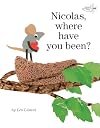
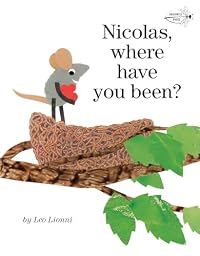
Nicolas, where have you been? tells the story about Nicolas the mouse who gets carried away by a big bird while collecting berries with his friends. He lives with the birds, they give him berries and they have fun. When he comes back to his friends he wants to tell them what happened but when they hear about the bird they get angry because the birds always get the good red berries before the mice. At the end Nicolas' friends the birds come and bring berries for all of them, and Nicolas' friends decide that “one bad bird doesn't make a flock”. This is a good opportunity to teach children about getting rid of prejudices against others
This book was really interesting to read. It's good example to show anyone that although some things in the past aren't good, you can change it.
This book follows a common theme for Leo Lionni; individual differences. This book tells a story about mice and birds. The mice assume the worst of the birds and label all birds the same. Nicholas soon learns that this is not true when he gets taken care of by a family of birds. The mice learn that not everyone who is different is bad. Some people have differences that are assets and they should be accepting of those differences.
This book could be used in the classroom to explain to students how differences in people do not mean they are bad or hurtful in any way. Just because one person is different and mean does not mean we can judge everyone you meet because of it.
This book is about a field mouse named Nicolas who was unable to find ripe red berries to eat. All the birds had taken the berries and so the field mice became angry. While they were searching for berries a bird swooped down and picked up Nicolas. He was able to wiggle himself free and ended up in a nest in a tree with other birds. Nicolas made friends with the birds and had to explain to his friends that some birds are nice. This is a book that should be used for third or fourth grade. If I used this book I would skip a page because the graphic is too harsh for children.
This book would be good to read to children, but not very young children. It would be good to teach lessons on getting along with others.
Members
- Recently Added By
Author Information

127+ Works 58,422 Members
Leo Lionni was born in Amsterdam on May 5, 1910. He attended the University of Zurich and also earned a doctorate in Economics from the University of Genoa in 1935. He taught himself to draw by visiting museums. After marrying Nora Maffi in 1931, Lionni moved to Milan, Italy, where he became known as a painter. In 1939 he moved to Philadelphia and show more began working in advertising design. Lionni held several positions in the artistic field including artistic director and design director. He also served as president of the American Institute of Graphic Arts. Around 1960 Lionni moved back to Italy. His first of over forty children's books was Little Blue and Little Yellow. Other titles include Inch by Inch, Frederick, Swimmy, and Alexander and the Wind-up Mouse, all of which won a Caldecott Honor. In addition, he received the American Institute of Graphic Arts Gold Medal in 1984. Lionni died on October 11, 1999 at his home in Tuscany, Italy at the age of 89. (Bowker Author Biography) show less
Awards and Honors
Awards
Notable Lists
Series

Work Relationships
Common Knowledge
- Canonical title*
- Nicolas, où étais-tu?
*Some information comes from Common Knowledge in other languages. Click "Edit" for more information.
Classifications
Statistics
- Members
- 203
- Popularity
- 160,573
- Reviews
- 13
- Rating
- (3.68)
- Languages
- 6 — Dutch, English, French, German, Italian, Japanese
- Media
- Paper, Audiobook
- ISBNs
- 17