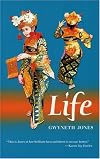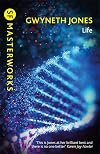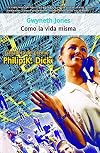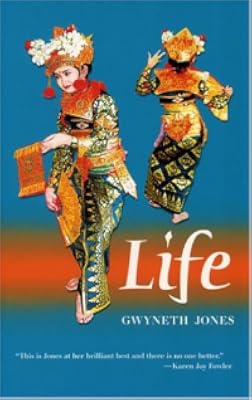
Life
by Gwyneth A. Jones
On This Page
Description
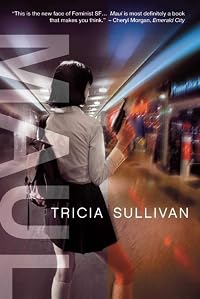
Anna Senoz is a brilliant young scientist, working towards her PhD and a bright career when she makes a discovery that could change the world of genetics forever. The 'Transferred Y' chromosome, however, isn't as welcomed by her peers, or the wider society. Anna is forced to choose between her dedication to her discovery, the progress of her career, and her responsibilities to her family. Does scientific integrity mean speaking out against the naysayers? Are the potential ramifications of show more her discovery too wide-reaching for her to risk pursuing it? Winner of the 2004 Philip K. Dick award, Life examines society's fixation on biological sex, the struggles of women in STEM, and the pressures placed upon them by families, colleagues and friends alike. Perfect for fans of alternate histories and near-future feminist SFF, like The Handmaid's Tale and Vox. show lessTags
Recommendations
















Member Reviews
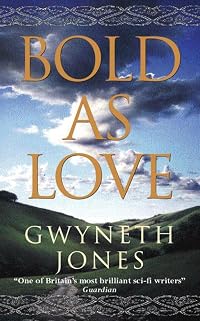
I am curious about the reaction this book would get from someone unfamiliar with Jones’ other work. Her [b:Bold as Love|1118463|Bold as Love (Bold as Love, #1)|Gwyneth Jones|https://images.gr-assets.com/books/1327928608s/1118463.jpg|1105495] series is one of my favourite sci-fi universes. Unlike everything else by her that I’ve read, this novel isn’t really science fiction, although it is a speculative vision of the near future. There is even an AI, briefly. The focus, though, is on the professional and personal life of Anna Sendoz. I found her an interesting, believable, and sympathetic character. In fact, the whole cast of characters were fundamentally flawed enough to ring true. There seemed to me to be a tension between the show more detailed insights into the characters thoughts and emotions and the overarching theme of 'transferred Y', however. Or perhaps it was more of a gap between my expectations and reality? I thought that the book would challenge and interestingly deconstruct notions of gender, Judith Butler style. It did not, as the characters were trapped within depressingly rigid social gender constructions. Only one, Ramone, made any real effort to break out and that seemed self-destructive and oddly unanchored. There is a whole mass of gender and queer theory in the world, which somehow Ramone never seemed to encounter. The point might have been that biology isn’t important, society and culture trap us in gender roles regardless.
As a partial biography of Anna Sendoz, the novel was engaging but depressing. As an exploration of the implications of the fictional ‘transferred Y’, it did not satisfy. The word 'gender' was rarely used, which avoided what could have been an interesting exploration of gender identity. 'Sexual identity' was often used, which confused me as I wasn’t sure if this meant femininity/masculinity or sexuality - two very different concepts. The relationship between gender and sexuality also wasn’t addressed. The afterword rather explains this: Jones was writing a personal novel, she calls it 'the story of my life as a writer'. What I was expecting was more of a science fiction novel that delved sensitively into gender issues - which are incredibly rare. 'Life' is well written and vivid, but I had different hopes for it. Anna Sendoz is an excellent character, I just wish she wasn’t so cis and heterosexual. show less
As a partial biography of Anna Sendoz, the novel was engaging but depressing. As an exploration of the implications of the fictional ‘transferred Y’, it did not satisfy. The word 'gender' was rarely used, which avoided what could have been an interesting exploration of gender identity. 'Sexual identity' was often used, which confused me as I wasn’t sure if this meant femininity/masculinity or sexuality - two very different concepts. The relationship between gender and sexuality also wasn’t addressed. The afterword rather explains this: Jones was writing a personal novel, she calls it 'the story of my life as a writer'. What I was expecting was more of a science fiction novel that delved sensitively into gender issues - which are incredibly rare. 'Life' is well written and vivid, but I had different hopes for it. Anna Sendoz is an excellent character, I just wish she wasn’t so cis and heterosexual. show less
a very understated account of a brilliant female scientist, whose career difficulties are gender-based. the background setting is a world gradually falling into chaos based on geopolitical issues generated in our present. the research involves DNA changing, rapidly altering male/female characteristics. it's also a realistic account of a marriage from the point of view of both parties and even of the small child they share, of a number of friendships complicated over time in a culture that's very gradually disintegrating, and of the central character's experience of the world around her. her view of and response to the events in her life is also driven by her experience of a rape she never reveals to anyone: instead perennially stepping show more around it in every situation, always attempting to placate aggressors though she sees clearly their duplicity as they attempt to silence her or arrange to take credit for her work. because she has some form of undiagnosed Asperger's, she also has difficulty meeting people head-on, preferring to prioritize work over socializing, especially because she knows very well she's onto something world-changingly important. but she has an unusual voice and point of view. altogether a very thought-provoking book on many fronts, which could have been marketed as mainstream fiction, but which because of its setting reads very much like Kim Stanley Robinson's way of telling a story, and to him she dedicates the book. show less
I was excited by the idea of this book: a near-future woman scientist's discovery of some paradigm-shifting biological sex genetic thingy. And I read the whole thing straight through (have a cold) but what I came away with was that Jones's characterizations are bizarrely homophobic and even misogynist. Certainly Jones is willing to have the one lesbian character in the book be an avowed woman-hater and the one "lesbian" sex scene is as bad as some kind of 80s-era Naiad Press romance: "...they got naked and lay between them, and hugged and kissed and nuzzled and licked and enjoyed each other..." All non-gender-conforming and/or queer people in this novel are characterized as freaks, unstable, immoral, frivolous, or ugly. Seriously? This show more won the James Tiptree prize? show less
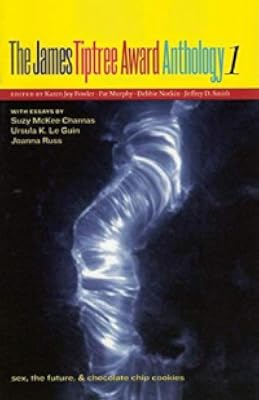
Tiptree honours list 2004. Monotonous, middle-class soap; hardly enough science fiction in it to be worth the name. What were the Tiptree award people thinking? Got half-way and couldn't be bothered to continue.
A tremendously moving book about one woman's scientific career, its stops and starts, the life she builds for herself, and the earthshattering discovery she makes. I loved it.
I finished this quite a while ago actually - some time in April while I was travelling. Can't remember my final views on it apart from it didn't feel very sf-y despite clear sf tropes such as proper AI existing.
This book will suck you into it.
Members
- Recently Added By
Published Reviews
Jones's genius here, however, is in the many layers and textures of experience she gives us, her recognition that great discoveries, great science, great art—like great sorrow and tragedy—take place against the minutiae of our days...This is a novel that strives fully to limn contemporary life, where we began and what we have become.
added by ltimmel
Remarkably rich and sophisticated...Life [is] a bold but accurate title for a work that anchors itself in the commonest meaning of the term (the old 24/7) and subtly weaves its way toward the larger scientific and philosophical versions that we tend to give capital letters and a lot more respect.
added by ltimmel
[...]Like all of Jones’s work, Life demands—and amply repays—close reading. In addition to writing well about the thrills and tedium of scientific research, she manages to be both clinical and lyrical in describing her characters’ exploration of their sensuality.
added by ltimmel
Lists

Best Feminist Science Fiction
188 works; 34 members

Favorite Science Fiction by Women Authors
737 works; 202 members

BingoDOG - Scientists in Fiction
111 works; 17 members

SF Masterworks
193 works; 8 members
Author Information

97+ Works 3,717 Members
Awards and Honors
Awards
Distinctions
Notable Lists
Series
Belongs to Publisher Series
SF Masterworks (New design)
Common Knowledge
- Original publication date
- 2004
- Blurbers
- Fowler, Karen Joy; Charnas, Suzy McKee; Robinson, Kim Stanley
Classifications
Statistics
- Members
- 186
- Popularity
- 176,409
- Reviews
- 9
- Rating
- (3.42)
- Languages
- English, Spanish
- Media
- Paper, Ebook
- ISBNs
- 4
- ASINs
- 2