On This Page
Description
The best military and scientific minds on Earth band together in a desperate attempt to preserve an alien society from the deadly force heading for its home planet.Tags
Recommendations



Member Reviews
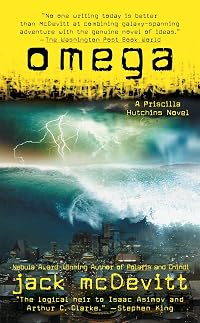
The archaeological mysteries which were prevalent in the first three books are gone, replaced by a xeno-sociology/rescue mission. A new, thriving medieval civilization has been discovered on the world of Lookout. There's just one catch: an Omega cloud, those mysterious galactic phenomena that attack and destroy anything with straight lines--buildings for instance--is headed right for it.
The inhabitants have been dubbed "Goompahs" after a cartoon character whom they resemble. Images of the creatures builds sympathy for them back home and a rescue mission is conceived. One drawback, besides the lack of time, is that there must be as little contact with the natives as possible, so as to prevent, or at least, minimize "culture shock". The show more question of "How do you rescue a people without them knowing that you're there" arises.
Hutch, true to her word in Chindi, has quit her career as pilot and, as a reward for her past work, now works as a high ranking bureaucrat at the Space Academy. She organizes the rescue mission but doesn't actually go. She's regulated to a supporting character role in this book, which was a disappointment for me as McDevitt has made her a likable character. Instead, the book's main characters are Digby "Digger" Dunn and David Collingdale.
Digger, who was on the original exploratory ship, initially isn't intent on saving the Goompahs so much as he's attracted to Kellie, the pilot of the ship he's on. But an accident, taking the life of the expedition leader, forces him into the leadership role while the relief mission scrambles to get there in time. Digger develops an affection for the Goompahs and his character evolves from being lightly self-centered to self-sacrificing.
Meanwhile, Collingdale is cast as a Captain Ahab and the omega is his white whale. At first his hatred of the omegas is reasonable, but the closer he gets to Lookout, the worse he gets. Once there, his obsession takes over, alienating his crewmates (and this reader). McDevitt builds us up for final confrontation between Collingdale and the omega but just as it's climaxing, McDevitt puts the scene "off camera". It's the equivalent of showing Obi-wan about to duel with Vader but not actually showing the actual fight or hearing the dialogue, though you could infer its outcome from Luke's reaction. It left me feeling a little cheated.
McDevitt's writing style continues to be excellent and his Goompahs make for interesting aliens. His characters are real and I could easily visualize the world. This novel won the John W Campbell Award for best sci-fi novel of the year and it's been nominated for a Nebula. I can see why. McDevitt tells a good story and is able to utilize action without relying on epic battles to do so. His characters, at least in this series, use their brains to solve their problems and only use violence as a last resort. And in this novel, violence, as represented by Collingdale, achieves nothing, while Digger's personal evolution symbolizes the human race as a whole.
Perhaps it was Hutch's explanation for the Omegas themselves that did it. While the idea for them is original and intriguing, it was ultimately unsatisfying for me. It would be interesting to see McDevitt write a novel about a meeting between Earth and the Omega creators and see what happens. Could McDevitt write a novel about resolving the conflict between the two without resorting to violence? show less
The inhabitants have been dubbed "Goompahs" after a cartoon character whom they resemble. Images of the creatures builds sympathy for them back home and a rescue mission is conceived. One drawback, besides the lack of time, is that there must be as little contact with the natives as possible, so as to prevent, or at least, minimize "culture shock". The show more question of "How do you rescue a people without them knowing that you're there" arises.
Hutch, true to her word in Chindi, has quit her career as pilot and, as a reward for her past work, now works as a high ranking bureaucrat at the Space Academy. She organizes the rescue mission but doesn't actually go. She's regulated to a supporting character role in this book, which was a disappointment for me as McDevitt has made her a likable character. Instead, the book's main characters are Digby "Digger" Dunn and David Collingdale.
Digger, who was on the original exploratory ship, initially isn't intent on saving the Goompahs so much as he's attracted to Kellie, the pilot of the ship he's on. But an accident, taking the life of the expedition leader, forces him into the leadership role while the relief mission scrambles to get there in time. Digger develops an affection for the Goompahs and his character evolves from being lightly self-centered to self-sacrificing.
Meanwhile, Collingdale is cast as a Captain Ahab and the omega is his white whale. At first his hatred of the omegas is reasonable, but the closer he gets to Lookout, the worse he gets. Once there, his obsession takes over, alienating his crewmates (and this reader). McDevitt builds us up for final confrontation between Collingdale and the omega but just as it's climaxing, McDevitt puts the scene "off camera". It's the equivalent of showing Obi-wan about to duel with Vader but not actually showing the actual fight or hearing the dialogue, though you could infer its outcome from Luke's reaction. It left me feeling a little cheated.
McDevitt's writing style continues to be excellent and his Goompahs make for interesting aliens. His characters are real and I could easily visualize the world. This novel won the John W Campbell Award for best sci-fi novel of the year and it's been nominated for a Nebula. I can see why. McDevitt tells a good story and is able to utilize action without relying on epic battles to do so. His characters, at least in this series, use their brains to solve their problems and only use violence as a last resort. And in this novel, violence, as represented by Collingdale, achieves nothing, while Digger's personal evolution symbolizes the human race as a whole.
Perhaps it was Hutch's explanation for the Omegas themselves that did it. While the idea for them is original and intriguing, it was ultimately unsatisfying for me. It would be interesting to see McDevitt write a novel about a meeting between Earth and the Omega creators and see what happens. Could McDevitt write a novel about resolving the conflict between the two without resorting to violence? show less
Omega continues on in much the same vein as the previous Academy books. Science fiction in a universe where life is remarkably rare and civilization even more so. This time though... we've found someone.
The Omegas (clouds coming in 8000 year waves from the center of the galaxy which have a tendency to seek out and destroy right angles) return in the book, pointing directly to a new civilization. It's thousands of light years away, so there are only a limited number of ships that can possibly get there in time.
Hutch takes more of a backseat role this time, opening the stage to a few new characters. And just when I was finally getting to know her too. I like the new characters well enough and the death toll is at least lower this time. show more We'll see if they stick around in the next two books.
Overall, despite an entire civilization at stake, this book someone doesn't quite get as intense as those before it. Perhaps just because I've now read five of these in a row, but I can see from the outset which solutions are going to fail, which will partially succeed, and how they're finally going to save the day. It's not a problem per say, but it's getting there.
Final oddity (and this might have had some impact on the previous paragraph): I've actually read this book before. I'm fairly impressed that I managed to pick up and read the fourth in a series without realizing it (even if this is one series where that's not necessarily a problem) and that I didn't notice I was rereading until about 20% of the way into the book. It must have been pre-GoodReads that I last read it. Amusing. show less
The Omegas (clouds coming in 8000 year waves from the center of the galaxy which have a tendency to seek out and destroy right angles) return in the book, pointing directly to a new civilization. It's thousands of light years away, so there are only a limited number of ships that can possibly get there in time.
Hutch takes more of a backseat role this time, opening the stage to a few new characters. And just when I was finally getting to know her too. I like the new characters well enough and the death toll is at least lower this time. show more We'll see if they stick around in the next two books.
Overall, despite an entire civilization at stake, this book someone doesn't quite get as intense as those before it. Perhaps just because I've now read five of these in a row, but I can see from the outset which solutions are going to fail, which will partially succeed, and how they're finally going to save the day. It's not a problem per say, but it's getting there.
Final oddity (and this might have had some impact on the previous paragraph): I've actually read this book before. I'm fairly impressed that I managed to pick up and read the fourth in a series without realizing it (even if this is one series where that's not necessarily a problem) and that I didn't notice I was rereading until about 20% of the way into the book. It must have been pre-GoodReads that I last read it. Amusing. show less
Overall good book. A little boring in places. I think it is because McDevitt shows a realistic world where space travel is just a job. There are heroics but they take place hand in hand with foul-ups and bad decisions. Nobody is "Spaceman Spiff - star explorer" they are just people. It is very much like real life and real life can be a boring slog to get through sometimes.
For anyone following this series, there is more information about the omega clouds that are causing so much trouble and wiping out civilizations.
For anyone following this series, there is more information about the omega clouds that are causing so much trouble and wiping out civilizations.
This is my favorite McDevitt novel to date. It is a little less action driven, and a lot more thought provoking. The Goompahs are an interesting alien race, not because they are compellingly different, but because of how similar they are to humans in many ways (although with a few telling differences). I particularly enjoyed the role of the theater and the arts in Goompah society. And the role of religion in any society is given a sensitive treatment. The cast of protagonists is made up of reasonably normal, everyday people thrown into a situation where they choose to act heroically, to risk their lives for a noble cause. And in McDevitt's universe, when people take risks, there are usually prices to be paid. While some aspects of the show more climax were predictable, others were surprising. And there were smaller surprises sprinkled throughout the book. show less
I'm of two minds on this book.
It's pretty damn awesome when it comes to characters and the gentle push toward an alternate Star Trek kind of universe with almost no posturing and no overpowered gunships. The dearth of alien species is a nice touch, making it more of an archeological mystery. These future humans happen to be peaceful, too, for once, and most of their principled actions reflect those of the Federation but there's also a more realistic bending of the rules, too.
Enter this book. The Omega clouds are absolutely immense intergalactic clouds of nanotech that spike huge energies and are apparently programmed to seek out any intelligent life. Cool, right? It might explain the lack of aliens. The next world in the path of one show more of these happens to be pre-industrial LIVING aliens! Oops. And the cloud will reach them during this novel. Oops.
Enter conflict, a race to save an alien species, provide tons of commentary on general human stupidity and opportunism. Hey, look, let's grab as much as we can of their civ to sell because they're all about to become instant relics!
It sounds like a really good episode of Trek, right? Right. Well, no complaints there. I never expected total and complete originality out of these. Just a careful and methodical worldbuilding, care and devotion to characters, and a hopeful outlook despite everything. Including a very regular death toll on every single outing. (Wait... redshirts?)
So what's my problem? We get a fully developed alien culture here including PoVs from these guys, right down to a fully religious world-build and science-debates and a huge survival thing.
Well... I'll be honest. As long as we stuck with the humans I was pretty invested. The aliens? ... not so much. The whole self-aware cartoon character nod and the way we humans fell for how cute these buck-toothed aliens... well... I guess I can see it but I didn't really appreciate it.
It might just be me. The commentary was fairly clever but the way it was pulled off? I don't think McDevitt went far enough. Or the amount he did go was a bit too far for the pacing and investment I was supposed to have in saving these guys.
Too much of the novel was slightly meh. Not a lot of meh. Just slightly. The rest was engaging and interesting. :) Hence the four stars. But this is pretty much on the same level as the second Academy novel for me. show less
It's pretty damn awesome when it comes to characters and the gentle push toward an alternate Star Trek kind of universe with almost no posturing and no overpowered gunships. The dearth of alien species is a nice touch, making it more of an archeological mystery. These future humans happen to be peaceful, too, for once, and most of their principled actions reflect those of the Federation but there's also a more realistic bending of the rules, too.
Enter this book. The Omega clouds are absolutely immense intergalactic clouds of nanotech that spike huge energies and are apparently programmed to seek out any intelligent life. Cool, right? It might explain the lack of aliens. The next world in the path of one show more of these happens to be pre-industrial LIVING aliens! Oops. And the cloud will reach them during this novel. Oops.
Enter conflict, a race to save an alien species, provide tons of commentary on general human stupidity and opportunism. Hey, look, let's grab as much as we can of their civ to sell because they're all about to become instant relics!
It sounds like a really good episode of Trek, right? Right. Well, no complaints there. I never expected total and complete originality out of these. Just a careful and methodical worldbuilding, care and devotion to characters, and a hopeful outlook despite everything. Including a very regular death toll on every single outing. (Wait... redshirts?)
So what's my problem? We get a fully developed alien culture here including PoVs from these guys, right down to a fully religious world-build and science-debates and a huge survival thing.
Well... I'll be honest. As long as we stuck with the humans I was pretty invested. The aliens? ... not so much. The whole self-aware cartoon character nod and the way we humans fell for how cute these buck-toothed aliens... well... I guess I can see it but I didn't really appreciate it.
It might just be me. The commentary was fairly clever but the way it was pulled off? I don't think McDevitt went far enough. Or the amount he did go was a bit too far for the pacing and investment I was supposed to have in saving these guys.
Too much of the novel was slightly meh. Not a lot of meh. Just slightly. The rest was engaging and interesting. :) Hence the four stars. But this is pretty much on the same level as the second Academy novel for me. show less
McDevitt, Jack. Omega. Academy No. 4. Ace, 2003.
Jack McDevitt has had a long career of writing very good science fiction. He creates nuanced and believable characters and puts them in a credible far future space-faring society. The Academy is a government-funded organization of scientists and spaceship crews that make first contact with alien species and explore astrophysical anomalies. Most of the books in the series deal with Fermi’s paradox as the Academy works to find out why technological societies are so rare. Omega offers a partial explanation, the eponymous Omega Cloud, a cloud of gas and nanoparticles thousands of kilometers long. It homes in on star systems with technological societies, destroying artificial structures. No show more one knows why. Now a newly discovered pre-industrial society is threatened, and an expedition is launched to warn the aliens and try some tricks to deflect the cloud. It is the sort of situation one might find in a Star Trek plot, complete with its own version of the Prime Directive, but McDevitt handles it more realistically than the usual Trek story. For one thing, space travel is expensive, starships are in short supply and the central characters of the series are aging. His early protagonist, Priscilla “Hutch” Hutchinson, is now an administrator struggling with funding and public relations. The expedition has trouble learning the alien language without violating its non-interference mandate. No Babel Fish or universal translators here. In sum, Omega is a well-told story with intriguing ideas, adequate action, and engaging characters. 4 stars. show less
Jack McDevitt has had a long career of writing very good science fiction. He creates nuanced and believable characters and puts them in a credible far future space-faring society. The Academy is a government-funded organization of scientists and spaceship crews that make first contact with alien species and explore astrophysical anomalies. Most of the books in the series deal with Fermi’s paradox as the Academy works to find out why technological societies are so rare. Omega offers a partial explanation, the eponymous Omega Cloud, a cloud of gas and nanoparticles thousands of kilometers long. It homes in on star systems with technological societies, destroying artificial structures. No show more one knows why. Now a newly discovered pre-industrial society is threatened, and an expedition is launched to warn the aliens and try some tricks to deflect the cloud. It is the sort of situation one might find in a Star Trek plot, complete with its own version of the Prime Directive, but McDevitt handles it more realistically than the usual Trek story. For one thing, space travel is expensive, starships are in short supply and the central characters of the series are aging. His early protagonist, Priscilla “Hutch” Hutchinson, is now an administrator struggling with funding and public relations. The expedition has trouble learning the alien language without violating its non-interference mandate. No Babel Fish or universal translators here. In sum, Omega is a well-told story with intriguing ideas, adequate action, and engaging characters. 4 stars. show less
Typical McDevitt. On the one hand, life on Earth in the 23rd century seems identical to about 1990. I'm surprised characters don't read the morning paper and open mail. On the other hand, interstellar travel! Flight with little concern for fuel! Invisibility via lightbenders! You have to read McDevitt for the adventure story and the sympathetic if not very deep characters.
This novel features the planet-blasting Omega clouds introduced earlier in the series. They are attracted to and wipe out artificial structures like cities. Now one is bearing down on a planet with a just discovered race of aliens named Goompahs after a popular kids TV show. Wait. Did I say 1990s above. I meant 1960s. The Federation --I mean, Academy -- Protocol says show more to not interfere but the Goompahs are too popular so ships are sent to either destroy or distract the Omega cloud or convince the Goompahs to abandon their cities.
There's the unforgivable use of the old trope where someone says "I have an idea what those clouds are but let me work on it and get back to you in two days" and you know what happens next. Otherwise the book proceeds smoothly if slowly through various successes and failures in the rescue attempt. Though this is part of the Priscilla Hutchins series, at this point she is primarily an administrator who sets up the missions. She also gets to propose a solution to what the clouds are but you won't like it so don't read this for that.
Recommended for McDevitt fans. If you've not read him, start earlier in the series, like The Engines of God or Deepsix when Hutchins is more front and center. show less
This novel features the planet-blasting Omega clouds introduced earlier in the series. They are attracted to and wipe out artificial structures like cities. Now one is bearing down on a planet with a just discovered race of aliens named Goompahs after a popular kids TV show. Wait. Did I say 1990s above. I meant 1960s. The Federation --I mean, Academy -- Protocol says show more to not interfere but the Goompahs are too popular so ships are sent to either destroy or distract the Omega cloud or convince the Goompahs to abandon their cities.
There's the unforgivable use of the old trope where someone says "I have an idea what those clouds are but let me work on it and get back to you in two days" and you know what happens next. Otherwise the book proceeds smoothly if slowly through various successes and failures in the rescue attempt. Though this is part of the Priscilla Hutchins series, at this point she is primarily an administrator who sets up the missions. She also gets to propose a solution to what the clouds are but you won't like it so don't read this for that.
Recommended for McDevitt fans. If you've not read him, start earlier in the series, like The Engines of God or Deepsix when Hutchins is more front and center. show less
Members
- Recently Added By
Lists

hypatian_kat to-read
429 works; 3 members
Talk Discussions
Past Discussions
Found: SF: First Contact story in Name that Book (December 2023)
Author Information

124+ Works 20,937 Members
Jack McDevitt (born 1935) is an American science fiction author whose novels frequently deal with attempts to make contact with alien races, and with archaeology or xenoarchaeology. He attended La Salle University, where a short story of his won the annual Freshman Short Story Contest and was published in the school's literary magazine, Four show more Quarters. He received a Master's degree in literature from Wesleyan University in 1971. Before becoming a full-time author, he was an English teacher, naval officer, Philadelphia taxi driver, customs officer and motivational trainer. His first published story was The Emerson Effect in The Twilight Zone Magazine in 1981. Two years later, he published his first novel, The Hercules Text, which won the Philip K. Dick Special Award. He won the 2006 Nebula Award for Best Novel for Seeker, the UPC International Prize for his novella Ships in the Night in 1991, and the John W. Campbell Memorial Award for best SF novel for Omega in 2003. (Bowker Author Biography) show less
Some Editions
Awards and Honors
Awards
Distinctions
Series

Belongs to Publisher Series
Common Knowledge
- Canonical title*
- Oméga
- Original title
- Omega
- Original publication date
- 2003
- People/Characters
- Priscilla 'Hutch' Hutchins
- Dedication
- For Jean and Scotty Parrish, USN
- First words
- It was the most majestic series of structures David Collingdale had ever seen.
- Last words*
- (Click to show. Warning: May contain spoilers.)Oder hätten sie ausgesehen wie Insekten.
- Blurbers
- King, Stephen
*Some information comes from Common Knowledge in other languages. Click "Edit" for more information.
Classifications
Statistics
- Members
- 1,170
- Popularity
- 21,538
- Reviews
- 25
- Rating
- (3.66)
- Languages
- 5 — Czech, English, French, German, Spanish
- Media
- Paper, Audiobook, Ebook
- ISBNs
- 11
- ASINs
- 10