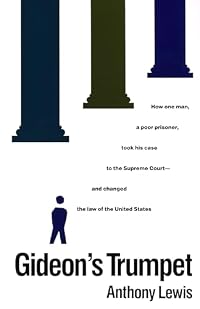
Gideon's Trumpet
by Anthony Lewis
On This Page
Description
History. Law. Politics. Nonfiction. A history of the landmark case of Clarence Earl Gideon's fight for the right to legal counsel. Notes, table of cases, index. The classic backlist bestseller. More than 800,000 sold since its first pub date of 1964.Tags
Recommendations









Member Reviews
A simply told yet thought-provoking account of how an indigent prisoner's appeal to the Supreme Court helped establish the right to counsel in felony cases for all defendants. As another reviewer has mentioned, the book provides a wonderfully accessible look at how the American justice system, and particularly the Supreme Court, works. Lewis also takes the time to explain the larger legal issues and theories at stake in this case in language that the average reader can comprehend. Thanks to reading this book, I can say that I almost understand the difference between the "incorporation" and "absorption" views of the Fourteenth Amendment. Ever the journalist, Lewis doesn't ignore the human element in this case either, taking the time to show more provide detailed portraits of all the major personalities involved in this case and quoting many of them at length.
The book is also notable for espousing a sort of high-toned sixties-era idealism that's been missing from American politics lately. Many of the lawyers who worked on Gideon's case were well-off and well-educated but felt a duty to use their talents to improve society as a whole, and Gideon himself seems to have had an unshakable faith that the justice system would eventually recognize what he saw as his fundamental rights. Lewis's tone throughout suggests a genuine belief that American society is progressively becoming fairer and more humane and that thoughtful men in institutions like the Supreme Court can make a real difference. His writing has a moral force – unobscured by contemporary "culture war" distinctions – that strikes this reader as positively inspiring. show less
The book is also notable for espousing a sort of high-toned sixties-era idealism that's been missing from American politics lately. Many of the lawyers who worked on Gideon's case were well-off and well-educated but felt a duty to use their talents to improve society as a whole, and Gideon himself seems to have had an unshakable faith that the justice system would eventually recognize what he saw as his fundamental rights. Lewis's tone throughout suggests a genuine belief that American society is progressively becoming fairer and more humane and that thoughtful men in institutions like the Supreme Court can make a real difference. His writing has a moral force – unobscured by contemporary "culture war" distinctions – that strikes this reader as positively inspiring. show less
In 1961, Clarence Earl Gideon was charged in the State of Florida with the offense of burglary, a felony. He asked the court to appoint an attorney to represent him. The judge refused, telling Gideon that Florida only provided counsel in capital cases. So Gideon went to trial, representing himself, and was convicted.
From the Florida State Prison in Raiford, in 1962, Clarence Earl Gideon wrote a letter to the United States Supreme Court, asking that his conviction be overturned on the grounds that he should have been given a lawyer. He was fighting an uphill battle. The Court had previously ruled in Betts v. Brady that the 6th Amendment right to counsel did not apply to the states. Gideon was asking the Court to change its mind, just show more twenty years later.
The Court agreed to hear his case, and appointed Abe Fortas to brief and argue it. The rest is history. Gideon won his case (and at retrial, with counsel, was acquitted), and indigent criminal defendants are now guaranteed the right to counsel. 2003 marked the 40th anniversary of Gideon v. Wainwright, which is the foundation stone of indigent defense throughout the United States (and not so incidentally of my career as a public defender!).
Anthony Lewis was for many years the New York Times Supreme Court correspondent. His work covering the Court was knowledgeable and incisive. In this book, he explains clearly and simply the legal history that Gideon and Fortas had to face, and how this historic change came about. show less
From the Florida State Prison in Raiford, in 1962, Clarence Earl Gideon wrote a letter to the United States Supreme Court, asking that his conviction be overturned on the grounds that he should have been given a lawyer. He was fighting an uphill battle. The Court had previously ruled in Betts v. Brady that the 6th Amendment right to counsel did not apply to the states. Gideon was asking the Court to change its mind, just show more twenty years later.
The Court agreed to hear his case, and appointed Abe Fortas to brief and argue it. The rest is history. Gideon won his case (and at retrial, with counsel, was acquitted), and indigent criminal defendants are now guaranteed the right to counsel. 2003 marked the 40th anniversary of Gideon v. Wainwright, which is the foundation stone of indigent defense throughout the United States (and not so incidentally of my career as a public defender!).
Anthony Lewis was for many years the New York Times Supreme Court correspondent. His work covering the Court was knowledgeable and incisive. In this book, he explains clearly and simply the legal history that Gideon and Fortas had to face, and how this historic change came about. show less
An interesting book for the details it gives into how the Supreme Court works. We get details on how petitions are made, how clerkships work, how briefs are formulated. (Some of these details are dated and inaccurate for today, and unfortunately a modern reader not familiar with the Supreme Court would have no idea. For example, the composition of lawyers arguing cases before the Court has narrowed a lot.)
The subtitle is rather misleading, though, even though Lewis tries to back it up:
> The case of Gideon v. Wainwright is in part a testament to a single human being. Against all the odds of inertia and ignorance and fear of state power, Clarence Earl Gideon insisted that he had a right to a lawyer and kept on insisting all the way to show more the Supreme Court of the United States.
In fact, this is pretty much nonsense. The Supreme Court case and its outcome had very little to do with anything from Gideon. It was not about his insistence, his persistence—no, he was just there at the right time. The court wanted a case in order to change Betts v. Brady, and Gideon came along. His lawyers argued the case well, while the other side only tried halfheartedly since they knew they'd lost coming in.
> His triumph there shows that the poorest and least powerful of men—a convict with not even a friend to visit him in prison—can take his cause to the highest court in the land and bring about a fundamental change in the law.
And this moral is, therefore, also wrong. (This also means that a large part of the book, describing all the details of Gideon's life, turns out to be irrelevant.)
It is not just details that have fallen out of date. My biggest problem is that Lewis seems determined to blow a trumpet for the Supreme Court, papering over or simply ignoring its flaws.
> The freedom to decide as one’s conscience and intellect demand, without fear of political retribution, is a rare luxury for any office-holder, and it certainly helps to explain what happens to men when they don the robes of a Supreme Court justice. The southern Senator required to go through the motions of defending segregation—and many in the Senate today are only going through the motions—can shed that dispiriting burden if he goes on the bench. The state judge who has to look to political bosses for re-election—as many do—cuts that tie upon appointment to the Supreme Court. The independence given to the justices enables them to do things that others know are right but have never had the courage or the determination to do by themselves.
Today politicians on the Supreme Court parrot Fox News. Is it good that they can do so "without fear of political retribution"? Is it good that they have the "courage and determination" to commit rape? Obviously, one can tilt too far to one side or the other, but Lewis's determination to look at the Court through rose-colored glasses, and skip over its darker side, makes his book worse than naive. show less
The subtitle is rather misleading, though, even though Lewis tries to back it up:
> The case of Gideon v. Wainwright is in part a testament to a single human being. Against all the odds of inertia and ignorance and fear of state power, Clarence Earl Gideon insisted that he had a right to a lawyer and kept on insisting all the way to show more the Supreme Court of the United States.
In fact, this is pretty much nonsense. The Supreme Court case and its outcome had very little to do with anything from Gideon. It was not about his insistence, his persistence—no, he was just there at the right time. The court wanted a case in order to change Betts v. Brady, and Gideon came along. His lawyers argued the case well, while the other side only tried halfheartedly since they knew they'd lost coming in.
> His triumph there shows that the poorest and least powerful of men—a convict with not even a friend to visit him in prison—can take his cause to the highest court in the land and bring about a fundamental change in the law.
And this moral is, therefore, also wrong. (This also means that a large part of the book, describing all the details of Gideon's life, turns out to be irrelevant.)
It is not just details that have fallen out of date. My biggest problem is that Lewis seems determined to blow a trumpet for the Supreme Court, papering over or simply ignoring its flaws.
> The freedom to decide as one’s conscience and intellect demand, without fear of political retribution, is a rare luxury for any office-holder, and it certainly helps to explain what happens to men when they don the robes of a Supreme Court justice. The southern Senator required to go through the motions of defending segregation—and many in the Senate today are only going through the motions—can shed that dispiriting burden if he goes on the bench. The state judge who has to look to political bosses for re-election—as many do—cuts that tie upon appointment to the Supreme Court. The independence given to the justices enables them to do things that others know are right but have never had the courage or the determination to do by themselves.
Today politicians on the Supreme Court parrot Fox News. Is it good that they can do so "without fear of political retribution"? Is it good that they have the "courage and determination" to commit rape? Obviously, one can tilt too far to one side or the other, but Lewis's determination to look at the Court through rose-colored glasses, and skip over its darker side, makes his book worse than naive. show less
I had to read this for Criminal Procedure and frankly I'm glad that it doesn't seem to be required reading in most classrooms anymore. The only people who should read this (without any real necessity) are law students or bored attorneys. Anyone else deserves a more updated look at the way the American legal system works.
Admittedly, so far as I am aware, a lot is unchanged. The basic procedure for a number of things is probably pretty much the same, and that's why only people directly involved in the legal field should read it. It's a nice learning tool and a neat look at history. There are some very interesting descriptions of people and events in the book that make you feel like you're actually there or watching archival footage of show more what was going on. One of the more interesting parts is a detailed letter Gideon wrote to Fortas about his life, contained in full detail. I enjoy reading about history, so that was quite interesting. My favorite part of the book, however, is reading about Gideon's last lawyer in the book, W. Fred Turner, who did a masterful job with some authorial explanatory detail that just makes it enjoyable to read, and particularly rewarding after reading the rest of the story. A true testament to what good lawyers can accomplish. Not what I know the average indigent defendant today will receive (and not for lack of trying; I understand the plight of the overworked public defender), but well. There's that 1964 publication date and the author does talk about the problem for a few pages.
And that's my biggest problem with the book. It was published in 1964, only a year after the case at the story's heart. I don't think that's too soon to talk about something or even write about it, but I really wish there was someone who had written a modern-day version of this novel for the 2015 audience. It's irritating, at best, to constantly hear about how lawyers and judges and justices are "men" who are the most educated and how Washington is filled with well-educated "men" and how the law is a man's world. The legal world still has plenty of gender issues. But lawyers aren’t JUST men anymore. Lawmakers aren’t JUST men anymore (and they weren’t JUST men in 1964 but whatever). It's a book out of time and the middle/upper-class white-male lens is aggravating, at best.
It's quite odd to see the author referencing certain seminal cases by name but for some reason choosing to reference what I'm presuming is Plessy v. Ferguson and Brown v. Board of Education as "the school segregation cases". The observations on certain justices as living people when the entire bench of Gideon v. Wainwright has passed away (the most recent passed away in the early 2000s) is frequently disconcerting, particularly as this is meant to help us understand how the supreme court works today. I understand that reading historical literature does that, but still. There are also like two chapters that are completely invalid where the author waxes poetic on politics and legal decisions that have been invalidated or changed due to changing social opinion.
I do appreciate the way it didn’t just feature the case as an anomaly. Rather, the case was the culmination of social and political feeling moving towards the justices wanting this change. I liked how it focused on the people involved and it was really interesting to see how the states were largely on the side of this decision. Like my professor said, the way it focused on the people involved and not just the concepts really helped. There's a lot of detail about how the whole thing came together, who was involved, and how it wasn't just a tiny man named Gideon against an array of state lawyers who wouldn't let him speak (at least in the Supreme Court).
Overall, honestly, unless you’re a MAJOR history fan and there’s nowhere else you can turn to for a decent look at the history around this case, or else unless you’re a law student required to read this for something, read something else. show less
Admittedly, so far as I am aware, a lot is unchanged. The basic procedure for a number of things is probably pretty much the same, and that's why only people directly involved in the legal field should read it. It's a nice learning tool and a neat look at history. There are some very interesting descriptions of people and events in the book that make you feel like you're actually there or watching archival footage of show more what was going on. One of the more interesting parts is a detailed letter Gideon wrote to Fortas about his life, contained in full detail. I enjoy reading about history, so that was quite interesting. My favorite part of the book, however, is reading about Gideon's last lawyer in the book, W. Fred Turner, who did a masterful job with some authorial explanatory detail that just makes it enjoyable to read, and particularly rewarding after reading the rest of the story. A true testament to what good lawyers can accomplish. Not what I know the average indigent defendant today will receive (and not for lack of trying; I understand the plight of the overworked public defender), but well. There's that 1964 publication date and the author does talk about the problem for a few pages.
And that's my biggest problem with the book. It was published in 1964, only a year after the case at the story's heart. I don't think that's too soon to talk about something or even write about it, but I really wish there was someone who had written a modern-day version of this novel for the 2015 audience. It's irritating, at best, to constantly hear about how lawyers and judges and justices are "men" who are the most educated and how Washington is filled with well-educated "men" and how the law is a man's world. The legal world still has plenty of gender issues. But lawyers aren’t JUST men anymore. Lawmakers aren’t JUST men anymore (and they weren’t JUST men in 1964 but whatever). It's a book out of time and the middle/upper-class white-male lens is aggravating, at best.
It's quite odd to see the author referencing certain seminal cases by name but for some reason choosing to reference what I'm presuming is Plessy v. Ferguson and Brown v. Board of Education as "the school segregation cases". The observations on certain justices as living people when the entire bench of Gideon v. Wainwright has passed away (the most recent passed away in the early 2000s) is frequently disconcerting, particularly as this is meant to help us understand how the supreme court works today. I understand that reading historical literature does that, but still. There are also like two chapters that are completely invalid where the author waxes poetic on politics and legal decisions that have been invalidated or changed due to changing social opinion.
I do appreciate the way it didn’t just feature the case as an anomaly. Rather, the case was the culmination of social and political feeling moving towards the justices wanting this change. I liked how it focused on the people involved and it was really interesting to see how the states were largely on the side of this decision. Like my professor said, the way it focused on the people involved and not just the concepts really helped. There's a lot of detail about how the whole thing came together, who was involved, and how it wasn't just a tiny man named Gideon against an array of state lawyers who wouldn't let him speak (at least in the Supreme Court).
Overall, honestly, unless you’re a MAJOR history fan and there’s nowhere else you can turn to for a decent look at the history around this case, or else unless you’re a law student required to read this for something, read something else. show less
If you have ever wondered how the statement "you have the right to speak to an attorney. If you cannot afford an attorney, one will appointed to you" first came about you should read Gideon's Trumpet by Anthony Lewis. Gideon's Trumpet follows the case of Clarence Earl Gideon, a petty thief who had been in and out of jail all his life. After landing in a Florida jail for breaking and entering Gideon managed to file a handwritten petition certiorari with the Supreme Court claiming his right to legal counsel was violated during his trial. the Supreme Court agreed. This launched Gideon v. Wainright, a landmark case that started the evolution of the Miranda Warning. While Lewis's book is brief it is highly readable and informative. It is show more easy to see Clarence Gideon, and even the legal system, as real humans making history. show less
This book tells the story of the 9-0 Supreme Court decision holding that the due process clause under the 14th amendment requires that defendants in state criminal cases be provided counsel if they are unable to afford to pay for counsel. The book is interesting and well-written and recounts Gideon's story as the appellant, the appointment of Abe Fortas by the Supreme Court to handle the appeal, his strategy, how the Supreme Court makes decisions, the precedent relevant to the case and also the personalities and views of the then-serving Justices.
Very new and original description of the procedures and politics behind hearing a case in front of the US Supreme court. Good legal writing for the layman.
Members
- Recently Added By
Lists

Blue Pyramid 1,276 Best Books of All Time
1,248 works; 32 members

Edgar Award
418 works; 15 members
Author Information

8+ Works 1,649 Members
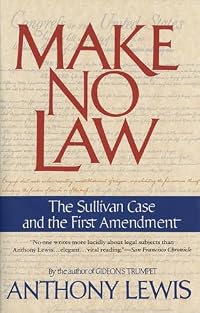
Two-time Pulitzer Prize winner Anthony Lewis is the author of Make No Law and the bestseller Gideon's Trumpet. In his nearly five decades of writing and reporting for The New York Times, he served as the Time's London bureau chief for eight years; he now contributes the twice-weekly "Abroad at Home" column to the paper's op-ed page. (Bowker Author show more Biography) show less
Awards and Honors
Awards
Distinctions
Common Knowledge
- Canonical title
- Gideon's Trumpet
- Original title
- Gideon's Trumpet
- Original publication date
- 1964
- People/Characters
- Abe Fortas; Clarence Earl Gideon
- Important places
- Florida, USA; USA
- Related movies
- Hallmark Hall of Fame: Gideon's Trumpet (1980 | IMDb)
Classifications
Statistics
- Members
- 961
- Popularity
- 27,373
- Reviews
- 11
- Rating
- (3.86)
- Languages
- English
- Media
- Paper, Audiobook, Ebook
- ISBNs
- 8
- ASINs
- 22