On This Page
Description
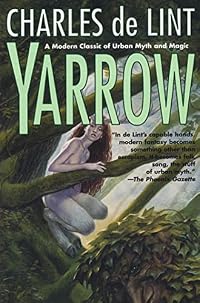
From the acclaimed author ofMoonheartandMemory and Dream Cat Midhir had made a reputation as the author of popular fantasy novels. But the secret that her fans didn't know was that her Otherworld was no fantasy. Then, one night, a thief stole her dreams. Since then, she's been trapped in the everyday. And the Others are coming to find her... YarrowTags
Recommendations














Member Reviews
[[Charles de Lint]] is a favorite; his urban fantasy arrived before anyone else even knew what that might look like. He is a master builder of worlds and characters, always with a unique story, if connected to his larger world. This one was no different. The book, overall, had the feel of [Winesburg, Ohio], especially in the early chapters when he is laying out the cast. The heroine is an author who believes that she writes only from her exquisitely vivid dreams. But those dreams abandon her and she develops writer's block. Turns out the dreams are more real than she believed, and a vampire type monster is feeding on her and the other residents of the town.
5 bones!!!!!
Highly Recommended
5 bones!!!!!
Highly Recommended
3.5 stars
Cat is an author and gets her inspiration through dreams. Unfortunately, she has not been dreaming for a few months and is now blocked. What she doesn’t know is that there is… something out there feeding on her dreams! And he’s feeding on others, as well, but Cat’s dreams are the ones he really wants.
This was good. I liked the real world sections of the book more than the dream sections, but that’s not a surprise to me. Cat didn’t really have friends in the real world, so I enjoyed the sections where she was making friends (though that was more secondary to the story). There were a lot of characters introduced at the very start of the book, so I was afraid I would get them confused, but surprisingly, it was rare to show more not figure out who we were following in the story fairly quickly – de Lint must have given enough clues to be able to follow easily. show less
Cat is an author and gets her inspiration through dreams. Unfortunately, she has not been dreaming for a few months and is now blocked. What she doesn’t know is that there is… something out there feeding on her dreams! And he’s feeding on others, as well, but Cat’s dreams are the ones he really wants.
This was good. I liked the real world sections of the book more than the dream sections, but that’s not a surprise to me. Cat didn’t really have friends in the real world, so I enjoyed the sections where she was making friends (though that was more secondary to the story). There were a lot of characters introduced at the very start of the book, so I was afraid I would get them confused, but surprisingly, it was rare to show more not figure out who we were following in the story fairly quickly – de Lint must have given enough clues to be able to follow easily. show less
This is one of my favorite de Lint books, I read it back in high school and I just really identified with the lead character and so wanted her powers.
Charles de Lint is one of the best at writing urban fantasy, he was in fact my introduction to it, and I love the mix of mysticism, darkness, depth and sheer beauty he brings to his stories and characters.
When I read it I felt that Caitlin and the characters she created were as real as anyone I knew in the real world, and was totally sucked into the story and the dangers she was in. I was totally engaged in the world he created here and felt that the threat to Caitlin was real and there was no real guarantee that she would escape unscathed as de Lint doesn't always write happy endings show more for all his characters. show less
Charles de Lint is one of the best at writing urban fantasy, he was in fact my introduction to it, and I love the mix of mysticism, darkness, depth and sheer beauty he brings to his stories and characters.
When I read it I felt that Caitlin and the characters she created were as real as anyone I knew in the real world, and was totally sucked into the story and the dangers she was in. I was totally engaged in the world he created here and felt that the threat to Caitlin was real and there was no real guarantee that she would escape unscathed as de Lint doesn't always write happy endings show more for all his characters. show less
This is urban fantasy from back when that did not automatically mean a formulaic vampire-werewolf-femme-fatale love triangle. Its a story about a group of people whose lives are intruded upon by an immortal human-like predator that feeds on dreams. The intended main course of his culinary tour of Ottowa is to be Cat, a fantasy author whose source of inspiration for her books comes from fantastical beings in a magical land that she is able to visit in her own dreams. Once her nocturnal sightseeing trips become snacks for the evil one, she suffers a major dose of writer's block. a genuine misanthrope who has only ever really connected to the beings she meets in her dreams, she is now cut off from her only friends and endangered by a show more mysterious assailant. Discovering and dealing with said assailaint can only come about if she breaks through her isolation and connects with the people around her.
A decent urban fantasy tale, quiet dark in bits, which reminded me to some extent of Neil Gaiman's work. Entertaining but not exceptional. show less
A decent urban fantasy tale, quiet dark in bits, which reminded me to some extent of Neil Gaiman's work. Entertaining but not exceptional. show less
Yet another book I haven't read in probably twenty years, Yarrow is the story of Cat Midhir, a fantasy novelist who, unbeknownst to everyone but herself, is
dependent on her dreams for her writing. Every night she has found herself in another world, where she sits at the feet of the tall fae bard Kothlen as he spins tales, which she on waking weaves into her books. Every night of her life since she was very young she has had what for lack of better language she calls dreams - every night until three months ago, when she stopped dreaming at all, and because of that stopped writing. We the reader know what she cannot: there's an ancient creature called Lysistratus who feeds off dreams, off soul, and who finds her a rich source of show more sustenance.
Quick note: why on earth call a soul/dream vampire "Lysistratus"?? There was a real Lysistratus in the 4th century who was a highly skilled sculptor (a creator), and there was the fictional Lysistrata, the Athenian heroine of Aristophanes's comedy about the women on both sides of a war deciding to withhold sex until peace could be achieved. Not, either of them, anything remotely appropriate for this character, which is unusual, especially if my assumption is right, that he took the name for himself.
This was probably one of the first de Lint books I read, which helped lead to my reading more, which is by and large a good thing ... but if this was my first time reading it I'm not at all sure I'd pursue the author. It's not bad, at all; it's well-written, characters are well done, there's a good story, the setting (especially the Otherworld) is very good... I just didn't like it. I will, of course, being me, explain.
First off, the main character. Cat Midhir is, we are told early in the book, sick unto death of explaining to everyone in the universe and his sister how her
name is pronounced. Honey? I have to spell both my names to everyone in the universe, because both names have multiple variations. You should have taken a self-explanatory pseudonym if it's going to get to you this much, and you didn't, and it's an odd name so it will keep happening, so suck it up. And that's the thin end of the wedge, cracking open her character for the reader: there's not much there, there. She is a talented writer, but socially inept and alone (what ever happened to her parents? It's not a good thing that I can't remember if we're told). Now that her dreams have abandoned her, she can't write a single decent sentence, and I'm afraid I can't muster up a single spark of sympathy for her. I have delusions of authorship. I've had a couple of wild dreams that might someday, with a lot of work, become something readable. I have not ever had the ridiculous advantage of being able to sit at the feet of a bard, soak in his stories, and then write them down. We are assured that she took the stories deeper than Kothlen did, expanding, fleshing out the places he skimmed over and using her own gift of expression to turn them into best-selling novels... but we are also told several times that every word she tries to write without the umbilical cord of the Otherworld is "lifeless". I'll buy that she's not merely transcribing but actually writing - but how am I supposed to feel anything but mild contempt for a woman who has sponged off others for her livelihood? A woman who has never had to sit in front of a blank sheet of paper and search for what comes next in the story? Given a rich source like Kothlen, I'd be a best-seller too. If anything, her "writer's block" gives me a self-righteous and slightly perverse delight. Again, suck it up, honey, and sink or swim on your own damn merits. Wet dishrag, her.
The other characters, as I said, are well done: Peter, the bookstore owner who has tentatively befriended her over the years and who becomes a true friend now; Ben, the cab-driver who has had a minor obsession with her since he read her first book (though I kept thinking he was an old man for some reason); Mick, the mohawked punk-rocker with a heart, apparently, of gold; Rick, whose name is well chosen as the only word I can think of to describe him ends in "rick"... The Otherworld characters are not as strong, but sketched in well enough to serve, if not as clearly as I would like. Some of the many red shirts in the story were given more time and delineation than the major characters of the Otherworld, and I resented being asked to get to know and like them (which I didn't, always) in the pages before they were hideously murdered. That was actually a problem with the beginning of the book, as well: a large number of characters were introduced, one after the other, and it was fairly clear which ones weren't going to be around long. After that it was just a matter of Lysistratus picking them off at will.
My main issue with characterization shouldn't be a big one, but is: their language. As in profanity. It's constant, and every non-fae male character, antagonist or pro-, cusses like a sailor. And it's not just nice pungent anglo-saxon words, but it's those anglo-saxon words with "jesus" (no caps) in front, which ... Come on. I'm not a prude when it comes to strong language - anyone who thinks so has not driven with me on the highway - but this was just too much. On every page, every circumstance from minor annoyance to lives being threatened prompts the same response. It gets old.
Also, I was reminded frequently that de Lint has a horror background under another name. There were strong horror elements throughout - Lysistratus is evil, and does evil for evil's sake, and it's no fun to read. And that's something of a problem. As with profanity, some is fine, even good in context. More is not better. If I want to read horror, I will read horror. I don't want to read horror. I don't appreciate a constant barrage of blood-soaked scenes packaged as a fantasy - particularly with my edition's cover - except for the skull in the foreground, it leads a prospective reader to believe the concentration is on the fae, not the evil. I'm uneasy with the idea that L stole people's souls, too, but that's my own issue. Or, to be more timely, hang-up. Which leads me to - -
A last issue, sometimes fairly easily overlooked but still a distraction, was that the book did not age well: it is very, very dated. Very. This was startling at times (there was a comment about the awareness of Reagan in office south of the border apparently intent on starting a war, which was an unexpected and unusual Canadian political commentary), and almost funny at times (how many times would a cell phone have made all the difference? And - a turntable! Aw!), but frequently it was just ... odd. The name-checking was annoying - there was a great detail of corroborative detail, intended to give artistic verisimilitude ... who was on the turntable, what books Peter was ordering, what books everyone was reading (everyone) (seriously) - it felt grafted on to prove de Lint was "hip". Oddest, though, and unintentionally hilarious, was Lysistratus humming the Human League song "Don't You Want Me". The radio station I leave on at work plays this now and then, and I get the joke. It's just not funny. He could have been an amazing Big Bad. He wasn't. He was the well-dressed "Dude" (*sigh*) with the piercing blue eyes who you really want to avoid, and particularly to avoid having sex with. Who has terrible tast in music. That detracts from his fearsomeness, and I think it would have even in the 80's.
***minor spoilers***
The ending felt a little rushed. I still don't think Cat did enough, and what she did was undermined and cleaned up to pave the way for a happily-ever-after, with some major questions left unanswered (Is the whole Otherworld, or is it not, part of her? And how in hell is she the deer woman whose name escapes me? And why? And when??). I resented the death of one major character, rather than regretting it, and unfortunately the result of "the Dude"'s eye contact - paralysis - was sometimes funnier than it was scary. And in the end ... two things. I can't help but be resentful that someone who is never shown as deserving has a devoted lover, a loyal friend, access to faery, and a continuing career I'd kill for. The other thing is: I've been listening to a movie review/writing podcast called "The Popcorn Dialogues", and a comment made in one I just heard was that if at the end of a romantic comedy you're thinking "Geez, I really thought she'd end up with the other guy", it's not a successful romance story. That's the case here: I don't quite get why we needed both Ben and Peter.
Overall, three stars; probably won't read it again unless in twenty more years I forget not only the book but this review; disappointed; not in the mood for more de Lint soon. But I do admit I want to read Cat's books. show less
dependent on her dreams for her writing. Every night she has found herself in another world, where she sits at the feet of the tall fae bard Kothlen as he spins tales, which she on waking weaves into her books. Every night of her life since she was very young she has had what for lack of better language she calls dreams - every night until three months ago, when she stopped dreaming at all, and because of that stopped writing. We the reader know what she cannot: there's an ancient creature called Lysistratus who feeds off dreams, off soul, and who finds her a rich source of show more sustenance.
Quick note: why on earth call a soul/dream vampire "Lysistratus"?? There was a real Lysistratus in the 4th century who was a highly skilled sculptor (a creator), and there was the fictional Lysistrata, the Athenian heroine of Aristophanes's comedy about the women on both sides of a war deciding to withhold sex until peace could be achieved. Not, either of them, anything remotely appropriate for this character, which is unusual, especially if my assumption is right, that he took the name for himself.
This was probably one of the first de Lint books I read, which helped lead to my reading more, which is by and large a good thing ... but if this was my first time reading it I'm not at all sure I'd pursue the author. It's not bad, at all; it's well-written, characters are well done, there's a good story, the setting (especially the Otherworld) is very good... I just didn't like it. I will, of course, being me, explain.
First off, the main character. Cat Midhir is, we are told early in the book, sick unto death of explaining to everyone in the universe and his sister how her
name is pronounced. Honey? I have to spell both my names to everyone in the universe, because both names have multiple variations. You should have taken a self-explanatory pseudonym if it's going to get to you this much, and you didn't, and it's an odd name so it will keep happening, so suck it up. And that's the thin end of the wedge, cracking open her character for the reader: there's not much there, there. She is a talented writer, but socially inept and alone (what ever happened to her parents? It's not a good thing that I can't remember if we're told). Now that her dreams have abandoned her, she can't write a single decent sentence, and I'm afraid I can't muster up a single spark of sympathy for her. I have delusions of authorship. I've had a couple of wild dreams that might someday, with a lot of work, become something readable. I have not ever had the ridiculous advantage of being able to sit at the feet of a bard, soak in his stories, and then write them down. We are assured that she took the stories deeper than Kothlen did, expanding, fleshing out the places he skimmed over and using her own gift of expression to turn them into best-selling novels... but we are also told several times that every word she tries to write without the umbilical cord of the Otherworld is "lifeless". I'll buy that she's not merely transcribing but actually writing - but how am I supposed to feel anything but mild contempt for a woman who has sponged off others for her livelihood? A woman who has never had to sit in front of a blank sheet of paper and search for what comes next in the story? Given a rich source like Kothlen, I'd be a best-seller too. If anything, her "writer's block" gives me a self-righteous and slightly perverse delight. Again, suck it up, honey, and sink or swim on your own damn merits. Wet dishrag, her.
The other characters, as I said, are well done: Peter, the bookstore owner who has tentatively befriended her over the years and who becomes a true friend now; Ben, the cab-driver who has had a minor obsession with her since he read her first book (though I kept thinking he was an old man for some reason); Mick, the mohawked punk-rocker with a heart, apparently, of gold; Rick, whose name is well chosen as the only word I can think of to describe him ends in "rick"... The Otherworld characters are not as strong, but sketched in well enough to serve, if not as clearly as I would like. Some of the many red shirts in the story were given more time and delineation than the major characters of the Otherworld, and I resented being asked to get to know and like them (which I didn't, always) in the pages before they were hideously murdered. That was actually a problem with the beginning of the book, as well: a large number of characters were introduced, one after the other, and it was fairly clear which ones weren't going to be around long. After that it was just a matter of Lysistratus picking them off at will.
My main issue with characterization shouldn't be a big one, but is: their language. As in profanity. It's constant, and every non-fae male character, antagonist or pro-, cusses like a sailor. And it's not just nice pungent anglo-saxon words, but it's those anglo-saxon words with "jesus" (no caps) in front, which ... Come on. I'm not a prude when it comes to strong language - anyone who thinks so has not driven with me on the highway - but this was just too much. On every page, every circumstance from minor annoyance to lives being threatened prompts the same response. It gets old.
Also, I was reminded frequently that de Lint has a horror background under another name. There were strong horror elements throughout - Lysistratus is evil, and does evil for evil's sake, and it's no fun to read. And that's something of a problem. As with profanity, some is fine, even good in context. More is not better. If I want to read horror, I will read horror. I don't want to read horror. I don't appreciate a constant barrage of blood-soaked scenes packaged as a fantasy - particularly with my edition's cover - except for the skull in the foreground, it leads a prospective reader to believe the concentration is on the fae, not the evil. I'm uneasy with the idea that L stole people's souls, too, but that's my own issue. Or, to be more timely, hang-up. Which leads me to - -
A last issue, sometimes fairly easily overlooked but still a distraction, was that the book did not age well: it is very, very dated. Very. This was startling at times (there was a comment about the awareness of Reagan in office south of the border apparently intent on starting a war, which was an unexpected and unusual Canadian political commentary), and almost funny at times (how many times would a cell phone have made all the difference? And - a turntable! Aw!), but frequently it was just ... odd. The name-checking was annoying - there was a great detail of corroborative detail, intended to give artistic verisimilitude ... who was on the turntable, what books Peter was ordering, what books everyone was reading (everyone) (seriously) - it felt grafted on to prove de Lint was "hip". Oddest, though, and unintentionally hilarious, was Lysistratus humming the Human League song "Don't You Want Me". The radio station I leave on at work plays this now and then, and I get the joke. It's just not funny. He could have been an amazing Big Bad. He wasn't. He was the well-dressed "Dude" (*sigh*) with the piercing blue eyes who you really want to avoid, and particularly to avoid having sex with. Who has terrible tast in music. That detracts from his fearsomeness, and I think it would have even in the 80's.
***minor spoilers***
The ending felt a little rushed. I still don't think Cat did enough, and what she did was undermined and cleaned up to pave the way for a happily-ever-after, with some major questions left unanswered (Is the whole Otherworld, or is it not, part of her? And how in hell is she the deer woman whose name escapes me? And why? And when??). I resented the death of one major character, rather than regretting it, and unfortunately the result of "the Dude"'s eye contact - paralysis - was sometimes funnier than it was scary. And in the end ... two things. I can't help but be resentful that someone who is never shown as deserving has a devoted lover, a loyal friend, access to faery, and a continuing career I'd kill for. The other thing is: I've been listening to a movie review/writing podcast called "The Popcorn Dialogues", and a comment made in one I just heard was that if at the end of a romantic comedy you're thinking "Geez, I really thought she'd end up with the other guy", it's not a successful romance story. That's the case here: I don't quite get why we needed both Ben and Peter.
Overall, three stars; probably won't read it again unless in twenty more years I forget not only the book but this review; disappointed; not in the mood for more de Lint soon. But I do admit I want to read Cat's books. show less
Cat Midhir is a best-selling fantasy author, but now she's blocked. Her stories come from her dreaming life in the Other World, and now she's no longer dreaming. Someone is stealing her dreams.
Charles de Lint is one of my favorite fantasy authors. This is one of his very early works (I'm pretty sure I've read it before a long time ago). I found it a bit uneven, especially in the beginning where there are a lot of characters to keep track of. About a third into the book the story found it's pace and cohesion, and it was all good from there.
Yarrow is a bit more gritty than most of Mr. de Lint's books. References to the eighties time period didn't make it seem dated though there were times when I wished Ben or Peter had a cell phone in show more the more harrowing parts.
The writing is best (in my opinion) when Cat is in the Otherworld. The descriptions and characters draw the reader in so you never want Cat to wake up. Still, it's a satisfying urban fantasy tale and a solid story from this master author. show less
Charles de Lint is one of my favorite fantasy authors. This is one of his very early works (I'm pretty sure I've read it before a long time ago). I found it a bit uneven, especially in the beginning where there are a lot of characters to keep track of. About a third into the book the story found it's pace and cohesion, and it was all good from there.
Yarrow is a bit more gritty than most of Mr. de Lint's books. References to the eighties time period didn't make it seem dated though there were times when I wished Ben or Peter had a cell phone in show more the more harrowing parts.
The writing is best (in my opinion) when Cat is in the Otherworld. The descriptions and characters draw the reader in so you never want Cat to wake up. Still, it's a satisfying urban fantasy tale and a solid story from this master author. show less
I must confess that I read this book to kill three birds with one stone. I needed a ‘Y’ title, a Canadian book, and a fantasy book so I could fit it into three challenges. I had always wanted to read de Lint anyway, so it seemed like a good fit. But, it really wasn’t. This was my first foray into urban fantasy and while I’m not giving up on it yet, I don’t know if I really like the genre.
Cat Midhir is an isolated Canadian fantasy writer who finds inspiration through her dreams. Suddenly, though, she has a severe writer’s block and cannot find the reason for it. She confides in Peter, a bookshop owner, and the two become friends. Peter helps her to open up and even thinks he can fix her up with his friend Ben. Meanwhile, Cat show more soon realizes she is being stalked and is afraid to go to her own home at night. Afraid of being alone, she begins spending more and more time with Peter.
This story actually reminded me a bit of Lisey’s Story by Stephen King. I was uncomfortable with aspects of that story, and was even more so with this one. Yarrow was much too gritty for my taste, but I’m usually in the minority on that score. On the positive side, de Lint knows how to build characters. I really, really liked the ‘good guys’ in this and really hated the bad ones. I probably will try at least one more of de Lint’s books before I make a final judgment. Any suggestions?
1986, 255 pp. show less
Cat Midhir is an isolated Canadian fantasy writer who finds inspiration through her dreams. Suddenly, though, she has a severe writer’s block and cannot find the reason for it. She confides in Peter, a bookshop owner, and the two become friends. Peter helps her to open up and even thinks he can fix her up with his friend Ben. Meanwhile, Cat show more soon realizes she is being stalked and is afraid to go to her own home at night. Afraid of being alone, she begins spending more and more time with Peter.
This story actually reminded me a bit of Lisey’s Story by Stephen King. I was uncomfortable with aspects of that story, and was even more so with this one. Yarrow was much too gritty for my taste, but I’m usually in the minority on that score. On the positive side, de Lint knows how to build characters. I really, really liked the ‘good guys’ in this and really hated the bad ones. I probably will try at least one more of de Lint’s books before I make a final judgment. Any suggestions?
1986, 255 pp. show less
Members
- Recently Added By
Author Information

196+ Works 43,381 Members
Charles de Lint, an extraordinarily prolific writer of fantasy works, was born in the Netherlands in 1951. Due to his father's work as a surveyor, the family lived in many different places, including Canada, Turkey, and Lebanon. De Lint was influenced by many writers in the areas of mythology, folklore, and science fiction. De Lint originally show more wanted to play Celtic music. He only began to write seriously to provide an artist friend with stories to illustrate. The combination of the success of his work, The Fane of the Grey Rose (which he later developed into the novel The Harp of the Grey Rose), the loss of his job in a record store, and the support of his wife, Mary Ann, helped encourage de Lint to pursue writing fulltime. After selling three novels in one year, his career soared and he has become a most successful fantasy writer. De Lint's works include novels, novellas, short stories, chapbooks, and verse. He also publishes under the pseudonyms Wendelessen, Henri Cuiscard, and Jan Penalurick. He has received many awards, including the 2000 World Fantasy Award for Best Collection for Moonlight and Vines, the Ontario Library Association's White Pine Award, as well as the Great Lakes Great Books Award for his young adult novel The Blue Girl. His novel Widdershins won first place, Amazon.com Editors' Picks: Top 10 Science Fiction & Fantasy Books of 2006. In 1988 he won Canadian SF/Fantasy Award, the Casper, now known as the Aurora for his novel Jack, the Giant Killer. Also, de Lint has been a judge for the Nebula Award, the World Fantasy Award, the Theodore Sturgeon Award and the Bram Stoker Award. (Bowker Author Biography) show less
Some Editions
Awards and Honors
Awards
Notable Lists
Series

Common Knowledge
- Original title
- Yarrow : An Autumn Tale
- Original publication date
- 1986
- People/Characters
- Albert Cousins; Andy Barnes; Becki Bones; Ben Summerfield; Bill McKinty; Caitlin "Cat" Midhir (show all 21); Debbie Mitchell; Ellen Henderson; Farley O'Dennehy; Kothlen (Foxmoon); Lisa Henderson; Lysistratus (Lucius Marn); May Featherston; Melissa Robinson; Mick Jennings; Mynfel; Peter Baird; Rick Kirkby; Stella Sidney; Tiddy Mun; Toby Weye
- Important places
- Canada; Ontario, Canada; Ottawa, Ontario, Canada
- Dedication
- for Rodger, Pat & Jon of the House of SF in Ottawa
John, Terri, Tanya, Naomi & Jack of Bakka Books in Toronto
and not to forget Sean Costello - for the loan of Zeus - First words
- Old ghosts lived behind Cat Midhir's eyes, memories that had no home until they came to haunt her.
- Last words
- (Click to show. Warning: May contain spoilers.)Smiling to himself, Peter went on home.
- Original language
- English
Classifications
Statistics
- Members
- 1,121
- Popularity
- 22,427
- Reviews
- 15
- Rating
- (3.83)
- Languages
- English
- Media
- Paper, Ebook
- ISBNs
- 6
- ASINs
- 5