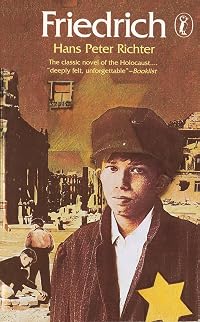
Friedrich
by Hans Peter Richter
On This Page
Description
A young German boy recounts the fate of his best friend, a Jew, during the Nazi regime.Tags
Recommendations














Member Reviews
The story of two young boys growing up as friends in Germany in the early 1930s. One of them is Jewish, and of course their lives take very different paths.
*sigh* I think my mental and emotional tolerance for Holocaust literature is overtaxed. This was a compelling read, but so stark and bleak. And of course in some ways that's only right, but that's *all* this book offered. No hint that there were people trying to help others escape, no commentary on the bleakness at all. I think that if this were a novel written for adults, I'd not have an issue with it, but as a middle school book it just seems too grim and with no payoff for it.
*sigh* I think my mental and emotional tolerance for Holocaust literature is overtaxed. This was a compelling read, but so stark and bleak. And of course in some ways that's only right, but that's *all* this book offered. No hint that there were people trying to help others escape, no commentary on the bleakness at all. I think that if this were a novel written for adults, I'd not have an issue with it, but as a middle school book it just seems too grim and with no payoff for it.
The nameless narrator recounts a series of memories that illuminate Friedrich's story as a Jew in German society during the thirties and early forties. There is no concentration camp or ghetto in this narrative, but rather the gradual discrimination that the family endures, never believing that there is a real threat; never in this century could people revert to the savagery of the middle ages.
The narrator explains what he did, what he thought, how the friendship grew & changed, but never seemed to feel guilty or really torn for not doing much to make a difference. There were no lessons learned,no predictable character growth which sets this apart from much young adult fiction out there. I liked the fact that the protagonist and his show more family had no names, as they didn't do anything truly honorable, and it's the Schneiders who will be remembered. One would expect the story to be narrated from Friedrich's point of view, but Richter's choice of making his friend tell the story is much more poignant, lending insight into how such events were even possible.
There were no scenes to make your stomach turn, fortunately, but enough information to ignite fury. Ultimately, this novel shows the persecution of the jews from a gentile perspective, of a gentile who disagrees with what's happening but doesn't have the motivation to object or pass up the benefits of joining along (the more common story). Nothing extraordinary to aspire to here--more humdrum real life and boy does it suck sometimes. show less
The narrator explains what he did, what he thought, how the friendship grew & changed, but never seemed to feel guilty or really torn for not doing much to make a difference. There were no lessons learned,no predictable character growth which sets this apart from much young adult fiction out there. I liked the fact that the protagonist and his show more family had no names, as they didn't do anything truly honorable, and it's the Schneiders who will be remembered. One would expect the story to be narrated from Friedrich's point of view, but Richter's choice of making his friend tell the story is much more poignant, lending insight into how such events were even possible.
There were no scenes to make your stomach turn, fortunately, but enough information to ignite fury. Ultimately, this novel shows the persecution of the jews from a gentile perspective, of a gentile who disagrees with what's happening but doesn't have the motivation to object or pass up the benefits of joining along (the more common story). Nothing extraordinary to aspire to here--more humdrum real life and boy does it suck sometimes. show less
You may be inclined to ask what more can be said about the horrors of the holocaust. If so, then read this book.
While somewhat slow in pace, hanging in there will bring reward. In fact, the pace appears deliberate and analogous to the creeping dangers of the Nazi party, that when in full horrific elevation many looked back and realized the day to day progress as one denial after another slowly happened to Jews.
This story is told by Hans whose family is struggling. Out of work in a post WWII German economy, Hans' father worries about how to feed his wife and son. Above them lives his friend Friedrich who is Jewish His father is a government worker with a stable job. Generous with his resources, Friedrich's family graciously assists where show more and whenever they can.
As the Nazi party takes hold, Han discovers that his father has a very lucrative job. Joining the Jungvolk, Hans is enamored with a sense of purpose and belonging. When Friedrich is denied education, his father losses his job and the Nazi's destroy their apartment, killing Friedrich's mother, Han and his family must make a moral decision to help.
They do so reluctantly but not at the level that would place their status in a precarious manner.
Not wanting to spoil the ending, I'll simply say I encourage you to find a copy and read it. show less
While somewhat slow in pace, hanging in there will bring reward. In fact, the pace appears deliberate and analogous to the creeping dangers of the Nazi party, that when in full horrific elevation many looked back and realized the day to day progress as one denial after another slowly happened to Jews.
This story is told by Hans whose family is struggling. Out of work in a post WWII German economy, Hans' father worries about how to feed his wife and son. Above them lives his friend Friedrich who is Jewish His father is a government worker with a stable job. Generous with his resources, Friedrich's family graciously assists where show more and whenever they can.
As the Nazi party takes hold, Han discovers that his father has a very lucrative job. Joining the Jungvolk, Hans is enamored with a sense of purpose and belonging. When Friedrich is denied education, his father losses his job and the Nazi's destroy their apartment, killing Friedrich's mother, Han and his family must make a moral decision to help.
They do so reluctantly but not at the level that would place their status in a precarious manner.
Not wanting to spoil the ending, I'll simply say I encourage you to find a copy and read it. show less
Read during Summer 2002
A very powerful story of pre and WWII Germany. It starts as a series of vignettes of two families; One Christian and one Jewish, who live in the same apartment house. The two boys are the same age and they and their families become friends but the prejudice that would fuel the Nazi party and the Holocaust is already starting. I find often that the children's books about the Holocaust are often more compelling since they can be so straight forward. Horrible in a way that teaches but does not lecture and is not sensational.
A very powerful story of pre and WWII Germany. It starts as a series of vignettes of two families; One Christian and one Jewish, who live in the same apartment house. The two boys are the same age and they and their families become friends but the prejudice that would fuel the Nazi party and the Holocaust is already starting. I find often that the children's books about the Holocaust are often more compelling since they can be so straight forward. Horrible in a way that teaches but does not lecture and is not sensational.
Hans Peter Richter tells us a story about two boys. They are the same age and live in the same block of flats, so they know each other well. Friedrich is Jewish. This book traces the fortunes of the two families and is told by an unnamed narrator. The narrator's unemployed German father joins the Nazi party and shares in Hitler's success. He finds work and can afford a holiday. Gradually the Jewish family have everything taken away from them. Friedrich's father is forced to retire from his job in the civil service. Friedrich has to leave the German school and attend a special Jewish school. The movements of Jews are restricted by curfews, they must carry Jewish identity cards, they may not go to the cinema and they must wear yellow show more stars on their clothes. There is a gradual decay into lawlessness. Friedrich's friend is in a difficult position. He is a member of the Jungvolk (the Hitler Youth Movement) and even finds himself swept along in the mob violence. But he still considers himself to be Friedrich's friend. When seventeen year old Friedrich is finally left alone, what can his friend do to help him and what will his friend do? show less
Hans and his best friend Friedrich have grown up together in the same building in Germany. However, Friedrich's family is Jewish. As Hitler comes to power, Friedrich's dad is forced to quit his job and Friedrich is kicked out of school. things change for Friedrich and his family. Friedrich's father is forced to quit is job, because Hitler does not allow Jews to own a business. While Hans joins the Hitler youth, he is forced to keep his friendship with Friedrich a secret. When Friedrich's mom is killed by the Nazi's and his father is sent to a concentration camp, Hans and his family try and help Friedrich. Although the book is slow in places, it is worth a read.
This book is wonderfully organized. It is organized into 2 or 3 page sections and each is labeled with a date. It starts in 1925, well before Hitler, then builds to 1942. There is also a chronology at the end showing what was happening on the national German political scene and to the Jews in particular. This is an excellent book for anyone, not just young adults to get a sense of what happened in a brief decade and a half to change all of these lives.
Members
- Recently Added By
Lists

1001 Children's Books You Must Read Before You Grow Up
774 works; 100 members

A Child's Book Tour of Germany
76 works; 5 members

Children's Literature, Briefly Historical Fiction Reading List
44 works; 4 members
Talk Discussions
Past Discussions
Young Adult Historical Fiction - Boy Killed When Not Allowed In Bomb Shelter in Name that Book (January 2019)
Author Information

6+ Works 1,312 Members
Awards and Honors
Series
Belongs to Publisher Series
Common Knowledge
- Canonical title
- Friedrich
- Original title
- Damals war es Friedrich
- Original publication date
- 1961
- People/Characters
- Narrator; Narrator's mother; Narrator's father; Friedrich Schneider; Herr Schneider; Frau Schneider (show all 7); Herr Johann Resch
- Important places
- Germany
- First words
- Someone had called him Polycarp, and he kept this name all the time he ruled over our front garden.
- Original language
- German
- Canonical DDC/MDS
- 833.914
Classifications
Statistics
- Members
- 1,163
- Popularity
- 21,547
- Reviews
- 16
- Rating
- (3.58)
- Languages
- 10 — Catalan, Danish, Dutch, English, French, German, Italian, Japanese, Korean, Spanish
- Media
- Paper, Audiobook, Ebook
- ISBNs
- 44
- ASINs
- 13