On This Page
Description
A hound rescues a schoolgirl from the Seine, becomes a beloved school pet, is chased away by the trustees, and returns with a surprise.Tags
Recommendations












Member Reviews
The story opens with the same narration as the original picture book, up to the point where Madeline scares Miss Clavel by balancing on the edge of the bridge. Only in this book, Madeline doesn't just scare Miss Clavel; she falls off the bridge into the water. And that would have been the end for small Madeline, but that a dog jumped in the water and saved her from her watery doom. The girls adopt their canine hero, and Madeline is quickly recuperated. They name the dog Genevieve (a female dog for the female students). Aside from the fight that breaks out every night as the girls struggle to choose who gets to sleep with the dog, life is better than ever in the boarding school.
Until the day the school trustees pay a visit. They notice show more every detail, especially the dog's tail sticking out from under the bed. The snooty board members force Genevieve to leave, despite Madeline's strong protests. Miss Clavel does not argue; instead, she wisely waits until the unwanted visitors leave, and then shepherds the girls outside so they can search for their dear dog. They range across Paris, searching every spot a dog might choose, but Genevieve is nowhere to be found. In the middle of the night (of course), Miss Clavel senses something is not right, and heads outside to find Genevieve howling under a street light. Even better, she soon has puppies, just enough for each girl to have a dog of her own, and end the fighting between them.
I enjoyed this story better than the first Madeline book. I liked the way the author played with the earlier established narrative formula, and then changed it for dramatic effect. For example, Madeline falling off the bridge, and Miss Clavel waking up in the night three times towards the end of the book. The story has a handful of truly hilarious moments, such as the girls breaking out into fights over the dog as soon as the lights are out (examine the illustrations closely as those girls are seriously throwing down and it makes me laugh), or Madeline standing on a chair and declaring that Genevieve will have her vengeance! In addition to these funny touches, the narrative is more compelling, and the illustrations remain charming and full of vivid scenes from France. The series feels like it established itself in the original book, and in this book has successfully built upon the foundation with a more interesting and entertaining story. show less
Until the day the school trustees pay a visit. They notice show more every detail, especially the dog's tail sticking out from under the bed. The snooty board members force Genevieve to leave, despite Madeline's strong protests. Miss Clavel does not argue; instead, she wisely waits until the unwanted visitors leave, and then shepherds the girls outside so they can search for their dear dog. They range across Paris, searching every spot a dog might choose, but Genevieve is nowhere to be found. In the middle of the night (of course), Miss Clavel senses something is not right, and heads outside to find Genevieve howling under a street light. Even better, she soon has puppies, just enough for each girl to have a dog of her own, and end the fighting between them.
I enjoyed this story better than the first Madeline book. I liked the way the author played with the earlier established narrative formula, and then changed it for dramatic effect. For example, Madeline falling off the bridge, and Miss Clavel waking up in the night three times towards the end of the book. The story has a handful of truly hilarious moments, such as the girls breaking out into fights over the dog as soon as the lights are out (examine the illustrations closely as those girls are seriously throwing down and it makes me laugh), or Madeline standing on a chair and declaring that Genevieve will have her vengeance! In addition to these funny touches, the narrative is more compelling, and the illustrations remain charming and full of vivid scenes from France. The series feels like it established itself in the original book, and in this book has successfully built upon the foundation with a more interesting and entertaining story. show less
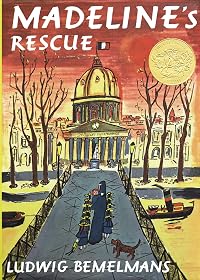
Parisian schoolgirl Madeline returns in this second picture-book devoted to her adventures, finding herself in need of rescue when her high-spirited antics land her in the Seine. When an obliging canine comes to her aid, fishing her out of the water, Madeline and her classmates (as well as their teacher, Miss Clavel) adopt the dog and name her Genevieve. All goes well with the new school resident, until the annual visit from the board of trustees, who insist that Genevieve must go. Can the girls and Miss Clavel find their beloved dog again, once she is ignominiously ejected from the school premises? And if they do, with whom will she sleep...?
Both of these questions are happily resolved in Madeline's Rescue, which was originally show more published in 1953, and chosen as the Caldecott Medal-winner in 1954. This status as a Caldecott title - the first book, Madeline, won a Caldecott Honor in 1940 - led me to pay particular attention to the artwork, during my recent read. Although interesting enough, I am not sure the illustrations really spoke to me, although I did think that the few full-color spreads were far more appealing than the plainer, white and yellow ones. The story itself is more engaging - I loved Genevieve's surprise at the end! - although the rhyming text is rather awkward in places. With lines like: "From now on, I hope you will listen to me, / And here is a cup of camomile tea," or "The dog loved biscuits, milk and beef / And they named it Genevieve," it just didn't read that well. This was a low three stars from me, leaving me to ponder my lukewarm response, in light of the book and its heroine's place as a perennial childhood favorite. Perhaps I would have loved Madeline, rather than just liking her, if I'd first met her as a girl myself...? show less
Both of these questions are happily resolved in Madeline's Rescue, which was originally show more published in 1953, and chosen as the Caldecott Medal-winner in 1954. This status as a Caldecott title - the first book, Madeline, won a Caldecott Honor in 1940 - led me to pay particular attention to the artwork, during my recent read. Although interesting enough, I am not sure the illustrations really spoke to me, although I did think that the few full-color spreads were far more appealing than the plainer, white and yellow ones. The story itself is more engaging - I loved Genevieve's surprise at the end! - although the rhyming text is rather awkward in places. With lines like: "From now on, I hope you will listen to me, / And here is a cup of camomile tea," or "The dog loved biscuits, milk and beef / And they named it Genevieve," it just didn't read that well. This was a low three stars from me, leaving me to ponder my lukewarm response, in light of the book and its heroine's place as a perennial childhood favorite. Perhaps I would have loved Madeline, rather than just liking her, if I'd first met her as a girl myself...? show less
Another charming story in the Madeline series, a brave dog named Genevieve rescues Madeline from falling into a river. Though Genevieve is sent away during an inspection, she comes back with a surprise that unites the orphans "with enough hound to go all around."
While the rhyming and meter of this story may not suit well for a poetry introduction, there is great potential to use this book for an inferencing lesson. For example, the book describes that Genevieve rescues Madeline from "a watery grave", which can be brought back to inferencing a drowning. Or, one could even ask students what "..enough hound to go all around" implies since the text doesn't directly say that Genevieve had puppies.
While the rhyming and meter of this story may not suit well for a poetry introduction, there is great potential to use this book for an inferencing lesson. For example, the book describes that Genevieve rescues Madeline from "a watery grave", which can be brought back to inferencing a drowning. Or, one could even ask students what "..enough hound to go all around" implies since the text doesn't directly say that Genevieve had puppies.
The is the first book I've read in the series regarding Madeline. I'll be sure to read more. In this rhyming book, Madelne's adventure includes the story of 12 little girls walking the two straight lines, leaving the house at half past nine.
Madeline, living in Paris, France is the smallest, fell from the wall and was rescued by a dog. The dog became part of the every day life of the group of the girls and their Mistress who took care of them. When a huge snow storm occurred, Lord Cucuface that the dog was a perfect disgrace and ushered him out the door into the snow.
The hunt for the dog was fruitless, and at night finally he was found. The 12 girls continued to argue regarding who would have the dog sleep with them. If they did not stop show more fighting the dog would need to leave. As the Mistress who previously made the dog stay outside discovered, there was a litter of puppies awaiting their dog.
All were more than happy as each little girl had her own dog to walk and pet all day and night long.
I liked the snappy poetic rhyming of the story! show less
Madeline, living in Paris, France is the smallest, fell from the wall and was rescued by a dog. The dog became part of the every day life of the group of the girls and their Mistress who took care of them. When a huge snow storm occurred, Lord Cucuface that the dog was a perfect disgrace and ushered him out the door into the snow.
The hunt for the dog was fruitless, and at night finally he was found. The 12 girls continued to argue regarding who would have the dog sleep with them. If they did not stop show more fighting the dog would need to leave. As the Mistress who previously made the dog stay outside discovered, there was a litter of puppies awaiting their dog.
All were more than happy as each little girl had her own dog to walk and pet all day and night long.
I liked the snappy poetic rhyming of the story! show less
In Paris, France, there lived twelve little girls. The smallest little girl was Madeline and she was not afraid of anything. One day, while walking on a bridge, Madeline slipped and fell off the bridge which gave Miss Clavel a fright. Coming to her rescue was a dog who would then go back to the school where Madeline, Miss Clavel, and the other girls lived. Each night, after Miss Clavel would turn out the light, the girls would fight about where the dog would sleep. The dog loved biscuits, milk, and beef, signing while Madeline played the piano, and her daily walk with the girls. They eventually named her Genevieve. Six months passed by and the time had come for the annual inspection, only problem was that dogs were not allowed in show more school. Genevieve was caught by the president of the board of trustees and thrown out. All the girls were sad and decided they would go looking for her, but, no matter how hard they looked, they could not find Genevieve. One night, Miss Clavel turned on a light and saw Genevieve outside. The girls were very happy and back to their old ways about fighting to see who she would sleep with. A couple days passed and Miss Clavel turned on her lights again, this time she found that Genevieve had puppies. There were enough puppies for all the girls at school to have one.
This book is great for rhyming and helps the story flow easier. Being a Caldecott medal winner, the illustrations are all hand drawn and quite fantastic. Colors in the book help set the mood. For example, when reading about the town, there are always many colors. The colors help show how vibrant Paris is. However, when things happen to Madeline, such as her falling off of the bridge, or whenever Miss Genevieve is mentioned, there is only yellow and black illustrations. The yellow and black illustrations showe the girls' time with Genevieve and all the things they did with her. A great book for the classroom. show less
This book is great for rhyming and helps the story flow easier. Being a Caldecott medal winner, the illustrations are all hand drawn and quite fantastic. Colors in the book help set the mood. For example, when reading about the town, there are always many colors. The colors help show how vibrant Paris is. However, when things happen to Madeline, such as her falling off of the bridge, or whenever Miss Genevieve is mentioned, there is only yellow and black illustrations. The yellow and black illustrations showe the girls' time with Genevieve and all the things they did with her. A great book for the classroom. show less
Summary:
The plot of the story begins when Madeline, one of twelve school girls falls into the seine and is rescued by a stray dog. After being rescued by the stray dog the girls decide to take the stray dog in and care for him. While bringing joy to all of the young girl having this dog also brings many conflicts and problems such as not wanting to share. The problem is resolved when the dog, Genevieve, has puppies and each little girl is able to have her own. Hence ending the story on a happy note.
Personal Reaction:
I personally really love this book for the purpose that it was quite a big chunk of my childhood. Overall the story has a good plot that contains conflicts which the intended reader can relate to. A good example of this show more could be when none of the girls want to share the dog. Another great quality of the book is that it rhymes helping the story to flow from page to page. It also creates a rhythm when reading that is easier to entertain the audience with.
Classroom Extension Ideas:
1. Have children explain or write about a time when they had to share.
2. Children could bring a picture of their animals for show and tell.
3. The children could draw their own versions on what Madeline looks like and tell their own version of the story. show less
The plot of the story begins when Madeline, one of twelve school girls falls into the seine and is rescued by a stray dog. After being rescued by the stray dog the girls decide to take the stray dog in and care for him. While bringing joy to all of the young girl having this dog also brings many conflicts and problems such as not wanting to share. The problem is resolved when the dog, Genevieve, has puppies and each little girl is able to have her own. Hence ending the story on a happy note.
Personal Reaction:
I personally really love this book for the purpose that it was quite a big chunk of my childhood. Overall the story has a good plot that contains conflicts which the intended reader can relate to. A good example of this show more could be when none of the girls want to share the dog. Another great quality of the book is that it rhymes helping the story to flow from page to page. It also creates a rhythm when reading that is easier to entertain the audience with.
Classroom Extension Ideas:
1. Have children explain or write about a time when they had to share.
2. Children could bring a picture of their animals for show and tell.
3. The children could draw their own versions on what Madeline looks like and tell their own version of the story. show less
Fun book. Simple and elegant. Nice illustrations. I feel like I could read this book multiple times. Love the rhymes and makes me want to do the same. Now I just need grandchildren to read it to.
For us adults: What about the trustees, what happens when they come back? A dog rescued her, but although a Newfoundland would do that, and I miss my Newfies of old :-(, would an average dog save someone in the water? Well, it maybe looks like a yellow lab-ish, do labs save people in the water like Newfoundland dogs? Also, puppies are nice, but no mention of the cleaning needed for all the puppies:
And there on the stoop
Was a whole lot of puppy ...
(Stoop: is a small staircase ending in a platform and leading to the entrance of an apartment show more building or other building.) show less
For us adults: What about the trustees, what happens when they come back? A dog rescued her, but although a Newfoundland would do that, and I miss my Newfies of old :-(, would an average dog save someone in the water? Well, it maybe looks like a yellow lab-ish, do labs save people in the water like Newfoundland dogs? Also, puppies are nice, but no mention of the cleaning needed for all the puppies:
And there on the stoop
Was a whole lot of puppy ...
(Stoop: is a small staircase ending in a platform and leading to the entrance of an apartment show more building or other building.) show less
Members
- Recently Added By
Lists

Favorite Childhood Books
1,646 works; 518 members

Caldecott Medal Books
91 works; 15 members

Best children's picture books
377 works; 85 members
Honey For a Child's Heart
1,152 works; 25 members

Books About Girls
219 works; 17 members

Romalda Spalding's Writing Road To Reading
213 works; 3 members

French Books
102 works; 15 members

Dogs -- children's/young adult fiction
1,317 works; 9 members

1950s
340 works; 22 members

Early Picture Books
467 works; 9 members

Written and Illustrated By
805 works; 1 member
Author Information

96+ Works 30,975 Members
Ludwig Bemelmans, April 27, 1898 - October 1, 1962 Ludwig Bemelmans was born on April 27, 1898 in Meran, then Austria. At the age of eight, his parents divorced and he moved with his mother to Regensburg, Germany. He was enrolled into various public and private schools and failed out of most of them. At the age of twelve, unsure of what else to do show more with him, Bemelmans was apprenticed to an uncle in the hotel business and proceeded to go through many jobs, being repeatedly dismissed. After supposedly shooting and almost killing a waiter, his family gave him the ultimatum of reform school or emigration to the United States. He arrived in America in 1914 with reference letters from his uncle to various hotel managers in New York. Bemelmans obtained a job as a waiter in the Ritz-Carlton, but left that job to join the Army in 1917. In the Army, he worked with German speaking recruits and as a military hospital guard. In 1918, Bemelmans became a naturalized citizen, returning to hotel and restaurant work a year later, eventually opening his own restaurant. In the 1934, at the suggestion of one of his friends, Bemelmans began to write, producing his first children's book, "Hansi." He was best known though, for his series of books about the little french girl, "Madeline," which is still a childhood favorite. "Madeline's Rescue," the second book in the series, won the Caldecott Medal in 1953. His first book for adults was entitled, "My War with the United States" and was a diary of his experiences in the service during World War I. In fact, Bemelmans usually wrote his books based on his life experiences, such as "Life Class" and "Hotel Splendide," about his life as a restaurateur, his travels to Ecuador and Italy appeared in "The Donkey Inside" and "Italian Holiday," and his brief stint as a screenwriter in Hollywood was the basis for "Dirty Eddie." Bemelmans wrote about a book or two a year and was a contributor to Town and Country and Horizon, as well as a cover illustrator for The New Yorker. In his later years, Bemelmans enjoyed some small fame from painting, with some of his work appearing in various galleries. Ludwig Bemelmans died of pancreatic cancer in New York on October 1, 1962. (Bowker Author Biography) show less
Awards and Honors
Series

Work Relationships
Common Knowledge
- Canonical title
- Madeline's Rescue
- Original title
- Madeline's Rescue
- Original publication date
- 1953
- People/Characters
- Madeline Fogg; Miss Clavel; Genevieve [Madeline] (dog)
- Important places
- Paris, France; France
- First words
- In an old house in Paris that was covered with vines
Lived twelve little girls in two straight lines. - Last words
- (Click to show. Warning: May contain spoilers.)And to her surprise she found. That suddenly there was enough hound. To go all around.
- Original language
- English
- Canonical DDC/MDS
- 813.54; FIC BEM
Classifications
Statistics
- Members
- 5,080
- Popularity
- 2,726
- Reviews
- 92
- Rating
- (4.04)
- Languages
- English, French, German, Japanese
- Media
- Paper, Audiobook, Ebook
- ISBNs
- 60
- UPCs
- 2
- ASINs
- 37