
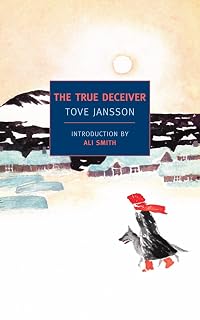
The True Deceiver
by Tove Jansson
On This Page
Description
Deception--the lies we tell ourselves and the lies we tell others--is the subject of this, Tove Jansson's most unnerving and unpredictable novel. Here Jansson takes a darker look at the subjects that animate the best of her work, from her sensitive tale of island life, The Summer Book, to her famous Moomin stories: solitude and community, art and life, love and hate.Snow has been falling on the village all winter long. It covers windows and piles up in front of doors. The sun rises late show more and sets early, and even during the day there is little to do but trade tales. This year everybody's talking about Katri Kling and Anna Aemelin. Katri is a yellow-eyed outcast who lives with her simpleminded brother and a dog she refuses to name. She has no use for the white lies that smooth social intercourse, and she can see straight to the core of any problem. Anna, an elderly children's book illustrator, appears to be Katri's opposite: a respected member of the village, if an aloof one. Anna lives in a large empty house, venturing out in the spring to paint exquisitely detailed forest scenes. But Anna has something Katri wants, and to get it Katri will take control of Anna's life and livelihood. By the time spring arrives, the two women are caught in a conflict of ideals that threatens to strip them of their most cherished illusions.
. show less
Tags
Recommendations





















Member Reviews
In the small northern village of Västerby (the original town with this name is in Sweden; where Jansson's village is is anyone's guess), the winter is keeping everyone inside. Except for Katri Kling and her dog.
This is how Jansson starts her novel. Without any references of time - if anything the novel makes sure not to mention any recent event - making the story timeless. We get the how and the where but the when never gets revealed. And it is not needed - because the story is as old as the world - the story of the battle between truth and lie; between reality and dreams.
Katri Kling had been living for years with her younger brother (now a teenager and "a bit slow") at the fringe of society in Västerby. She is different - her eye show more color does not match what everyone expects, her hair is the wrong color. In a small place like Västerby not being local is almost a crime. To add to that, she believes that any truth should be spelled out, that the little lies and niceties that the polite society demands are nonsense. But when some of her decisions and advices are revealed, Katri emerges as a calculating and scheming person - the truth can be bended and she is pretty good at it.
And as chance will have it, the village has one more loner - Anna Aemelin - an wealthy artist that lives alone and creates beautiful watercolors of the ground in the forest... with rabbits with flowery fur thrown everywhere. When the novel opens, Katri had decided that she wants to use Anna and is planning her way into the older woman home and heart.
When Anna's and Katri's worlds finally collide, it is obvious that nothing will be the same ever again. Katri's cunning and calculating ways have nothing to do with the artistic and dreamlike world Anna had been living in - and Katri will not allow her to keep living in it. And while the two worlds clash, the life in the village continues the same way it had always been going - and we are treated to glimpses and views from it, intermingled with the drama that happens in the lives of the protagonists.
It is a novel of change; a novel of growing up (mentally if not physically) - Anna looses all treats that make her who she is... and need to rediscover herself - except that the new Anna is not the innocent person she was before Katri injected herself in her life. Using the truth, Katri manages to deceive Anna in more than one ways, to use her naivete to gain what she needs. And in a way it is a novel of everything ugly that hides in people's hearts.
But it is also a novel of hope - because at the end, even if all old is ruined, the new is not necessarily bad. Maybe Anna will never be the same, maybe she will never have all that she had been used to. But Katri had changed as well - without realizing and without expecting it.
The last sentence of the novel is the ultimate summary of the whole novel - and it works much better than any epilogue could have worked. It is final and unyielding.
A highly recommended read - although it is not a cheerful and easy read.
PS: Do not read the introduction before you read the novel. I enjoyed it a lot but I am happy I read the novel first. show less
This is how Jansson starts her novel. Without any references of time - if anything the novel makes sure not to mention any recent event - making the story timeless. We get the how and the where but the when never gets revealed. And it is not needed - because the story is as old as the world - the story of the battle between truth and lie; between reality and dreams.
Katri Kling had been living for years with her younger brother (now a teenager and "a bit slow") at the fringe of society in Västerby. She is different - her eye show more color does not match what everyone expects, her hair is the wrong color. In a small place like Västerby not being local is almost a crime. To add to that, she believes that any truth should be spelled out, that the little lies and niceties that the polite society demands are nonsense. But when some of her decisions and advices are revealed, Katri emerges as a calculating and scheming person - the truth can be bended and she is pretty good at it.
And as chance will have it, the village has one more loner - Anna Aemelin - an wealthy artist that lives alone and creates beautiful watercolors of the ground in the forest... with rabbits with flowery fur thrown everywhere. When the novel opens, Katri had decided that she wants to use Anna and is planning her way into the older woman home and heart.
When Anna's and Katri's worlds finally collide, it is obvious that nothing will be the same ever again. Katri's cunning and calculating ways have nothing to do with the artistic and dreamlike world Anna had been living in - and Katri will not allow her to keep living in it. And while the two worlds clash, the life in the village continues the same way it had always been going - and we are treated to glimpses and views from it, intermingled with the drama that happens in the lives of the protagonists.
It is a novel of change; a novel of growing up (mentally if not physically) - Anna looses all treats that make her who she is... and need to rediscover herself - except that the new Anna is not the innocent person she was before Katri injected herself in her life. Using the truth, Katri manages to deceive Anna in more than one ways, to use her naivete to gain what she needs. And in a way it is a novel of everything ugly that hides in people's hearts.
But it is also a novel of hope - because at the end, even if all old is ruined, the new is not necessarily bad. Maybe Anna will never be the same, maybe she will never have all that she had been used to. But Katri had changed as well - without realizing and without expecting it.
The last sentence of the novel is the ultimate summary of the whole novel - and it works much better than any epilogue could have worked. It is final and unyielding.
A highly recommended read - although it is not a cheerful and easy read.
PS: Do not read the introduction before you read the novel. I enjoyed it a lot but I am happy I read the novel first. show less
How exciting to discover that one of my favorite children's book authors wrote more than the Moominland stories that I've loved for years! And even better to discover that her writing for adults is just as good as her children's tales.
This is a beautiful book. The story - a young woman, Katri Kling, insinuates herself into the life of well-known children's book illustrator Anna Aemelin in order to benefit the younger brother she is responsible for - is told in a deceptively simple manner. Jansson's writing is as clean and stark as the snowy landscape in which the story is set, and the story's pace is as quiet and unurgent as life in this little town seems to be. But this is a story about deception - the lies that Katri and Anna tell show more each other to get what they want, and the lies they tell themselves about who they are. The characters and the story may seem outwardly calm, but the machinations and struggles going on underneath the surface fill the book with tension and an almost sinister feeling of suspense.
This story and these characters will stay with me for a long time.
(This book was translated from Swedish to English by Thomas Teal. Not being able to read the book in the original, I don't know how much of his voice was added, but I'm sure he must deserve some credit for the beautiful cadence and language of this book.) show less
This is a beautiful book. The story - a young woman, Katri Kling, insinuates herself into the life of well-known children's book illustrator Anna Aemelin in order to benefit the younger brother she is responsible for - is told in a deceptively simple manner. Jansson's writing is as clean and stark as the snowy landscape in which the story is set, and the story's pace is as quiet and unurgent as life in this little town seems to be. But this is a story about deception - the lies that Katri and Anna tell show more each other to get what they want, and the lies they tell themselves about who they are. The characters and the story may seem outwardly calm, but the machinations and struggles going on underneath the surface fill the book with tension and an almost sinister feeling of suspense.
This story and these characters will stay with me for a long time.
(This book was translated from Swedish to English by Thomas Teal. Not being able to read the book in the original, I don't know how much of his voice was added, but I'm sure he must deserve some credit for the beautiful cadence and language of this book.) show less
 This review was written for LibraryThing Early Reviewers.
I love stories of hermits and outcasts. I think it dates back to my first exposure to Heidi and her hermit grandfather. From the minute Heidi appeared on his doorstep, I knew his hermit days were over, but I never tire of his journey. This weakness of mine made me particularly vulnerable to the charms of The True Deceiver by Tove Jansson. The Summer Book had well-prepared me for Jansson's lovely-in-their-oddness characters. Yet Katri's journey in The True Deceiver, still surprised me by the degree to which she was left broken by her decision to abandon her independence to help her brother Mats build the boat of his dreams. The brittle dance between Katri and her co-conspirator Anna (a children's book author and illustrator ) seems to show more have all the steps carefully choreographed, but just when you think Katri is doing all the leading in this Tango, Anna takes over the lead and turns the story in unusual ways. Additionally, having read as many Russian novels I have, I thought I was used to snowy tales, but The True Deceiver's remote wintry Swedish setting made me yearn for the snow in the same way I did when I read Smilla's Sense of Snow many years ago. Jansson is gifted at making both characters and setting crackle with life's hardness and fleeting moments of warmth. Don't less this book pass you by! show less
This review was written for LibraryThing Early Reviewers.This short novel is set in remote Northern Scandanavia during winter. Katri Kling is unpopular in the small village, largely because she is brutally honest and lacks tact. The village children taunt her as a witch. Her primary concern is caring for and protecting her brother Mats, who is intellectually challenged, although he is a master boat builder.
Katri insinuates herself into the life of Anna, a reclusive, well-to-do children's book author who lives in the village. As Anna comes to rely on Katri, Katri convinces her that she is being taken advantage of by the villagers and by her editors and publishers. As Anna begins to question her trust in the basic goodness of people, she also begins to fear that she will be unable to write the show more whimsical children's books she is noted for.
The intricate psychological study of these three characters forms the heart of this book, which is very dark, and beautifully written. The cold, bleak atmosphere, and the starkness of the winter village create a perfect backdrop for the interaction of the characters. show less
Katri insinuates herself into the life of Anna, a reclusive, well-to-do children's book author who lives in the village. As Anna comes to rely on Katri, Katri convinces her that she is being taken advantage of by the villagers and by her editors and publishers. As Anna begins to question her trust in the basic goodness of people, she also begins to fear that she will be unable to write the show more whimsical children's books she is noted for.
The intricate psychological study of these three characters forms the heart of this book, which is very dark, and beautifully written. The cold, bleak atmosphere, and the starkness of the winter village create a perfect backdrop for the interaction of the characters. show less
I absolutely loved this book.On the first reading I enjoyed it but didn't quite "get it`" but, like an elusive thought, it kept playing on my mind.
Katri and her dog were as one: alone, different, isolated in a hostile and uncomfortable world that they have difficulty fitting into. They learn to play a part that allows them to survive, straightjacketed perhaps from reality and from their true selves, their true natures. Katri has learned to "show her teeth" but doesn't appear to know how to smile. Is this deceit or survival? Her yellow "different" eyes widen when alarmed and for a moment we are allowed to glimpse her true identity, her inner soul.
As the book goes on I was both alarmed and appalled initially at her deception. But why, show more when so many of us are blinded to the truth, unable to even see it, let alone to confront it, to know what we truly want from life. And so we go on acting, playing a part that is expected of us, hiding behind superficial veneers, unable to confront and talk about the truth because it is too uncomfortable, too painful, too cruel?
Jansson gradually strips away the layers. Here is a book that appears, at first, to be simple but as soon as you dig below the surface and the snow starts to clear, the true nature and feelings of the main protaganists can be revealed. So the truth, the cruel and uncomfortable truth of their real identities (and so too ours) , their real ruthlessness and their real personalities are allowed to reveal themselves. The snow melts and everything is there to be discovered, but only if we are able to open our minds to reality and the freedom to see things as they really are, as they could be if we can only confront our inner selves.
Katri learns to play, to love, to hug, to feel and therefore becomes less different, less alone. She doesn't nee d the dog to protect her anymore but is able to connect with real people on a level previously denied to her. Yes, she has always loved Mats instinctively as a natural mother on an animal level of protecting, caring and nurturing but she has never really talked to him. Giving him the boat is a symbol of her true love; the boat will allow him to escape and sail away, to discover his true self as all our children should be allowed eventually to do.
Anna, on the otherhand, has always lived isolated and alone, apparently happy in her cocooned, idealistic and ridiculously unreal little world at the rabbit house. She has squirrelled herself away. Unable to even look at real meat (let alone eat it), she has been perhaps even more isolated and alone than Katri. Oh yes, people like her, because she has learned how to play her part well and with apparent success. Unlike Katri, material wealth has come easily to her and with a great deal of inherited luck. But how many of us can afford the luxury of such luck? She doesn't like real children. She has never had a real animal. She has always deceived herself that her parents were kind. It is only when her relationship with Mats and Katri allows her to confront the truth of her petty life, is she able to strip away the layers of deception and see the truth. With her piles of possessions lying on the ice, waiting to sink into the deep, she can be cleansed, released and liberated to develop. Katri has made her confront her true nature, her true self. She isn't really sweet or nice or even clever. She has just found a way of surviving her lonely existence through her talent for painting. By entering the real world, I believe she becomes a deeper, more real and fully rounded human being, able to connect to her inner and spiritual self.
Good Art should challenge us, should make us uncomfortable with ourselves so we can evolve, becoming better people in the process where we can truly connect with each other.
Words, art, symbols are essential to allow us to free ourselves from reality and connect to something higher and more meaningful outside and within our true selves. Only by confronting our past, can we release ourselves to explore the future. When Anna finally puts her only "friends" letters on the ice and revisits the reality of her past and her parents she is able to realise how very unimportant she was to them. Only then can she truly connect with Mats and Katri. In the end, they are alive, they are here now, they need love, material comfort and help, and by giving she receives true help, the comfort and the companionship that would have been denied her if Katri's circumstances hadn't forced her to connect with her.
We all need other people to survive. We all deceive because we have to in order to survive. And in the end that is what life is all about surviving and trying, on occasions, to take something a little higher, a little better and a lot more loving from the abyss.
The True Deceiver can be a life changing book if you can allow yourself to connect with it! show less
Katri and her dog were as one: alone, different, isolated in a hostile and uncomfortable world that they have difficulty fitting into. They learn to play a part that allows them to survive, straightjacketed perhaps from reality and from their true selves, their true natures. Katri has learned to "show her teeth" but doesn't appear to know how to smile. Is this deceit or survival? Her yellow "different" eyes widen when alarmed and for a moment we are allowed to glimpse her true identity, her inner soul.
As the book goes on I was both alarmed and appalled initially at her deception. But why, show more when so many of us are blinded to the truth, unable to even see it, let alone to confront it, to know what we truly want from life. And so we go on acting, playing a part that is expected of us, hiding behind superficial veneers, unable to confront and talk about the truth because it is too uncomfortable, too painful, too cruel?
Jansson gradually strips away the layers. Here is a book that appears, at first, to be simple but as soon as you dig below the surface and the snow starts to clear, the true nature and feelings of the main protaganists can be revealed. So the truth, the cruel and uncomfortable truth of their real identities (and so too ours) , their real ruthlessness and their real personalities are allowed to reveal themselves. The snow melts and everything is there to be discovered, but only if we are able to open our minds to reality and the freedom to see things as they really are, as they could be if we can only confront our inner selves.
Katri learns to play, to love, to hug, to feel and therefore becomes less different, less alone. She doesn't nee d the dog to protect her anymore but is able to connect with real people on a level previously denied to her. Yes, she has always loved Mats instinctively as a natural mother on an animal level of protecting, caring and nurturing but she has never really talked to him. Giving him the boat is a symbol of her true love; the boat will allow him to escape and sail away, to discover his true self as all our children should be allowed eventually to do.
Anna, on the otherhand, has always lived isolated and alone, apparently happy in her cocooned, idealistic and ridiculously unreal little world at the rabbit house. She has squirrelled herself away. Unable to even look at real meat (let alone eat it), she has been perhaps even more isolated and alone than Katri. Oh yes, people like her, because she has learned how to play her part well and with apparent success. Unlike Katri, material wealth has come easily to her and with a great deal of inherited luck. But how many of us can afford the luxury of such luck? She doesn't like real children. She has never had a real animal. She has always deceived herself that her parents were kind. It is only when her relationship with Mats and Katri allows her to confront the truth of her petty life, is she able to strip away the layers of deception and see the truth. With her piles of possessions lying on the ice, waiting to sink into the deep, she can be cleansed, released and liberated to develop. Katri has made her confront her true nature, her true self. She isn't really sweet or nice or even clever. She has just found a way of surviving her lonely existence through her talent for painting. By entering the real world, I believe she becomes a deeper, more real and fully rounded human being, able to connect to her inner and spiritual self.
Good Art should challenge us, should make us uncomfortable with ourselves so we can evolve, becoming better people in the process where we can truly connect with each other.
Words, art, symbols are essential to allow us to free ourselves from reality and connect to something higher and more meaningful outside and within our true selves. Only by confronting our past, can we release ourselves to explore the future. When Anna finally puts her only "friends" letters on the ice and revisits the reality of her past and her parents she is able to realise how very unimportant she was to them. Only then can she truly connect with Mats and Katri. In the end, they are alive, they are here now, they need love, material comfort and help, and by giving she receives true help, the comfort and the companionship that would have been denied her if Katri's circumstances hadn't forced her to connect with her.
We all need other people to survive. We all deceive because we have to in order to survive. And in the end that is what life is all about surviving and trying, on occasions, to take something a little higher, a little better and a lot more loving from the abyss.
The True Deceiver can be a life changing book if you can allow yourself to connect with it! show less
I am having a lot of feels about approaching the end of Tove Jansson's works that have been translated into English that I have not read yet.
I love her so much.
Her writing is so matter of fact that the premise of this book comes off as almost reasonable, even as what happens in this book borders on the unhinged. Over the course of a winter in a small Scandinavian village, the lives of two very different women collide. Katri, a young adult living with her teenage brother, does not fit into the village. Anna, an older artist who illustrates children's books, is a bit of a local institution, even as she stays mostly in her house juat outside the village, and barely interacts with anyone but the man who delivers the mail and the groceries, show more and the woman who comes to clean once a week. Anna is sentimental, whereas Katri does not believe in dissembling or social niceties.
Like most of Jansson's work, this deals in the life of the artist, in where creativity comes from and the demands placed upon it. It is also very much about how to live in community, both the rewards and trials of relationship, and what we owe one another. This work in particular is about deception, especially self-deception, what it means to see and think clearly.
And as always in Jansson's works, nature and the weather set the tone. The snowdrifts that are cleared and then re-form by the next day. The ice, and the first signs of its retreat. The changing amounts of light.
I found my sympathies constantly shifting between Katri and Anna in this book. But of course, they aren't exactly in opposition, and neither is truly a villain. Katri's actions are certainly sometimes shocking, and it is also sometimes difficult to answer whether Anna losing some of her illusions is good for her or not.
I wish I could visit them again, five years down the road from the end of this book. show less
I love her so much.
Her writing is so matter of fact that the premise of this book comes off as almost reasonable, even as what happens in this book borders on the unhinged. Over the course of a winter in a small Scandinavian village, the lives of two very different women collide. Katri, a young adult living with her teenage brother, does not fit into the village. Anna, an older artist who illustrates children's books, is a bit of a local institution, even as she stays mostly in her house juat outside the village, and barely interacts with anyone but the man who delivers the mail and the groceries, show more and the woman who comes to clean once a week. Anna is sentimental, whereas Katri does not believe in dissembling or social niceties.
Like most of Jansson's work, this deals in the life of the artist, in where creativity comes from and the demands placed upon it. It is also very much about how to live in community, both the rewards and trials of relationship, and what we owe one another. This work in particular is about deception, especially self-deception, what it means to see and think clearly.
And as always in Jansson's works, nature and the weather set the tone. The snowdrifts that are cleared and then re-form by the next day. The ice, and the first signs of its retreat. The changing amounts of light.
I found my sympathies constantly shifting between Katri and Anna in this book. But of course, they aren't exactly in opposition, and neither is truly a villain. Katri's actions are certainly sometimes shocking, and it is also sometimes difficult to answer whether Anna losing some of her illusions is good for her or not.
I wish I could visit them again, five years down the road from the end of this book. show less
In The True Deceiver, Tove Jansson depicts the world views of realism/cold truth and blissful ignorance/naiveté attempting to coexist, with the results you might expect. Katri Kling represents realism and truth, her head for numbers means she's never cheated, and she knows how to deal with those who try. She takes advantage where she sees an opening (even using deception to do so, because truth isn't the same as honesty) and is good at getting what she wants, but her tendency to tell it exactly how it is wins her few friends and makes her more than a few enemies. Anna Aemelin represents blissful ignorance, her career as the illustrator of children's books allowing her to live an unexamined life of comfort, even while being taken show more advantage of her softness and lack of concern in ways she doesn't grasp. When Katri identifies Anna as a path to comfort for her and, more importantly, her brother Mats, the conflict is inevitable.
With their very first interaction Katri's unwillingness to conform to polite social convention begins to open Anna's eyes to the world, making her realize that she no longer likes coffee and perhaps never did. As their lives get more entwined Anna's ignorance is stripped away layer by layer, as Katri reveals to her that the many people in her life have been cheating her through small things that have escaped her notice and that the story of her past that she's built up in her head doesn't necessarily match reality. Along with Anna's ignorance, however, her bliss is also stripped away: old friends are recategorized as meaningless, pettiness and distrust rise to the surface, and even her art suffers. Katri, for her part, doesn't escape from the confrontation between the two world views unscathed, her dog that was once obedient only to her devolves into a wild animal when torn between the structured old life and this new mix of order and emotional chaos. Firm control or constantly ignoring it might keep the beast in check, but half measures drive him wild. The truth has many benefits, but it is not without its costs. Likewise, naiveté is not without its virtues.
I'm not sure exactly where Mats fits into this dichotomy- I believe he represents innocence and true goodness, as even in the one instance where he loses his temper he takes only the most harmless revenge in the heat of the moment, and bears no grudges. Both Katri and Anna try to help Mats as much as they can, albeit in different ways. Katri tries to protect him, better him, and give him what he wants no matter the cost to herself. Anna likewise wants Mats to be happy, and gives him gifts both large and small, from letting him choose books first to trying to give him his greatest dream almost on a whim. Nevertheless, Mats doesn't seem to have a perspective of his own to contrast with the other two on display, he mostly seems to content to sit and observe.
Overall the dynamic depicted in this book is an interesting one, bolstered by solid writing even in translation. Some of the symbols are excellent and striking as well- after they move into Anna's house, Mats puts much of Anna's old and forgotten furniture and other junk onto the ice, to sit there and wait for the spring thaw to melt the ice and send it sinking into the lake or floating off into parts unknown. The village setting is also well fleshed out for a book of this length- it doesn't feel quite complete, but almost there. Also, despite how much time I've dedicated to writing about what the characters in The True Deceiver represent, that symbolism doesn't subsume who they are. Unlike The Pilgrim's Progress, these are characters in addition to symbols, as Jansson gives us scenes like Katri describing how individualists need to hide in a pack even more than the others so that people do not realize that they are different. This anecdote comes from the character of Katri, not just the abstract idea of truthfulness, and the book is stronger because it melds characters and their philosophies in ways that complement each.
Why, then, the 3 star rating? Despite the fact that I found the central conflict of this story interesting, there ultimately wasn't anything interesting that this book had to say about this conflict. Because of their interactions Anna is left more cynical and lonely than she was before Katri came into her life, and Katri attempts to undue the changes she has wrought as best she can, even if that means putting kindness before the truth. The ending makes it seem as though she will be successful, at least when it comes to this specific attempt, but it leaves up in the air what Katri is going to do next. So what is the lesson here? That sometimes the truth should be softened, as its cold hard nature can sometimes do more harm than good? Or that deception, even self-deception, can be a beneficial thing in some instances? Sure, those things are true, but they aren't great insights. It may be because I'm not 100% sure how Mats plays into the message of the book (though I don't think so), but I didn't come out of The True Deceiver with any new insights into the nature of truthfulness or deception, or of human nature in general. Still, this is one of those 3 star books that are worth reading and which I'd have no problem recommending, and I'll be checking out Jansson's other longer work, The Summer Book, sometime in the not-too-distant future. show less
With their very first interaction Katri's unwillingness to conform to polite social convention begins to open Anna's eyes to the world, making her realize that she no longer likes coffee and perhaps never did. As their lives get more entwined Anna's ignorance is stripped away layer by layer, as Katri reveals to her that the many people in her life have been cheating her through small things that have escaped her notice and that the story of her past that she's built up in her head doesn't necessarily match reality. Along with Anna's ignorance, however, her bliss is also stripped away: old friends are recategorized as meaningless, pettiness and distrust rise to the surface, and even her art suffers. Katri, for her part, doesn't escape from the confrontation between the two world views unscathed, her dog that was once obedient only to her devolves into a wild animal when torn between the structured old life and this new mix of order and emotional chaos. Firm control or constantly ignoring it might keep the beast in check, but half measures drive him wild. The truth has many benefits, but it is not without its costs. Likewise, naiveté is not without its virtues.
I'm not sure exactly where Mats fits into this dichotomy- I believe he represents innocence and true goodness, as even in the one instance where he loses his temper he takes only the most harmless revenge in the heat of the moment, and bears no grudges. Both Katri and Anna try to help Mats as much as they can, albeit in different ways. Katri tries to protect him, better him, and give him what he wants no matter the cost to herself. Anna likewise wants Mats to be happy, and gives him gifts both large and small, from letting him choose books first to trying to give him his greatest dream almost on a whim. Nevertheless, Mats doesn't seem to have a perspective of his own to contrast with the other two on display, he mostly seems to content to sit and observe.
Overall the dynamic depicted in this book is an interesting one, bolstered by solid writing even in translation. Some of the symbols are excellent and striking as well- after they move into Anna's house, Mats puts much of Anna's old and forgotten furniture and other junk onto the ice, to sit there and wait for the spring thaw to melt the ice and send it sinking into the lake or floating off into parts unknown. The village setting is also well fleshed out for a book of this length- it doesn't feel quite complete, but almost there. Also, despite how much time I've dedicated to writing about what the characters in The True Deceiver represent, that symbolism doesn't subsume who they are. Unlike The Pilgrim's Progress, these are characters in addition to symbols, as Jansson gives us scenes like Katri describing how individualists need to hide in a pack even more than the others so that people do not realize that they are different. This anecdote comes from the character of Katri, not just the abstract idea of truthfulness, and the book is stronger because it melds characters and their philosophies in ways that complement each.
Why, then, the 3 star rating? Despite the fact that I found the central conflict of this story interesting, there ultimately wasn't anything interesting that this book had to say about this conflict. Because of their interactions Anna is left more cynical and lonely than she was before Katri came into her life, and Katri attempts to undue the changes she has wrought as best she can, even if that means putting kindness before the truth. The ending makes it seem as though she will be successful, at least when it comes to this specific attempt, but it leaves up in the air what Katri is going to do next. So what is the lesson here? That sometimes the truth should be softened, as its cold hard nature can sometimes do more harm than good? Or that deception, even self-deception, can be a beneficial thing in some instances? Sure, those things are true, but they aren't great insights. It may be because I'm not 100% sure how Mats plays into the message of the book (though I don't think so), but I didn't come out of The True Deceiver with any new insights into the nature of truthfulness or deception, or of human nature in general. Still, this is one of those 3 star books that are worth reading and which I'd have no problem recommending, and I'll be checking out Jansson's other longer work, The Summer Book, sometime in the not-too-distant future. show less
Members
- Recently Added By
Published Reviews
ThingScore 100
That there can still be as-yet untranslated fiction by Jansson is simultaneously an aberration and a delight, like finding buried treasure, especially when the translator is as well suited to her resonant, minimal style as Thomas Teal (who was also the original English translator of The Summer Book in the 1970s). The True Deceiver is another fortunate first, and it is an unassuming, show more unexpected, powerful piece of work. show less
added by fannyprice
Lists

Books Read in 2022
5,166 works; 114 members

Books Read in 2021
5,361 works; 113 members

Top Five Books of 2023
767 works; 317 members
Author Information

643+ Works 31,190 Members
Tove Jansson has received the Hans Christian Andersen prize for children's literature. The world of the Moomintroll has become internationally famous thanks to her brilliant sense of humor and fabulous illustrations. The delightful Moomintrolls make it through catastrophe after catastrophe through cooperation and plain luck. Although Jansson is show more best known for her children's books, her adult fiction is equally entertaining. (Bowker Author Biography) show less
Some Editions
Awards and Honors
Awards
Distinctions
Notable Lists
Series
Belongs to Publisher Series
Work Relationships
Is contained in
Common Knowledge
- Canonical title
- The True Deceiver
- Original title
- Den ärliga bedragaren
- Original publication date
- 1982
- People/Characters
- Anna Aemelin; Katri Kling; Mats Kling; Edvard Liljeberg; Fru Sundblom; Madame Nygård
- Important places
- Västerby, Finland
- Dedication
- For Maya
- First words
- It was an ordinary dark winter morning, and snow was still falling.
- Last words
- (Click to show. Warning: May contain spoilers.)Det hade varit otänkbart att störa marken med blommiga kaniner.
- Original language
- Swedish
Classifications
- Genres
- Fiction and Literature, General Fiction
- DDC/MDS
- 839.7374 — Literature & rhetoric German & related literatures Other Germanic literatures Swedish literature Swedish fiction 1900-1999 1945-1999
- LCC
- PT9875 .J37 .A7513 — Language and Literature German, Dutch and Scandinavian literatures Swedish literature Individual authors or works 1900-1960
- BISAC
Statistics
- Members
- 1,159
- Popularity
- 21,594
- Reviews
- 48
- Rating
- (3.94)
- Languages
- 10 — English, Estonian, Finnish, French, German, Italian, Japanese, Norwegian (Bokmål), Polish, Swedish
- Media
- Paper, Ebook
- ISBNs
- 28
- ASINs
- 9
