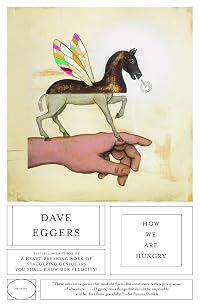
How We Are Hungry
by Dave Eggers
On This Page
Description
A debut collection of short stories presents a compelling cast of characters who struggle with inconvenient revelations, from the deserts of Egypt to the side of Interstate 5.Tags
Recommendations






















Member Reviews
I love Dave Eggers' style. I didn't love every piece in this collection, but I am so drawn to his ability to refresh the short story form. I think part of the reason that I love people who play with form and style is that I would love to do more of that in my own writing. I'd love to be more willing, as Eggers is, to abandon expectations. I'm also wildly jealous of his gift with titles - my two favorite stories in this book are called "The Only Meaning of the Oil-Wet Water" (I love compound adjectives!) and "After I Was Thrown in the River and Before I Drowned." The latter is an utter gem that is narrated by a dog. Beautiful.
The first story in this collection, about a grieving man on the move in the Middle East, was perfect. The writing was so tight, the action so constant, the meaning so heavy, I was hooked. And the rest of the book never lived up to the great expectations that were immediately set. The rest of the stories were too saturated in middle-class angst, with unlikeable characters doing unlikeable things.
Dave Eggers es uno de los mejores escritores jóvenes norteamericanos del momento. Perteneciente a la next generation, junto a autores de la talla de David Foster Wallace, Jonathan Franzen o Jonathan Lethem, Eggers ha sabido buscarse un hueco entre tan grandes compañeros.
Eggers nos habla en ‘Guardianes de la intimidad’ del absurdo de la vida contemporánea, del sinsentido de la época que nos ha tocado vivir. Mediante frases cortas, precisas y elegantes, el autor nos deslumbra con sus ideas e inteligencia a la hora de abordar las historias de estos cuentos. Porque Eggers escribe muy bien. Aparte de algún que otro cuento experimental, la mayoría de relatos son de corte convencional, regalándonos escenas realmente memorables. Dave show more sabe bien lo que quiere transmitir y sabe llegar al lector en cada uno de sus cuentos, mostrándonos lo que hay en ellos, y más importante, lo que hay más allá de ellos.
Encuentro varios puntos en común en sus cuentos, empezando por la presencia constante de animales, desde caballos hasta ovejas, pasando por extraños pájaros. Y también el comportamiento de los norteamericanos en países extranjeros, como Tanzania, Egipto o Escocia, pero sin dejar de lado las historias que suceden en la misma Norteamérica. Eggers busca el Cuento Total, y a fe mía que en algunos de ellos lo consigue. Reseñar también los títulos de los cuentos, perfectamente escogidos.
Estos son los quince relatos incluidos en ‘Guardianes de la intimidad’:
Otra. (**) El protagonista llega a Egipto para pasar las vacaciones, en busca de algo exótico, y cree haberlo encontrado en un guía y sus caballos.
Lo que significa que una muchedumbre de un país lejano atrape a un soldado que representa a tu país, le dispare, lo saque a rastras de su vehículo y luego lo mutile entre el polvo. (***) Brevísimo relato de apenas una página, y una dura reflexión sobre la guerra vista desde la lejanía.
El único significado del agua oleosa. (***) Hand y Pilar se encuentran en Costa Rica para practicar surf. Son viejos amigos. Pilar, con una vida insatisfecha, cree que puede tener algo con Hand.
Sobre querer tener al menos tres paredes levantadas antes de que ella llegue a casa. (***) Otro brevísimo pero significativo cuento.
Trepar a la ventana fingiendo bailar. (*****) Mi cuento favorito del libro, en el que se narra el viaje de Fish, el protagonista, para visitar a su primo, que ha tenido otro suicidio frustrado.
Espera furiosa, floreciendo. (****) Otro breve cuento, en el que una madre soltera espera impaciente de madrugada el regreso de su hijo.
Silencio. (*****) Erin invita a Tom a un viaje por Escocia. Erin le está muy agradecida a Tom por su apoyo en los últimos meses, y Tom espera mucho de este encuentro. Muy buen cuento, donde salen a relucir ciertos secretos.
Tu madre y yo. (**) Pequeña fábula donde un padre cuenta a su hijo todo lo que han hecho por el mundo y la humanidad en su conjunto.
Naveed. (***) Stephanie reflexiona sobre las relaciones sexuales que ha mantenido hasta ahora, y no le convence el número.
Apuntes para un cuento de un hombre que no morirá solo. (****) Eggers nos muestra la construcción de un cuento desde el inicio, un cuento que tratará sobre un hombre que no quiere morir solo.
Acerca del hombre que comenzó a volar después de conocerla. (**) Pues eso.
Montaña arriba, en lento descenso. (*****) Rita llega a Moshi, Tanzania, con la intención de subir a la cima del Kilimanjaro, y siente mucha seguridad en lo que va hacer. Esta será toda una aventura, donde conocerá a la gente del lugar, tan distinta a ella (o no), aventura que le ayudará a decidir sobre su vida futura. Se trata de un cuento impresionante.
Hay algunas cosas que debería callarse. ¿?
Cuando aprendieron a aullar. (***) Reflexión sobre las generaciones más recientes, que no habían conocido lo que era el Dolor hasta hace bien poco.
Después de que me lanzarán al río y antes de ahogarme. (***) Esta es la historia de un perro narrada por él mismo, un perro al que le gusta correr. show less
Eggers nos habla en ‘Guardianes de la intimidad’ del absurdo de la vida contemporánea, del sinsentido de la época que nos ha tocado vivir. Mediante frases cortas, precisas y elegantes, el autor nos deslumbra con sus ideas e inteligencia a la hora de abordar las historias de estos cuentos. Porque Eggers escribe muy bien. Aparte de algún que otro cuento experimental, la mayoría de relatos son de corte convencional, regalándonos escenas realmente memorables. Dave show more sabe bien lo que quiere transmitir y sabe llegar al lector en cada uno de sus cuentos, mostrándonos lo que hay en ellos, y más importante, lo que hay más allá de ellos.
Encuentro varios puntos en común en sus cuentos, empezando por la presencia constante de animales, desde caballos hasta ovejas, pasando por extraños pájaros. Y también el comportamiento de los norteamericanos en países extranjeros, como Tanzania, Egipto o Escocia, pero sin dejar de lado las historias que suceden en la misma Norteamérica. Eggers busca el Cuento Total, y a fe mía que en algunos de ellos lo consigue. Reseñar también los títulos de los cuentos, perfectamente escogidos.
Estos son los quince relatos incluidos en ‘Guardianes de la intimidad’:
Otra. (**) El protagonista llega a Egipto para pasar las vacaciones, en busca de algo exótico, y cree haberlo encontrado en un guía y sus caballos.
Lo que significa que una muchedumbre de un país lejano atrape a un soldado que representa a tu país, le dispare, lo saque a rastras de su vehículo y luego lo mutile entre el polvo. (***) Brevísimo relato de apenas una página, y una dura reflexión sobre la guerra vista desde la lejanía.
El único significado del agua oleosa. (***) Hand y Pilar se encuentran en Costa Rica para practicar surf. Son viejos amigos. Pilar, con una vida insatisfecha, cree que puede tener algo con Hand.
Sobre querer tener al menos tres paredes levantadas antes de que ella llegue a casa. (***) Otro brevísimo pero significativo cuento.
Trepar a la ventana fingiendo bailar. (*****) Mi cuento favorito del libro, en el que se narra el viaje de Fish, el protagonista, para visitar a su primo, que ha tenido otro suicidio frustrado.
Fish está conduciendo, abofeteándose para mantenerse alerta, y mientras cuenta para asegurarse de que Adam lleva siete. Uno: las muñecas (con una sierra pequeña contra sus brazos delgados y blancos como el papel). Dos: veneno (bebió cera para el suelo servida en un vaso de tubo transparente). Tres: disparo al estómago. O a un lado del estómago; la bala le rozó, atravesó la ventana y llegó a la iglesia episcopaliana de la casa de al lado. No hubo muertos ni heridos, pero Adam se sintió tan mal que, cuatro: se apuñaló en la pierna con una cuchilla de carnicero. Cinco: intentó meter un secador de pelo en la bañera con él dentro, pero por lo visto el aparato era a prueba de suicidios –se apagó solo y Adam se quedó tiritando en el agua, que se había enfriado mientras él reunía el valor para suicidarse-. Seis: ¿cuál fue el sexto? ¿Empotrar un coche contra un árbol? No quedó claro si el accidente había sido intencionado.
Espera furiosa, floreciendo. (****) Otro breve cuento, en el que una madre soltera espera impaciente de madrugada el regreso de su hijo.
Silencio. (*****) Erin invita a Tom a un viaje por Escocia. Erin le está muy agradecida a Tom por su apoyo en los últimos meses, y Tom espera mucho de este encuentro. Muy buen cuento, donde salen a relucir ciertos secretos.
Tu madre y yo. (**) Pequeña fábula donde un padre cuenta a su hijo todo lo que han hecho por el mundo y la humanidad en su conjunto.
Naveed. (***) Stephanie reflexiona sobre las relaciones sexuales que ha mantenido hasta ahora, y no le convence el número.
Apuntes para un cuento de un hombre que no morirá solo. (****) Eggers nos muestra la construcción de un cuento desde el inicio, un cuento que tratará sobre un hombre que no quiere morir solo.
Acerca del hombre que comenzó a volar después de conocerla. (**) Pues eso.
Montaña arriba, en lento descenso. (*****) Rita llega a Moshi, Tanzania, con la intención de subir a la cima del Kilimanjaro, y siente mucha seguridad en lo que va hacer. Esta será toda una aventura, donde conocerá a la gente del lugar, tan distinta a ella (o no), aventura que le ayudará a decidir sobre su vida futura. Se trata de un cuento impresionante.
Hay algunas cosas que debería callarse. ¿?
Cuando aprendieron a aullar. (***) Reflexión sobre las generaciones más recientes, que no habían conocido lo que era el Dolor hasta hace bien poco.
Después de que me lanzarán al río y antes de ahogarme. (***) Esta es la historia de un perro narrada por él mismo, un perro al que le gusta correr. show less
I savored this book like a rich dessert. I preferred reading it when I had ample quiet time to not only lose myself in the story, but to absorb the nuances of Eggers' writing technique. I loved the way he played with words and showed all the ways his very real characters hungered for love, achievement, freedom, meaning beyond the everyday. My favorites were "What It Means When a Crowd..." and "Up the Mountain Coming Down Slowly" because these felt the most relevant to the here and now.
A collection of short stories from Dave Eggers, one of my favorite authors, one of which ("The Only Meaning of the Oil-Wet Water") continues on with the characters from his novel, "You Shall Know Our Velocity".
Eggers is creative and always entertaining. Collections of short stories are always a little hard to review because one's response will vary across the stories, and this is no exception; I think it's particularly true in this case because Eggers pushes the envelope in content and style.
I really enjoyed "Climbing to the Window, Pretending to Dance", "Quiet", and "Up the Mountain Coming Down Slowly". "Up the Mountain" is about a group of American tourists with various backgrounds and skeletons in the closet hiking up Mt. show more Kilimanjaro and is the most touted; I suppose this is because it's the most "complete" of the stories. "Quiet" tells of the difficulty of friendship turning romantic for two friends who meet in Scotland. "Climbing to the Window" is about coping with a cousin's suicide attempt.
Eggers has both a lightness and a deepness about him and is not afraid to try new forms. He is not always for everybody because the lightness can come across sometimes as silly, the deepness trite, and the new forms strange. An example of the latter is the two page story "What It Means When a Crowd In a Faraway Nation Takes a Soldier Representing your own Nation, Shoots HIm, Drags Him from his Vehicle and then Mutilates him in the Dust"; whew the title is almost longer than the story.
However, when he's on, he's on, and there's no denying Eggers has talent and is worth reading.
Quotes:
On God, from "The Only Meaning of the Oil-Wet Water":
"But then why God at all? The oil-wet water was not God. It was not the least bit spiritual. It was oil-wet water, and it felt perfect when Pilar put her hand into it, and it kissed her palm again and again, would never stop kissing her palm and why wasn't that enough?"
On helplessness in relationships, from "Climbing to the Window, Pretending to Dance":
"Years ago he thought he could have an effect on Adam's life, but now he knows he's a spectator, a parent watching a child's sporting event, hands twisted into fists, unable to influence the outcome."
On sorrow, from "Climbing..."
"...this is nothing, this drive - this is sorrow. It makes you want to freeze the world and shatter it with an ax."
On desire, from "Quiet":
"I was overcome: I coveted her and the world in that order.
I kept a close eye on the side of her head, to see if she would turn her face toward mine. If that were to happen I would kiss her for a short time and then stop, and then laugh it off, pretend that we were just being dopes. I would kiss her long enough to satisfy my curiosity about kissing her but briefly enough that I could dismiss the kiss - ha ha what a riot, coiuldn't matter less.
But it would always matter! I would always think of this time, of these hugs, of a kiss, should it come. I would catalog it and reference it frequently..."
On the pain of knowing, from "Quiet":
"Why do we pursue information that we know will never leave our heads? I was inviting a permanent, violent guest into my home. He would defecate on my bed. He would shred my clothes, light fires on the walls. I could see him walking up the driveway and I stood at the door, knowing that I'd be a fool to bring him inside. But still I opened the door."
And this from "Quiet", a touch of sorrow and a great ending:
"Why does it give so much comfort to be responsible for someone's sleep? We all - don't we? - want creatures sleeping in our homes while we walk about, turning off lights. I wanted this now. I touched Erin's soft head and she allowed me. She allowed me because she was tired. She seemed so profoundly tired. After Scotland I would not hear from her again.
As my fingers spidered through the strands of Erin's hair, the brightness outside took my eyes from the room. The moon was striped by the blinds but I could see its nickly shimmer on the bay. It looked like aluminum foil, when crumpled and then smoothed with a thumb or the back of a knife. It smiled, eyed me with an unwelcome knowingness, and began to speak."
On parenthood, from "Up the Mountain Coming Down Slowly":
"No one ever said so but they didn't think it appropriate that the kids slept in her bed. Gwen had found it odd when Rita had bought a larger bed, but Rita knew that having those two bodies near her, never touching anywhere but a calf or ankle, her body calming their fears, was the only indispensible experience of her life or anyone else's."
On meaninglessness, from "After I Was Thrown in the River":
"You tell me it matters, what they all say. I have listened and long ago I stopped. Just tell me it matters and I will listen to you and I will want to be convinced. You tell me that what is said is making a difference, that those words are worthwhile words and mean something. I see what happens. I live with people who are German. The collect steins. They are good people. Their son is dead. I see what happens." show less
Eggers is creative and always entertaining. Collections of short stories are always a little hard to review because one's response will vary across the stories, and this is no exception; I think it's particularly true in this case because Eggers pushes the envelope in content and style.
I really enjoyed "Climbing to the Window, Pretending to Dance", "Quiet", and "Up the Mountain Coming Down Slowly". "Up the Mountain" is about a group of American tourists with various backgrounds and skeletons in the closet hiking up Mt. show more Kilimanjaro and is the most touted; I suppose this is because it's the most "complete" of the stories. "Quiet" tells of the difficulty of friendship turning romantic for two friends who meet in Scotland. "Climbing to the Window" is about coping with a cousin's suicide attempt.
Eggers has both a lightness and a deepness about him and is not afraid to try new forms. He is not always for everybody because the lightness can come across sometimes as silly, the deepness trite, and the new forms strange. An example of the latter is the two page story "What It Means When a Crowd In a Faraway Nation Takes a Soldier Representing your own Nation, Shoots HIm, Drags Him from his Vehicle and then Mutilates him in the Dust"; whew the title is almost longer than the story.
However, when he's on, he's on, and there's no denying Eggers has talent and is worth reading.
Quotes:
On God, from "The Only Meaning of the Oil-Wet Water":
"But then why God at all? The oil-wet water was not God. It was not the least bit spiritual. It was oil-wet water, and it felt perfect when Pilar put her hand into it, and it kissed her palm again and again, would never stop kissing her palm and why wasn't that enough?"
On helplessness in relationships, from "Climbing to the Window, Pretending to Dance":
"Years ago he thought he could have an effect on Adam's life, but now he knows he's a spectator, a parent watching a child's sporting event, hands twisted into fists, unable to influence the outcome."
On sorrow, from "Climbing..."
"...this is nothing, this drive - this is sorrow. It makes you want to freeze the world and shatter it with an ax."
On desire, from "Quiet":
"I was overcome: I coveted her and the world in that order.
I kept a close eye on the side of her head, to see if she would turn her face toward mine. If that were to happen I would kiss her for a short time and then stop, and then laugh it off, pretend that we were just being dopes. I would kiss her long enough to satisfy my curiosity about kissing her but briefly enough that I could dismiss the kiss - ha ha what a riot, coiuldn't matter less.
But it would always matter! I would always think of this time, of these hugs, of a kiss, should it come. I would catalog it and reference it frequently..."
On the pain of knowing, from "Quiet":
"Why do we pursue information that we know will never leave our heads? I was inviting a permanent, violent guest into my home. He would defecate on my bed. He would shred my clothes, light fires on the walls. I could see him walking up the driveway and I stood at the door, knowing that I'd be a fool to bring him inside. But still I opened the door."
And this from "Quiet", a touch of sorrow and a great ending:
"Why does it give so much comfort to be responsible for someone's sleep? We all - don't we? - want creatures sleeping in our homes while we walk about, turning off lights. I wanted this now. I touched Erin's soft head and she allowed me. She allowed me because she was tired. She seemed so profoundly tired. After Scotland I would not hear from her again.
As my fingers spidered through the strands of Erin's hair, the brightness outside took my eyes from the room. The moon was striped by the blinds but I could see its nickly shimmer on the bay. It looked like aluminum foil, when crumpled and then smoothed with a thumb or the back of a knife. It smiled, eyed me with an unwelcome knowingness, and began to speak."
On parenthood, from "Up the Mountain Coming Down Slowly":
"No one ever said so but they didn't think it appropriate that the kids slept in her bed. Gwen had found it odd when Rita had bought a larger bed, but Rita knew that having those two bodies near her, never touching anywhere but a calf or ankle, her body calming their fears, was the only indispensible experience of her life or anyone else's."
On meaninglessness, from "After I Was Thrown in the River":
"You tell me it matters, what they all say. I have listened and long ago I stopped. Just tell me it matters and I will listen to you and I will want to be convinced. You tell me that what is said is making a difference, that those words are worthwhile words and mean something. I see what happens. I live with people who are German. The collect steins. They are good people. Their son is dead. I see what happens." show less
Lacking substance. Of fifteen stories, one story consists of six empty pages. (There is only a title.) Half of the other stories are only, barely two pages long. Many stories are about nothing, or much of the content is baloney. The stories at the beginning of the book seem better, and the overall quality declines toward the end. It is not clear what the title of the collection refers to. Maybe the sense of undernourishment, we are left with upon finishing the book; mentally, that is.
I have trouble putting my finger on what I find wrong with this collection. I generally enjoy Eggers. (Note, I consider You Shall Know Our Velocity a really great book.) But then I have trouble enjoying any of the McSweeney collections.
So, what is wrong with this collection? In general, I could get no involvement in the longer pieces. A lot seems to happen in them, but they are just pieces of nothing. Of interest, the short pieces (and I mean short – one- two-page write ups) are the stars of the collection. Quick shots that generally left me stunned.
So why couldn’t the long pieces do that? I can’t answer that. All I can say is that, even when they were at their “best”, they still weren’t good enough to make me think there show more might be something there. show less
So, what is wrong with this collection? In general, I could get no involvement in the longer pieces. A lot seems to happen in them, but they are just pieces of nothing. Of interest, the short pieces (and I mean short – one- two-page write ups) are the stars of the collection. Quick shots that generally left me stunned.
So why couldn’t the long pieces do that? I can’t answer that. All I can say is that, even when they were at their “best”, they still weren’t good enough to make me think there show more might be something there. show less
Members
- Recently Added By
Lists

to get
244 works; 2 members

The Complete Rory Gilmore Reading List
506 works; 5 members
Author Information

168+ Works 73,352 Members
Dave Eggers was born on March 12th, 1970, in Boston, Massachusetts. His family moved to Lake Forest, Illinois when he was a child. Eggers attended the University of Illinois at Urbana-Champaign, until his parents' deaths in 1991 and 1992. The loss left him responsible for his eight-year-old brother and later became the inspiration for his highly show more acclaimed memoir "A Heartbreaking Work of Staggering Genius". Published in 2000, the memoir was nominated for a nonfiction Pulitzer the following year. Eggers edits the popular "The Best American Nonrequired Reading" published annually. In 1998, he founded the independent publishing house, McSweeney's which publishes a variety of magazines and literary journals. Eggers has also opened several nonprofit writing centers for high school students across the United States. Eggers has written several novels and his title, A Hologram for the King, was a finalist for the 2012 National Book Award. His most recent work of fiction, entitled The Circle, was published in 2013. His recent nonfiction books are The Monk of Mokha (January 2018) and What Can a Citizen Do? (Illustrated by Shawn Harris)(September 2018). (Bowker Author Biography) show less
Awards and Honors
Distinctions
Series
Belongs to Publisher Series
Work Relationships
Common Knowledge
- Canonical title*
- Pourquoi nous avons faim
- Original title
- How we are hungry
- Original publication date
- 2004
- Dedication
- This book is for Chris.
- First words
- I'd gone to Egypt, as a courier, easy. (Another)
- Last words
- (Click to show. Warning: May contain spoilers.)Everyone in the life before was cranky, I think, because they just wanted to know. (After I was thrown in the River)
*Some information comes from Common Knowledge in other languages. Click "Edit" for more information.
Classifications
Statistics
- Members
- 2,366
- Popularity
- 8,287
- Reviews
- 27
- Rating
- (3.62)
- Languages
- 8 — Dutch, English, French, German, Italian, Portuguese, Spanish, Swedish
- Media
- Paper, Audiobook, Ebook
- ISBNs
- 26
- ASINs
- 7