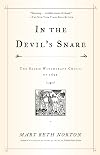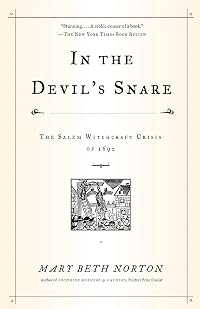
In the Devil's Snare: The Salem Witchcraft Crisis of 1692
by Mary Beth Norton
On This Page
Description
In January 1692 in Salem Village, Massachusetts, two young girls began to suffer from inexplicable fits. Seventeen months later, after legal action had been taken against 144 people, 20 of them put to death, the ignominious Salem witchcraft trials finally came to an end. Mary Beth Norton gives us a unique account of the events at Salem, helping us to understand them as they were understood by those who lived through the frenzy. Describing the situation from a seventeenth-century perspective, show more Norton examines the crucial turning points, the accusers, the confessors, the judges, and the accused, among whom were thirty-eight men. She shows how the situation spiraled out of control following a cascade of accusations beginning in mid-April. She explores the role of gossip and delves into the question of why women and girls under the age of twenty-five, who were the most active accusers and who would normally be ignored by male magistrates, were suddenly given absolute credence. Norton moves beyond the immediate vicinity of Salem to demonstrate how the Indian wars on the Maine frontier in the last quarter of that century stunned the collective mindset of northeastern New England and convinced virtually everyone that they were in the devil's snare. And she makes clear that ultimate responsibility for allowing the crisis to reach the heights it did must fall on the colony's governor, council, and judges. show lessTags
Recommendations


















Member Reviews
A fascinating read that argues the big context in New England matters to understanding what has always seemed to be a hyper-localized and idiosyncratic event in the late 17th century. The book subsequently almost becomes as much about the Maine frontier as Salem Village, and as much about Indian wars against the local Wabanakis as about Satan's evil designs upon a town or a colony. It's a compelling argument and makes a lot of sense. What's missing is a convincing explanation for how a general context that applies to much of New England north of Boston manifested as a witchcraft crisis in a relatively discrete geographic location. That never really comes together here.
Overall, a good reinterpretation of a well-known (or supposedly so) show more episode of the pre-Enlightenment American experience. show less
Overall, a good reinterpretation of a well-known (or supposedly so) show more episode of the pre-Enlightenment American experience. show less
An interesting and fun read on this seminal event in American history. Norton does a phenomenal job challenging many of the popularized caricatures of the Salem Witch Trials including feminist and rationalist interpretations. Far form being a coordinated attack on powerless women by powerful men, Norton shows that the Salem Witch "crisis" was far more women-led than we've been told. Women and their testimonies were overwhelmingly believed in the courtroom, not dismissed. Even men were counted among the victims by controversy's end!
I think Norton presents sufficient evidence to categorize the crisis as a product of Indian Wars more than anything else. The vast amount of overlap between victims of the paranormal activity and Indian show more brutality is hard to ignore. That the colonists in Essex county saw them as one and the same is also evident. show less
I think Norton presents sufficient evidence to categorize the crisis as a product of Indian Wars more than anything else. The vast amount of overlap between victims of the paranormal activity and Indian show more brutality is hard to ignore. That the colonists in Essex county saw them as one and the same is also evident. show less
A fantastic book! Norton locates the Salem witch trials in their North American context, noting the impact of King Philip's war and King William's war on the psyche of the people, particularly on the Maine frontier. Her work is well researched and provides a fascinating perspective.
Fastidious...I got lost in the details at times, but Norton's argument and analysis, though slow in forthcoming, seemed realistic, nuanced, fresh, and considered. More than anything this is an historical accounting--I wanted more commentary than I received, but left still feeling like many answers were found.
Norton examines why a relatively common situation, accusations of witchcraft, spun so far out of control in Salem in 1692. She argues that the tensions caused by the French and Indian Wars led the residents of Salem and the surrounding area to feel they were under attack by the devil both physically (in the form of Indians) and spiritually (in the form of witches). It's a compelling argument and one of the few explanations I've seen that is based on the context in which the panic occurred rather than judged by modern standards.
Another book about the Salem witch trials. The author puts forth a theory I hadn't really been familiar with but that I found interesting. That the eastward--the frontier of Maine (which at that time was pretty close to Salem)--provided a lot of the reasons for the trials. The Puritans, after all, felt that America was a heathen land, ruled by the devil, and they were the ones who brought God there. A lot of the accusers described seeing a "dark man" with the wtiches, which is a term frequently used by them to describe Indians. Also at that time, King Charles' War wasn't distant history and the Wabanakis and the French were extremely violent toward the English. Many of the accused and accusers had links to towns in Maine that had been show more decimated and families that had been killed and/or abducted. (On a more personal note, the Penobscot, which T's distantly descended from, were a smaller group of Wabanaki, which could, in a far-fetched idea, mean that his distant ancestors may have had some impact on this whole thing. Yes, my imagination does fly free sometimes.)
Anyway, good book with a very interesting theory. And the author takes into account the men who were accused more than any other author I've read on the subject, which I appreciated. show less
Anyway, good book with a very interesting theory. And the author takes into account the men who were accused more than any other author I've read on the subject, which I appreciated. show less
2.5 stars
In addition to looking at the accusations and trials of the “witches” in the Salem, Mass. area in the late 17th century, this author looks at other things happening in the area at the time to see if there is a connection. Specifically, the First and Second Indian Wars happened in the years leading up to the witch accusations and trials.
I do find the Salem witches an interesting topic, but a number of nonfiction books I’ve read about it (including this one) have not held my interest. I do find it hard, sometimes, to read books with a lot of quotations from other sources, and this one (and other books on this topic) has a lot of that.
In addition to looking at the accusations and trials of the “witches” in the Salem, Mass. area in the late 17th century, this author looks at other things happening in the area at the time to see if there is a connection. Specifically, the First and Second Indian Wars happened in the years leading up to the witch accusations and trials.
I do find the Salem witches an interesting topic, but a number of nonfiction books I’ve read about it (including this one) have not held my interest. I do find it hard, sometimes, to read books with a lot of quotations from other sources, and this one (and other books on this topic) has a lot of that.
Members
- Recently Added By
Lists

New England Witch Trials -- nonfiction
9 works; 1 member

In Our Time books
4,934 works; 2 members

Books in the Bibliography of Contested Continent by Peter Mancall
495 works; 1 member
Author Information

27+ Works 2,853 Members
Mary Beth Norton is Mary Donlon Alger Professor of History at Cornell University. She is the author of many books, including Liberty's Daughters: The Revolutionary Experience of American Women, 1750-1800, also from Cornell; In the Devil's Snare: The Salem Witchcraft Crisis of 1692; and Founding Mothers Fathers: Gendered Power and the Forming of show more American Society. show less
Awards and Honors
Common Knowledge
- Original publication date
- 2002
- Important places
- Massachusetts, USA; Salem, Massachusetts, USA; Maine, USA
- Important events
- Salem witch trials (1692 | 1693)
- Dedication
- For the other Americanists and the other women in the Cornell history department, and especially for I.V. (Itsie) Hull
- First words
- Salem. (Introduction)
- Last words
- (Click to show. Warning: May contain spoilers.)From the Epilogue: Captain John Hill of Saco reported in 1693 that an Indian told him "that the FrenchMinisters were better than the English, for before the French came among them there were a great many Witches among the Indians, but now there were none, and there were much Witches among the English Ministers as Burroughs, who was Hang'd for it."
- Blurbers
- McCullough, David; Ray, Benjamin C.; Main, Gloria L.; Butler, Jon; Berkin, Carol; Rosenthal, Bernard
- Original language
- English
- Canonical DDC/MDS
- 133.43097445
- Canonical LCC
- BF1575
Classifications
- Genres
- History, Nonfiction, General Nonfiction, Religion & Spirituality
- DDC/MDS
- 133.43097445 — Philosophy & psychology Parapsychology & occultism Specific topics in parapsychology and occultism Demonology and witchcraft Magic and witchcraft Standard subdivisions History, geographic treatment, biography North America Northeastern U.S. Massachusetts
- LCC
- BF1575 — Philosophy, Psychology and Religion Psychology Occult sciences Witchcraft
- BISAC
Statistics
- Members
- 984
- Popularity
- 26,673
- Reviews
- 20
- Rating
- (3.89)
- Languages
- English
- Media
- Paper, Ebook
- ISBNs
- 5
- ASINs
- 5