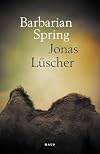
Frühling der Barbaren
by Jonas Lüscher
On This Page
Description
On a business trip to Tunisia, Preising, a leading Swiss industrialist, is invited to spend the week with the daughter of a local gangster.He accompanies her to the wedding of two London city traders at a desert luxury resort that was once the site of an old Berber oasis.Tags
Recommendations











































Member Reviews
This slim novella, shortlisted for the Swiss Book Prize back in 2013, is another entry in the small roster of fictional works addressing the global financial crisis. In this case, the approach is to examine the dynamics of a group of ‘brash and self-confident’ London bankers gathered together for a wedding at a luxury resort in Tunisia.
You can see why this was a priority target for English translation – not just for its portrait of finance wankers (who are in danger of supplanting football hooligans as our most depressing exported stereotype), but also for its vision of the UK as being at the centre of global meltdown. By setting the action just slightly into the future, Lüscher allows himself to imagine some of the consequences show more of collapse, in terms which, post-Brexit, have become more feasible than ever.
In effect, what Preising was presenting me with here was a variation on the by-now familiar theme of ‘Where were you when Britain went bankrupt?’. Latterly, this genre had taken over from the earlier ‘Where were you on 9/11?’ […] Likewise, we all now vividly remember the moment when the baby-faced PM in his baby-blue silk tie – an unduly optimistic and frivolous choice in the circumstances, I always thought – commenced his speech with the words ‘In thirteen hundred and forty-five, when King Edward the Third told his Florentine bankers…’ Sure, it had far less visual impact than 9/11, but it's still seared on our collective memory.
The climax is a suitably Ballardian spiral into social breakdown and violence, all played out in the microcosm of this North African resort. Lüscher doesn't have Ballard's control or his flashes of genuine weirdness – but he does have a great hook, and the themes of financial disaster and Arab Spring give him plenty to work with. A bullish debut; analysts recommend buy. Warning: likes can go down as well as up. show less
You can see why this was a priority target for English translation – not just for its portrait of finance wankers (who are in danger of supplanting football hooligans as our most depressing exported stereotype), but also for its vision of the UK as being at the centre of global meltdown. By setting the action just slightly into the future, Lüscher allows himself to imagine some of the consequences show more of collapse, in terms which, post-Brexit, have become more feasible than ever.
In effect, what Preising was presenting me with here was a variation on the by-now familiar theme of ‘Where were you when Britain went bankrupt?’. Latterly, this genre had taken over from the earlier ‘Where were you on 9/11?’ […] Likewise, we all now vividly remember the moment when the baby-faced PM in his baby-blue silk tie – an unduly optimistic and frivolous choice in the circumstances, I always thought – commenced his speech with the words ‘In thirteen hundred and forty-five, when King Edward the Third told his Florentine bankers…’ Sure, it had far less visual impact than 9/11, but it's still seared on our collective memory.
The climax is a suitably Ballardian spiral into social breakdown and violence, all played out in the microcosm of this North African resort. Lüscher doesn't have Ballard's control or his flashes of genuine weirdness – but he does have a great hook, and the themes of financial disaster and Arab Spring give him plenty to work with. A bullish debut; analysts recommend buy. Warning: likes can go down as well as up. show less
This is a powerful little book that tells in a few (125) pages the imaginary story of a group of British tourists and a Swiss businessman and what could happen in the event of an economic collapse. A very interesting short novel.
Heerlijke satire in de beste traditie van Swift en Sterne. Deed me denken aan Houellebecq (Platform) en Kracht (Imperium). Aanrader, dus.
Un OVNI... une fable contemporaine? Une nouvelle de troisième degré? Une lecture agréable en fait, mais qui à le goût d'une ébauche. Et il est probable que J. Lüscher a trouvé la bonne distance.
Apr 9, 2016French
Ratings
Members
- Recently Added By
Lists

Fish Out of Water: The Perils of Abroad
25 works; 5 members

CH-Autoren (Swiss Authors)
265 works; 9 members

Die besten Werke der deutschsprachigen Erzählliteratur von 1924 bis 2024
100 works; 2 members
Author Information

9 Works 173 Members
Awards and Honors
Series
Belongs to Publisher Series
btb (74823)
Common Knowledge
- Canonical title*
- Frühling der Barbaren
- Original title
- Frühling der Barbaren
- Original publication date
- 2013
- First words*
- "Nein", sagte Preising, "du stellst die falschen Fragen", und um seinem Einwand Nachdruck zu verleihen, blieb er mitten auf dem Kiesweg stehen.
- Last words*
- (Click to show. Warning: May contain spoilers.)"Du stellst schon wieder die falsche Frage", sagte Preising.
- Original language*
- Deutsch
*Some information comes from Common Knowledge in other languages. Click "Edit" for more information.
Classifications
Statistics
- Members
- 73
- Popularity
- 424,043
- Reviews
- 4
- Rating
- (4.05)
- Languages
- 5 — Dutch, English, French, German, Italian
- Media
- Paper, Audiobook, Ebook
- ISBNs
- 9
- ASINs
- 2