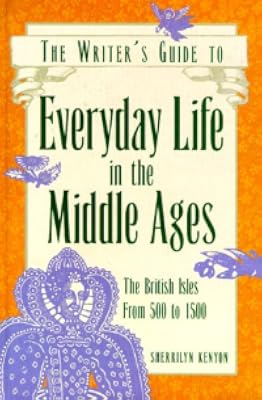
The Writer's Guide to Everyday Life in the Middle Ages: The British Isles from 500 to 1500
by Sherrilyn Kenyon
Writer's Guides to Everyday Life
On This Page
Description
Gives an overview of life in Northwestern Europe from 500 to 1500 and provides details for writers to portray the lives and times of the Middle Ages accurately.Tags
Recommendations














Member Reviews
This book gets a bad rep because it's simplistic and a lot of the info could've been found on Wikipedia, but this book doesn't pretend to be anything more than a quick and dirty reference book. Throughout, the author urges readers to do more research if they want specifics. For what this was, I'd say it was worth it. It was nicely broken up into easily digestible sections with useful if basic information in each. It's nice to have a resource that combines food with clothing with religious practices with economy with titles. Could Kenyon have gone into more detail? Absolutely, but she's not a historian. She did list some interesting titles for each chapter to make further research easier.
The biggest letdown for me was that this book show more says it reviews every day life from years 500-1500, but that's deceptive. Kenyon barely dips into the 15th century, which is what I was interested in reading. The 15th century was full of turmoil with the War of the Roses and the influences in this century from Flanders and Burgundy. The clothing section only discussed up to 1461, leaving about 40 years untouched, which was incredibly frustrating.
Anyone interested in the daily lives of those from the 10th-14th centuries will find a lot in this book. It's a great starting off point, even if it does leave one wanting more. show less
The biggest letdown for me was that this book show more says it reviews every day life from years 500-1500, but that's deceptive. Kenyon barely dips into the 15th century, which is what I was interested in reading. The 15th century was full of turmoil with the War of the Roses and the influences in this century from Flanders and Burgundy. The clothing section only discussed up to 1461, leaving about 40 years untouched, which was incredibly frustrating.
Anyone interested in the daily lives of those from the 10th-14th centuries will find a lot in this book. It's a great starting off point, even if it does leave one wanting more. show less
Sherrilyn Kenyon is a popular and successful romance author, spanning several genres – paranormal, historical, action-adventure. The Writer’s Guide To Everyday Life in the Middle Ages is the only book of hers I’ve ever read; I recognized the author’s name as familiar when I saw the book in the remainder bin, but couldn’t associate it with anything in particular.
My initial response was “Good grief, this is gut-wrenchingly bad. It must be something she wrote as class notes in high school that was dusted off and printed when she became successful.” As it turns out, though, instead this is one of her first published works. The Writer’s Guide To Everyday Life In … is a series; I’m at a loss as to why the series editors show more picked out what was then a relatively unknown author to do this one. The major problem is this isn’t a coherent book at all; it’s a series of lists with very little in the way of explanation: a list of foods that includes Viaund Royal, Capon de Haut De Grace, Leche Lumbarde, and Blaundesorye without any description of what they were; list of king’s names without any discussion of their reigns (the kings of England get a sentence; the kings of France, Norway, and “Wales” do not – not even a hint that there wasn’t really a “King of Wales”) – and so on.
The illustrations are photographs of people at a Renaissance Festival. I’m not kidding. The “Franciscan monk” didn’t even take off his eyeglasses. The front cover includes an etching of Elizabeth I, who wasn’t born until 1533 (Kenyon’s definition of “medieval” ends in 1500). This might not be Kenyon’s fault; every book in the series has a portrait in the lower left corner of the cover and the book designer might have inflicted it on her. The bibliographies are extensive - there is a general bibliography for the whole book and one for each chapter – but I’m suspicious; I wager that Ms. Kenyon didn’t even come close to reading all the books she references but instead just copied more lists.
So I hate to find nothing good about a book. Thus: If you were a junior high school student who wanted to write historical romance stories, and your junior high school history courses only covered politically correct material like the evils of the McCarthy era and minority group history, and you lived in a community with no public library, and you were impoverished and could only afford one book of your own, and if you had Web access and were willing to double-check everything, this might be acceptable. That’s about it, though. show less
My initial response was “Good grief, this is gut-wrenchingly bad. It must be something she wrote as class notes in high school that was dusted off and printed when she became successful.” As it turns out, though, instead this is one of her first published works. The Writer’s Guide To Everyday Life In … is a series; I’m at a loss as to why the series editors show more picked out what was then a relatively unknown author to do this one. The major problem is this isn’t a coherent book at all; it’s a series of lists with very little in the way of explanation: a list of foods that includes Viaund Royal, Capon de Haut De Grace, Leche Lumbarde, and Blaundesorye without any description of what they were; list of king’s names without any discussion of their reigns (the kings of England get a sentence; the kings of France, Norway, and “Wales” do not – not even a hint that there wasn’t really a “King of Wales”) – and so on.
The illustrations are photographs of people at a Renaissance Festival. I’m not kidding. The “Franciscan monk” didn’t even take off his eyeglasses. The front cover includes an etching of Elizabeth I, who wasn’t born until 1533 (Kenyon’s definition of “medieval” ends in 1500). This might not be Kenyon’s fault; every book in the series has a portrait in the lower left corner of the cover and the book designer might have inflicted it on her. The bibliographies are extensive - there is a general bibliography for the whole book and one for each chapter – but I’m suspicious; I wager that Ms. Kenyon didn’t even come close to reading all the books she references but instead just copied more lists.
So I hate to find nothing good about a book. Thus: If you were a junior high school student who wanted to write historical romance stories, and your junior high school history courses only covered politically correct material like the evils of the McCarthy era and minority group history, and you lived in a community with no public library, and you were impoverished and could only afford one book of your own, and if you had Web access and were willing to double-check everything, this might be acceptable. That’s about it, though. show less
Worst book ever written on the middle ages. I kept it to use in my class on good and back resources. Just awful!
Worst book ever written on the middle ages. I kept it to use in my class on good and back resources. Just awful!
Ratings
Members
- Recently Added By
Author Information

261+ Works 96,992 Members
Sherrilyn Kenyon was born in Columbus, Georgia in 1965. She attended the University of Georgia. She has written novels and nonfiction works using both her real name and the pseudonym Kinley MacGregor. The name was created when she started writing historical romances. She writes several series including The Dark-Hunters, The League, Lords of show more Avalon, BAD Agency and the Chronicles of Nick. In 2018 her title, Death Doesn't Bargain, made the bestseller list. (Bowker Author Biography) show less
Series

Common Knowledge
- Alternate titles
- The Writer's Guide to Everyday Life in the Middle Ages
- Original publication date
- 2000
- People/Characters
- Geoffrey Chaucer; Marie de France; Richard Barber; King Henry II of England; King Stephen; Eleanor of Aquitaine (show all 22); Catherine Moriarty; M. Marte; Besancon; Patricia Orr; J.W. Thomson; Maryanne Kowaleski; Judith M. Bennett; Marian K. Dale; Sidney Painter; Georges Duby; G.C. Coulton; F.W. Maitland; Henri Pirenne; Karen Armstrong; Carthusians; Benedictines
- Important places
- England, UK; France; Roman Empire; Germany; Scotland, UK
- Important events
- Normandy Invasion; Crusades
Classifications
Statistics
- Members
- 316
- Popularity
- 100,921
- Reviews
- 4
- Rating
- (3.40)
- Languages
- English
- Media
- Paper, Ebook
- ISBNs
- 3
- UPCs
- 1
- ASINs
- 2