
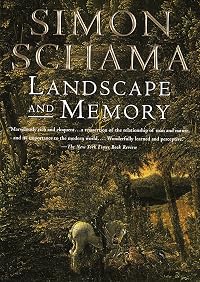
Landscape and Memory
by Simon Schama
On This Page
Description
Opening a radically new and original path into history, Simon Schama explores the scenery of our Western culture, both real landscapes and landscapes of the mind that have given us our sense of homeland, the dark woods of our imagined origins. What unfolds is a series of compelling journeys through space and time: from the ancient woodland of Poland, a symbol over the centuries of national endurance, through the forest birthplace of the German psyche, to the Big Trees of Yosemite that gave a show more new nation its holy past. Through all of history, from pre-classical antiquity to the Third Reich and beyond, Schama uncovers the myths and memories that have stamped themselves on our most basic social instincts and institutions: territorial identity, the wild and domestic, mortality and immortality. show lessTags
Recommendations



































Member Recommendations
Member Reviews
Schama presents a wide-ranging meditation on the role of nature in Western civilization from ancient times to the present. In an enormously rich, labyrinthine survey, Columbia University humanities professor Schama, author of prize-winning books on the French Revolution (Citizens) and Dutch culture (The Embarrassment of Riches), explores the role of landscape in myth, art and culture. Full of wondrous and forgotten lore, his mind-expanding study links the Egyptian myth of Osiris, sacrified king-god of the Nile, to pagan traditions of the sacred stream, Christian baptism and modern images of the fertile, fatal river. He follows woodlands-based myths of utopian primitivism from Tacitus through German Romanticism, the work of contemporary show more painter Anselm Kiefer and the militant nationalism that culminated in Hitler. Ranging freely over Western literature, history, art and mythology, Schama examines Mount Rushmore as an icon of democracy, unfenced suburban lawns as symbols of social solidarity, Bernini's Fountain of the Four Rivers in Rome, Sir Walter Raleigh's journey to Guiana, Thoreau's meditations at Walden Pond, Swiss climber Horace Benedict de Saussure's ascent of Mount Blanc in 1787. Arguing that the boundaries between the wild and the cultivated are more flexible than is commonly assumed, this synthesis maps an uncharted geography of the imagination.
Schama argues persuasively that Europeans and Americans have been shaped by nature as much as they themselves have shaped nature. He discusses the impact of sacred or mysterious rivers, forests, and mountains in forging the Western imagination. Individuals discussed include the expected (e.g., Henry David Thoreau) as well as some surprises (e.g., Louis XIV and Hitler). The fact that nature has had a huge impact on Western history is not a startling new revelation, but Schama is a marvelous writer and an impressive scholar. He brings together familiar and not-so-familiar stories to create a fresh reappraisal of more than 2000 years of history. show less
Schama argues persuasively that Europeans and Americans have been shaped by nature as much as they themselves have shaped nature. He discusses the impact of sacred or mysterious rivers, forests, and mountains in forging the Western imagination. Individuals discussed include the expected (e.g., Henry David Thoreau) as well as some surprises (e.g., Louis XIV and Hitler). The fact that nature has had a huge impact on Western history is not a startling new revelation, but Schama is a marvelous writer and an impressive scholar. He brings together familiar and not-so-familiar stories to create a fresh reappraisal of more than 2000 years of history. show less
This book is a fascinating treatise on the role nature (specifically wood, water, and rock) has played in Western culture. Art and history professor at Columbia University, Schama considered this the one book he needed to write. He expertly touches on so many examples of our environment's influence on our collective memory that the book is difficult to describe- everything from Hitler's obsession with the forests of Europe and the battles fought to get Susan B. Anthony on Mount Rushmore, to Western lust for Egyptian obelisks and dance parties held on the massive stumps of California Sequoias in the mid-nineteenth century. This work is also, with its classical layout and type font and its many excellent illustrations, one of the most show more beautifully designed books I've ever seen. Highly recommended. show less
Got it. Finally. Took me one and a half years to read that fucker! Actually, I stopped after the most - and only - relevant part, the one about ROCK, leaving the summary part out.
Doesn't make for smooth bedside reading... My eyes would capitulate after a couple of pages.
It is highly interesting and Schama tries hard to make the reading entertaining, but it remains scientific and in parts highly speculative. His line of reasoning is not always easy to follow and I couldn't always detect a red line between the places that he presents and how they are perceived and how they mirror the society of a certain time.
Lastly, some contents have been put in quite arbitrarily - at least that's what it seems to me.
Doesn't make for smooth bedside reading... My eyes would capitulate after a couple of pages.
It is highly interesting and Schama tries hard to make the reading entertaining, but it remains scientific and in parts highly speculative. His line of reasoning is not always easy to follow and I couldn't always detect a red line between the places that he presents and how they are perceived and how they mirror the society of a certain time.
Lastly, some contents have been put in quite arbitrarily - at least that's what it seems to me.
A rich and satisfying look into the European heritage. Beautifully written, lyrical prose that is a joy to read.
I find this a hard book to finish. It is one of those books it seems difficult to get into although the material is interesting and the thought good.
Very interesting historical study of how topography and landscape shaped the culture and laws of modern societies.
fascinating but pretentious
Members
- Recently Added By
Published Reviews
In various cultures, both classic and contemporary, the author studies myths and how they relate to landscapes. Repeatedly, the subject of an idyllic, pastoral place, an Arcadia, arises. In the last chapter, he focuses briefly on Central Park, praising its designer, Frederick Law Olmsted, for his vision of a heroic urban Arcadia. For Mr. Schama, Central Park seems to encapsulate the show more double-sided nature of the Arcadian concept. The dreamlike version is, he said, "a place of effortless bucolic sweetness, where you can lie on your back and smell the grass while there's a faint noise of people hitting balls with bats." The nightmare version is "a slightly scary, sinister, dense place of sex and death." show less
added by John_Vaughan
Lists

Mustich's 1000 Books to Read Before You Die: A Life Changing List
1,001 works; 19 members

In Our Time books
4,934 works; 2 members
Author Information

70+ Works 19,203 Members
Simon Schama is an historian, educator, and writer. He was born in London, England on February 13, 1945. Schama earned a B.A. in history in 1966 from Cambridge University and later became a fellow of Christ College. Schama was a Fellow and Tutor in Modern History at Brasenose College, Oxford from 1976 to 1980. He also was an Erasmus Lecturer in show more the civilization of the Netherlands at Harvard University in 1978, and from 1980 to 1993 he was Professor of History and Mellon Professor of the Social Sciences and Senior Associate at the Center for European Studies. Schama has been the Old Dominion Professor of Humanities at Columbia University since 1993, teaching in the history, art history and archaeology departments. Schama's 1977 book, Patriots and Liberators: Revolution in the Netherlands, 1780-1813, received the Wolfson Prize for history and the Leo Gershoy Memorial Prize of the American History Association. Another book, Citizens: A Chronicle of the French Revolution, won the NCR Prize for Nonfiction. Schama also worked as an art critic for The New Yorker and has written historical and art documentaries for the BBC. In 2001 he received the CBE. In 2006 Schama earned the National Book Critics Circle Award for Nonfiction for Rough Crossings. His more recent works include A History of Britain and The Sory of the Jews, both written in multiple volumes. (Bowker Author Biography) Simon Schama is the author of The Embarrassment of Riches, Citizens, Landscape and Memory, and most recently, Rembrandt's Eyes. He is currently Old Dominion Professor of the Humanities at Columbia University. The second installment of his epic history of Britain is due to be published in April 2001. (Publisher Provided) show less
Some Editions
Awards and Honors
Notable Lists
Common Knowledge
- Canonical title
- Landscape and Memory
- Original title
- Landscape and Memory
- Original publication date
- 1995
- Epigraph
- It is in vain to dream of a wildness distant from ourselves. There is none such. It is the bog in our brains and bowels, the primitive vigor of Nature in us, that inspires that dream. I shall never find in the wilds of ... (show all)Labrador any greater wildness than in some recess of Concord, i.e., than I import into it.
Henry David Thoreau, Journal, August 30, 1856 - Dedication
- For Chloë and Gabriel
- First words
- It was only when I got to secondary school that I realized that I wasn't supposed to like Rudyard Kipling.
- Last words
- (Click to show. Warning: May contain spoilers.)It is the bog in our brain and bowels, the primitive vigor of Nature in us, that inspires that dream.
- Original language
- English
- Disambiguation notice
- 1st edition (1995): Landscape and memory / Simon Schama
Classifications
- Genres
- History, Nonfiction, Art & Design, Science & Nature, General Nonfiction
- DDC/MDS
- 304.23 — Society, government, & culture Social sciences, sociology & anthropology Factors affecting social behavior Human ecology
- LCC
- GF50 .S33 — Geography, Anthropology and Recreation Human ecology. Anthropogeography Human ecology. Anthropogeography
- BISAC
Statistics
- Members
- 1,773
- Popularity
- 12,335
- Reviews
- 12
- Rating
- (4.08)
- Languages
- 7 — Dutch, English, French, German, Italian, Portuguese, Swedish
- Media
- Paper
- ISBNs
- 19
- ASINs
- 4