All Shook Up: How Rock 'n' Roll Changed America
by Glenn C. Altschuler
On This Page
Description
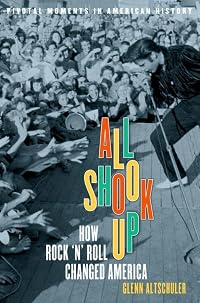
The birth of rock 'n roll ignited a firestorm of conroversy - one critic called it "musical riots put to a switchblade beat" - but if it generated much sound and fury, what, if anything, did it signify? As Glenn Altschuler reveals in 'All Shook Up', the rise of rock 'n roll - and the outraged reception to it - in fact can tell us a lot about the values of the United States in the 1950s, a decade that saw a great struggle for the control of popular culture. Altschuler shows, in particular, show more how rock's "switchblade beat" opened up wide fissures in American society along the fault-lines of family, sexuality, and race. show lessTags
Recommendations









Member Reviews
A nice, enthusiastics read of the musically seminal decade roughly around the '50s. I don't see the author making a cogent argument that rock "changed" America. It could have been symptom, catalyst, cause or had any of those roles at different times. I do like that the author went deeper into more obscure pioneers and dimensions of this story than I usually see in such histories, including coverage of Pat Boone bleaching rock, LaVern Baker, Jack Barry, the broadcaster-led BMI, payola and the birth of Top 40, Arlan Coolidge, social critic Vance Packard, Elvis Presley's longtime guitarist Scotty Moore, and more. The biggest thing for me was a clear vision on how hillbilly instrumentalists reacting to R&B gave birth to the rock sound and show more rock combo formatL
..."Bill Haley and the Comets." Composed of sixshow less
or seven men, playing stringed instruments, drums, and a saxophone,
with Haley as guitarist and lead singer, the Comets played driving and
danceable music. Haley's own composition, "Crazy, Man, Crazy,"
reached the Billboard's Top Twenty. The tune had a pop beat, The
Cash Box reported; the lyrics "lend themselves to R&B treatment, and
the instrumentalization is hillbilly."
"He didn't even know what to
call it, for the love of Christ," snorts critic Nick Tosches, citing Haley's
comment that the Comets used country and western instruments to
play rhythm and blues, "and the result is pop music....
A nice, enthusiastics read of the musically seminal decade roughly around the '50s. I don't see the author making a cogent argument that rock "changed" America. It could have been symptom, catalyst, cause or had any of those roles at different times. I do like that the author went deeper into more obscure pioneers and dimensions of this story than I usually see in such histories, including coverage of Pat Boone bleaching rock, LaVern Baker, Jack Barry, the broadcaster-led BMI, payola and the birth of Top 40, Arlan Coolidge, social critic Vance Packard, Elvis Presley's longtime guitarist Scotty Moore, and more. The biggest thing for me was a clear vision on how hillbilly instrumentalists reacting to R&B gave birth to the rock sound and show more rock combo formatL
Merged review:
A nice, enthusiastics read of the musically seminal decade roughly around the '50s. I don't see the author making a cogent argument that rock "changed" America. It could have been symptom, catalyst, cause or had any of those roles at different times. I do like that the author went deeper into more obscure pioneers and dimensions of this story than I usually see in such histories, including coverage of Pat Boone bleaching rock, LaVern Baker, Jack Barry, the broadcaster-led BMI, payola and the birth of Top 40, Arlan Coolidge, social critic Vance Packard, Elvis Presley's longtime guitarist Scotty Moore, and more. The biggest thing for me was a clear vision on how hillbilly instrumentalists reacting to R&B gave birth to the rock sound and rock combo formatL
..."Bill Haley and the Comets." Composed of six
or seven men, playing stringed instruments, drums, and a saxophone,
with Haley as guitarist and lead singer, the Comets played driving and
danceable music. Haley's own composition, "Crazy, Man, Crazy,"
reached the Billboard's Top Twenty. The tune had a pop beat, The
Cash Box reported; the lyrics "lend themselves to R&B treatment, and
the instrumentalization is hillbilly."
"He didn't even know what to
call it, for the love of Christ," snorts critic Nick Tosches, citing Haley's
comment that the Comets used country and western instruments to
play rhythm and blues, "and the result is pop music....
Merged review:
A nice, enthusiastics read of the musically seminal decade roughly around the '50s. I don't see the author making a cogent argument that rock "changed" America. It could have been symptom, catalyst, cause or had any of those roles at different times. I do like that the author went deeper into more obscure pioneers and dimensions of this story than I usually see in such histories, including coverage of Pat Boone bleaching rock, LaVern Baker, Jack Barry, the broadcaster-led BMI, payola and the birth of Top 40, Arlan Coolidge, social critic Vance Packard, Elvis Presley's longtime guitarist Scotty Moore, and more. The biggest thing for me was a clear vision on how hillbilly instrumentalists reacting to R&B gave birth to the rock sound and rock combo formatL
..."Bill Haley and the Comets." Composed of sixshow less
or seven men, playing stringed instruments, drums, and a saxophone,
with Haley as guitarist and lead singer, the Comets played driving and
danceable music. Haley's own composition, "Crazy, Man, Crazy,"
reached the Billboard's Top Twenty. The tune had a pop beat, The
Cash Box reported; the lyrics "lend themselves to R&B treatment, and
the instrumentalization is hillbilly."
"He didn't even know what to
call it, for the love of Christ," snorts critic Nick Tosches, citing Haley's
comment that the Comets used country and western instruments to
play rhythm and blues, "and the result is pop music....
Altschuler is at his best when writing about the sociolgy of how Rock'n'Roll impacted the wider cuture of the time; be it as a lighting rod for adults disconcerted by galloping social change, a tool for adolescents making an identity statement, or a bone of contention between rival commercial syndicates. What Altschuler is less than good at is writing about the music itself. At that point your attention is going to wander, though Altschuler does have some interesting remarks to make about the limits of Rock'n'Roll as an instrument of integration. It also would have been helpful if he had spent more time earlier in the book discussing the social stresses of the time from the perspective of the critics; particularly the period obsession show more with juvenile delinquency that flavored so much of the social opposition to the new music (instead of about half way through the text). show less
A fairly strong critique of the cultural influence of Rock 'n' Roll. It does a good job with the 1950s explaining the multiple music traditions that would blend into what would be come described as Rock and R. Most prominent of these were of course recordings by black musicians that would have tremendous impact on Elvis and other icons of the Rock pantheon. As Rock mutated it would serve the rebellious undercurrent of 50s and 60s teens and blend with the Civil Rights movement, anti-war movement, and other segments of the emerging counterculture.
The narrative is first rate when it covers the ascent of the early rockers, the upheaval in the record industry, and the religious and conservative forces that attempted to stifle the growth of show more R and R. It is suspect and much too cursory in evaluating the 1960s and such performers as Dylan. To suggest that Dylan's career as a political protest singer commenced in '65 with " Like a Rollin' Stone" is way off the tracks. He was well established by then and had recorded his most famous protest songs before that.
One other noteworthy defect is the organization of the chapters. There are rarely any markers or breaks between ideas and themes, and the paragraphs often run on interminably, containing lists and artists, and do not effectively transition between topics.
Those criticisms aside, it is a good snapshot of the era and has enough engaging content to earn a good but not outstanding rating. show less
The narrative is first rate when it covers the ascent of the early rockers, the upheaval in the record industry, and the religious and conservative forces that attempted to stifle the growth of show more R and R. It is suspect and much too cursory in evaluating the 1960s and such performers as Dylan. To suggest that Dylan's career as a political protest singer commenced in '65 with " Like a Rollin' Stone" is way off the tracks. He was well established by then and had recorded his most famous protest songs before that.
One other noteworthy defect is the organization of the chapters. There are rarely any markers or breaks between ideas and themes, and the paragraphs often run on interminably, containing lists and artists, and do not effectively transition between topics.
Those criticisms aside, it is a good snapshot of the era and has enough engaging content to earn a good but not outstanding rating. show less
Ratings
Members
- Recently Added By
Author Information
12 Works 326 Members
Glenn C. Altschuler is Thomas and Dorothy Litwin Professor of American Studies and Dean of the School of Continuing Education and Summer Sessions at Cornell University
Series
Belongs to Publisher Series
Common Knowledge
- Canonical title
- All Shook Up: How Rock 'n' Roll Changed America
Classifications
Statistics
- Members
- 156
- Popularity
- 209,835
- Reviews
- 5
- Rating
- (3.28)
- Languages
- English
- Media
- Paper, Ebook
- ISBNs
- 6
- UPCs
- 1
- ASINs
- 1