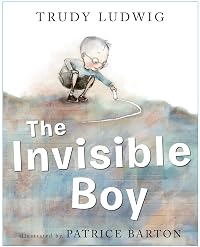
The Invisible Boy
by Trudy Ludwig
On This Page
Description
Brian has always felt invisible at school, but when a new student, Justin, arrives, everything changes.Tags
Recommendations




















Member Reviews
Brian feels invisible in Mrs. Carlotti's class. Overlooked by his teacher, who pays more attention to the louder children, left out at lunchtime by his peers, and ignored when it comes time to choose players for the kickball teams, he quietly waits and hopes that someone will notice him. Then one day a boy named Justin comes to school, and Brian's act of kindness, after he observes the other children ridiculing the new pupil's Korean lunch, opens up a world of friendship - of being visible - to him...
An engaging and thought-provoking story is paired here with expressive illustrations that perfectly embody the themes explored in the narrative, making The Invisible Boy a truly successful picture-book on all fronts. I found the story quite show more moving, and thought author Trudy Ludwig really captured the poignancy of the experiences of many quieter children, who, like Brian, patiently wait to be noticed. The happy conclusion to the tale felt natural, rather than forced, and the discussion questions at the rear make it plain that the hope is that story will be used to help children explore issues of social inclusion, and work out their own happy endings. The artwork, done first in pencil and then colored digitally, really works well with the text, depicting Brian in a faded, colorless way at first, symbolizing his figurative invisibility in his classroom, and then moving to a more colorful, filled-in look, as he gains more social interaction through his friendship with Justin. Recommended to anyone looking for children's stories that address issues of bullying, kindness, social inclusion, and cross-community friendship. show less
An engaging and thought-provoking story is paired here with expressive illustrations that perfectly embody the themes explored in the narrative, making The Invisible Boy a truly successful picture-book on all fronts. I found the story quite show more moving, and thought author Trudy Ludwig really captured the poignancy of the experiences of many quieter children, who, like Brian, patiently wait to be noticed. The happy conclusion to the tale felt natural, rather than forced, and the discussion questions at the rear make it plain that the hope is that story will be used to help children explore issues of social inclusion, and work out their own happy endings. The artwork, done first in pencil and then colored digitally, really works well with the text, depicting Brian in a faded, colorless way at first, symbolizing his figurative invisibility in his classroom, and then moving to a more colorful, filled-in look, as he gains more social interaction through his friendship with Justin. Recommended to anyone looking for children's stories that address issues of bullying, kindness, social inclusion, and cross-community friendship. show less
It looks like we're starting the new year with thinking about hope and compassion - not a bad combination.
Trudy Ludwig writes the only "issue" picture books that I really want in my library. She has written books about gossiping, bullies, show-offs, and perfectionism. Her books are written simply enough to appeal to young children but tackle the issues in a realistic way. She never stereotypes or offers simplistic solutions to complex problems. Her latest book deals with an introverted child who is, well, invisible.
We're introduced to Brian, the invisible boy, as a small gray character. His teacher is taken up with the boisterous Nathan and the whiny Sophie and all the other kids in her class. Nathan isn't any trouble, he's quiet, he show more does his work...and he's invisible. He's left out of games, parties, and events. He's just too quiet and the kids are used to ignoring him. But Brian is amazing at drawing and would like to be included - he just doesn't know how to get started.
When a new boy comes to school, Brian makes a few quiet overtures and Justin responds. Slowly, Brian gains color and life and becomes part of the school community with the help of Justin. Brian is still quiet, enjoys drawing, and doesn't suddenly become the class clown by the end of the story, but he is included and has finally made a friend or two.
The book ends with discussion questions and a list of resources both for adults and for kids. Patrice Barton's soft, glowing colors are the perfect background for this simple story and her powerful images of Brian slowly brightening from the invisible, gray child to a happy, colorful kid will hopefully influence children just as strongly as the story itself. I liked that Ludwig didn't blame anyone - the teacher is busy with the more demanding children, the other kids have all formed their own friends and cliques and don't stop to think to include Brian, and Brian himself doesn't know how to explain that he wants to be included. Change happens when Brian gets the courage to make a friendly gesture and Justin takes the time to include Brian in his new friendships.
Verdict: I'll be putting this in my parenting section (books for parents to read with their children about various issues) and recommending it to teachers to use in their classrooms. It's a great way to get kids to pause and think a little about including other kids rather than demanding that teachers try to force friendships. It's also a gentle way to remind introverted kids that taking that first step to offer friendship can be the key to becoming a friend.
ISBN: 9781582464503; Published 2013 by Random House; Review copy provided by the publisher; Added to the library show less
Trudy Ludwig writes the only "issue" picture books that I really want in my library. She has written books about gossiping, bullies, show-offs, and perfectionism. Her books are written simply enough to appeal to young children but tackle the issues in a realistic way. She never stereotypes or offers simplistic solutions to complex problems. Her latest book deals with an introverted child who is, well, invisible.
We're introduced to Brian, the invisible boy, as a small gray character. His teacher is taken up with the boisterous Nathan and the whiny Sophie and all the other kids in her class. Nathan isn't any trouble, he's quiet, he show more does his work...and he's invisible. He's left out of games, parties, and events. He's just too quiet and the kids are used to ignoring him. But Brian is amazing at drawing and would like to be included - he just doesn't know how to get started.
When a new boy comes to school, Brian makes a few quiet overtures and Justin responds. Slowly, Brian gains color and life and becomes part of the school community with the help of Justin. Brian is still quiet, enjoys drawing, and doesn't suddenly become the class clown by the end of the story, but he is included and has finally made a friend or two.
The book ends with discussion questions and a list of resources both for adults and for kids. Patrice Barton's soft, glowing colors are the perfect background for this simple story and her powerful images of Brian slowly brightening from the invisible, gray child to a happy, colorful kid will hopefully influence children just as strongly as the story itself. I liked that Ludwig didn't blame anyone - the teacher is busy with the more demanding children, the other kids have all formed their own friends and cliques and don't stop to think to include Brian, and Brian himself doesn't know how to explain that he wants to be included. Change happens when Brian gets the courage to make a friendly gesture and Justin takes the time to include Brian in his new friendships.
Verdict: I'll be putting this in my parenting section (books for parents to read with their children about various issues) and recommending it to teachers to use in their classrooms. It's a great way to get kids to pause and think a little about including other kids rather than demanding that teachers try to force friendships. It's also a gentle way to remind introverted kids that taking that first step to offer friendship can be the key to becoming a friend.
ISBN: 9781582464503; Published 2013 by Random House; Review copy provided by the publisher; Added to the library show less
Truthfully. Has there ever been a kid in existence that hasn't felt excluded at some point? Feeling like a Brian is SO relatable. I think the extent of feeling invisible is different for everyone, but haven't we all felt invisible to someone at some point? For me, "The Invisible Boy" brings me to back to growing up as the youngest in a loud and lively family. Hard to get a word in, often times I would just remain quiet because it was easier than fighting to literally have my voice heard. Being invisible in the crowd of my energetic family definitely became an insecurity of mine. And I think everyone has their own story that would help them to feel how Brian feels and the lonely place he is in.
Luckily, Brian has something special to him show more which allows him to connect to another student which breaks this wall of isolation. Brian LOVES to draw and when he notices other classmates laughing at the new student, he draws him a picture affirming him. I love the lessons this teaches- 1)art is an amazing way for people to express themselves and connect to others. 2) An act of intentional kindness goes a long way. It can make someones day, make someone feel noticed, give them love, or in this case spark a beautiful friendship.
This book is directed towards early elementary, but I think I could use it in middle school too since it has the themes of friendship and inclusion. show less
Luckily, Brian has something special to him show more which allows him to connect to another student which breaks this wall of isolation. Brian LOVES to draw and when he notices other classmates laughing at the new student, he draws him a picture affirming him. I love the lessons this teaches- 1)art is an amazing way for people to express themselves and connect to others. 2) An act of intentional kindness goes a long way. It can make someones day, make someone feel noticed, give them love, or in this case spark a beautiful friendship.
This book is directed towards early elementary, but I think I could use it in middle school too since it has the themes of friendship and inclusion. show less
I really liked this book for many reasons. First, I enjoyed the illustrations in the book. The main character, Brain, was never colored in to show that he was invisible. He was always in white and grey while all the other characters are colorful and bright. However, I liked when he made a new friend the color started to come into Brian, like he was no longer invisible. I also liked this book because the illustrator had drawings that the characters Brian liked to draw. For example, when Brian was drawing “fire breathing dragons” while everyone else in the class was playing games, the illustrator drew the fire breathing dragon as if it was Brian drawing them. I liked that because it gave the reader insight as to what Brain’s show more imagination was like. I also liked this story because it is relatable, lots of children are quiet or shy and don’t have as many friends as the louder, more outgoing kids but this book shows that it is possible to make friends even if you are shy. The message in this story is very powerful because it is about inclusion. For example, when Justin and Emilio allow Brian to be in their group project it makes Brian colorful and happy. It teaches people that just because someone is quiet or different than you doesn’t mean that you shouldn’t be including them. The differences people have make them special and those differences need to be embraced. show less
So I read this book at the library and it absolutely made me cry. It's the story of a little by named Brian who is invisible to everyone--his teacher notices the kids who act out, his classmates never both with him, etc. OMG could I relate bigtime. Brian is used to being invisible and pretty much exists on his own, drawing and imagining. But sometimes he's forced into social situations like sports or lunchtime, which are hell for him because no one wants him there. He feels so invisible he wants to just draw a hole and disappear into it. But then a new kid comes and gets teased a little. And though the new kid is quickly loved and accepted by his classmates, Brian's leaves him a note and drawing and--guess what? Brian GETS NOTICED BY show more SOMEONE. Nice going, new kid. The new kid even convinces a classmate to include Brian on a project, and the three of them have fun and use Brian's drawing talent well. By the end of the book, Brian is drawing cool thing for everyone. He gets to be who he is, doing what he likes to do, and doesn't have to change just to get noticed or included. This is the best thing ever. Seriously.
The art is so lovely. I can't even describe the style... rough but detailed, soft but striking? Brian is in black and white for most of the book, but every time he actually gets noticed just a little, part of him gets a little color to it (usually the hand doing the drawing). Such a sweet and clever device.
The part that really got me was the author's dedication at the end thanking his friend for always including him. I totally lost it at that moment (and am crying now, just writing it). For those of us who've felt like that at any moment of our lives, just wanting to be noticed and included not awkwardly invisible, those little things mean the world. And it's so lovely that so much of that struggle was so beautifully put in this book. show less
The art is so lovely. I can't even describe the style... rough but detailed, soft but striking? Brian is in black and white for most of the book, but every time he actually gets noticed just a little, part of him gets a little color to it (usually the hand doing the drawing). Such a sweet and clever device.
The part that really got me was the author's dedication at the end thanking his friend for always including him. I totally lost it at that moment (and am crying now, just writing it). For those of us who've felt like that at any moment of our lives, just wanting to be noticed and included not awkwardly invisible, those little things mean the world. And it's so lovely that so much of that struggle was so beautifully put in this book. show less
This book was very sweet and I really enjoyed reading it for several reasons. My favorite part of the book is the illustrations in the book. When Brian feels invisible he is drawn in black and white while the other students are vivid colors. Also in one of the pictures the characters that are causing a disruption are highlighted by lines directing the reader’s eyes to them and away from Brian. However as Brian makes a friend and his classmates become closer with him he then becomes more and more colorful like the other students. Also I enjoy the main character Brian. He is believable and a mirror character for the reader. Many readers will be able to connect with feeling invisible and left out during school and by there peers, and show more teachers. For example, the students are picking kids for their kickball teams. Brian is the only student left who did not get picked. Finally, I liked that this story pushes the reader to think about how they treat others. This book can be a window book for readers to see how others feel when they are not included. Brian was not invited to a classmate’s birthday party because of this he felt left out and sad. The big idea/message of this story is to be kind to everyone, try to always include everyone and the power of friendship. show less
With an opening that will break your heart, The Invisible Boy chronicles the school days of a quiet, lonely, artistic boy who creates his friends with paper and pencil.
"Can you see Brian, the invisible boy? Even Mrs. Carlotti has trouble noticing him in her classroom. She's too busy dealing with Nathan and Sophie. Nathan has problems with what Mrs. Carlotti calls "volume control." He uses his outside voice inside too much. Sophie whines and complains when she doesn't get her way.
Nathan and Sophie take up a lot of space. Brian doesn't."
To illustrate the above, a page bursts with brightly colored pencil sketches of Sophie and Nathan. Sophie - crying, back of hand to head, the other arm outstretched for dramatic effect. Nathan - arms show more raised to the sky, jubilantly shouting and joyful. The facing page has a small, black and white sketch on notebook paper of Brian - bespectacled, hands behind his back, eyebrows raised timidly, eyes taking a sideways glance at the drama on the opposite page. He's darling and he's cute, and his situation is heartbreakingly familiar.
Brian makes a shy attempt to befriend Justin, a new student, and it begins to look as if he's finally found a friend. When the popular kids try to make Justin choose between Brian and the rest, Justin reaches out his hand to touch Brian's shoulder to include him in the group. As he does, the invisible boy is infused with color emanating from the touch of his new friend. He is invisible no more.
This is a wonderfully illustrated story about loneliness, and the small amount of kindness and compassion that it takes to combat it. It is however, a shame that it takes the introduction of a new student to remedy Brian's misery. Before sharing this one with a class, teachers would be wise to prepare suggestions for kindness and inclusion that will work within their own classroom settings.
The Invisible Boy wraps up with Questions for Discussion, Recommended Reading for Adults and Recommended Reading for Kids.
http://shelf-employed.blogspot.com show less
"Can you see Brian, the invisible boy? Even Mrs. Carlotti has trouble noticing him in her classroom. She's too busy dealing with Nathan and Sophie. Nathan has problems with what Mrs. Carlotti calls "volume control." He uses his outside voice inside too much. Sophie whines and complains when she doesn't get her way.
Nathan and Sophie take up a lot of space. Brian doesn't."
To illustrate the above, a page bursts with brightly colored pencil sketches of Sophie and Nathan. Sophie - crying, back of hand to head, the other arm outstretched for dramatic effect. Nathan - arms show more raised to the sky, jubilantly shouting and joyful. The facing page has a small, black and white sketch on notebook paper of Brian - bespectacled, hands behind his back, eyebrows raised timidly, eyes taking a sideways glance at the drama on the opposite page. He's darling and he's cute, and his situation is heartbreakingly familiar.
Brian makes a shy attempt to befriend Justin, a new student, and it begins to look as if he's finally found a friend. When the popular kids try to make Justin choose between Brian and the rest, Justin reaches out his hand to touch Brian's shoulder to include him in the group. As he does, the invisible boy is infused with color emanating from the touch of his new friend. He is invisible no more.
This is a wonderfully illustrated story about loneliness, and the small amount of kindness and compassion that it takes to combat it. It is however, a shame that it takes the introduction of a new student to remedy Brian's misery. Before sharing this one with a class, teachers would be wise to prepare suggestions for kindness and inclusion that will work within their own classroom settings.
The Invisible Boy wraps up with Questions for Discussion, Recommended Reading for Adults and Recommended Reading for Kids.
http://shelf-employed.blogspot.com show less
Members
- Recently Added By
Lists

Youth: Personal Values
252 works; 1 member
Author Information

14 Works 5,091 Members
All Editions
Awards and Honors
Awards
Distinctions
Common Knowledge
- Original publication date
- 2013
- Dedication
- Thank you, Brad, for always including me in your world.—T.J.L.
For Jerry—P.B.
Classifications
Statistics
- Members
- 2,705
- Popularity
- 6,847
- Reviews
- 190
- Rating
- (4.51)
- Languages
- English, French, Slovenian, Spanish
- Media
- Paper, Ebook
- ISBNs
- 16
- ASINs
- 2