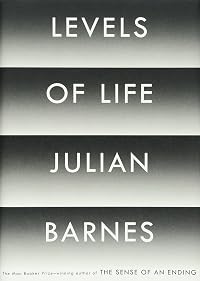
Levels of Life
by Julian Barnes
On This Page
Description
An essay on grief and love for the author's late wife Pat, in which he discusses ballooning, photography, love, and bereavement; putting two things and two people together; and then tearing those things apart.Tags
Recommendations















Member Recommendations

Member Reviews
‘Uxorious,’ Julian Barnes insists in the final essay of this grief-bound trilogy, “describes — and always will, whatever future dictionaries may permit — a man who loves his wife.” Julian Barnes is such a man. The death of his wife, Pat Kavanagh, in 2008 plunges him into a grief that he is utterly unprepared for, though grief, he notes, like death, “is banal and unique.” In a sense, we learn nothing from the grief of others. Nevertheless, the uxorious Barnes seeks in Levels of Life to in some way memorialize the love of his life.
Curiously (and not) the first two essays in this slim volume involve lighter than air flight, the antics of 19th century balloonists, and a love that was larger than life. This is exquisitely show more beautiful writing — Barnes at his best. Filled with erudition, lightly worn, but oh so artful in its representation. It is the kind of writing that gives one hope for creative non-fiction. If only it could always be like this. But perhaps that is asking too much. And certainly when Barnes turns to his particular case of personal grief in the third essay, the level of artfulness diminishes significantly. It is as though the closer he gets to himself, the less he is able to sustain those airy heights. Well, that’s grief all over, isn’t it?
Warmly recommended. show less
Curiously (and not) the first two essays in this slim volume involve lighter than air flight, the antics of 19th century balloonists, and a love that was larger than life. This is exquisitely show more beautiful writing — Barnes at his best. Filled with erudition, lightly worn, but oh so artful in its representation. It is the kind of writing that gives one hope for creative non-fiction. If only it could always be like this. But perhaps that is asking too much. And certainly when Barnes turns to his particular case of personal grief in the third essay, the level of artfulness diminishes significantly. It is as though the closer he gets to himself, the less he is able to sustain those airy heights. Well, that’s grief all over, isn’t it?
Warmly recommended. show less
This book was recommended to me by Dhanaraj a while back. It's the story of love and grief told with candor. The book is divided in three parts, the first one being about nineteenth century balloonists with emphasis on the French photographer/balloonist/writer Gaspard-Félix Tournachon who was the first person to do aerial photography, the second part of the book is a fictionalized love and heartbreak affair between the great French actress Sarah Bernhardt and British officer Fred Burnaby, and the final part an account of the writer's (Julian Barnes) grief and living after his wife's death.
At first when I started reading, I expected a memoir of the writer and so was confused reading about European balloonists in the 1800s but Barnes show more manages to make such striking and, later, fitting parallels with the metaphors and stories from the preceding parts of the book with his own account. This book doesn't pretend to be instructive on how to deal with grief, instead, it is remembrance, it is tribute to a love and wife, it is a man mourning and grieving. A wonderful book. show less
At first when I started reading, I expected a memoir of the writer and so was confused reading about European balloonists in the 1800s but Barnes show more manages to make such striking and, later, fitting parallels with the metaphors and stories from the preceding parts of the book with his own account. This book doesn't pretend to be instructive on how to deal with grief, instead, it is remembrance, it is tribute to a love and wife, it is a man mourning and grieving. A wonderful book. show less
Late in the third and final essay, Julian Barnes, man in mourning, grappling with grief, uses the pen in his battle with the tools of his craft – language. He has already told us he snaps at friends for their flippancy, or dull Englishness. This time, the whole language gets a telling – or its abusers anyway. Ignorant buggers would change it so that the meaning of its words deprive him of his grief. He tells us he is uxorious. No one uses that word anymore, so it is lost, so too is its meaning. He imagines this age we live – one that easily moves the meaning of words into new meanings – doing nasty things to uxorious. Uxorious of course means loving husband. That is his departure point for the entire book – uxorious husband show more loses loved wife and the world and all its meanings collapse around him. So, he negotiates in his grief with his reader to uphold this word with its intended meaning – knowing full well words are not connected to their identifier anyway. They are disconnected from source, like a grieving uxorious husband at the loss of the adored identifier of life. show less
The death of a loved one is the kind of pain everyone can understand and no one can explain to someone else. This peculiarity of grief is examined in Julian Barnes’ Levels of Life (2013). His slim, tightly woven book discusses the rise of ballooning, the complicated charm of Sarah Bernhardt, and the pitfalls of aerial photography in fin de siècle France and England as a means of exploring his grief over the death of his wife. Grief is like that: diverse topics that initially serve as distractions can bring us back to our own narrative; we seek to find, or impose, meaning at a time when life seems meaningless. Alternating between detached, wry commentary on the lives of others and an unsparing self-reflection, in his elegant and show more erudite style Barnes holds a mirror up to how we process loss.
Barnes writes: “Every love story is a potential grief story.” Ruminations about loss are, by nature, meditations on love. After a 30-year marriage, his beloved wife’s sudden death leaves him feeling angry and adrift, but most of all, diminished: “what was taken away is greater than the sum of what was there. “
The book is strongest when it fails to move the reader with a description of loss that doesn’t resonate, or with an assertion that doesn’t ring true. Amid moments of fulsome agreement (yes, that’s how it feels!), we then acknowledge our own, different experience of mourning, confirming Barnes’ observation that grief is at once both universal and singular. show less
Barnes writes: “Every love story is a potential grief story.” Ruminations about loss are, by nature, meditations on love. After a 30-year marriage, his beloved wife’s sudden death leaves him feeling angry and adrift, but most of all, diminished: “what was taken away is greater than the sum of what was there. “
The book is strongest when it fails to move the reader with a description of loss that doesn’t resonate, or with an assertion that doesn’t ring true. Amid moments of fulsome agreement (yes, that’s how it feels!), we then acknowledge our own, different experience of mourning, confirming Barnes’ observation that grief is at once both universal and singular. show less
As a fairly recent widow, I think that this book captures what grief is and how it feels better than anything else I have read. If you are looking for a way out of grief, or for a way to make it less painful, there is little comfort here. Barnes is an atheist who does not belief in an afterlife, so that escape route is closed off. Nor does he understate the solitariness of grief, the loneliness, and the impossibility of making sense of loss. But he does say what grief is like, and that is something to hold on to -- recognizing that one is not alone. I skimmed through the other essays, I am ashamed to say, being rather narrowly focussed these days.
Barnes' command of language will draw you in...his willingness to lay bare his beating heart will keep you reading to the end of this rather short essay triptych, though you may feel like a voyeur to someone's grief.
Levels of Life has plenty of light-hearted moments, but a darkness lies over the work even then. This is not a cheery read, but it does leave the reader with hope, of a sort. And you will make and lose a friend before it's over.
Levels of Life has plenty of light-hearted moments, but a darkness lies over the work even then. This is not a cheery read, but it does leave the reader with hope, of a sort. And you will make and lose a friend before it's over.
Its amazing that the less Julian Barnes writes, the more he manages to fit it. A piece in 3 parts. In the first he talks about ballooning and uses it as a metaphor for love. In the second he talks about being grounded and wanting to soar. In the third he talks about descending to the depths and his grief at the quick death of his wife. The first 2 parts are interesting essays in themselves. The honest exploration of grief in the 3rd part is devastating and possibly the best thing he has written; its instantly recognisable to anyone who has lost anyone close and can be considered definitive. Superb and highly recommended
Members
- Recently Added By
Lists

The Guardian's 100 best books of the 21st century
100 works; 21 members

Books You Bought in 2013
35 works; 3 members

Books Read in 2016
4,666 works; 199 members

Deathreads
78 works; 2 members
Author Information

89+ Works 43,096 Members
Julian Barnes was born in Leicester, England, on January 19, 1946. He received a degree in modern languages from Magdalen College, Oxford University in 1968. He has held jobs as a lexicographer for the Oxford English Dictionary, a reviewer and literary editor for the New Statesmen and the New Review, and a television critic. He has written show more numerous works of fiction including Arthur and George, Pulse: Stories, The Noise of Time, and England, England. He received the Somerset Maugham Award in 1980 for Metroland, the Geoffrey Faber Memorial Prize in 1985 and a Prix Medicis in 1986 for Flaubert's Parrot, and the Man Booker Prize in 2011 for The Sense of an Ending. He also writes non-fiction works including Letters from London, The Pedant in the Kitchen, and Nothing to Be Frightened Of. He received the Shakespeare Prize by the FVS Foundation in 1993, the Austrian State Prize for European Literature in 2004, and the David Cohen Prize for Literature in 2011. He writes detective novels under the pseudonym Dan Kavanaugh. His works under this name include Duffy, Fiddle City, Putting the Boot In, and Going to the Dogs. (Bowker Author Biography) show less
Some Editions
Awards and Honors
Awards
Distinctions
Notable Lists
Common Knowledge
- Canonical title*
- Hoogteverschillen
- Original title
- Levels of Life
- Original publication date
- 2013
- People/Characters
- Pat Kavanagh; Sarah Bernhardt; Nadar; Fred Burnaby
- Dedication
- for Pat
- First words
- You put together two things that have not been put together before. And the world is changed.
- Quotations
- A woman friend said that she envied me my grief, because `if [her husband] died, it would be more complicated for me'. She did not elaborate; nor did she need to.
Some friends are as scared of grief as they are of death; they avoid you as if they fear infection.
There are two essential kinds of loneliness: that of not having found someone to love, and that of having been deprived of the one you did love. - Last words
- (Click to show. Warning: May contain spoilers.)All that has happened is that from somewhere--or nowhere--an unexpected breeze has sprung up, and we are in movement again. But where are we being taken? To Essex? The German Ocean? Or, if that wind is a northerly, then, perhaps, with luck, to France.
- Original language
- English
*Some information comes from Common Knowledge in other languages. Click "Edit" for more information.
Classifications
Statistics
- Members
- 1,205
- Popularity
- 20,650
- Reviews
- 78
- Rating
- (3.90)
- Languages
- 16 — Catalan, Czech, Danish, Dutch, English, French, German, Italian, Korean, Norwegian (Bokmål), Portuguese, Romanian, Slovenian, Spanish, Swedish, Turkish
- Media
- Paper, Audiobook, Ebook
- ISBNs
- 53
- ASINs
- 13