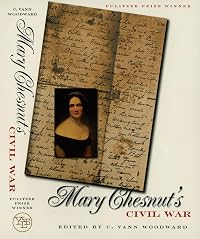
Mary Chesnut's Civil War
by Mary Chesnut, C. Vann Woodward (Editor)
On This Page
Description
An authorized account of the Civil War, drawn from the diaries of a Southern aristocrat, records the disintegration and final destruction of the Confederacy.Tags
Recommendations



















Member Reviews
I would say this is mostly a woman's book, that is, looking at things that women are more likely to enjoy or appreciate. She considers the impact on the household of various events, including changes in clothing options, food, modes of travel. We get commentary on those who did not go to war and the praise for those who did. We share the sorrows of mothers who lost sons and wives who lost their husbands of only a few days. What I did not expect were the number of women who died, sometimes along with their babies, leaving behind distraught soldier husbands unable to get furloughs.
I was keenly interested in the close friendship between Mrs. Chesnut and Mrs. Davis, wife of President Jefferson Davis. Even as public outcry against that show more President devolved into viciousness toward his wife, Mary Chesnut never abandoned her friend and remained a stolid admirer. She also tracked most closely the relationship between Sally "Buck" Preston and General AP "Sam" Hood. I found myself rooting for a marriage between the two. Even though they eventually parted, Buck's mother deeply opposed to the marriage, Mary remained fast friends with each, valuing each time she saw either of them.
What this contributes to the history of the Civil War is a behind the scenes picture of the lives of citizens, mostly wealthy citizens, of part of the Confederacy. We meet the wives and families of familiar Confederate leaders and learn of their losses and reactions to wider events. Mary Chesnut is somewhat unusual in that she had always opposed slavery although she relied heavily on slaves to enable her life style. While she did not mourn the end of slavery, she also paints a rarely reported fact that slaves were also not always welcomed nor helped by the invading Yankees. We also have a chance to observe as the wealthy come to have nothing, much of their posessions stolen and their homes burned. How do you find a place to live when your Confederate money is worthless? How do you eat when your extra clothes went long ago just to buy food? You have no money to pay your debts and those who owe you can't pay because they have no money either. And you can't pay the former slaved who have chosen to remain with you. Now what? show less
I was keenly interested in the close friendship between Mrs. Chesnut and Mrs. Davis, wife of President Jefferson Davis. Even as public outcry against that show more President devolved into viciousness toward his wife, Mary Chesnut never abandoned her friend and remained a stolid admirer. She also tracked most closely the relationship between Sally "Buck" Preston and General AP "Sam" Hood. I found myself rooting for a marriage between the two. Even though they eventually parted, Buck's mother deeply opposed to the marriage, Mary remained fast friends with each, valuing each time she saw either of them.
What this contributes to the history of the Civil War is a behind the scenes picture of the lives of citizens, mostly wealthy citizens, of part of the Confederacy. We meet the wives and families of familiar Confederate leaders and learn of their losses and reactions to wider events. Mary Chesnut is somewhat unusual in that she had always opposed slavery although she relied heavily on slaves to enable her life style. While she did not mourn the end of slavery, she also paints a rarely reported fact that slaves were also not always welcomed nor helped by the invading Yankees. We also have a chance to observe as the wealthy come to have nothing, much of their posessions stolen and their homes burned. How do you find a place to live when your Confederate money is worthless? How do you eat when your extra clothes went long ago just to buy food? You have no money to pay your debts and those who owe you can't pay because they have no money either. And you can't pay the former slaved who have chosen to remain with you. Now what? show less
I kept thinking of Scarlett O'Hara while reading this. It's the portrait of a hot-blooded, cocky, pugnacious society that was teetering on the brink of destruction, like Carthage during the Punic Wars.
It's hard to have much sympathy. Chesnut is snide, hard-nosed, delusional, insightful, and vulnerable all at the same time. Her view into the minds and actions of the Confederate upper crust as things crumble around them touched my heart even as their motivations escaped me.
The irony is that once the hotheads had their way they were shoved aside and spent the rest of the war kvetching on the sidelines, excreting the same poisonous grease on their own side as they'd poured on Lincoln and the North a few scant months before.
Chesnut's book show more was originally published in a truncated edition after her death. Here Woodward has pieced together and deciphered her original text giving Chesnut's portraits of the Civil War's most compelling personalities a modern freshness that everyone can enjoy. show less
It's hard to have much sympathy. Chesnut is snide, hard-nosed, delusional, insightful, and vulnerable all at the same time. Her view into the minds and actions of the Confederate upper crust as things crumble around them touched my heart even as their motivations escaped me.
The irony is that once the hotheads had their way they were shoved aside and spent the rest of the war kvetching on the sidelines, excreting the same poisonous grease on their own side as they'd poured on Lincoln and the North a few scant months before.
Chesnut's book show more was originally published in a truncated edition after her death. Here Woodward has pieced together and deciphered her original text giving Chesnut's portraits of the Civil War's most compelling personalities a modern freshness that everyone can enjoy. show less
Any and every civil war historian has reached for Mary Chesnut's diaries it seems. They stand alone in that she traveled in the highest circles, was a ruthless social observer and faithful diarist. One of the coolest things Erik Larson, the author of The Demon of Unrest did, was make Mary Chesnut a character in his narrative history of the time leading up to the fall of Fort Sumter. This annotated version of Mary Chesnut's diary is a great way to approach her writing, although she is available for far less on public domain. The audiobook of her diary is very good, especially if you like a calm, background read. That being said, she is remarkable for taking your into the parlor of people that found enslavement defensible.
Perfectly good book no doubt. However, one must be interested in the social life of the top one percent of the southern aristocracy, which I am not, finding them to be a particularly stupid and uninteresting group, even by usual aristo standards. The capacity of this group to bring about a war based on slavery - slavery! - and then lose that war against the odds, suggests Mary Chestnut should have written even more of a satire than she did write.
considered to be one of the best eye witness journals of the civil war and on a par with the best novels written on the war. Thanks to C Vann Woodward for his great work editing the original book of Mary Chesnut and congrats on winning the 1982 Pulitzer Prize in History for his work.. A great book for the Civil War enthusiast. This is not a story about civil war battles, but of the upper echelon society and people who actually managed the war for the South out of Richmond Va.Mary has keen insight in the hearts and minds of fellow elites and her relationship to her slaves is very interesting. One slave family insists on staying after the war and is the only bread winning person in the household selling food in the local market. This is a show more unique civil war book. She gives us a striking picture of the elaborate parties, food and drink, as their world, the confederacy, crumbles around them show less
3328. Mary Chesnut's Civil War, Edited by C. Vann Woodward (read July 17, 2000) This won the 1982 Pulitzer Prize for history, and I thought I should read it. I have only read about half of the Pulitzer History prizewinners, and I have found some are real duds--I think of The Transformation of Virginia, which I read Feb 16, 1999, and thought was a complete waste of time for me. But this book is one that really takes one into the time as seen by a well-educated and perceptive woman who moved in the ruling circles of the Confederacy--she was a big friend of Jeff Davis's wife, e.g. The diary is superlatively edited and reading this book is certainly a highlight of my recent reading, even tho some of the account of social events which show more preoccupied Mrs. Chesnut did not interest me much. Very worth reading. show less
Reviewed April 16, 2008
Wow, where do I start? In my civil war class we often referred to Mary Chestnut’s writings, I knew when I got the chance that reading this diary would help round out my understanding of the American civil war. I must note here that without the prior class, understanding this diary would be near impossible. Also, when reading a diary, (especially one meant for publication as this one is) the reader must understand that some entries might be embellished, or omitted. Mary Chesnut is a well educated wealthy Southern woman. She married into wealth, position and government. James Chesnut became Jefferson Davis’s aide-de-camp during the war, this put Mary in the position of being present where things were happening. show more She saw the bombing of Fort Sumner, and fled Richmond and other Southern cities before invasion by the Yankees. Sherman’s March to the Sea went though many of the towns she had lived in, having great impact on her home state, South Carolina. Through Mary’s eyes we see military hospitals where she and friends spent many mornings feeding the wounded, also intimate details of her friends lives, prominent people like General Sam Hood and President Davis. The relationships with her slaves/servants were the most interesting to me, a complicated matter that she does not spend enough time on. Often she mentions feeling she knows nothing about how her servants feel on the slavery issue. Several times Mary proclaims her belief that women are slaves to their fathers, then their husbands, there is no freedom for these women. In the end Mary’s servants, though freed continue to work for her with no pay. In fact after the war, one female servant is the only wage earner for the family, selling eggs and cheese. When the husband of her maid asks for money, Mary tells him that she has no money, his wife is free to go whenever she chooses. The servants live free of charge on her land and home, and can go if they want. They do not choose to go, I know this happened, especially in homes where slaves lived for many years, their families are nearby, and feel they have no where to go anyway, so they stay. Mary is very well educated, which surprised me greatly, she is always reading (read “Uncle Tom’s Cabin” twice in her diary). Mary reads quite a lot of French books, she also could read German. Many times Mary chides the North for having horrible spellers amongst their soldiers. In my civil war class we discussed the horrible starving conditions the South lived in during the war. Mary does not experience this until the very end, in early 1865. Up until this point her diary entries are full of exotic balls, weddings and plays, and the dinners, brunches, breakfasts, desserts.... She eats her way through the civil war, they pull taffy, make mint juleps, and entertain with food all the time. Only when the end is very near, is Mary forced to travel to “safer” cities and away from her comfortable home and larder. She is careful to bring her maid everywhere though. Caspian asked me near the end of the book if Mary still thought the South had a chance to win. After thinking about it a bit, I think she believed it in the beginning of the war, but by 1864 she wrote about winning battles if they just did this or that, but even when Sherman cut a path through the South, Mary only talks about staying one step ahead of Sherman, not winning the entire war. I think like most of the South thought France and/or England would step in and recognize the Confederacy, this would force the North to allow the South to break free. At times the diary is very confusing to follow, you do not always know who is speaking, and to whom. She references poems, and novels often, sometimes you do not know when her quotes end and Mary’s narrative begins. Dates are not always plentiful, nor is her location always clear. Interesting read 9-2008 show less
Wow, where do I start? In my civil war class we often referred to Mary Chestnut’s writings, I knew when I got the chance that reading this diary would help round out my understanding of the American civil war. I must note here that without the prior class, understanding this diary would be near impossible. Also, when reading a diary, (especially one meant for publication as this one is) the reader must understand that some entries might be embellished, or omitted. Mary Chesnut is a well educated wealthy Southern woman. She married into wealth, position and government. James Chesnut became Jefferson Davis’s aide-de-camp during the war, this put Mary in the position of being present where things were happening. show more She saw the bombing of Fort Sumner, and fled Richmond and other Southern cities before invasion by the Yankees. Sherman’s March to the Sea went though many of the towns she had lived in, having great impact on her home state, South Carolina. Through Mary’s eyes we see military hospitals where she and friends spent many mornings feeding the wounded, also intimate details of her friends lives, prominent people like General Sam Hood and President Davis. The relationships with her slaves/servants were the most interesting to me, a complicated matter that she does not spend enough time on. Often she mentions feeling she knows nothing about how her servants feel on the slavery issue. Several times Mary proclaims her belief that women are slaves to their fathers, then their husbands, there is no freedom for these women. In the end Mary’s servants, though freed continue to work for her with no pay. In fact after the war, one female servant is the only wage earner for the family, selling eggs and cheese. When the husband of her maid asks for money, Mary tells him that she has no money, his wife is free to go whenever she chooses. The servants live free of charge on her land and home, and can go if they want. They do not choose to go, I know this happened, especially in homes where slaves lived for many years, their families are nearby, and feel they have no where to go anyway, so they stay. Mary is very well educated, which surprised me greatly, she is always reading (read “Uncle Tom’s Cabin” twice in her diary). Mary reads quite a lot of French books, she also could read German. Many times Mary chides the North for having horrible spellers amongst their soldiers. In my civil war class we discussed the horrible starving conditions the South lived in during the war. Mary does not experience this until the very end, in early 1865. Up until this point her diary entries are full of exotic balls, weddings and plays, and the dinners, brunches, breakfasts, desserts.... She eats her way through the civil war, they pull taffy, make mint juleps, and entertain with food all the time. Only when the end is very near, is Mary forced to travel to “safer” cities and away from her comfortable home and larder. She is careful to bring her maid everywhere though. Caspian asked me near the end of the book if Mary still thought the South had a chance to win. After thinking about it a bit, I think she believed it in the beginning of the war, but by 1864 she wrote about winning battles if they just did this or that, but even when Sherman cut a path through the South, Mary only talks about staying one step ahead of Sherman, not winning the entire war. I think like most of the South thought France and/or England would step in and recognize the Confederacy, this would force the North to allow the South to break free. At times the diary is very confusing to follow, you do not always know who is speaking, and to whom. She references poems, and novels often, sometimes you do not know when her quotes end and Mary’s narrative begins. Dates are not always plentiful, nor is her location always clear. Interesting read 9-2008 show less
Members
- Recently Added By
Lists

Non-Fiction Worth Reading
1,025 works; 264 members

Read These Too
458 works; 9 members
Author Information

11+ Works 2,044 Members
Awards and Honors
Awards
Notable Lists
Series
Belongs to Publisher Series
Work Relationships
Is contained in
Common Knowledge
- Original publication date
- 1981
- People/Characters
- Mary Boykin Chesnut; James Chesnut (Jnr); P. G. T. Beauregard; John B. Magruder; Abram (Chesnut slave); Yaller Abram (Chesnut slave) (show all 40); Adam (Burwell Boykin slave); James Hopkins Adams; William Wirt Adams; Edward Adamson; Martha Adamson; Mrs Adger; Harriet Lowndes Aiken (Mrs William Aiken); Henrietta Aiken; William Aiken; Albert, Prince Consort (mentioned); Louisa Gabriella Patterson Allen (Mrs John Allan, referred to as the 'Scotch' Allens to distinguish them from the 'Irish' Allans); William G. Allan; Catherine Jessup Allen (Mrs William 'Buck' Allen); Benjamin Allston; Benjamin George Allston; Robert F. W. Allston; Ally; Jacob Motte Alston; Robert A. Alston; William Algernon Alston (Jnr); Mrs Ambler; Ammon (Reynolds slave); Ellen Douglas Ancrum; Mr Ancrum; Thomas James Ancrum; William Alexander Ancrum (Snr and Jnr); Anderson (as General Anderson); Richard Heron Anderson; Mrs Richard Heron Anderson; Robert Anderson; Eliza Bayard Clinch Anderson (Mrs Robert Anderson); Ellen Mary Davis Anderson (Mrs Thomas Salmond Anderson, as Mrs Thomas Anderson, a niece of Jefferson Davis); Richard Snowden Andrews; Anne (Chesnut slave maid)
- Important places
- USA; Richmond, Virginia, USA; South Carolina, USA; Virginia, USA; Abbeville, South Carolina, USA; Abbeville County, South Carolina, USA (show all 45); Abingdon, Virginia, USA; Adams Run, South Carolina, USA; Alabama, USA; Alexandria, Virginia, USA; Algiers, Algeria (as Algiers); Algiers, Louisiana, USA; Allegheny Mountains, USA; Allendale, South Carolina, USA; Alston, South Carolina, USA; Annapolis, Maryland, USA; Apsley House, London, England, UK (mentioned); Aquia Creek, Virginia, USA; Arlington, Virginia, USA; Arlington House, Arlington, Virginia, USA; Arlington National Cemetery, Virginia, USA; Athens, Georgia, USA; Atlanta, Georgia, USA; Audley, Virginia, USA; Augusta, Georgia, USA; Baltimore, Maryland, USA; Bath, Maine, USA; Belmont, Missouri, USA; Bentonville, North Carolina, USA; Bethel, Virginia, USA; Blue Ridge Mountains, USA; Bluffton, South Carolina, USA; Branchville, South Carolina, USA; Brandon, Virginia, USA; Brockenbrough House, Richmond, Virginia, USA (as Brockenbrough Mansion); Bull Run River, Virginia, USA; Buncombe County, North Carolina, USA; Cambridge, Massachusetts, USA; Camden, South Carolina, USA; Canada; Cape Hatteras, North Carolina, USA; Catawba, South Carolina, USA; Cedar Key, Florida, USA (as Cedar Keys, Florida, USA); Charleston, South Carolina, USA; Charleston Harbor, South Carolina, USA
- Important events
- American Civil War (1861-1865)
- Dedication
- To my students
at Johns Hopkins and at Yale - First words
- Introduction: Literary critics who have written most thoughtfully about the work of Mary Boykin Chesnut have expressed some puzzlement and perplexity.
February 18, 1861. Conecuh. Ems. I do not allow myself vain regrets or sad foreboding. - Last words
- (Click to show. Warning: May contain spoilers.)And - and the weight that hangs upon our eyelids - is of lead.
Classifications
- Genres
- History, Nonfiction, General Nonfiction, Biography & Memoir
- DDC/MDS
- 973.782 — History & geography History of North America United States Civil War Era (1857-1865) Personal narratives, vindications, secret service Personal narratives, southern side
- LCC
- E487 .C5 — History of the United States United States Civil War period, 1861-1865 The Civil War, 1861-1865 Confederate States of America
- BISAC
Statistics
- Members
- 998
- Popularity
- 26,354
- Reviews
- 13
- Rating
- (4.15)
- Languages
- English
- Media
- Paper, Audiobook
- ISBNs
- 4
- ASINs
- 23