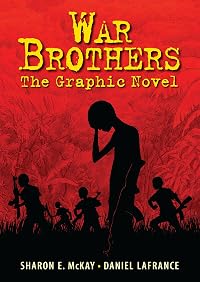
War Brothers: The Graphic Novel
by Sharon E. McKay (Writer), Daniel Lafrance (Illustrator)
On This Page
Description
When fourteen-year-old Jacob is brutally abducted and forced to become a child soldier, he struggles to hold on to his sanity and the will to escape.Daniel Lafrance's striking artwork and the poignant, powerful text capture the very essence of life as a child soldier. Readers will never forget the experiences of this young boy struggling to survive, unsure who to trust, afraid of succumbing to madness, and above all, desperate to get to freedom. In the end, Jacob engineers a daring escape.
show more This graphic novel is based on the acclaimed novel of the same title, winner of a 2009 Arthur Ellis award. The author spent time in Uganda and based this story on real-life accounts of the horrors inflicted on child soldiers and their victims. This is a story of unthinkable violence, but also one of hope, courage, friendship, and family.
. show less
Tags
Recommendations
Member Reviews
My story is not an easy one to tell, and it is not an easy one to read. The life of a child soldier is full of unthinkable violence and brutal death. But this is also a story of hope, courage, friendship, and family. We Ugandans believe that family is most important.
I thought you should be prepared for both the bad and the good. There is no shame in closing the book now.
Jacob is fourteen when the book opens. He comes from a loving family, enjoys playing soccer with his friends, and is brilliant in math. One night after light's out, the door to his school dormitory is kicked in and just like that, he and his schoolmates are abducted and forcibly inducted into the Lord's Resistance Army (LRA). Beaten, starved, and treated as beasts of show more burden, the children are worn down, traumatized by violence, and forced to become child soldiers. Their lives are truly horrific. And unfortunately Jacob's story is far too close to being a true story.
War Brothers is also about friendship, loyalty, and faith. When all sees lost, the light can come again. The artist Daniel Lafrance depicts Jacob's life in the LRA in frames on black pages, whereas his life before his abduction is drawn on white pages. In addition to this stark contrast, Lafrance sparingly uses a bold red to highlight the violence. The result is a horrifying and claustrophobic reading experience interspersed with moments of light and open space. Although the author has also written a young adult novel of the same name, I think reading it would be a very different experience. show less
I thought you should be prepared for both the bad and the good. There is no shame in closing the book now.
Jacob is fourteen when the book opens. He comes from a loving family, enjoys playing soccer with his friends, and is brilliant in math. One night after light's out, the door to his school dormitory is kicked in and just like that, he and his schoolmates are abducted and forcibly inducted into the Lord's Resistance Army (LRA). Beaten, starved, and treated as beasts of show more burden, the children are worn down, traumatized by violence, and forced to become child soldiers. Their lives are truly horrific. And unfortunately Jacob's story is far too close to being a true story.
War Brothers is also about friendship, loyalty, and faith. When all sees lost, the light can come again. The artist Daniel Lafrance depicts Jacob's life in the LRA in frames on black pages, whereas his life before his abduction is drawn on white pages. In addition to this stark contrast, Lafrance sparingly uses a bold red to highlight the violence. The result is a horrifying and claustrophobic reading experience interspersed with moments of light and open space. Although the author has also written a young adult novel of the same name, I think reading it would be a very different experience. show less
By now you know the spiel; I received this book through a GoodReads giveaway. Even though it was free I’m not above giving a crushing review to a free book. As further preamble, I don’t seek out to read graphic novels but I will look at anything put in front of me, so here we go.
As I said in the intro, I’m not a comic books sort of reader in general so right off that puts me at a bit of a disadvantage. I don’t have a whole lot to compare this to. In simple terms it was about a 45 minute read even with the distraction of pedaling an exercise bike the whole time. Being a comic book it’s very easy to read and very accessible. The illustrations were well done, dark and foreboding. That fits well since the topic was itself so dark show more and foreboding. So as graphic novels go, absolutely no complaints at a technical level.
The content, as you have no doubt surmised from the publisher’s description, surrounds the conscription of young men by Ugandan rebels. Written from the perspective of a young man who is a victim of this conscription, it does tend to tug at your heart strings. In the U.S. there’s not a lot of awareness that this sort of thing goes on so I applaud the book for introducing this hitherto untold story to domestic readers. It tells the story in a heart-felt way but left me as a reader rather wanting more information. The graphic novel genre only supports so much throughput so this isn’t an especially surprising eventuality.
To sum up, an interesting story told in far too brief a format. I wanted more data but what was presented was fairly intriguing. Not the most amazing thing I’ve ever read but certainly a 45 minutes well spent. show less
As I said in the intro, I’m not a comic books sort of reader in general so right off that puts me at a bit of a disadvantage. I don’t have a whole lot to compare this to. In simple terms it was about a 45 minute read even with the distraction of pedaling an exercise bike the whole time. Being a comic book it’s very easy to read and very accessible. The illustrations were well done, dark and foreboding. That fits well since the topic was itself so dark show more and foreboding. So as graphic novels go, absolutely no complaints at a technical level.
The content, as you have no doubt surmised from the publisher’s description, surrounds the conscription of young men by Ugandan rebels. Written from the perspective of a young man who is a victim of this conscription, it does tend to tug at your heart strings. In the U.S. there’s not a lot of awareness that this sort of thing goes on so I applaud the book for introducing this hitherto untold story to domestic readers. It tells the story in a heart-felt way but left me as a reader rather wanting more information. The graphic novel genre only supports so much throughput so this isn’t an especially surprising eventuality.
To sum up, an interesting story told in far too brief a format. I wanted more data but what was presented was fairly intriguing. Not the most amazing thing I’ve ever read but certainly a 45 minutes well spent. show less
The Story
"You are rebels now. You fight for freedom. You fight for the Lord's Resistance Army and for god!
Kony is our leader and we do as he says!
I shall tell you the rules and you will listen!
Only soldiers eat. If you want to eat, you will fight with us. This is your choice. If you die of hunger, it is your choice. If you steal food, you will be killed."
This is a story that needs to be shared, this is a story that needs to be heard.
Im Uganda, since the 1980s, a rebel leader named Joseph Kony has been leading his "Lord's Resistance Army" (LRA) by kidnapping the children of the towns he and his child-soldiers pass through. They steal the boys as soldiers, the girls as "wives," and they kill anyone who gets in their way. As the quote show more above demonstrates, these children have only the choice between death, or following the orders of their kidnappers. If they refuse to do as they're told, to partake in the killing and kidnap of others, they are either beaten severely (possibly to death) or flat out killed. And for years, most of the rest of the world had no idea this was going on, and/or sat in silence.
Now, the story of these traumatized children is being told.
Technically, this graphic novel is fictionalized. It is not one single boy's related account, as it is portrayed. But don't let that fool you. While it is not one boy's literal account, it is hundreds of thousands of boys' accounts. Only, unlike Jacob, many of them do not find the way back to relay their unique tales themselves. But as the postscript itself says, "Everything that happened in this book has happened, and is happening still. The LRA continues to torment, abduct, and murder children. There are as many as 250,000 child soldiers in over 35 countries. We can realize a world without child soldiers."
"'No. I heard you tell Paul that you want people to know about us. So tell the world, Jacob. Tell them that we are the same... Just children trying to survive.'"
The Art
The art in this book is amazing. The panels of a natural outdoor scene, or where that serves as a background (including the sky with clouds), have a deceptively "simplistic" style that appears drawn, almost as if with crayons. These are the pages that are most beautiful, in my opinion. Not only are they deceptively simplistic, but the style almost carries an innocence with it, an innocence that couldn't be further from the events taking place within its borders. This, combined with the overall phenomenal skill, creates a stunningly beautiful sets amidst the harrowing terror of events taking place. It is difficult to accurately describe, but even if the story were not something everyone needs to read, I would suggest everyone look at it for the art alone. show less
"You are rebels now. You fight for freedom. You fight for the Lord's Resistance Army and for god!
Kony is our leader and we do as he says!
I shall tell you the rules and you will listen!
Only soldiers eat. If you want to eat, you will fight with us. This is your choice. If you die of hunger, it is your choice. If you steal food, you will be killed."
This is a story that needs to be shared, this is a story that needs to be heard.
Im Uganda, since the 1980s, a rebel leader named Joseph Kony has been leading his "Lord's Resistance Army" (LRA) by kidnapping the children of the towns he and his child-soldiers pass through. They steal the boys as soldiers, the girls as "wives," and they kill anyone who gets in their way. As the quote show more above demonstrates, these children have only the choice between death, or following the orders of their kidnappers. If they refuse to do as they're told, to partake in the killing and kidnap of others, they are either beaten severely (possibly to death) or flat out killed. And for years, most of the rest of the world had no idea this was going on, and/or sat in silence.
Now, the story of these traumatized children is being told.
Technically, this graphic novel is fictionalized. It is not one single boy's related account, as it is portrayed. But don't let that fool you. While it is not one boy's literal account, it is hundreds of thousands of boys' accounts. Only, unlike Jacob, many of them do not find the way back to relay their unique tales themselves. But as the postscript itself says, "Everything that happened in this book has happened, and is happening still. The LRA continues to torment, abduct, and murder children. There are as many as 250,000 child soldiers in over 35 countries. We can realize a world without child soldiers."
"'No. I heard you tell Paul that you want people to know about us. So tell the world, Jacob. Tell them that we are the same... Just children trying to survive.'"
The Art
The art in this book is amazing. The panels of a natural outdoor scene, or where that serves as a background (including the sky with clouds), have a deceptively "simplistic" style that appears drawn, almost as if with crayons. These are the pages that are most beautiful, in my opinion. Not only are they deceptively simplistic, but the style almost carries an innocence with it, an innocence that couldn't be further from the events taking place within its borders. This, combined with the overall phenomenal skill, creates a stunningly beautiful sets amidst the harrowing terror of events taking place. It is difficult to accurately describe, but even if the story were not something everyone needs to read, I would suggest everyone look at it for the art alone. show less
This was the kind of graphic novel that makes me want to go out and grab the original. I need to know if that book rips at the emotions the way this one did.
The book takes us into history and politics and everyday life in Uganda, Africa. In so doing, it shows that life, and human nature, are the same around the world. Especially the love between father and son.
Jacob just wants to be a kid. He excels in mathematics (he and his friends can do calculations in his head that I have trouble with on a calculator). He has a scholarship to attend a special school, one designed to train future leaders. He and his friend Tony arrive filled with hopes for the future. But the local warlord needs recruits, and kids make good cannon fodder. Not even show more the special guards hired by the parents stop rebel soldiers from raiding the school and abducting students. From then on, Jacob’s main job becomes survival as he waits for his father to rescue him. Meanwhile, the soldiers begin the process of turning the boys into killers.
The book pulls few punches. Readers’ hearts pound as a frightened boy is told to choose between short-sleeves or long: being amputated at the wrist, or above the elbow. We watch female captives, one maimed for trying to escape, others forced to be the “wives” of soldiers and bear babies while they themselves are still children. The boys are told that if they even speak to one of the girls they will be beaten…and the girl will be killed. The graphics are excellent and enhance the story. We see and feel the shock and fear, the grief as friends die or agree to become killers in exchange for food and shelter. We feel the fatigue and the jungle heat. Watch as adults turn children into brutes.
“The commanders can tell which boys can be broken like glass. Shattered glass cannot be put back together. When the good boys become LRA they become especially mean, especially dangerous.”
Jacob witnesses atrocities; watches his friend Tony, the boy who once wanted to become a priest, become a gun-toting convert after being forced to kill another child. He believes his father will rescue him, rejects the religious zeal of his captors and does everything he can to keep a frail boy alive during weeks spent trekking through the African jungle. Jacob’s hopes sink when he learns the government refuses to make a deal to get the schoolboys back. If he is going to survive, he has to make that happen, even if it means agreeing to join the soldiers on a raid. The rules are simple: only those who fight and kill get food. Jacob is handed a panga (machete) and told to kill the enemy. An enemy who turns out to be a mother struggling to protect her screaming child.
Five boys, including Jacob and Tony, and one girl manage to escape. When they return from the jungle they are looked on with fear. Some parents refuse to take their children back.
“People watched us. They thought we were killers with a thirst to kill again.”
When a boy who has been handed a weapon and taught to take life turns around and saves a life, how does he earn absolution? Can he be trusted or forgiven? Even by himself? The book asks the questions. It does not hand out easy answers.
This book is justifiably labeled 9th grade and up. The brutality begins on the opening panels. We see children armed with guns and machetes attacking a mother trying to defend her own child. It makes an effective hook, I had to keep reading when I turned a page and the book went into the past, to scenes of tranquility in Uganda before the boys became pawns in a war.
This makes an ideal “gateway book” for High School youth who might be considered reluctant readers. By that I mean the book has a sound hook for older high school students. I admit to reading frantically to see what would happen next. I visualize many reluctant readers doing the same. It does a good job of depicting the universality of family life, the dreams of the young, and how those dreams can be ripped apart by the irrationality of war. Teachers, parents and librarians can use this story to evoke discussions of combat situations in the present and the past, street wars, and other areas relevant to young readers’ lives and futures. show less
The book takes us into history and politics and everyday life in Uganda, Africa. In so doing, it shows that life, and human nature, are the same around the world. Especially the love between father and son.
Jacob just wants to be a kid. He excels in mathematics (he and his friends can do calculations in his head that I have trouble with on a calculator). He has a scholarship to attend a special school, one designed to train future leaders. He and his friend Tony arrive filled with hopes for the future. But the local warlord needs recruits, and kids make good cannon fodder. Not even show more the special guards hired by the parents stop rebel soldiers from raiding the school and abducting students. From then on, Jacob’s main job becomes survival as he waits for his father to rescue him. Meanwhile, the soldiers begin the process of turning the boys into killers.
The book pulls few punches. Readers’ hearts pound as a frightened boy is told to choose between short-sleeves or long: being amputated at the wrist, or above the elbow. We watch female captives, one maimed for trying to escape, others forced to be the “wives” of soldiers and bear babies while they themselves are still children. The boys are told that if they even speak to one of the girls they will be beaten…and the girl will be killed. The graphics are excellent and enhance the story. We see and feel the shock and fear, the grief as friends die or agree to become killers in exchange for food and shelter. We feel the fatigue and the jungle heat. Watch as adults turn children into brutes.
“The commanders can tell which boys can be broken like glass. Shattered glass cannot be put back together. When the good boys become LRA they become especially mean, especially dangerous.”
Jacob witnesses atrocities; watches his friend Tony, the boy who once wanted to become a priest, become a gun-toting convert after being forced to kill another child. He believes his father will rescue him, rejects the religious zeal of his captors and does everything he can to keep a frail boy alive during weeks spent trekking through the African jungle. Jacob’s hopes sink when he learns the government refuses to make a deal to get the schoolboys back. If he is going to survive, he has to make that happen, even if it means agreeing to join the soldiers on a raid. The rules are simple: only those who fight and kill get food. Jacob is handed a panga (machete) and told to kill the enemy. An enemy who turns out to be a mother struggling to protect her screaming child.
Five boys, including Jacob and Tony, and one girl manage to escape. When they return from the jungle they are looked on with fear. Some parents refuse to take their children back.
“People watched us. They thought we were killers with a thirst to kill again.”
When a boy who has been handed a weapon and taught to take life turns around and saves a life, how does he earn absolution? Can he be trusted or forgiven? Even by himself? The book asks the questions. It does not hand out easy answers.
This book is justifiably labeled 9th grade and up. The brutality begins on the opening panels. We see children armed with guns and machetes attacking a mother trying to defend her own child. It makes an effective hook, I had to keep reading when I turned a page and the book went into the past, to scenes of tranquility in Uganda before the boys became pawns in a war.
This makes an ideal “gateway book” for High School youth who might be considered reluctant readers. By that I mean the book has a sound hook for older high school students. I admit to reading frantically to see what would happen next. I visualize many reluctant readers doing the same. It does a good job of depicting the universality of family life, the dreams of the young, and how those dreams can be ripped apart by the irrationality of war. Teachers, parents and librarians can use this story to evoke discussions of combat situations in the present and the past, street wars, and other areas relevant to young readers’ lives and futures. show less
Disclosure: I received a free copy of War Brothers: The Graphic Novel by Sharon E. McKay via GoodReads First Reads, courtesy of Annick Press.
The graphic novel War Brothers tackles the difficult subject of child soldiers in Uganda's rebel army under Kony Joseph. This is a tasteful, sensitive portrayal through the eyes of a fictional boy who is captured by soldiers no older than himself and thrown headlong into the horrors of warfare that ravage his home country.
Some of the images and events in the book are disturbing, but they are taken from real-life events, and serve to bring an important message to teen readers: boys such as those in the book have in fact been forced into fighting, lost their lives, or suffered PTSD and social show more ostrazation if they are lucky enough to survive. The themes of friendship, bravery, faith, and family bring hope glimmering to the surface, just as lighter images appear toward the end of the book, symbolizing possibilities of a better future for the children who survived.
War Brothers is not overly wordy, instead allowing Daniel LaFrance's skillfully drawn images show the emotions of the characters far clearer than dialogue possibly could. Raw fear and pain in the faces of the young boys draw the reader in as one of this band of brothers, making it impossible not to empathize with their ordeal. show less
The graphic novel War Brothers tackles the difficult subject of child soldiers in Uganda's rebel army under Kony Joseph. This is a tasteful, sensitive portrayal through the eyes of a fictional boy who is captured by soldiers no older than himself and thrown headlong into the horrors of warfare that ravage his home country.
Some of the images and events in the book are disturbing, but they are taken from real-life events, and serve to bring an important message to teen readers: boys such as those in the book have in fact been forced into fighting, lost their lives, or suffered PTSD and social show more ostrazation if they are lucky enough to survive. The themes of friendship, bravery, faith, and family bring hope glimmering to the surface, just as lighter images appear toward the end of the book, symbolizing possibilities of a better future for the children who survived.
War Brothers is not overly wordy, instead allowing Daniel LaFrance's skillfully drawn images show the emotions of the characters far clearer than dialogue possibly could. Raw fear and pain in the faces of the young boys draw the reader in as one of this band of brothers, making it impossible not to empathize with their ordeal. show less
War Brothers written by Sharon E. McKay, with artwork by Daniel Lafrance is a graphic novel, a work of fiction based on the actual abduction of school children in Uganda by a terrorist group that call themselves the Lord’s Resistance Army. This story centres on a young boy, Jacob, and his friends that are taken from their school and forced into slavery. These boys were originally being held for ransom, but when this didn’t work out, they were given a choice of either becoming soldiers or being killed.
Jacob and his friends were the lucky ones that managed to escape. It wasn’t easy returning to their lives, they continue to be haunted by their experiences but at least they were safe. It took a long time before they were accepted show more back as most people were frightened by them.
Although a work of fiction, the author based her story on interviews with abductees in Uganda. Also of note is the fact that this story is set in 2002, but the Lord’s Resistance Army continues to torment, abduct and murder children today. War Brothers, with it’s powerful images and riveting text paints a vivid picture of the brutality and desperation that faces children in over 35 different countries today. show less
Jacob and his friends were the lucky ones that managed to escape. It wasn’t easy returning to their lives, they continue to be haunted by their experiences but at least they were safe. It took a long time before they were accepted show more back as most people were frightened by them.
Although a work of fiction, the author based her story on interviews with abductees in Uganda. Also of note is the fact that this story is set in 2002, but the Lord’s Resistance Army continues to torment, abduct and murder children today. War Brothers, with it’s powerful images and riveting text paints a vivid picture of the brutality and desperation that faces children in over 35 different countries today. show less
As one might guess from the cover, this graphic novel is violent and tragic, depicting the way one 14-year old is kidnapped on the way to his school and marched into the jungle to become part of the LRA (Lord's Resistance Army). Not understanding exactly what the army is fighting for, they are told they are fighting for God, even though one of the children points out that one of the ten commandments states, "Thou shalt not kill." No matter. A machete is put in their hand and they are given the choice to kill or be killed. Since this is written for school-aged children, rape is not even mentioned, just that these soldiers raid towns, steal any food and children, and kill everyone else. Some life! They manage to keep up each others' hope show more for rescue.
Even more heart-wrenching is how the boys are viewed with fear and distrust when they manage to escape and return to their town. I think this book barely scrapes the surface of the horrors these children experienced and I will continue with the book A Long Way Gone by Ishmael Beah. show less
Even more heart-wrenching is how the boys are viewed with fear and distrust when they manage to escape and return to their town. I think this book barely scrapes the surface of the horrors these children experienced and I will continue with the book A Long Way Gone by Ishmael Beah. show less
Members
- Recently Added By
Published Reviews
ThingScore 75
Aimed at younger readers, it tells the story with plenty of emotion while shielding readers from the most horrific of the atrocities being committed by Kony and his henchmen. Rape—a common tool in war—is described euphemistically as “bothering the girls"; the beating death of a wounded boy is shown in blackout.
This makes it an excellent book for use with young readers, given that the show more emotional and psychological torture used on the youths is explained well. By forcing children to choose between dying themselves or killing another, then using the fact that they have killed as proof that they can never go home, Kony’s troops create their damaged and brutal soldiers. show less
This makes it an excellent book for use with young readers, given that the show more emotional and psychological torture used on the youths is explained well. By forcing children to choose between dying themselves or killing another, then using the fact that they have killed as proof that they can never go home, Kony’s troops create their damaged and brutal soldiers. show less
added by KelMunger
Lists

Recommended Comics / Graphic Novels
595 works; 122 members
Club Read's Graphic Stories Recommendations
127 works; 2 members

Red Dot 2014-2015 - Mature Readers - Longlist
36 works; 5 members

Books Read in 2024
4,623 works; 126 members
Author Information

Awards and Honors
Awards
Distinctions
Notable Lists
Work Relationships
Is an adaptation of
Common Knowledge
- Canonical title
- War Brothers: The Graphic Novel
- Original publication date
- 2013-02-07
- People/Characters
- Jacob Kitino; Paul; Oteka; Norman; Tony; Hannah
- Important places
- Gulu, Uganda; Uganda; Sudan; Murchison Falls, Uganda
- Important events
- Lord's Resistance Army insurgency
- Epigraph
- In each of us there is the possibility to be a beast, but also the possibility to reach the stars.
-Eleanor Roosevelt - Dedication
- To the MacLeod men in my life: David, Sam, Joe, Richard, Bryan, Stirling, Kai, and Angus (Gus).
-Sharon E. McKay
To my son Max and my wife Nadia.
-Daniel Lafrance - First words
- Gulu, Uganda, 2002
Dear Reader
My name is Kitano Joseph. - Last words
- (Click to show. Warning: May contain spoilers.)I hope this is right.
Jacob
Gulu, Uganda, 2012 - Blurbers
- Tomsons, Melanie
- Original language
- English
- Disambiguation notice
- Sharon E. McKay also wrote the young adult novel War Brothers, upon which this graphic novel is based. Please do not combine the two works.
Classifications
- Genres
- Teen, Graphic Novels & Comics, Horror
- DDC/MDS
- 741.5 — Arts & recreation Drawing & decorative arts Drawing Comic books, graphic novels, fotonovelas, cartoons, caricatures, comic strips
- LCC
- PN6727 .M3845 .W37 — Language and Literature Literature (General) Literature (General) Collections of general literature Comic books, strips, etc.
- BISAC
Statistics
- Members
- 171
- Popularity
- 191,753
- Reviews
- 17
- Rating
- (4.19)
- Languages
- English
- Media
- Paper, Ebook
- ISBNs
- 6
- ASINs
- 1